
Caregiver decision guide
A Caregiver's Wildfire Smoke Preparedness Checklist for Chronic Conditions
Wildfire smoke poses unique health risks for older adults with chronic conditions like COPD, heart disease, diabetes, CKD, and dementia. This condition-by-condition checklist helps family caregivers prepare for, respond to, and recover from smoke events, covering medication management, oxygen dependence, power outage readiness, indoor air quality, and symptom monitoring.
“Stay inside” is useful wildfire-smoke advice for a healthy adult with a tight house, a working air conditioner, and no medical equipment. It is not a care plan for an older parent with COPD, heart disease, diabetes, chronic kidney disease, dementia, oxygen tubing, insulin in the refrigerator, and a spouse who forgets why the windows have to stay closed.
The air quality health risks for seniors during wildfire smoke become more practical, and more urgent, when they are tied to the condition in front of you. A person with COPD may need earlier inhaler refills and symptom tracking. A person with heart disease may need a lower threshold for calling a clinician about chest pressure, unusual fatigue, or shortness of breath. A person with diabetes may need more glucose checks and a refrigeration plan for insulin. A person with dementia may need someone else to notice symptoms they cannot describe.
Use this checklist before smoke season, when smoke is forecast or visible, during a smoke event, and after the air clears. It is written for family caregivers, not clinicians. It does not replace a doctor’s instructions, oxygen supplier guidance, emergency medical care, or local evacuation orders.
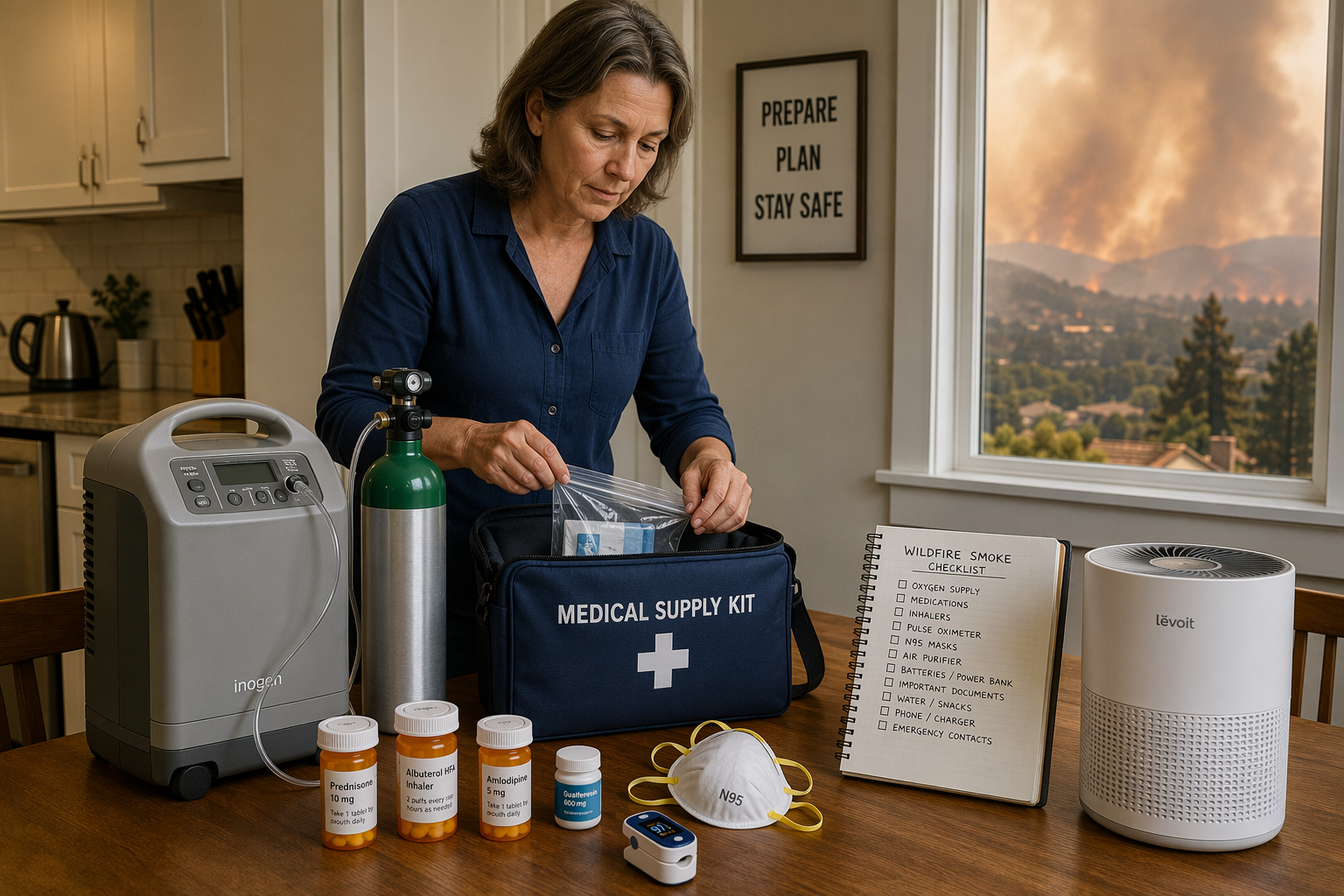
The Master Checklist: Before, During, and After Smoke
The goal is not to turn the caregiver into an air-quality scientist. The goal is to remove the small points of failure that become dangerous when clinics are busy, pharmacies close early, the house is hot, or the older adult cannot explain what feels different.
| When | Caregiver actions | Why it matters |
|---|---|---|
| Before smoke season | Update medication lists, refill rescue medications, confirm oxygen and power backup, choose a clean room, check HVAC settings, buy replacement filters, and write condition-specific call thresholds. | Most preventable problems show up before the smoke arrives: missing supplies, unclear instructions, dead batteries, and no one sure who to call. |
| When smoke is forecast | Close windows early, run filtration, move medications and monitoring tools into the clean room, charge devices, call the older adult if you are remote, and review symptoms to watch. | Waiting until the room smells smoky usually means indoor air has already changed. |
| During the event | Track symptoms by condition, keep exertion low, protect medication and equipment, watch hydration and glucose if relevant, and call for help when symptoms cross the agreed line. | Smoke events create overlapping stress: breathing, heart workload, temperature, sleep disruption, confusion, and medication timing. |
| After smoke clears | Replace or check filters, restock medications, document symptoms and calls, inspect equipment, and update the plan while the details are still fresh. | The next event is easier to manage if the last one leaves a better plan behind. |
Pre-Season Preparation: The Work That Pays Off Later
Before smoke season, make one written plan for the person, not one generic wildfire plan for the house. Older adults are identified by AirNow, the CDC, the EPA, and AARP as a group at higher risk during poor air quality and wildfire smoke, but age alone is too blunt for caregiving decisions.[1][2][3] The useful version asks: which diagnosis would get worse first, what equipment keeps this person stable, and who notices when something changes?
- Put the current medication list in three places: the clean room, the caregiver’s phone, and the emergency go-bag. Include dose, timing, prescribing clinician, pharmacy, oxygen flow settings if applicable, and allergies.
- Ask each clinician what should trigger a call during smoke: oxygen saturation change, rescue inhaler use, chest discomfort, swelling, weight change, glucose range, confusion, reduced urination, or dehydration signs.
- Refill time-sensitive medications early enough that a weekend smoke event does not become a pharmacy problem. Pay special attention to inhalers, nebulizer medication, heart medications, insulin, test strips, and diuretics.
- Write down equipment dependencies: oxygen concentrator, CPAP or BiPAP, nebulizer, refrigerator for insulin, mobility devices, phone charger, hearing-aid charger, and any remote monitoring device.
- Confirm who can physically enter the home if you cannot: neighbor, building manager, adult grandchild, paid caregiver, or local emergency contact. Make sure that person knows where the spare key is.
- Choose the clean room before smoke arrives. It should be a room where the older adult can safely spend long stretches of time, with fewer windows and doors if possible, space for medications and water, and access to a bathroom plan.
If the older adult lives alone, the pre-season plan should include check-in timing. “Call Mom every day” is too vague when smoke is thick. A better plan says who calls in the morning, who checks again before bed, what questions they ask, and what happens if no one answers.
Long-distance caregivers need a second layer: someone local who can confirm whether windows are actually closed, whether the air cleaner is running, whether the person is using oxygen correctly, and whether the house is getting too hot. Remote air-quality apps can tell you what is happening outside; they cannot tell you whether a parent turned off the purifier because the sound bothered them.
Build the medical kit around the diagnoses
A smoke-season medical kit should not be a random drawer of supplies. It should match the older adult’s conditions and the decisions you may have to make quickly.
| Condition or need | Put in the kit | Ask the clinician or supplier before smoke season |
|---|---|---|
| COPD or asthma | Rescue inhaler, spacer if prescribed, nebulizer supplies if used, pulse oximeter if part of the care plan, symptom log. | When to use rescue medication, when to call, and whether the action plan changes during smoke. |
| Heart disease | Blood pressure cuff if used, medication list, daily weight log if heart failure is present, symptom log. | Which symptoms require urgent care and whether fluid, exertion, or medication instructions change during smoke or heat. |
| Diabetes | Glucose meter or CGM supplies, test strips, batteries or charger, fast-acting glucose, water, insulin storage plan. | How often to check glucose during illness-like stress, poor appetite, dehydration risk, or evacuation. |
| Chronic kidney disease | Medication list, fluid instructions, blood pressure tools if used, clinician contact, diet notes if relevant. | What dehydration signs, fluid changes, blood pressure readings, or medication issues should trigger a call. |
| Dementia | Simple written routine, favorite calming items, ID, emergency contacts, door plan, medication organizer. | How to handle agitation, refusal to stay in the clean room, sleep disruption, or worsening confusion. |
| Oxygen or powered equipment | Backup battery information, supplier phone number, extension cords if safe, charging schedule, evacuation destination. | How long backup power lasts, what to do during an outage, and when to switch from home management to emergency help. |
Caregivers who already maintain broader emergency plans may want to keep wildfire-smoke preparation beside other disaster planning, such as an earthquake preparedness checklist for seniors. The overlap is real: medications, backup power, safe rooms, mobility, and a local contact list matter in more than one kind of emergency.
COPD and Asthma: Do Not Wait for a Crisis Breathing Pattern
For a senior with COPD or asthma, the smoke plan begins with the rescue plan. Wildfire smoke is linked with respiratory symptoms and hospital use, and research among older adults has found increases in respiratory hospital admissions during smoke exposure.[4] A Montana study also reported impaired lung function in 33.9% of participants at two-year follow-up after wildfire smoke exposure, a finding that is useful as a warning sign but should not be treated as a national estimate for every older adult exposed to smoke.[5]
The practical point is simple: do not discover during a smoke event that the rescue inhaler is expired, the spacer is missing, the nebulizer tubing is cracked, or no one knows whether two extra puffs are allowed.
- Before smoke season: confirm the written COPD or asthma action plan, refill rescue medications, check nebulizer supplies, and ask whether the clinician wants oxygen saturation tracked.
- When smoke is forecast: reduce exertion early, move the person to the clean room before symptoms start, and keep rescue medication within reach rather than in a bathroom cabinet.
- During smoke: watch for increased coughing, wheezing, chest tightness, unusual fatigue, faster breathing, trouble speaking in full sentences, or needing rescue medication more often than the action plan allows.
- Call for medical advice: if symptoms are worsening despite the prescribed plan, if oxygen readings fall below the clinician’s threshold, or if the caregiver is unsure whether the person is tiring out.
- Call emergency services: if breathing is severely difficult, lips or face look bluish or gray, confusion appears with breathing trouble, or the person cannot stay awake or speak normally.
Masks deserve a careful note. A well-fitting N95 may reduce inhaled particles for some people, but a frail older adult with COPD, heart disease, cognitive impairment, or panic with face coverings may not tolerate one safely. The better first move is usually cleaner indoor air and less movement, not forcing a mask on someone who is struggling.
Heart Disease: Watch for Quiet Symptoms, Not Just Chest Pain
Wildfire smoke is not only a lung problem. The American Heart Association reported research showing that heavy smoke exposure during California wildfire periods was associated with up to a 70% higher risk of out-of-hospital cardiac arrest, and that emergency department visits for heart attacks increased 42% within one day of dense smoke exposure, most notably among adults 65 and older.[6] Those findings come from specific study settings, not a promise that the same increase will occur in every community, but they justify a lower threshold for paying attention.
For caregivers, the hard part is that cardiac symptoms in older adults do not always announce themselves as dramatic chest pain. During smoke, fatigue, shortness of breath, nausea, lightheadedness, sweating, pressure, jaw or arm discomfort, new swelling, or sudden decline in walking tolerance should not be brushed off as “just the air.”
- Before smoke season: ask the cardiology or primary-care team what symptoms mean “call us,” what symptoms mean “go now,” and whether daily blood pressure, pulse, weight, or fluid tracking is useful for this person.
- Check medication supply: blood pressure medications, heart failure medications, anticoagulants, nitroglycerin if prescribed, and any medication that should not be skipped during an evacuation or pharmacy delay.
- During smoke: keep activity low, avoid outdoor errands, move meals and medications into the clean room if needed, and track symptoms at the same time each day.
- Call promptly: for new chest pressure, unusual shortness of breath, fainting, severe weakness, new confusion, one-sided symptoms, or any symptom the clinician previously marked as urgent.
This is also where caregiver judgment gets emotionally heavy. Smoke days are full of ambiguous symptoms: poor sleep, heat, anxiety, dehydration, and boredom can all make an older person feel worse. A written call threshold keeps the caregiver from having to reinvent the decision while watching someone breathe across the kitchen table.
Diabetes: Treat Smoke Days Like Stress Days
The CDC identifies people with diabetes as a group at increased risk during wildfire smoke.[2] The caregiver task is less about the smoke particle itself and more about the chain reaction: stress, disrupted meals, less activity, dehydration, illness-like symptoms, evacuation risk, and power outages that threaten insulin refrigeration.
- Before smoke season: ask the diabetes clinician how often to check glucose during smoke events, poor appetite, illness-like stress, or evacuation.
- Plan insulin storage: know the usual refrigeration requirement, what the prescriber or pharmacist advises during a power outage, and where insulin can be kept if the home becomes unsafe.
- Stock supplies: meter, strips, lancets, CGM supplies if used, chargers or batteries, fast-acting glucose, water, and snacks the older adult will actually eat.
- During smoke: watch for missed meals, less drinking, vomiting, diarrhea, unusual sleepiness, confusion, very high or low readings, and medication timing errors.
- If you are remote: ask for actual readings, not “Are your sugars okay?” If the person cannot report readings reliably, arrange for a local check.
A smoke event can also make ordinary diabetes routines harder. The person may not want to leave the clean room to eat. They may nap through a check. They may drink less because getting to the bathroom is inconvenient. Those are not minor details when medication and food timing matter.
Chronic Kidney Disease: Keep Hydration and Medication Instructions Clear
Chronic kidney disease belongs in the smoke plan even though the quantified wildfire-smoke evidence is thinner than it is for heart and lung disease. The CDC lists chronic kidney disease among conditions that can place people at higher risk during wildfire smoke.[2] For caregivers, that means the plan should be explicit about hydration, blood pressure, medication timing, and when to call.
The tricky part is that “drink more water” is not safe advice for every older adult with kidney disease, heart failure, or fluid restrictions. Before smoke season, ask the clinician what fluid guidance applies during hot, smoky days; what reduced urination, dizziness, swelling, or weight change means; and whether any medication instructions change if the person is eating poorly or becoming dehydrated.
- Write down the person’s fluid guidance in plain language and place it with the medication list.
- Keep kidney-related appointments, lab schedules, dialysis contacts if applicable, and pharmacy information in the smoke plan.
- During smoke, watch for dizziness, poor intake, vomiting, diarrhea, reduced urination, swelling, sudden weight change, or new confusion.
- Do not change prescription medications because of smoke without medical guidance unless the clinician has already provided written instructions for that situation.
Dementia: The Symptom Monitor Is Usually You
Dementia changes wildfire-smoke preparation because the older adult may not recognize danger, remember instructions, tolerate a closed-up room, or describe symptoms accurately. A scoping review on wildfires and older adults describes cognitive impairment and dementia as factors that can complicate preparedness, evacuation, communication, and recovery.[7]
This is where generic advice breaks down fastest. “Keep windows closed” sounds easy until a parent with dementia opens the door repeatedly because the house feels stuffy. “Monitor symptoms” sounds easy until the person cannot explain chest pressure, dizziness, thirst, or shortness of breath.
- Before smoke season: simplify the environment. Put the clean room where the person already rests, if possible, and keep familiar objects, water, medications, glasses, hearing aids, and comfort items nearby.
- Use visible cues: a sign on the door saying “Please keep closed today,” a simple note by the window, or a routine card that says when the caregiver will return.
- During smoke: watch behavior as a symptom source. New agitation, sleepiness, wandering, refusal to eat, breathlessness, coughing, sweating, or sudden confusion may be the first sign that something is wrong.
- Plan for cooperation, not obedience. If the air cleaner noise bothers them, move it farther away if still effective for the room, use a familiar chair, add calming activities, and avoid arguing about smoke.
- If doors are repeatedly opened, assign supervision or a local check-in rather than assuming reminders will work.
Caregivers managing cognitive decline may need a broader home plan beyond smoke season. An early-stage dementia home safety checklist can help connect smoke preparation with wandering risk, medication safety, stove safety, and emergency contacts.
Oxygen, CPAP, Nebulizers, and Power: Make the Backup Plan Boring
Medical equipment turns wildfire smoke from an air-quality problem into a logistics problem. If the oxygen concentrator, CPAP, BiPAP, nebulizer, refrigerator, phone, or powered recliner fails, the caregiver may have only a short window to respond.
- Call the oxygen or equipment supplier before smoke season and ask exactly how long backup power lasts, how to maintain batteries, and what to do during a prolonged outage.
- Keep supplier phone numbers, account numbers, oxygen settings, and equipment model information in the clean room and on the caregiver’s phone.
- Charge backup batteries before smoke arrives, not after the power flickers.
- Ask the utility or local emergency management office whether any medical baseline, priority notification, or outage alert program is available.
- Identify where the older adult can go if the home loses power or becomes too hot: a relative’s house, a cleaner-air shelter, a medical facility, or another location approved by the care team.
Do not hide this plan in one caregiver’s head. If a spouse, neighbor, or paid aide may be the person on-site, they need the same written instructions. In an outage, “Dad’s oxygen thing stopped beeping” is not enough information.
Indoor Air: A Clean Room Beats a Vague Closed-House Plan
Being indoors helps only if indoor air is actually protected. EPA guidance for wildfire smoke focuses on reducing smoke entry and creating a cleaner room with filtration where people can spend time during smoke events.[8] That matters because buildings vary. A limited study discussed by KFF Health News found that indoor PM2.5 levels in several Idaho long-term care facilities sometimes tracked outdoor levels during wildfire smoke events; the study was small and not nationally representative, but it is enough to challenge the comforting assumption that walls alone solve the problem.[9]

Choose one room and make it easy to live in for a while. A bedroom often works better than a living room because it has a door, fewer people passing through, and a place to rest. The room should have the air cleaner, medications, water, phone charger, symptom log, glasses, hearing aids, mobility aid, and anything needed to avoid repeated trips through the house.
- Close windows and exterior doors before smoke is heavy, and reduce avoidable door opening.
- Use a portable HEPA air cleaner sized for the room, and run it continuously during the event if the manufacturer instructions allow.
- Use HVAC settings that recirculate indoor air when appropriate for the system, and avoid bringing smoky outdoor air inside.
- Replace or upgrade filters according to the HVAC system’s limits and manufacturer instructions; a filter that strains the system is not a safe upgrade.
- Avoid indoor particle sources: candles, incense, smoking, frying, unnecessary vacuuming, and fireplaces.
- Watch temperature. A tightly closed room that becomes dangerously hot is not a safe clean room.
Portable air cleaners are not magic, but they can make a meaningful indoor difference. The American Heart Association has reported that portable air cleaners can reduce indoor particulate matter by about 50% to 60%, with an upfront cost range of about $50 to $200 in the cited discussion.[6] Treat those figures as general context, not a guarantee for every room, because performance depends on room size, airflow, filter condition, door opening, and whether the unit is actually running.
Buying decisions should stay practical: look for a true HEPA unit sized for the room, avoid ozone-generating devices, check replacement-filter cost and availability, and choose controls the older adult or caregiver can understand. If you are comparing broader equipment choices, a home safety products guide for seniors can help keep the purchase decision from turning into a panic buy.
During the Smoke Event: What to Check Each Day
During a smoke event, the caregiver’s job is to narrow the day. Fewer rooms. Fewer errands. Fewer chances to miss a symptom. The daily check should be short enough that someone will actually do it, but specific enough to catch condition-related trouble.
| Check | What to look for | Caregiver action |
|---|---|---|
| Breathing | More coughing, wheezing, chest tightness, faster breathing, rescue inhaler use, low oxygen reading if monitored. | Follow the action plan; call if symptoms exceed the written threshold. |
| Heart symptoms | Chest pressure, unusual fatigue, shortness of breath, sweating, nausea, dizziness, swelling, sudden weakness. | Reduce activity and call promptly for new or concerning symptoms; use emergency services for severe or urgent signs. |
| Diabetes | High or low glucose readings, missed meals, poor fluid intake, vomiting, confusion, supply problems. | Increase checks according to the clinician’s plan and protect insulin and testing supplies. |
| Kidney disease | Poor intake, reduced urination, dizziness, swelling, sudden weight change, medication uncertainty. | Follow written fluid and medication instructions; call if warning signs appear. |
| Dementia | New agitation, sleepiness, wandering, door opening, refusal to eat or drink, inability to report symptoms. | Use observation rather than self-report; arrange supervision if the person cannot safely follow the smoke plan. |
| Equipment | Low batteries, oxygen problems, CPAP or nebulizer issues, refrigerator outage, phone not charged. | Switch to the backup plan early; do not wait until equipment failure becomes a medical emergency. |
| Room safety | Air cleaner off, doors opening often, room too hot, medications left elsewhere, tripping hazards from cords. | Reset the room so the older adult can remain there safely. |
A symptom log does not need to be elaborate. Date, time, air-quality level if known, medications used, oxygen reading if part of the plan, glucose if relevant, symptoms, and who was called are enough. The value shows up when a nurse asks, “How long has this been going on?” and the answer is not a guess.
For long-distance caregivers, a daily call should ask observable questions: Are the windows closed right now? Is the air cleaner on? What room are you sitting in? What was your last glucose reading? Did you use your rescue inhaler today? Can you read me the number on the oxygen meter? If the older adult cannot answer reliably, the plan needs a local person.
When to Call a Clinician or Emergency Services
The safest call thresholds are the ones written with the care team before smoke season. In the moment, use the older adult’s diagnosis, baseline, and clinician instructions. If something feels seriously wrong, do not wait for a perfect smoke-related explanation.
- Call the clinician or nurse line for worsening cough, wheeze, shortness of breath, increased rescue medication use, concerning glucose patterns, dehydration signs, medication confusion, or new symptoms that are not severe but are clearly different.
- Use urgent or emergency care for severe trouble breathing, chest pain or pressure, fainting, signs of stroke, severe weakness, bluish or gray lips or face, extreme confusion, inability to stay awake, or equipment failure that threatens oxygen or other essential care.
- Call the oxygen supplier or equipment provider early for alarms, battery problems, backup supply questions, or power concerns; do not wait until the backup is nearly gone.
- If evacuation is ordered, follow local instructions. Bring medications, oxygen documentation, chargers, glucose supplies, mobility aids, ID, insurance cards, and the written care plan.
Caregivers often hesitate because they do not want to overreact. Smoke events punish that hesitation when a person has little respiratory reserve, unstable heart disease, insulin dependence, kidney disease, or dementia. The call does not have to prove smoke caused the symptom. It only has to recognize that the symptom is unsafe.
After the Air Clears
Recovery is not just opening windows and putting the purifier away. The older adult may still be tired, medications may be low, filters may be dirty, and the caregiver may have learned something the original plan missed.
- Check symptoms for several days, especially breathing, chest discomfort, fatigue, confusion, sleep, appetite, hydration, and glucose patterns if relevant.
- Restock medications, inhalers, testing supplies, batteries, bottled water if used, masks, and air-cleaner filters.
- Inspect equipment: oxygen supplies, concentrator function, CPAP or nebulizer parts, extension cords, chargers, and backup batteries.
- Replace or evaluate HVAC and portable air-cleaner filters according to manufacturer instructions and how heavily they were used.
- Update the written plan with what actually happened: which room worked, which supplies were missing, which symptoms appeared, who answered the phone, and which decisions were hard.
If the smoke event exposed larger gaps in daily support, it may be time to revise the overall aging in place home care plan. A parent who could manage independently on normal days may still need temporary help when smoke, heat, power outages, mobility limits, or cognitive changes stack together.
Wildfire-smoke preparedness for seniors is not one checklist for everyone. It is a condition-specific care plan: reviewed before smoke season, used while the air is bad, and corrected after each event so the next smoky week does not depend on memory, luck, or a caregiver trying to solve everything at once.
References
- Older Adults and Air Quality — AirNow.gov
- Safety Guidelines: Wildfires and Wildfire Smoke — CDC
- How to Protect Yourself Against Wildfire Smoke — AARP
- Wildfire Smoke and Cause-Specific Hospitalization Among Older Adults — JAMA Network Open
- Long-term effects of wildfire smoke exposure on lung function — Toxics
- Wildfires may fuel heart health hazards: Smoke exposure increases cardiovascular risks — American Heart Association
- Wildfires and Older Adults: A Scoping Review — PMC
- Create a Clean Room to Protect Indoor Air Quality During a Wildfire — US EPA
- Indoor Air Quality in Long-Term Care During Wildfires — KFF Health News
Questions to bring to a clinician or OT
This is not medical, legal, or a family's final decision — only a framework. Bring these questions to a clinician, occupational therapist, or your local Area Agency on Aging.
Find Local HelpRelated reading
Noticed something outdated or inaccurate on this page? Flag a correction. We review every report against CDC, NIA, and AARP HomeFit guidance before updating a page.