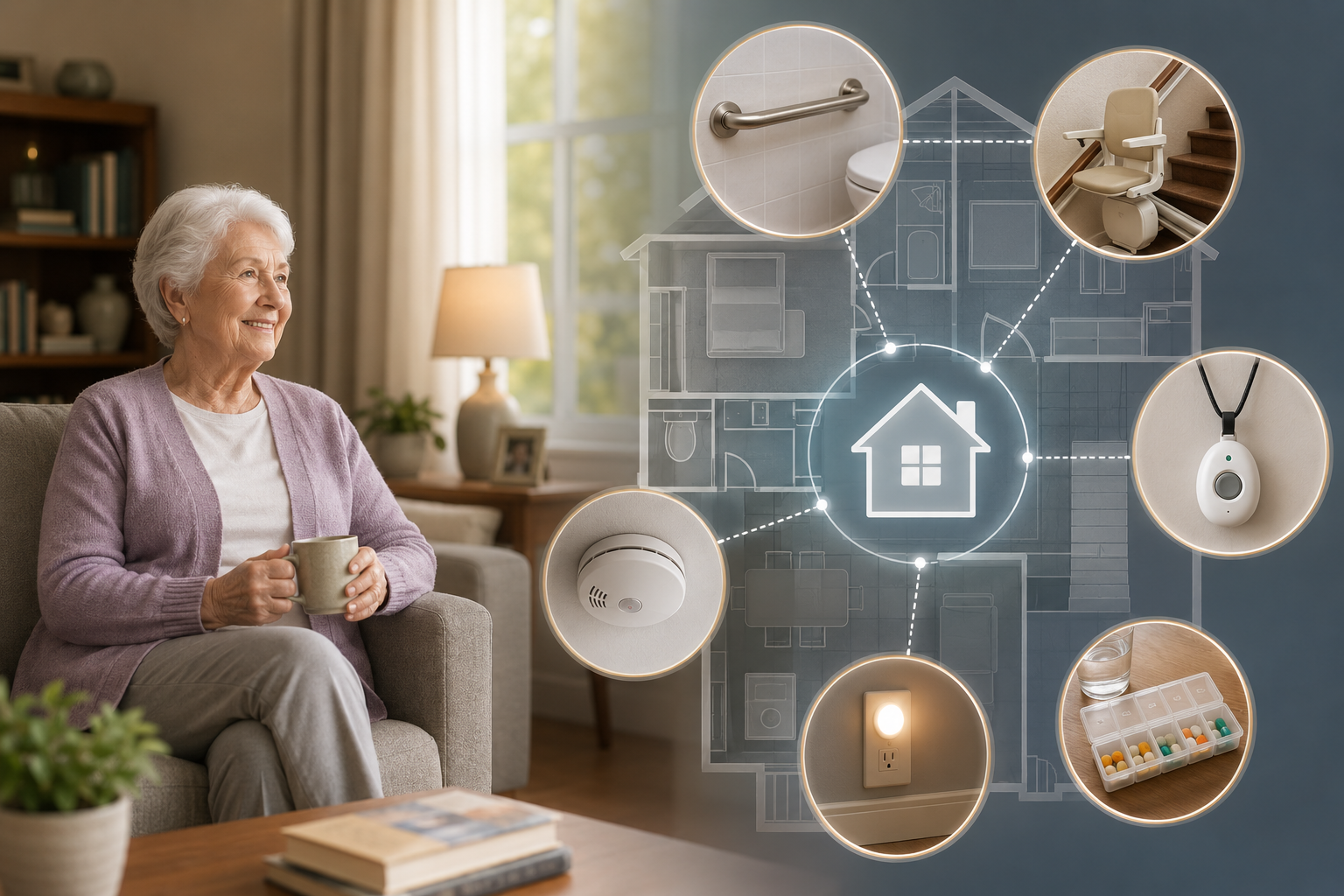
Choosing the right home safety products for seniors starts with understanding the categories of hazards and the key evaluation dimensions. This product-neutral guide helps you prioritize based on your loved one's specific situation, cost, and installation needs.
By Editorial Team
new caregiver
experienced caregiver
long-distance caregiving
spousal caregiver
working caregiver
daily routines
medication management
personal hygiene
care coordination
first steps
ADLs
IADLs
The first shopping trip after a fall is usually a messy one. Someone searches for home safety products for seniors, opens six tabs, and suddenly the cart has a shower chair, a medical alert pendant, a smart speaker, and a rug tape kit. The impulse is understandable. Something happened, or almost happened, and the house now looks less familiar: the tub edge looks higher, the hallway darker, the stairs steeper.
That urgency needs structure before it needs more products. About 1 in 4 older adults falls each year, and falls are the leading cause of fatal injury for adults 65 and older.[1] More than half of falls happen inside the home, according to NCOA’s summary of home safety standards work.[2] Yet only a small share of U.S. homes are considered aging-ready, with one widely cited estimate putting the figure at 10%.[3]
Those numbers do not mean every family needs the same package of equipment. They mean the home deserves a closer reading. Before buying, walk the rooms with a room-by-room home safety assessment or a fall-prevention checklist, then match products to the hazard you actually found: slipping, tripping, standing from a seat, missing a dose, cooking unsafely, or being unable to call for help.
Start With the Hazard, Not the Product
A grab bar, a motion light, and a medical alert system all belong in the broad world of senior safety, but they solve different problems. One helps someone stay upright. One helps them see the path. One helps them call for help after something has gone wrong. Treating them as interchangeable “safety upgrades” is how families overspend in one area and leave the real danger untouched.
Use the same five questions for every category:
What specific problem does it solve: slipping, poor lighting, weak transfers, missed medication, delayed emergency response, fire risk, or wandering access?
Can the older adult use it correctly under stress, at night, or when tired?
Does it need permanent installation, batteries, Wi-Fi, charging, subscriptions, or caregiver monitoring?
What fails first: suction, hardware, power, signal, memory, balance, or willingness to use it?
Is this a temporary bridge, a long-term solution, or a sign that a professional assessment is overdue?
Whether the risk is forgetting, double-dosing, refilling late, or caregiver visibility
Fire and carbon monoxide
Smoke and CO alarms, stove alerts, shut-off devices
Whether alarms are heard, batteries are maintained, and cooking risks are addressed
Everyday trip hazards
Night lights, cord control, handrails, ramps, non-slip strips
Whether a low-cost fix removes a repeated hazard
Bathroom Safety: Where Installation Matters Most
The bathroom deserves more attention than most product lists give it. It combines water, hard surfaces, tight turning space, clothing changes, nighttime urgency, and transfers from standing to sitting. SeniorLiving.org and CPSC both treat bathroom safety as a core home-safety concern for older adults, and the product choices here often depend less on features than on whether the support is installed well enough to bear real weight.[4][5]
Grab bars are not all the same kind of promise
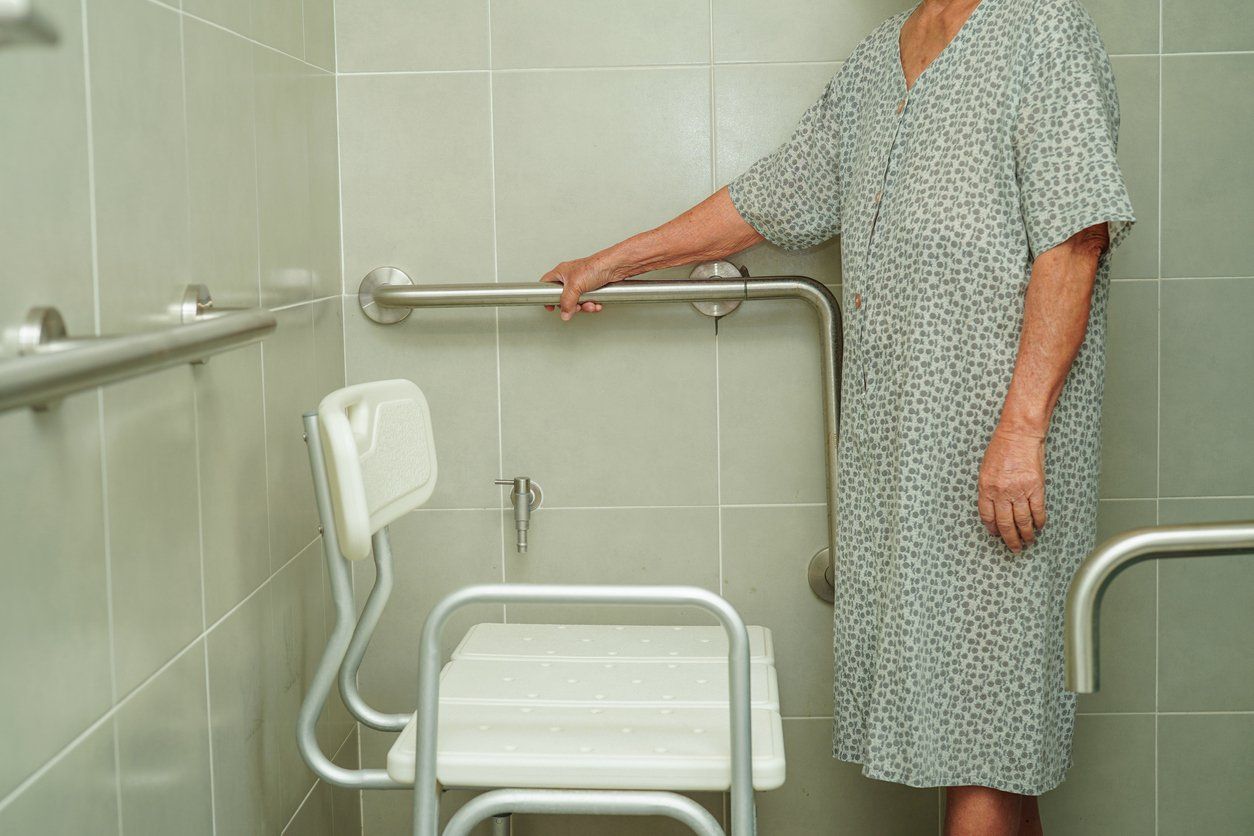
A properly installed, wall-mounted grab bar is a different product from a suction-cup bar. The first is meant to provide dependable support when someone loses balance or pushes up from a seated position. The second may be useful as a temporary cue or light steadying aid in a rental, but it should not be treated as a structural support. The mismatch is not small: the moment a person reaches for the bar is usually the moment there is no time to wonder whether suction is still holding.
Age Safe America’s home safety materials report that grab bars can reduce fall risk by up to 50% when properly installed, while also noting that many homes still lack basic aging-in-place features.[6] The important words are “properly installed.” A bar screwed into drywall without blocking or studs may look reassuring and fail at the worst possible time.
Good grab bar planning is specific. One bar may help at the shower entrance, another near the toilet, another along the back or side shower wall. Placement should follow the person’s actual movement: where they step in, where they turn, which hand is stronger, where they reach when rising, and whether they are transferring from a walker, wheelchair, or caregiver assist.
Seated bathing products solve a different problem
A shower chair, bath bench, or transfer bench is not just a comfort item. It changes the task. Instead of standing while washing, turning, and reaching, the person can sit for most of the routine. A transfer bench goes further by letting someone sit outside the tub and slide across, reducing the need to step over the tub wall.
The choice depends on the bathroom and the person. A compact shower chair may fit a stall shower but do little for a tub transfer. A transfer bench may be safer for entry but awkward in a tiny bathroom or incompatible with a shower door. A handheld shower head often matters as much as the chair because seated bathing becomes clumsy if the water source still assumes a standing body.
Toilet safety is about height, leverage, and dignity
Raised toilet seats, toilet safety frames, and nearby grab bars all address the same basic movement: lowering with control and standing back up. Weak knees, hip pain, poor balance, and post-surgery restrictions can turn that movement into the most dangerous transfer in the house.
Do not assume the highest seat is safest. If the person’s feet no longer rest securely on the floor, the transfer may become less stable. Check whether the device clamps securely, whether armrests interfere with clothing or hygiene, and whether the older adult can clean and use the setup without feeling trapped by it.
When portable fixes are not enough
Some bathrooms cannot be made safe enough with accessories. A narrow doorway, high tub wall, slippery tile, no blocking for grab bars, or a caregiver-assisted bathing routine may push the decision toward renovation. Walk-in tubs are often discussed in this category, with reported costs commonly ranging from about $3,000 to $10,000, though the real price depends on the model, plumbing, electrical work, region, and installation conditions.[4]
Before committing to a major project, compare it with a broader bathroom remodel for elderly safety and a full home modification cost guide. A walk-in tub can help some households, but it is not automatically better than a curbless shower, better lighting, reachable storage, and well-placed permanent grab bars.
Mobility and Transfer Products: More Equipment Is Not Automatically Safer
Mobility products sit closer to the person than almost anything else in the home. A cane, rollator, bed rail, or stair lift changes how someone moves through the day. If it fits their ability and the house, it can preserve independence. If it does not, it can become a new obstacle.
This category matters because the consequences of a bad fall are so high. CPSC notes that 95% of hip fractures are caused by falls, and Age Safe America identifies stair-related falls as producing more hospitalizations than falls in any other location.[5][6]
Canes and rollators need fit, training, and a clear route
A cane that is the wrong height can throw posture off. A rollator with a seat can encourage longer walks, but only if the person understands the brakes and has enough space to turn. A walker that works in a clinic may catch on thresholds, rugs, or tight bedroom furniture at home.
The product decision and the room decision belong together. If a parent now needs a rollator, the hallway, bathroom entrance, bed path, and kitchen route may need to change too. For a deeper look at matching mobility aids with the home environment, use a mobility-at-home adaptation guide rather than choosing the device in isolation.
Stairs require a severity-first decision
Stairs are where families often delay because the options feel expensive or emotionally heavy. Extra handrails, better lighting, contrast tape, and clutter removal may help when the person still has safe stair ability. But when balance, vision, leg strength, or cognition has changed, the question becomes whether the stairs are still a reasonable daily task.
Stair lifts are commonly cited in the $2,000 to $8,000 range, but that estimate can move with stair shape, rail length, landing needs, electrical work, and installation conditions.[6] A straight staircase is not the same project as a curved staircase. A lift also adds maintenance and requires the person to transfer safely on and off the chair at both ends.
If the family is unsure whether the problem is strength, balance, judgment, vision, or the stair design itself, an occupational therapist home modification assessment can keep a large purchase from becoming an expensive workaround for the wrong problem.
Bed rails and transfer aids need caution
Bed rails can help a person reposition or sit up, but they are not automatically benign. The main question is whether the person needs a handhold, a barrier, or supervised transfer support. A rail used by someone with confusion, poor judgment, or nighttime restlessness may create entrapment or climbing risks. A transfer pole, bed handle, or adjusted bed height may be a better match in some homes.
Watch the actual movement before buying: lying to sitting, sitting to standing, standing to walker, and returning to bed at night. The hard part is often not the first transfer of the morning; it is the half-awake one at 2 a.m.
Medical Alerts and Fall Detection: Coverage Systems, Not Fall Prevention
Medical alert systems are valuable when the real problem is delayed help. They do not make a slippery bathroom safer, and they do not keep a stair misstep from happening. Their job is to shorten the time between an event and a response.
SafeWise reports common medical alert pricing in the broad range of about $20 to $80 per month, with equipment fees varying by system.[7] That monthly number matters less than choosing the right coverage model.
System Type
Best Fit
Red Flags
Home-only base station
Someone who is mainly at home and needs a simple button-based way to call for help
No coverage outside the base range; may depend on power or landline/cellular connection
Cellular mobile device
Someone who goes out alone, drives, walks outdoors, or splits time between homes
Needs charging and may be forgotten on a counter
Wearable fall detection
Someone at risk of falling who may not be able to press a button
Fall detection is not perfect; false alarms and missed events are possible
Home sensors or hybrid systems
A caregiver wants pattern alerts or layered coverage
Setup, privacy expectations, subscriptions, and connectivity need agreement
The easy mistake is buying the most feature-rich plan instead of the plan that matches the risk. If a parent’s close call happened while showering and they rarely leave home alone, bathroom access to an alert button may matter more than nationwide GPS. If they walk the neighborhood daily, a home-only unit may leave the biggest gap untouched.
Also decide who receives the call or alert. A monitored system routes to a response center. Some caregiver alert devices notify family directly. That can be appropriate, but only if the family can actually respond at the times the device is most likely to be used.
Smart Home Safety: Helpful When the Household Can Support It
Smart home devices can be useful for long-distance caregivers, especially when the issue is visibility rather than hands-on support. Wirecutter’s smart home coverage for seniors discusses devices such as voice assistants, smart displays, video doorbells, smart locks, and sensors as tools that can help older adults and caregivers manage daily home tasks.[8] Age Safe America also describes smart home devices as part of senior independence planning in 2026.[9]
The practical filter is simple: if the safety function depends on Wi-Fi, charging, voice commands, app updates, or a caregiver noticing a phone notification, those are part of the product. They are not side details. A smart lock that no one knows how to override, a video doorbell with dead batteries, or a voice assistant that misunderstands a soft voice is not a reliable safety plan.
Motion-sensor lights can reduce dark-path risk without requiring the person to remember a switch.
Video doorbells may help caregivers see visitors or deliveries, but they require privacy boundaries and notification management.
Smart locks can help when family or responders need entry, but backup keys and power-failure plans still matter.
Water and stove shut-off devices are most useful when the hazard is a repeated appliance or flooding risk, not a vague desire to make the home “smarter.”
Voice assistants can help with reminders and hands-free calls, but they are a poor fit if speech, hearing, cognition, or internet reliability makes them frustrating.
For some older adults, smart devices preserve control. For others, they turn ordinary routines into troubleshooting. The difference is not age alone; it is comfort, cognition, hearing, vision, internet access, and whether a nearby person can maintain the system.
Medication Management: Match the Tool to the Failure Point
Medication products are often marketed as reminder tools, but missed doses are only one failure point. Some people forget whether they already took a pill. Some take the wrong day’s dose. Some run out because no one sees the refill problem in time. Some can manage morning pills but not a changing evening schedule.
SeniorLiving.org and AgingCare both include medication management tools among equipment that can help older adults remain safer at home.[4][10] The useful question is how much structure is needed.
Medication Tool
Problem It Solves
Maintenance Burden
Basic pill organizer
Sorting by day or time when the person can self-manage
Someone must fill it accurately on schedule
Alarmed reminder
Prompting a person who forgets the time
Alarms must be heard, understood, and reset
Locked or automated dispenser
Reducing double-dosing or access to the wrong compartment
Requires setup, refills, power, and troubleshooting
Caregiver alert system
Letting someone else know a dose was missed
A caregiver must be willing and able to follow up
Do not use a complicated dispenser to solve a simple sorting problem. Do not use a simple plastic organizer when the real risk is double-dosing after memory changes. Medication safety gets better when the product matches the pattern, not when the device has the most compartments.
Fire and Carbon Monoxide Safety: Alarms Only Help If They Are Heard and Maintained
Fire safety can feel separate from fall prevention, but it belongs in the same home-safety conversation because the failure points are often ordinary: cooking, batteries, hearing, reaction time, and exits. CPSC reports that adults 65 and older are nearly twice as likely to die in a home fire, and that cooking is the leading cause of fire injury for this age group.[5]
The baseline products are working smoke alarms and carbon monoxide alarms. For someone with hearing loss, alarms may need strobe lights, bed shakers, linked alerts, or caregiver notification. For someone who forgets burners, stove alert devices or automatic shut-off products may address a more specific hazard than another reminder note taped to the cabinet.
The maintenance question is not optional. Batteries, expiration dates, sensor life, Wi-Fi connections, and who responds to alerts should be assigned to a person, not left as a household hope.
General Home Safety Products: Small Fixes Deserve Respect
Some of the least impressive products prevent the most predictable problems. The CDC STEADI home safety checklist tells older adults and families to remove tripping hazards, improve lighting, secure rugs, add grab bars, and keep frequently used items within reach.[11] None of that looks dramatic in a product photo. It is still the work that changes the path from bed to bathroom.
Motion-activated night lights help with nighttime bathroom trips, when low light and urgency combine.
Cord covers and cord shorteners remove trip lines across walking paths.
Non-slip strips or mats can help on slick surfaces, but loose mats can become hazards themselves.
Second handrails can make stairs safer when the person still has stair ability.
Threshold ramps can help walkers, rollators, and wheelchairs move through uneven transitions.
Furniture sliders, reachers, and storage changes can reduce bending, climbing, and awkward reaching.
The red flag in this category is false neatness. A rug taped down at the corners may still ripple. A night light placed behind furniture may not light the actual route. A ramp with the wrong slope or no edge protection can create a different danger. Cheap is fine. Careless is not.
How to Prioritize When Everything Suddenly Looks Unsafe
After a fall, the house can feel like a list of accusations. Start with sequence, not panic. The goal is to reduce the hazards most likely to happen and most likely to cause serious harm, while choosing products the older adult can actually use and the family can actually maintain.
Identify the room and task involved: bathing, toileting, stairs, bed transfer, cooking, medication, entry, or nighttime walking.
Separate prevention from response: grab bars and lighting reduce risk; medical alerts and caregiver notifications improve response.
Prioritize high-severity hazards first, especially bathroom transfers, stairs, cooking risk, and situations where the person could be alone after a fall.
Check user fit: strength, balance, vision, hearing, cognition, hand use, height, habits, and willingness.
Confirm installation reality: studs, blocking, electrical needs, Wi-Fi, thresholds, door swings, rental rules, and who will do the work.
Price ranges should be treated as planning estimates, not promises. Some useful fixes cost less than a dinner out. Larger modifications, including stair lifts, walk-in tubs, and full bathroom changes, can move into the thousands and sometimes beyond, depending on the home and installer.[3][4][6] If the budget is limited, that is another reason to begin with a prioritized home modification plan instead of a general shopping list.
When needs are unclear, use the CDC STEADI fall prevention checklist as a companion tool and consider an occupational therapist evaluation. The right home safety product is not the one that appears on the most lists. It is the one that fits the hazard, the person, the room, the home constraints, and the caregiver’s ability to keep it working.
Comments
Join the discussion with an anonymous comment.