Do Today, Plan for Later: A Home Safety Checklist for Early-Stage Dementia
For: adult childStage: early independence10 minReviewed: 2026-07-05
Do Today, Plan for Later: A Home Safety Checklist for Early-Stage Dementia
This room-by-room checklist helps you make immediate, low-effort safety changes for a parent with early-stage dementia while identifying modifications to plan for as the disease progresses — so you can act without stripping away their independence.
By Editorial Team
new caregiver
experienced caregiver
long-distance caregiving
spousal caregiver
working caregiver
daily routines
medication management
personal hygiene
care coordination
first steps
ADLs
IADLs
The useful question after an early dementia diagnosis is usually not, "How do I make this house perfectly safe?" It is, "What can I change this weekend without making my parent feel managed in their own kitchen?"
That distinction matters. Early-stage dementia home safety is not late-stage dementia proofing. The person may still cook, shower, sort pills, pay attention to routines, object to changes, and care deeply about how the house looks. At the same time, fall risk is already meaningfully elevated: a 2024 meta-analysis estimated annual fall prevalence at 34.88% for older adults with mild cognitive impairment and 43.55% for those with Alzheimer's disease, while also noting low-to-very-low evidence quality and high study heterogeneity, so those figures should be treated as directional rather than as exact predictions for one household.[1]
The ethical problem is just as real as the medical one. Penn LDI reported in 2024 that preserving independence was the top driver of aging-in-place preference among people with dementia, while families often planned only after a crisis forced the issue.[2] A parent who resists a drawer lock may accept a brighter hallway bulb. A parent who refuses a bathroom remodel may agree to a better bath mat and a grab bar if it is presented as a normal aging-in-place upgrade, not a verdict on their competence.
Start With Two Lists, Not One
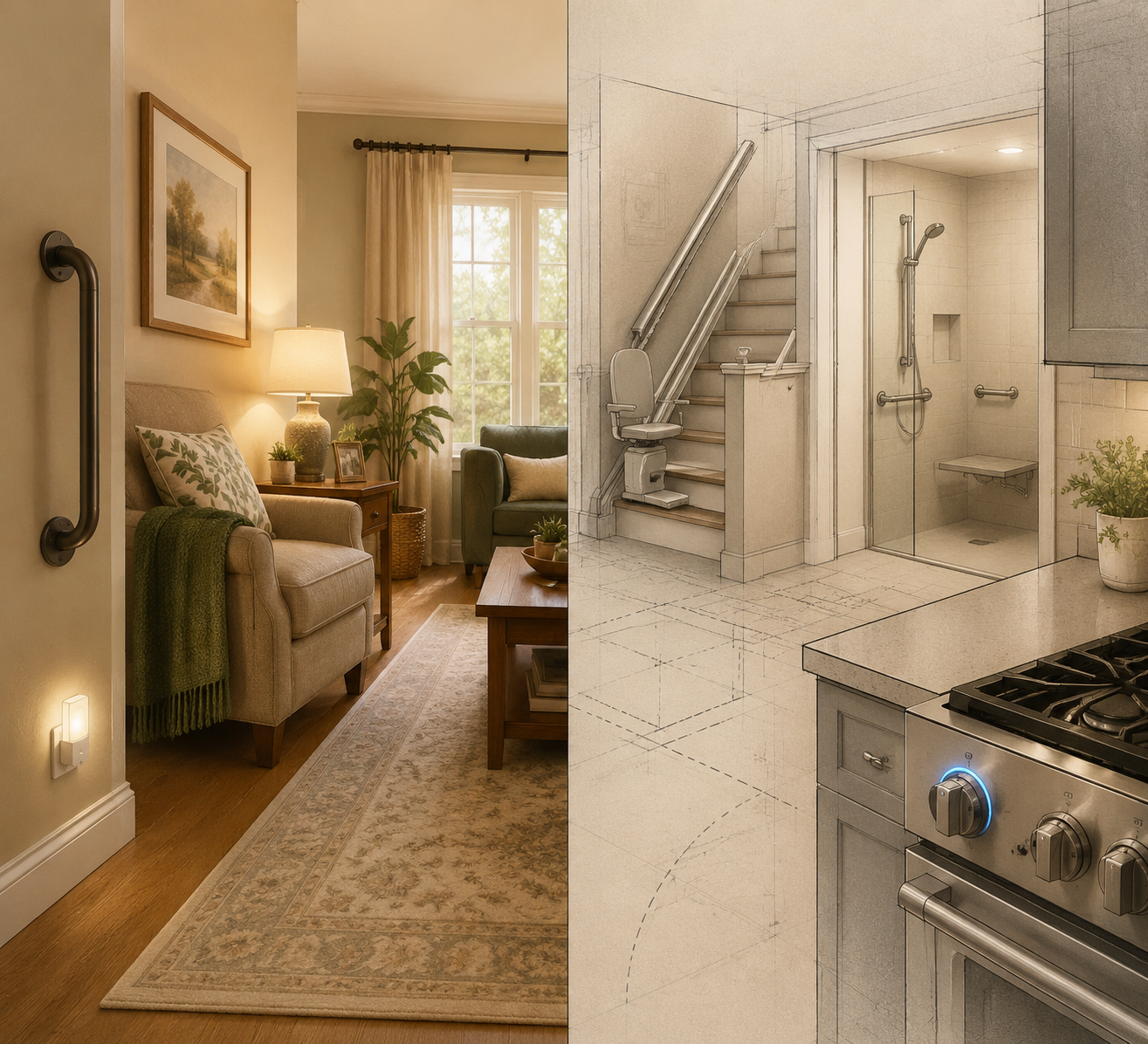
A single checklist can accidentally turn every small risk into an emergency. A better early-stage dementia home safety checklist separates changes into two lanes: things to do now because they are low-effort and hard to argue with, and things to plan for because they require money, contractors, new habits, or a bigger family decision.
Do Today
Plan for Later
Improve lighting, remove loose clutter, secure rugs, add nightlights, simplify medication setup, check smoke alarms, lower water heater temperature if needed.
Discuss bathroom remodeling, stair lifts, stove auto-shutoff devices, medication dispensers, monitoring technology, professional home assessments, and future supervision needs.
Choose changes that look like normal home maintenance and preserve familiar routines.
Choose changes that need consent, budgeting, installation, training, or a clear trigger for when they become necessary.
Act before the first serious fall, burn, medication mistake, or nighttime wandering episode.
Use early-stage capacity to make decisions with your parent while they can still state preferences.
Do not assume that another person in the house automatically solves the safety problem. Drexel University reported on research using 2015-2016 National Health and Aging Trends Study data showing a 45.5% fall rate among older adults with dementia, and the analysis found higher odds of falling among those living with others than among those living alone.[3] That does not mean living alone is safer in every case. It means supervision without a safer environment and clearer routines is not a plan.
The Weekend Pass: Small Changes That Usually Do Not Start a War
Walk the house at the times your parent actually uses it: early morning, evening, and the middle of the night if bathroom trips are common. Bring fresh bulbs, nightlights, nonskid backing, a label maker or painter's tape, and a willingness to leave some things alone for now.
Clear the main walking paths from bed to bathroom, kitchen to table, and favorite chair to front door.
Replace dim bulbs and add nightlights in the bedroom, bathroom, hallway, and kitchen.
Remove loose cords, unstable footstools, and small rugs that slide or curl.
Put frequently used dishes, clothing, toiletries, and cleaning items where they can be reached without climbing.
Test smoke and carbon monoxide alarms, and make sure alerts can be heard from the bedroom.
Write down the medication routine in one visible place and remove expired or duplicate bottles.
The National Institute on Aging recommends practical early-stage supports such as keeping important numbers visible, using nightlights, installing grab bars, setting the water heater to 120 F to help prevent burns, and considering automatic shut-off devices for appliances when needed.[4] Those are not dramatic interventions. They are the quiet backbone of a safer house.
Bathroom: Treat Falls and Burns as Immediate Risks
The bathroom is where families often wait too long because the room feels private. Privacy still matters. So does the fact that wet surfaces, thresholds, poor lighting, and nighttime urgency make this room one of the least forgiving places in the house.
Do Today
Plan for Later
Add a nonskid bath mat inside the tub or shower and a stable mat outside it.
Install permanent grab bars anchored into the wall, not suction-cup bars.
Put a nightlight on the route to the bathroom and one inside the bathroom.
Consider motion-sensor lighting if switches are hard to find at night.
Move shampoo, soap, towels, and toilet paper within easy reach.
Plan for a shower chair, handheld showerhead, raised toilet seat, or walk-in shower if balance declines.
Check whether hot water feels too hot and adjust the water heater if needed.
Ask an occupational therapist or qualified home-modification professional to assess layout before remodeling.
Remove cleaning chemicals, razors, and medications that are stored casually under the sink or on the counter.
Decide when privacy needs to shift toward standby help, especially after a fall, burn, or repeated confusion.
Grab bars are often easier to introduce before anyone "needs" them. Put them in the category of ordinary bathroom updating, the same way people replace a loose towel bar or add better lighting. If the bathroom needs more than small fixes, a deeper bathroom remodel for elderly dementia safety can wait until you have measured the real problems: stepping over the tub wall, standing long enough to shower, turning in a tight space, or finding the toilet at night.
Kitchen: Preserve the Routine, Narrow the Risk
The kitchen is usually the hardest room to change because it is not just a safety zone. It is where a parent makes coffee, proves they are still themselves, feeds the dog, answers the phone, and tells you they have been using that stove longer than you have been alive.
Start with visibility and sequence, not control. Label cabinets if searching is becoming frustrating. Keep one everyday pan, one cutting board, and one set of dishes easy to reach. Move sharp tools and heavy cookware only when there is a clear reason, and avoid turning the kitchen into a puzzle your parent has to relearn overnight. The Alzheimer's Association's home safety guidance emphasizes reducing hazards throughout the kitchen, including attention to appliances, sharp objects, cleaning products, and food safety as dementia progresses.[5]
Do Today
Plan for Later
Test smoke alarms and make sure someone else can be alerted if your parent may not respond reliably.
Consider smart smoke detectors or monitored alerts if your parent lives alone or is alone for long stretches.
Clear the stove area of towels, papers, mail, plastic containers, and loose sleeves or aprons.
Research stove auto-shutoff devices before the first serious cooking scare.
Put the most-used items at waist-to-shoulder height so cooking does not require a step stool.
Shift toward microwave meals, prepared foods, or supervised cooking if sequencing becomes unreliable.
Label key cabinets and drawers in plain language or with pictures if labels help more than they irritate.
Plan when to remove or disable appliances that are repeatedly left on or used unsafely.
Throw away spoiled food during normal cleaning rather than staging a confrontation.
Arrange grocery delivery, meal support, or shared meal routines if shopping and food storage start to fail.
Cooking should be watched for patterns, not one imperfect moment. Anyone can forget a burner once. The concern rises when your parent denies repeated events, cannot explain smoke, leaves the house while something is heating, confuses appliance controls, or stops recognizing spoiled food. That is when a stove shut-off device stops being a gadget and becomes a reasonable compromise between independence and fire risk.
If your parent lives alone, the kitchen plan needs an outside alert path. NIA guidance for people living alone with early-stage dementia includes considering automatic shut-off devices and arranging systems that help with safety while daily routines are still possible.[4] The Alzheimer's Association also offers guidance specifically for people with Alzheimer's or another dementia who live alone, including planning ahead for help with daily activities and safety needs.[6]
Bedroom and Night Routes: Fix the Trip Before the Fall
Nighttime is where a perfectly familiar house can become unfamiliar enough. Low light, urgency, sleep medication, pets, slippers, and a half-awake search for the bathroom all stack the risk.
Place a lamp within reach of the bed, and use bulbs bright enough to see the floor clearly.
Add nightlights from bed to bathroom, especially at turns, thresholds, and stair edges.
Remove low benches, laundry baskets, shoes, pet toys, and decorative items from the route.
Make sure the bed height allows both feet to rest on the floor before standing.
Keep glasses, hearing aids, phone, water, and a written emergency contact list in one consistent place.
Plan for later if nighttime confusion increases: motion-sensor lights, a bedside commode, door alerts, or a monitoring system may become appropriate. The point is not to install every device now. It is to know which problem each device would solve before you buy it.
Stairs, Entryways, and Living Areas
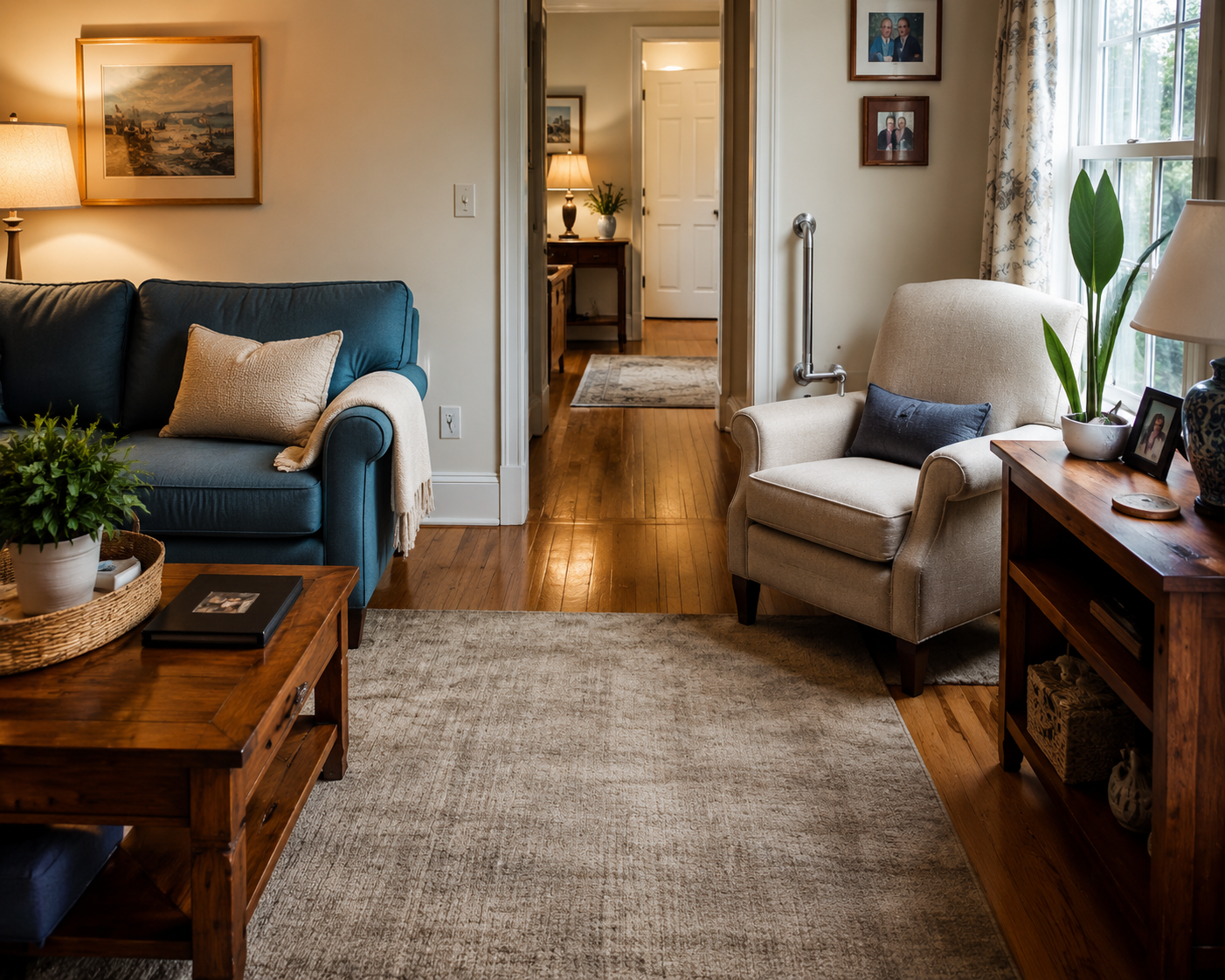
The front door, favorite chair, television room, and stairs often reveal whether the house is arranged for the person who lives there or for the furniture that has always been there. Early changes should make movement simpler without making the room look stripped.
Area
Do Today
Plan for Later
Stairs
Add bright lighting, remove loose objects, secure handrails on both sides if possible, and mark the top or bottom step with contrast if depth perception is changing.
Consider a stair lift, first-floor bedroom, or relocation within the home if stairs become avoided, rushed, or repeatedly misjudged.
Entryway
Clear shoes, packages, umbrellas, and mats that bunch up; keep keys, wallet, ID, and phone in one predictable place.
Consider a video doorbell, smart lock, or trusted-neighbor plan if door safety, scams, or lockouts become concerns.
Living room
Create a wide path to the favorite chair, bathroom route, and phone; stabilize or remove small tables and loose rugs.
Replace low or unstable seating if standing up requires rocking, pulling on furniture, or help.
Outdoor path
Improve porch lighting, remove hoses and planters from the path, and fix uneven mats or loose railings.
Plan repairs for steps, railings, cracked walkways, and snow or leaf removal before bad weather.
Medication, Firearms, and Other Quietly Urgent Items
Some of the most important safety work is not room-specific. It sits in drawers, pill bottles, purses, garages, and habits nobody has questioned for years.
Medication
Start by removing expired medications, duplicates, and old prescriptions that are no longer part of the current routine. Then make the active routine visible: morning, afternoon, evening, bedtime. If your parent can still manage pills with a weekly organizer, do not rush to replace that system just because it makes you nervous. Watch for missed doses, double doses, confusion after refills, or pills found in pockets and on counters.
Plan for later with a locked medication box, pharmacy blister packs, an automatic dispenser, or a caregiver check-in schedule. Medication devices help only if someone is responsible for filling them correctly and responding when doses are missed.
Firearms
If there are firearms in the home, do not leave this for a later stage. Confirm that guns are unloaded, locked, and stored separately from ammunition, or remove them from the home through a legal and family-approved plan. This is not a judgment about a lifetime of responsible ownership. Dementia changes memory, judgment, threat perception, and impulse control over time, and the safe storage decision is easier before a frightening incident.
Security and Scams
Put emergency contacts by the phone and in a wallet or purse. Reduce junk mail piles that invite confusion. If your parent is opening the door to strangers, giving out information by phone, or getting locked out, plan for a video doorbell, trusted-neighbor arrangement, call-screening setup, or smart lock. The Alzheimer's Association's early-stage caregiving guidance frames safety as a central decision point while the person can still participate in planning.[7]
Technology Belongs in the Plan, Not at the Center
Technology can be useful, especially for adult children who are not in the house every day. It can also create a false sense of control. A sensor can tell you the door opened. It cannot tell you whether your parent understood where they were going, whether the porch step was icy, or whether they will accept being watched.
Technology
Best early-stage use
Watch-out
Stove auto-shutoff
When cooking remains important but burners are being left on or cooking steps are becoming unreliable.
Install before a major scare if smaller kitchen changes are no longer enough.
Medication dispenser
When pill organizers are no longer reliable but the person can still respond to prompts.
Someone still has to fill it, monitor missed doses, and update medication changes.
GPS or ID option
When walks, errands, driving transitions, or getting lost have become concerns.
Choose the least intrusive option your parent will actually wear or carry.
Smart smoke detector
When your parent may not hear, understand, or respond to a standard alarm.
Make sure alerts go to someone who can act quickly.
Video doorbell
When visitors, scams, lockouts, or repeated door confusion are becoming a pattern.
Talk through privacy and access before installing it.
For families weighing sensors, alerts, and wandering-related tools, a focused guide to dementia monitoring systems that actually work is more useful than buying devices one by one after each scare.
When to Bring in Professional Help
Not every family needs a contractor, and not every home needs remodeling. Professional help becomes more useful when the same risk keeps showing up despite small fixes: repeated falls, fear of bathing, unsafe stairs, missed medications, cooking incidents, or a parent who can no longer explain what happened.
An occupational therapist can observe how your parent actually moves through the home. A qualified home-modification contractor can tell you whether a grab bar, ramp, shower change, or stair solution is structurally realistic. If you are coordinating multiple changes, a CAPS, occupational therapist, and contractor workflow can keep the project from becoming a series of expensive guesses.
Reassess After Specific Events, Not Just on a Calendar
A home safety plan should change when the disease changes, but families often need concrete triggers. Revisit the checklist after any of these events:
A fall, near-fall, new fear of walking, or unexplained bruise.
A cooking scare, smoke alarm, spoiled food pattern, or appliance left on.
Getting lost, wandering, repeated lockouts, or leaving at unusual times.
Missed doses, double doses, or confusion after a medication change.
Nighttime confusion, bathroom accidents, or new trouble finding the bathroom.
Resistance to once-routine tasks such as bathing, dressing, cooking, or using stairs.
If the reassessment shows that your parent needs another person present for large parts of the day or night, the question has moved beyond home setup. At that point, families may need to compare scheduled help, adult day programs, assisted living, or a trained live-in caregiver for dementia. Early-stage safety is not taking over the house all at once. It is making the next preventable crisis less likely while there is still time to plan with the person who lives there.

Comments
Join the discussion with an anonymous comment.