
Caregiver decision guide
From Crisis to Confidence: Building a Sustainable Family Caregiving Plan for Aging Parents
Most family caregiving begins in crisis mode, leaving adult children overwhelmed and unprepared. This guide provides a structured four-phase framework — Assess, Plan, Act, Adapt — to help you move from reactive urgency to a sustainable, stage-aware plan that protects both your parent and yourself.

The Crisis-to-Planning Gap: Why Most Caregivers Start Behind
If you are reading this in the days or weeks following a parent's fall, a new dementia diagnosis, or a sudden functional decline, you are not alone in feeling unprepared. The data bears this out with uncomfortable precision.
According to a 2025 survey of 1,029 family caregivers conducted by A Place for Mom, 70% of caregivers began their role with only partial readiness, and only about one in four felt completely prepared. More striking: 24% of respondents reported an immediate need for care, and another 25% needed care within 30 days. That means nearly half of all caregiving journeys begin with almost no runway. It is no surprise, then, that 54% of caregivers wish they had started making a senior care plan sooner.
The consequences of starting in crisis mode are well documented. The same survey found that 87% of caregivers experience stress or anxiety, and 78% report burnout. The National Institute on Aging notes that family caregivers face elevated risks of sleep problems, high blood pressure, and even premature death. Meanwhile, the American Psychological Association estimates that 40–70% of caregivers have clinically significant depressive symptoms — far higher than the general population.
These numbers are not meant to alarm you. They are meant to make a single point: starting without a plan is the norm, not a personal failure. The question is what you do next. A structured, stage-aware planning framework can reduce urgency-driven regret and improve outcomes for both you and your parent — whether you are in the middle of a crisis or trying to avoid one.
The Four-Phase Framework: Assess, Plan, Act, Adapt
The framework that follows — Assess → Plan → Act → Adapt — is designed for two kinds of readers. If you are in crisis mode, you can start with the Act phase to stabilize the immediate situation, then loop back to Assess and Plan when you have breathing room. If you are building understanding over time, follow the full arc in order. Either path is valid. The framework is a cycle, not a one-time checklist. You will return to it as your parent's needs change and as your own capacity shifts.
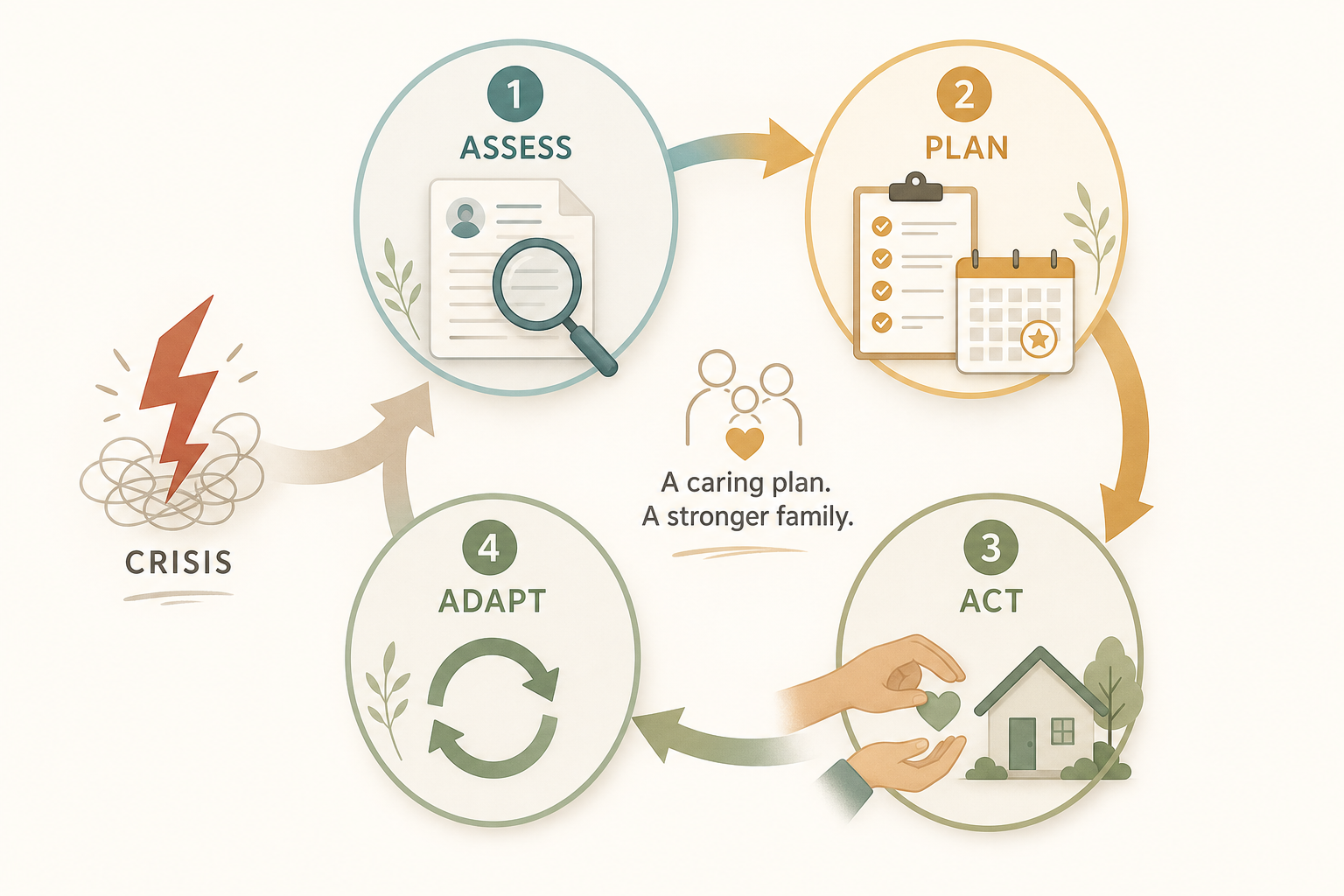
Phase 1: Assess — Understanding Where You and Your Parent Stand
Before you can build a plan, you need a clear picture of your parent's functional status, your own capacity, and the gaps between them. This phase is about gathering information, not making decisions.
Start with a functional evaluation using the Activities of Daily Living (ADLs) and Instrumental Activities of Daily Living (IADLs) framework. ADLs include bathing, dressing, toileting, transferring, and eating. IADLs include managing medications, handling finances, preparing meals, driving or using transportation, and housekeeping. A simple way to begin is to note which tasks your parent can do independently, which they need help with, and which they can no longer do at all.
While you are observing, also assess the home environment. Look for fall hazards — loose rugs, poor lighting, lack of grab bars in the bathroom, cluttered pathways. The CDC's STEADI model recommends a room-by-room safety audit. You can find detailed checklists in our Fall Prevention section.
The Key Conversations to Have Now
Assessment is not just about what you observe. It also requires conversations that many families avoid until a crisis forces them. These are difficult, but they are far harder in an emergency room or after a financial mistake.
- Driving safety: Has your parent had any recent close calls, fender benders, or near-misses? Have they gotten lost in familiar areas? A driving assessment by an occupational therapist can provide objective data.
- Financial awareness: Who pays the bills? Are there automatic payments set up? Has your parent given anyone else access to their accounts? Look for signs of missed payments, unusual spending, or confusion about basic finances.
- Medical decision-making: Does your parent have an advance directive or a living will? Have they designated a healthcare power of attorney? If not, these documents need to be completed while your parent can still participate in the conversation.
- Care preferences: Where does your parent want to live as they age? What level of help are they willing to accept? Understanding their preferences now can prevent painful conflicts later.
For a detailed guide on approaching these conversations with empathy and clarity, see our article on How to Have the Hard Conversations with Aging Parents.
Phase 2: Plan — Building Your Care Team and Legal-Financial Foundation
Once you have a clear picture of the current situation, the next phase is to build the infrastructure that will support sustainable care. Planning now prevents crisis decisions later — and it is the phase most caregivers skip because it feels less urgent than putting out fires.
Legal and Financial Essentials
These documents should be in place before you need them. If they are not, prioritize them immediately.
| Document | Purpose | Who Should Have It |
|---|---|---|
| Durable Power of Attorney (Financial) | Authorizes someone to manage financial affairs if your parent becomes incapacitated | The designated agent (often an adult child) |
| Healthcare Power of Attorney | Authorizes someone to make medical decisions if your parent cannot | The designated agent and the primary care physician |
| Advance Directive / Living Will | Documents your parent's wishes for end-of-life care | The designated agent, primary care physician, and hospital |
| HIPAA Release Form | Allows healthcare providers to share medical information with designated family members | Any family member who needs to coordinate care |
| Will or Trust | Directs how assets will be distributed after death | Executor and attorney |
On the financial side, gather information about your parent's income sources (Social Security, pensions, retirement accounts), assets, debts, and insurance coverage, including Medicare and any supplemental policies. Understanding what resources are available will shape every decision about care options. For a deeper dive into the financial implications of caregiving, see The Hidden Financial Toll of Caring for Aging Parents.
Identifying Your Care Team
Caregiving is rarely a one-person job, yet many caregivers try to make it one. The NAC/AARP 2025 report found that caregivers spend an average of 27 hours per week on care, and 24% provide 40 or more hours — the equivalent of a full-time job. Nearly half of working caregivers report impacts on their employment.
Your care team may include:
- Family members: Siblings, partners, and other relatives who can share specific tasks (driving to appointments, managing medications, handling finances). Be explicit about who does what. Vague agreements like "I'll help when I can" lead to resentment.
- Primary care provider: Your parent's doctor should be aware of the caregiving situation and any changes in your parent's functional status.
- Geriatric care manager: A professional who can assess needs, coordinate services, and monitor the plan over time. This is especially valuable for long-distance caregivers.
- Home health agency or home care agency: Depending on whether your parent needs skilled nursing care or assistance with daily activities.
- Area Agency on Aging (AAA): Your local AAA can provide information on available services, including meal delivery, transportation, and caregiver support programs.
For a comprehensive look at the types of care available, see our guide to Senior Care Options: A Complete Comparison of 9 Types of Care for Older Adults.
Phase 3: Act — Implementing Supports and Establishing Daily Routines
This is where planning becomes reality. The goal of the Act phase is to put supports in place that make daily life safer and more manageable for both your parent and yourself.
When to Bring in Different Types of Support
One of the hardest decisions caregivers face is knowing when to move from doing everything themselves to bringing in help. The following table can help you match your parent's needs to the appropriate level of support.
| Situation | Recommended Support | Typical Frequency |
|---|---|---|
| Parent needs help with housekeeping, meals, or transportation but is otherwise independent | Homemaker services, meal delivery (e.g., Meals on Wheels), volunteer driver programs | Weekly or as needed |
| Parent needs help with bathing, dressing, or medication reminders | Home health aide or personal care aide | A few hours per day, several days per week |
| Parent needs 24/7 supervision or has significant mobility or cognitive challenges | Live-in caregiver, adult day care, or consideration of assisted living or nursing home | Daily, around the clock |
| Parent is recovering from a hospitalization or surgery | Skilled home health care (nursing, physical therapy, occupational therapy) | Temporary, often daily for a few weeks |
| Caregiver needs a break to prevent burnout | Respite care — in-home aide, adult day center, or short-term nursing home stay | A few hours to a few weeks, as needed |
For a detailed staged framework on implementing home modifications and services, see Building an Aging in Place Services Plan: A Staged Decision Framework for Family Caregivers. For specific guidance on home modifications like grab bars, ramps, and stair lifts, see Aging in Place Home Modifications: A Decision Framework for Adult Children.
Establishing Daily Routines
Once supports are in place, establish a daily or weekly routine that provides structure for your parent and predictability for you. This might include:
- A consistent morning and evening routine for medication, meals, and personal care.
- A weekly schedule showing who is providing care on which days and at what times.
- A communication plan: How will you share updates with siblings or other family members? A shared digital calendar or a simple group chat can prevent misunderstandings.
- A backup plan: What happens if the home health aide calls in sick? Who is the emergency contact? Having a Plan B reduces panic when things go wrong.
Phase 4: Adapt — Recognizing When the Plan Needs to Change
Caregiving is not a static situation. Your parent's needs will change over time, and your own capacity will fluctuate. The Adapt phase is about recognizing when the current plan is no longer working and making adjustments without starting from scratch.
The A Place for Mom survey found that 25% of caregivers have been providing care for more than five years, and 75% for at least one year. A plan that works in month three may be inadequate by month 18. Adaptation is a sign of good planning, not failure.
Red Flags That Signal the Plan Needs Updating
Watch for these concrete signs that your parent's needs have changed or that the current support level is insufficient:
- A fall or near-fall, even if no injury occurred
- Unexplained weight loss or changes in appetite
- Missed medications or confusion about the medication schedule
- Wandering or getting lost in familiar places (especially relevant for dementia)
- Increased difficulty with bathing, dressing, or toileting
- Noticeable decline in personal hygiene or home cleanliness
- Unpaid bills, missed appointments, or other signs of financial or organizational confusion
- Your own health declining — feeling exhausted, overwhelmed, anxious, or easily angered
Building in Caregiver Protection: Respite, Boundaries, and Your Own Health
A sustainable caregiving plan must include protections for the caregiver. The data makes clear why this is non-negotiable. Caregivers spend an average of 22.8 hours per week on care, and nearly 30% spend more than 30 hours per week. The National Institute on Aging reports that caregivers are at higher risk for physical and mental health problems, including sleep issues, high blood pressure, and even premature death.
Building in caregiver protection means:
- Scheduling regular respite: This can be a few hours a week from a home health aide, a regular day at an adult day center, or a short-term nursing home stay to allow for a vacation or recovery from illness. The Lifespan Respite Program, reauthorized through 2030, provides funding for respite services in many states.
- Setting boundaries: Be clear about what you can and cannot do. It is okay to say no to tasks that are outside your comfort zone, such as bathing or toileting. It is okay to ask siblings to take on specific responsibilities.
- Monitoring your own health: Keep up with your own medical appointments. Pay attention to signs of caregiver stress — feeling exhausted, overwhelmed, anxious, easily angered, having trouble sleeping, or feeling sad or hopeless. These are not signs of weakness; they are signs that the current plan is not sustainable.
- Seeking support: Join a caregiver support group, either in person or online. The Family Caregiver Alliance and the Alzheimer's Association both offer support groups and helplines.
For a deeper exploration of burnout and its systemic causes, see our article Caregiver Burnout Is Not Your Fault: What the 2025-2026 Data Says About the Real Causes of Exhaustion — and What Actually Helps.
Resource Directory: Where to Turn for Help
The following national resources can help you find local services, get answers to specific questions, and connect with other caregivers. Bookmark this section — you will return to it as your needs evolve.
- Eldercare Locator: A public service of the U.S. Administration on Aging. Call 800-677-1116 or visit eldercare.acl.gov to find local services including meal delivery, transportation, legal assistance, and caregiver support.
- National Institute on Aging (NIA): Provides free publications and online resources on caregiving, including worksheets for assessing needs and planning care. Visit nia.nih.gov/health/caregiving.
- Area Agencies on Aging (AAA): Your local AAA can provide information on available services, conduct in-home assessments, and connect you with programs like Meals on Wheels and senior transportation.
- Family Caregiver Alliance (FCA): Offers fact sheets, webinars, and a national caregiver support line. Visit caregiver.org.
- PACareKit (Pennsylvania): A comprehensive guide to available services for informal caregivers. While Pennsylvania-specific, it serves as a model for the kind of resource directory every state should provide. Check if your state has a similar program.
- The GUIDE Model (Medicare): Launched in 2024, this Medicare program provides comprehensive dementia care coordination, including caregiver training, education, respite care services, and a 24/7 helpline. Over 300 centers have signed up. Ask your parent's healthcare provider if they participate.
- Credit for Caring Act (H.R. 2036): Proposed legislation that would provide up to $5,000 in tax credits for working family caregivers. As of mid-2026, the bill has stalled in Congress, but it is worth monitoring for updates.
You do not need to have everything figured out today. The goal is not perfection — it is progress. Start where you are. Use the framework. Return to it as things change. And remember: building a sustainable plan is one of the most important things you can do for your parent and for yourself.
Questions to bring to a clinician or OT
This is not medical, legal, or a family's final decision — only a framework. Bring these questions to a clinician, occupational therapist, or your local Area Agency on Aging.
Find Local HelpRelated reading
- The Sandwich Squeeze: How to Care for Both Aging Parents and Children Without Breaking
- From Frustration to Confidence: A Family Caregiver’s Framework for Teaching Technology to Older Adults
- Caregiver Burnout Is Not Your Fault: What the 2025-2026 Data Says About the Real Causes of Exhaustion — and What Actually Helps
Noticed something outdated or inaccurate on this page? Flag a correction. We review every report against CDC, NIA, and AARP HomeFit guidance before updating a page.