
Caregiver decision guide
How to Have the Hard Conversations with Aging Parents: A Practical Guide to Talking About Driving, Money, Independence, and Care Needs
A structured, empathetic framework for adult children who need to have difficult conversations with aging parents about driving safety, memory concerns, finances, moving from home, and end-of-life wishes — with specific scripts and strategies grounded in research from AARP and Banner Health.

The Conversation Everyone Avoids — and Why Delaying Makes Everything Harder
You know the conversation needs to happen. Maybe it's about your father's driving after that near-miss at the intersection. Maybe it's about your mother's stack of unopened bills. Or maybe it's the one you cannot even name yet — the conversation about whether the house they have lived in for forty years is still safe. You keep telling yourself there will be a better time. A weekend. A holiday. A moment when everyone is less tired.
The data suggests that waiting is the single most common regret among family caregivers. According to A Place for Mom's 2025 Senior Care Search Trends Report, 54% of caregivers wish they had started making a senior care plan sooner. That same report found that 24% of caregivers who found senior care in the past year said their need was immediate, and another 25% needed care within 30 days. In other words, nearly half of all caregiving situations escalate from manageable to urgent faster than families expect.
The cost of delay is not just logistical. It is emotional. When a conversation happens in the middle of a crisis — after a fall, a hospitalization, or a financial mistake — the parent feels ambushed, and the adult child feels like a stranger delivering bad news. The relationship takes a hit that could have been avoided with a slower, earlier approach.
This guide is built on a different premise: that hard conversations, when handled with structure and empathy, are acts of love — not confrontation. The following sections provide a research-backed framework and specific scripts for eight of the most common conversations families face, drawn from frameworks developed by AARP and Banner Health.
The AARP Framework: Five Principles for Any Hard Conversation
Before diving into specific topics, it helps to have a repeatable approach. Amy Goyer, AARP's family and caregiving expert, has developed a five-point framework that works across nearly every difficult caregiving conversation. These principles are not abstract — they are tactical moves that change the emotional temperature of a discussion.
- Talk early and often. Discuss matters when they are still hypothetical, not during a crisis. A conversation about driving at age 70, when the parent is still driving well, is a conversation about planning. The same conversation at age 82, after an accident, is a conversation about taking something away.
- Observe and do homework before acting. Ride along to assess driving. Stay for a few days to evaluate home safety. Research alternative transportation or housing options before you bring up a change. Data replaces opinion, and opinion feels like criticism.
- Approach with love, concern, and support. Avoid confrontation. Do not adopt a "parenting your parent" viewpoint — it triggers resistance. Use honest and caring communication that positions you as an ally, not an authority figure.
- Communicate effectively. Use "I" statements ("I am concerned about…") rather than "you" statements ("You need to…"). Ask for their input. Listen and reflect back what you hear. Validate their feelings even when you disagree with their conclusions.
- Include key people. A trusted doctor, an elder law attorney, or a geriatric care manager can facilitate the conversation in a way that a family member cannot. Sometimes the same words land differently when they come from a professional.
These five principles form the foundation for every script that follows. They are not a guarantee that the conversation will be easy, but they dramatically increase the odds that it will be productive.
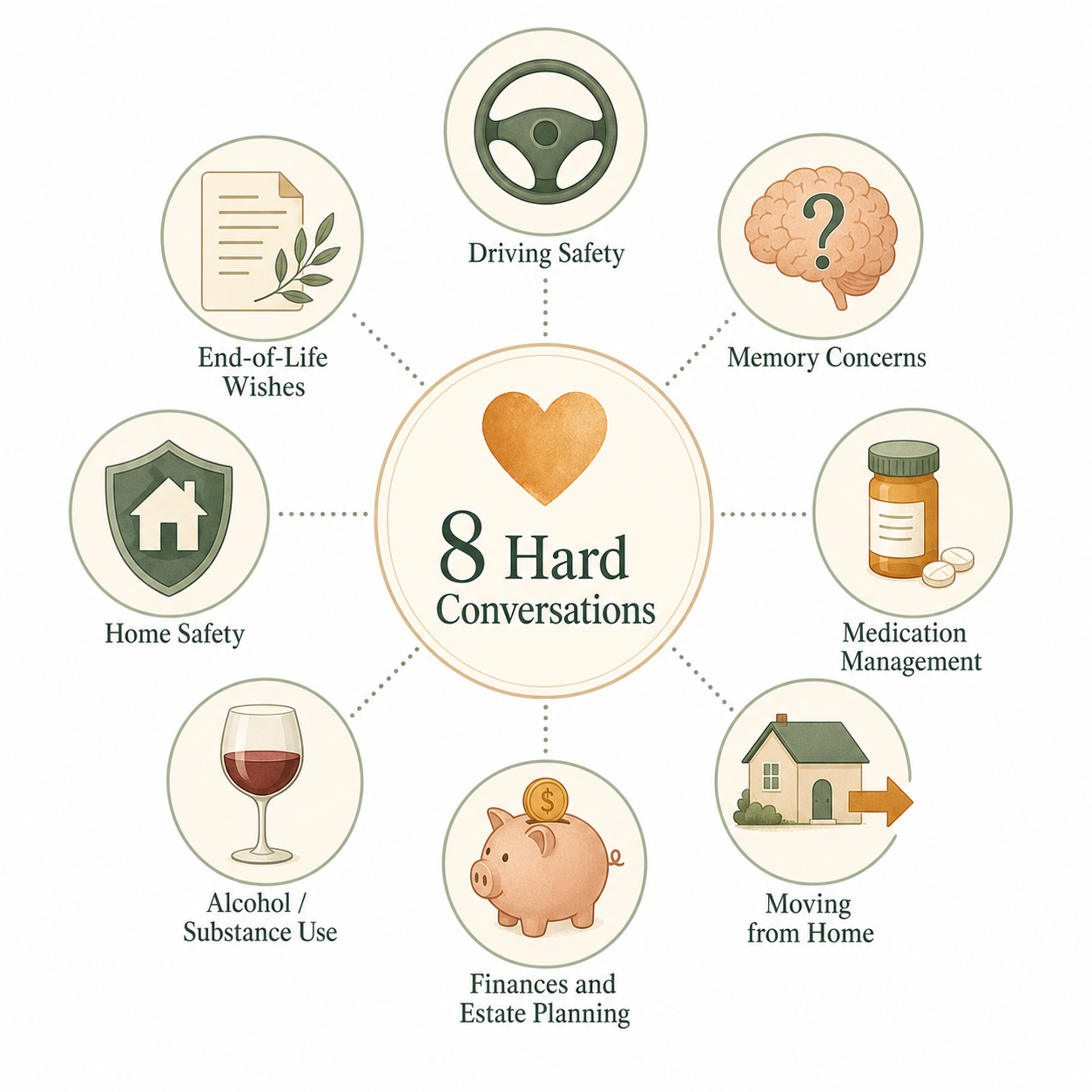
The 8 Hard Conversations: Scripts and Strategies for Each
The following eight conversations cover the most common — and most emotionally charged — topics that arise when caring for aging parents. Each entry includes a summary of what the research says, a starter script you can adapt, common pitfalls to avoid, and guidance on handling resistance.
Conversation A: Driving Safety
Driving is often the most emotionally charged topic because it represents independence. Banner Health's guidance recommends pointing to alternatives like rideshare services or senior transit before suggesting a driving limit. The goal is to frame the conversation around safety and options, not around loss.
Starter script: "Dad, I noticed you seemed a little unsure at that left turn yesterday. I get it — intersections are getting harder for everyone. I was reading about a senior ride service in our area that a lot of people use. Would you be open to trying it with me sometime, just to see what it's like?"
What to avoid: Do not ambush your parent with a driving test or a surprise intervention. Do not use phrases like "you're not safe" — instead, describe specific observations. If resistance is strong, ask a healthcare professional to assess and deliver the recommendation.
Conversation B: Memory Concerns
Memory concerns are frightening for everyone involved. Banner Health advises sharing observations gently and asking if your parent has noticed changes themselves. Remind them that treatment works best when started early — this frames the conversation around proactive health rather than decline.
What to avoid: Do not use diagnostic language like "Alzheimer's" or "dementia" in the first conversation. Do not correct or contradict your parent when they deny a memory lapse. If the conversation leads toward a potential facility transition, link to the guide on 10 Signs It's Time for Memory Care for a structured discussion of next steps.
Conversation C: Medication Management
Medication errors are one of the most common — and most preventable — risks for older adults. Banner Health suggests introducing practical tools like pill organizers or automated dispensers before discussing the underlying concern about adherence.
Starter script: "I know keeping track of all these pills is a lot. I saw this organizer that has alarms for each time of day — it looks pretty simple. What if we set it up together next weekend and see if it helps?"
What to avoid: Do not accuse your parent of forgetting or being irresponsible. Assume the system is the problem, not the person. Offer to help fill the organizer weekly — this turns a potential conflict into a shared routine.
Conversation D: Moving from Home
The prospect of leaving home is often met with immediate resistance because it feels like a loss of everything familiar. Banner Health recommends framing the conversation around what the parent will gain — less maintenance, more social connection, safety — rather than what they will lose.
Starter script: "I know this house means so much to you. I was thinking about how much time you spend on yard work and repairs, and I wonder if you'd rather use that time for things you enjoy. There are some lovely places nearby where you wouldn't have to worry about any of that. Would you be open to just looking at one with me?"
What to avoid: Do not push for a decision in one conversation. Do not frame the move as something you need for your own peace of mind — keep the focus on the parent's quality of life. If the parent is resistant, the guide on When Your Aging Parent Refuses Help offers a phased approach for working through that resistance.
Conversation E: Finances and Estate Planning
Money conversations are often the most private. According to Pew Research Center data, 39% of caregivers for a parent help manage finances regularly — yet many families never discuss estate planning until a crisis forces the issue.
Starter script: "I've been thinking about my own finances lately, and it made me realize I don't actually know what your wishes are if something happened. I'd feel better knowing we had a plan in place — not because anything is wrong, but because I want to honor what you would want. Would you be open to meeting with an elder law attorney together?"
What to avoid: Do not ask for account numbers or passwords in the first conversation. Do not imply that you are worried about your parent's financial competence. Frame the discussion around your own need to understand their wishes, not around a judgment of their current management.
Conversation F: Alcohol or Substance Use
This is one of the most difficult conversations because it involves shame and privacy. Banner Health advises bringing it up with compassion and noting that older adults feel alcohol's effects more strongly and often take medications that interact with alcohol.
Starter script: "Dad, I've noticed you've been having a drink most evenings, and I know your blood pressure medication can interact with alcohol. I'm not judging — I just want to make sure you're safe. Would you be willing to talk to your doctor about how much is okay?"
What to avoid: Do not use accusatory language like "you have a problem." Do not try to manage the behavior alone — involve a primary care physician who can discuss the medical implications without the emotional charge of a family conversation.
Conversation G: Home Safety and Household Help
Many older adults resist help because it feels like a loss of independence. Banner Health recommends framing household help as a benefit — a chance to relax after a lifetime of work — and suggesting outsourcing the hardest tasks first.
Starter script: "Mom, I see how hard you work keeping this place up. What if we found someone to handle the heavy cleaning once a week so you could use that energy for things you actually enjoy? It wouldn't mean you can't do things yourself — just that you don't have to do everything."
What to avoid: Do not frame help as something your parent "needs" because they cannot manage. Frame it as something they deserve. If the conversation moves toward hiring in-home care, the guide on Is It Time for Companion Care? provides a structured way to evaluate the option together.
Conversation H: End-of-Life Wishes
This is the conversation almost no one wants to have, and the one that causes the most pain when it is avoided. The key is to frame it around honoring the parent's wishes, not around anticipating death.
Starter script: "I was reading about advance directives, and it made me realize that if something happened, I wouldn't know what you would want. I want to make sure I can honor your wishes, not mine. Would you be willing to fill out a living will together? We can update it anytime."
What to avoid: Do not wait until a terminal diagnosis to start this conversation. Do not pressure for immediate answers — end-of-life wishes evolve, and the document should be revisited periodically. Involve an elder law attorney to ensure the paperwork is legally valid.
| Conversation | Best Opening Frame | Key Pitfall | Third Party to Involve |
|---|---|---|---|
| Driving safety | Alternatives and options | Surprise intervention | Primary care physician or DMV |
| Memory concerns | Proactive health check | Using diagnostic labels | Neurologist or geriatrician |
| Medication management | System improvement | Accusation of forgetting | Pharmacist |
| Moving from home | Gains, not losses | Pushing for one-decision | Geriatric care manager |
| Finances and estate planning | Your own need to know | Asking for passwords too soon | Elder law attorney |
| Alcohol or substance use | Medical interaction | Accusatory language | Primary care physician |
| Home safety and help | Deserved benefit | Framing as incapacity | Occupational therapist |
| End-of-life wishes | Honoring their wishes | Waiting for a crisis | Elder law attorney |
When to Bring in a Third Party: Doctors, Geriatric Care Managers, and Elder Law Attorneys
Sometimes the most loving thing you can do is step aside and let a professional carry the message. AARP's framework explicitly recommends including key people because a neutral third party can say things that a family member cannot say without damaging the relationship.
Here is when to involve each type of professional:
- Primary care physician: Best for driving safety concerns, memory assessments, and medication reviews. A doctor can frame the recommendation around medical facts rather than family opinions. Ask the doctor to write a letter or make a phone call before you raise the topic.
- Geriatric care manager: Best for care planning, family mediation, and navigating the long-term care system. They can assess the home environment, coordinate services, and facilitate conversations without the emotional history that complicates family discussions.
- Elder law attorney: Best for estate planning, powers of attorney, advance directives, and Medicaid planning. An attorney can explain legal documents in a neutral, professional context — which often feels less threatening than a family member raising the same topics.
If siblings disagree about the best approach, the guide on When Siblings Disagree offers strategies for getting the family on the same page before involving outside professionals.
What If They Still Won't Talk? Strategies for Persistent Resistance
Some parents will refuse to engage no matter how carefully you approach the conversation. This is not a reflection of your communication skills — it is a reflection of how deeply threatening these topics can feel. When you meet persistent resistance, consider these strategies:
- Use gradual introduction. Do not try to resolve everything in one sitting. Mention the topic, let it sit for a week, then bring it up again with a small piece of new information. Banner Health notes that you may need to revisit conversations multiple times before they stick.
- Use hypotheticals and stories of other families. "A friend of mine just went through this with her dad, and they found that…" removes the personal threat and allows your parent to consider an idea without admitting they need it.
- Know when safety overrides autonomy. If your parent is driving unsafely, leaving the stove on, or showing signs of serious financial exploitation, your obligation to protect them outweighs their right to refuse the conversation. In those cases, involve adult protective services, the Department of Motor Vehicles, or a healthcare proxy to intervene.
If you are feeling exhausted by the repeated attempts, the article on Caregiver Burnout Is Not Your Fault provides data on why this work is so draining and what actually helps. Your own well-being matters — you cannot have productive conversations when you are running on empty.
Hard Conversations Are Investments in Your Relationship
It is easy to see these conversations as threats to a relationship — moments when you risk angering or hurting the person you love most. But the data tells a different story. According to Pew Research Center's 2026 survey of 8,750 U.S. adults, 56% of caregivers for a parent say that caregiving has had a positive impact on their relationship with their parent. The difficult conversations, when handled with respect and empathy, are part of what builds that positive outcome.
Dr. Jerimya Fox of Banner Health puts it simply: "You want to collaborate, not dictate… When people feel like they are making a choice, not being told what to do, they are more likely to do it."
Every conversation in this guide is an invitation to collaborate. You are not taking something away from your parent — you are helping them navigate a stage of life that none of us were prepared for. The goal is not to win the argument. The goal is to make sure that when you look back on this period, you know you acted out of love, not avoidance.
If you are new to the caregiving role entirely, the New Caregiver Framework provides a step-by-step orientation to the broader responsibilities ahead. You do not have to master every conversation at once. Start with the one that matters most today, use the scripts as a starting point, and trust that each conversation makes the next one easier.
Questions to bring to a clinician or OT
This is not medical, legal, or a family's final decision — only a framework. Bring these questions to a clinician, occupational therapist, or your local Area Agency on Aging.
Find Local HelpRelated reading
Noticed something outdated or inaccurate on this page? Flag a correction. We review every report against CDC, NIA, and AARP HomeFit guidance before updating a page.