
Caregiver decision guide
Overnight Care for Elderly: A Complete Cost Guide for Families in 2026
A financial deep-dive for adult children assessing the cost of overnight care for an aging parent. Covers three cost models with real numbers, state-by-state variation, Medicare's hard line on custodial care, and payment strategies including VA benefits, Medicaid waivers, and creative alternatives.

The Price of Peace of Mind: Why Cost Confusion Is the #1 Barrier to Overnight Care
When your parent starts wandering at 2 a.m., falls getting out of bed, or becomes confused and agitated after dark, the question isn't just "Do they need help?" — it's "Can we afford it?" For most adult children, the answer is clouded by a fog of conflicting numbers, hidden fees, and a persistent myth that Medicare will cover the bill. That uncertainty leads to two equally bad outcomes: paying far more than necessary out of fear, or avoiding care altogether until a crisis forces the issue.
The financial reality is both sobering and more navigable than most families realize. The national median cost for in-home care in 2026 is $34 per hour, according to the A Place for Mom 2026 Costs of Long-Term Care and Senior Living Report. At that rate, a single 12-hour overnight shift through a home care agency runs approximately $408. But that's only one model. Flat-fee overnight care, live-in arrangements with sleep-time deductions, and emerging alternatives like student caregiver programs can cut that number by half or more. The problem isn't that overnight care is unaffordable — it's that families don't know which model fits their situation or how to pay for it.
This guide breaks down the three primary overnight care models with real 2026 cost data, explains why your location can double your bill, walks through Medicare's hard-and-fast exclusions, and maps out payment strategies — from long-term care insurance and VA benefits to Medicaid waivers and creative split-shift arrangements. The goal is to replace cost confusion with a clear, actionable financial picture.
Three Overnight Care Models and What They Actually Cost in 2026
Overnight care is not a single product. It comes in three distinct models, each with a different cost structure, level of service, and regulatory framework. Understanding the difference is the first step to avoiding overpaying.
| Model | How It Works | Typical Cost Range (2026) | Monthly Estimate (30 nights) |
|---|---|---|---|
| Hourly Agency Care | A caregiver stays awake for the entire shift (8–12 hours), providing active supervision, toileting assistance, reorientation, and fall prevention. | $30–$50 per hour (national median $34/hr) | $8,160–$14,400 (12-hr shift at median $34/hr = $12,240) |
| Flat-Fee Overnight Care | A caregiver stays overnight but is not required to remain awake. Duties include bedtime prep, nighttime monitoring, and morning assistance. Sleep is permitted if the client is stable. | $120–$200 per night | $3,600–$6,000 |
| Live-In Care | A caregiver lives in the home and provides 24/7 coverage. Under the Fair Labor Standards Act (FLSA), up to 8 hours of uninterrupted sleep can be excluded from paid hours, reducing the effective hourly cost. | $8,000–$12,000 per month | $8,000–$12,000 |
The hourly agency model is the most expensive option because you are paying for every minute of awake, active care. A caregiver working a 12-hour overnight shift at the national median of $34/hour costs the family $408 per night — before any agency markup or overtime. For 30 nights, that's $12,240.
The flat-fee overnight model is significantly cheaper because the caregiver is not required to stay awake. This model works well for seniors who need someone present for safety but do not require active intervention every hour. The caregiver helps with bedtime, responds to calls during the night, and assists with morning routines — but sleeps when the client is stable. At $120–$200 per night, monthly costs range from $3,600 to $6,000.
Live-in care occupies a middle ground. Because the caregiver lives in the home, the FLSA allows a sleep time deduction: the employer may exclude up to eight hours of sleep from the caregiver's paid hours, provided the caregiver gets at least five hours of uninterrupted sleep. This means you pay for roughly 16 hours of a 24-hour day, making live-in care substantially cheaper than 24/7 awake care (which would require two or three caregivers in shifts). Monthly costs typically land between $8,000 and $12,000.

State-by-State Cost Variation: Why Location Can Double Your Bill
Where your parent lives is one of the strongest predictors of what you will pay for overnight care. The national median of $34/hour masks a wide range: from $25/hour in Mississippi to $44/hour in South Dakota, according to the A Place for Mom 2026 Costs of Long-Term Care and Senior Living Report. That's a 76% difference — meaning a family in South Dakota pays nearly double what a family in Mississippi pays for the same 12-hour overnight shift.
| State | Median Hourly Rate (2026) | 12-Hour Overnight Cost | Monthly Cost (30 nights) |
|---|---|---|---|
| Mississippi | $25 | $300 | $9,000 |
| Alabama | $26 | $312 | $9,360 |
| Texas | $29 | $348 | $10,440 |
| Florida | $31 | $372 | $11,160 |
| National Median | $34 | $408 | $12,240 |
| California | $38 | $456 | $13,680 |
| New York | $40 | $480 | $14,400 |
| South Dakota | $44 | $528 | $15,840 |
These differences are driven by local labor markets, cost of living, and the supply of available caregivers. Rural areas with aging populations and few home care agencies tend to have higher rates because demand outstrips supply. Urban areas with a larger workforce may have more competitive pricing, but higher overhead costs for agencies can push rates up.
If your parent lives in a high-cost state, the flat-fee overnight model or live-in care with sleep deductions becomes even more attractive relative to hourly agency care. A family in South Dakota paying $44/hour for an awake overnight shift would spend $528 per night — but a flat-fee overnight arrangement at $200/night would save $328 per night, or nearly $10,000 per month.
Medicare's Hard Line: What It Covers and What It Won't Pay For
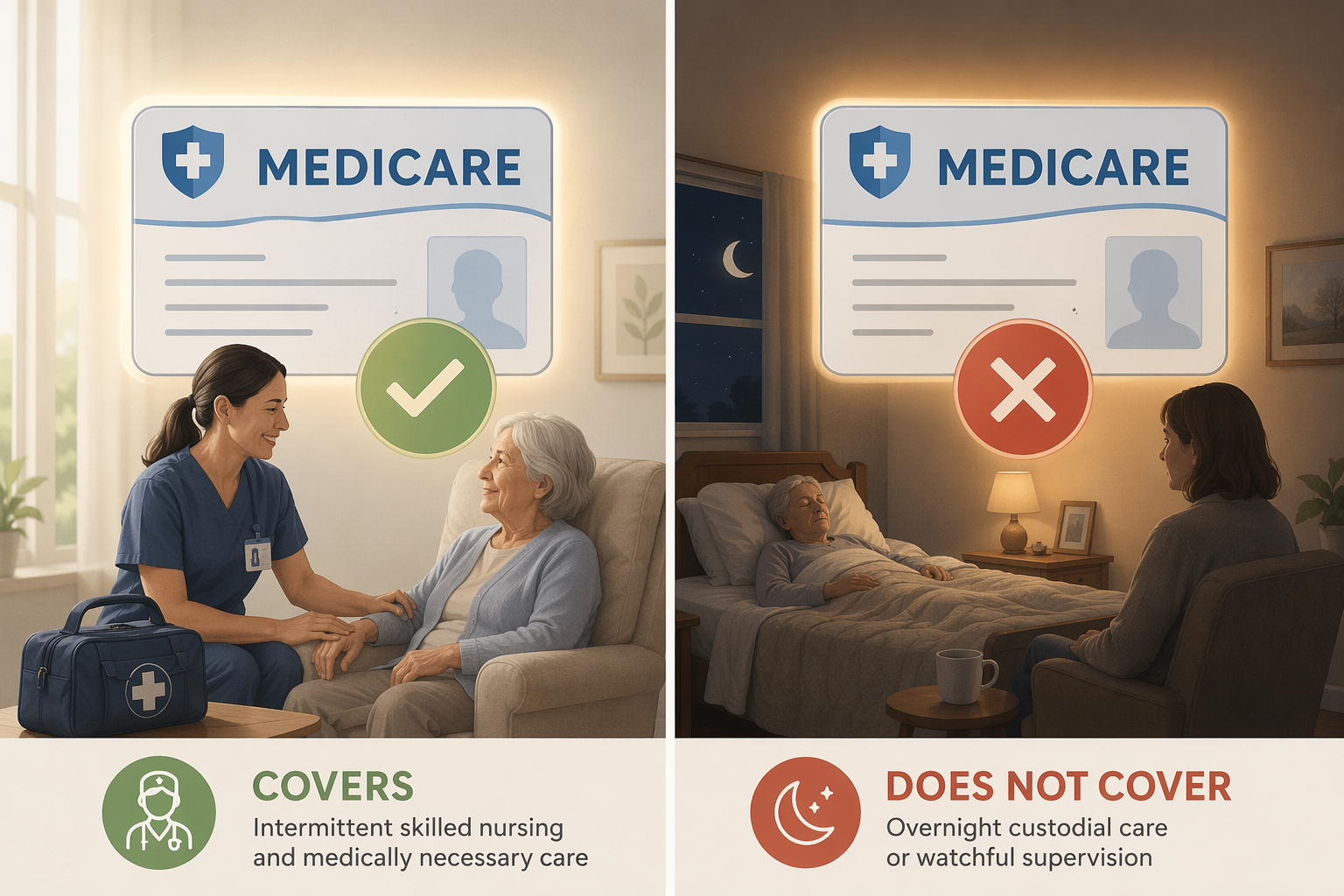
This is the single most misunderstood coverage gap families encounter. Medicare does not pay for 24-hour-a-day care at home. It does not pay for overnight care. It does not pay for custodial care — help with bathing, dressing, toileting, or eating — when that is the only care needed. The Medicare.gov page on home health services is explicit: Medicare covers only medically necessary, part-time, or intermittent skilled nursing care, and only if you are homebound and receiving skilled care at the same time.
Here is what Medicare will cover under its home health benefit:
- Part-time or intermittent skilled nursing care (e.g., wound care, IV therapy, catheter changes)
- Physical therapy, occupational therapy, and speech-language pathology
- Medical social services
- Part-time home health aide care — but only if you are also receiving skilled care at the same time
And here is what Medicare explicitly excludes:
- 24-hour-a-day care at home
- Overnight care or overnight monitoring
- Custodial or personal care (bathing, dressing, toileting, eating) when this is the only care needed
- Home meal delivery
- Homemaker services (shopping, cleaning) unrelated to a care plan
Medicare Advantage plans (Part C) may offer some additional home care benefits, but they are not required to cover overnight or custodial care either. If you have a Medicare Advantage plan, call the plan directly and ask specifically about overnight care coverage — do not assume it is included.
Alternatives and Offsets: How to Pay for Overnight Care Without Going Broke
Since Medicare won't cover overnight custodial care, families must look elsewhere. The good news is that several programs and strategies can offset the cost significantly — if you know where to look. Many families leave money on the table simply because they don't know these options exist.
Long-Term Care Insurance
If your parent has a long-term care insurance policy, check whether it covers in-home overnight care. Many policies include a home care benefit that pays a daily or monthly maximum toward a caregiver's services. The key is to start the claims process early — policies often have a waiting period (typically 30–90 days) before benefits begin. Do not wait until the care is already in place to file the claim.
VA Aid & Attendance Pension
Veterans and surviving spouses who need help with daily activities may qualify for the VA Aid & Attendance pension, which provides a monthly cash payment that can be used to pay for overnight care. In 2026, the maximum monthly benefit for a veteran is approximately $2,300, and for a surviving spouse, approximately $1,500. The application process is detailed and can take several months, so start early.
Medicaid HCBS Waivers
Medicaid's Home and Community-Based Services (HCBS) waivers allow states to use Medicaid funds to pay for in-home care, including overnight care, for people who would otherwise need nursing home care. Eligibility varies by state — income and asset limits are different from standard Medicaid — and waitlists can be long. But for families who qualify, HCBS waivers can cover a significant portion of overnight care costs.
PACE Programs
The Program of All-Inclusive Care for the Elderly (PACE) is a Medicare and Medicaid program that provides comprehensive medical and social services — including in-home care — to older adults who are eligible for nursing home care. PACE programs are available in many states and can cover overnight care as part of their all-inclusive benefit. The catch is that your parent must live in a PACE service area and meet the program's eligibility criteria.
Tax Deductions for Medical Expenses
If you itemize deductions on your federal tax return, you may be able to deduct the cost of overnight care as a medical expense — provided the care is for a qualifying person and the total medical expenses exceed 7.5% of your adjusted gross income. This includes payments to home care agencies and, in some cases, payments to private caregivers if they are properly classified as employees.
Agency vs. Private Hire: The Real Cost and Risk Tradeoffs
Once you decide on a care model, the next decision is whether to hire through a home care agency or directly hire a private caregiver. The cost difference is substantial, but so are the risks and responsibilities.
| Factor | Agency | Private Hire |
|---|---|---|
| Hourly cost to family | $30–$50/hr (includes agency markup) | $18–$28/hr (caregiver's actual wage) |
| Background checks | Agency handles screening and bonding | Family must conduct checks independently |
| Taxes and insurance | Agency handles payroll taxes, workers' comp, liability insurance | Family is responsible for payroll taxes, workers' comp, and liability |
| Backup coverage | Agency provides substitute if caregiver is sick | Family must arrange backup coverage |
| Overtime and FLSA compliance | Agency manages scheduling and overtime rules | Family must track hours and comply with FLSA |
| Supervision and training | Agency provides training and supervision | Family manages training and performance |
The agency markup — typically 30–50% above the caregiver's wage — covers the cost of screening, training, insurance, payroll taxes, and backup staffing. For a family that values simplicity and risk mitigation, that markup is worth every dollar. For a family with a tight budget and the capacity to manage a caregiver directly, private hire can save $10–$20 per hour.
For a full framework on evaluating and hiring a private caregiver, see our guide: Private Sitter for Elderly: A Complete Family Decision Framework.
Creative Models That Reduce Costs: Student Caregivers, Split-Shifts, and Respite Subsidies
Beyond the three standard models, several emerging and alternative arrangements can lower the cost of overnight care significantly. These are not guaranteed solutions — availability varies by location — but they are worth exploring.
Student Caregiver Programs
Programs like CareYaya connect families with pre-health college students who provide overnight care at significantly reduced rates — around $120 per night. These students are typically studying nursing, pre-med, or other health fields and are looking for clinical experience and affordable housing. The cost is lower because the student is not a professional caregiver and does not carry the overhead of an agency. This model works best for seniors who need companionship and safety monitoring rather than skilled medical care.
Split-Shift Arrangements
A split-shift arrangement divides the overnight period between a family caregiver and a professional caregiver. For example, a family member covers the early evening shift (7 p.m. to midnight) and a professional covers the overnight shift (midnight to 7 a.m.). This reduces the professional hours from 12 to 7, cutting the nightly cost by nearly half. The family caregiver still gets a full night's sleep — just not the entire night.
Respite Care Subsidies
Area Agencies on Aging (AAAs) and local nonprofit organizations often provide respite care subsidies that can be used to pay for overnight care. These programs are typically funded through the Older Americans Act or state-specific initiatives. The subsidies are often limited — a few hundred dollars per month — but they can offset a meaningful portion of the cost. Contact your local AAA to ask about respite care vouchers or subsidies.
Monthly Cost Projection Framework: Building Your Family's Overnight Care Budget
To build a realistic budget, start with three inputs: the number of nights per week you need coverage, the care model that fits your parent's needs, and the hourly or nightly rate in your area. Use this formula to estimate your monthly cost:
Monthly Cost = (Nights per Week × 4.33) × (Cost per Night or Shift)
Here is how that formula plays out for different scenarios at the national median rate:
| Scenario | Nights/Week | Model | Cost per Night | Monthly Cost |
|---|---|---|---|---|
| Weekend coverage only | 2 | Flat-fee overnight ($160/night) | $160 | $1,386 |
| Every other night | 3.5 | Flat-fee overnight ($160/night) | $160 | $2,425 |
| Every night, awake agency | 7 | Hourly agency (12 hrs × $34/hr) | $408 | $12,240 |
| Every night, flat-fee | 7 | Flat-fee overnight ($160/night) | $160 | $4,845 |
| Every night, live-in | 7 | Live-in with FLSA deduction | $267–$400 | $8,000–$12,000 |
These projections highlight a key insight: the choice of care model has a far larger impact on monthly cost than the number of nights. Switching from hourly agency care to flat-fee overnight care for the same 7-night schedule saves $7,395 per month — a 60% reduction.
The goal of this framework is not to give you a single answer — it is to give you the tools to run your own numbers. Every family's situation is different. Your parent's care needs, your local rates, your available payment sources, and your own capacity to manage a caregiver all factor into the final decision. What matters is that you make that decision with clear eyes, not cost confusion.
Questions to bring to a clinician or OT
This is not medical, legal, or a family's final decision — only a framework. Bring these questions to a clinician, occupational therapist, or your local Area Agency on Aging.
Find Local HelpRelated reading
Noticed something outdated or inaccurate on this page? Flag a correction. We review every report against CDC, NIA, and AARP HomeFit guidance before updating a page.