
Room checklist
Private Sitter for Elderly: A Complete Family Decision Framework
A step-by-step framework for adult children deciding whether to hire a private sitter for an aging parent. Includes a self-assessment quiz, private-vs-agency decision tree, cost comparison, employer responsibilities checklist, and payment assistance options.

When an aging parent needs regular help at home, the first question is not "how do I hire?" but "should I hire privately at all?" The answer depends on your tolerance for administrative work, your financial situation, and the level of risk you can accept. This framework is designed for adult children in their 40s and 50s who are in information-gathering mode — not yet ready to post a job ad, but ready to understand what private hiring actually requires.
Is Hiring a Private Sitter Right for Your Family? A Self-Assessment Quiz
Before you research rates or write a job description, take a few minutes to assess whether your family is prepared to act as a direct employer. The quiz below covers the four core responsibilities that come with private hiring. Answer honestly — there is no penalty for deciding that an agency is a better fit.
- Payroll and tax management: Are you willing to obtain an Employer Identification Number (EIN) from the IRS, withhold Social Security and Medicare taxes from each paycheck, file quarterly payroll tax returns, and issue a W-2 at year-end? The IRS classifies private caregivers as household employees, not independent contractors. Paying under the table is illegal and forfeits the medical expense tax deduction you may be entitled to.
- Background checks and vetting: Can you run a thorough background check — including criminal history, motor vehicle records, and professional reference verification — without relying on an agency's screening infrastructure? The Family Caregiver Alliance emphasizes that families who hire privately assume full responsibility for vetting.
- Liability and insurance: Do you have workers' compensation insurance, or are you prepared to purchase it? In some states it is legally required. Even where it is not, legal experts recommend it. Your homeowner's policy may not cover a paid caregiver's on-the-job injury.
- Backup care planning: If your sitter calls in sick, takes a vacation, or quits without notice, do you have a contingency plan? Agencies provide replacement caregivers. Private hiring means you are the backup coordinator.
Private Sitter vs. Agency: A Decision Tree for Your Situation
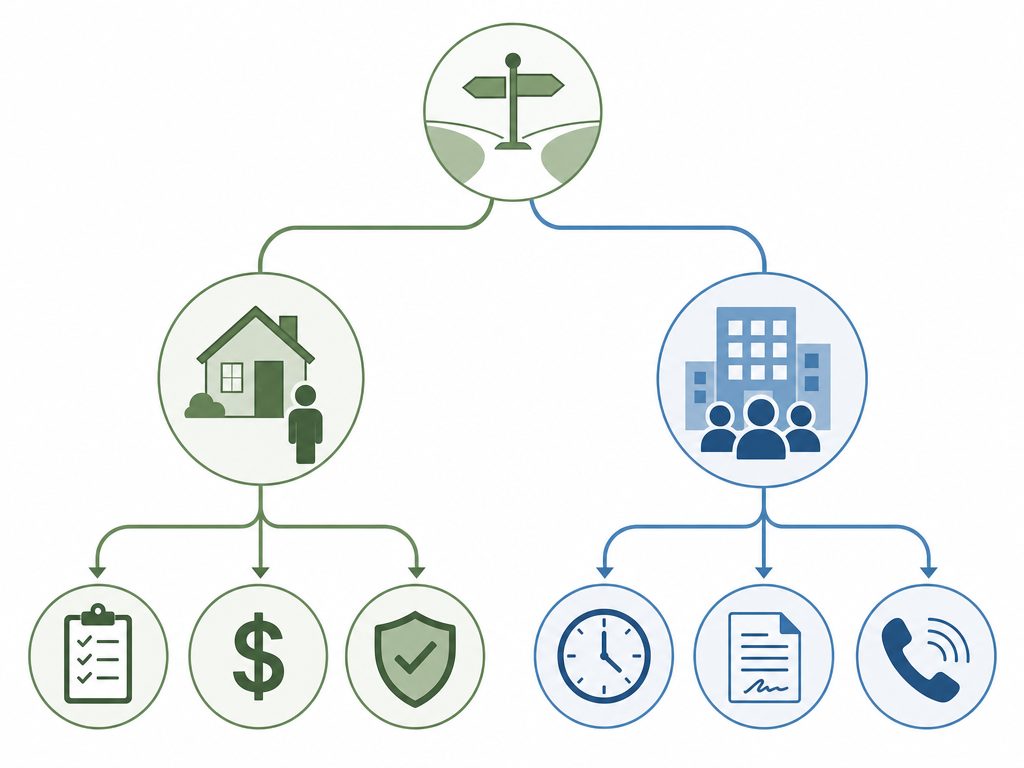
The choice between a private sitter and an agency caregiver is not just about cost. It is a trade-off between control and convenience, flexibility and risk. The decision tree below maps the key branching points.
| Decision Factor | Private Sitter | Agency Caregiver |
|---|---|---|
| Cost | 20–30% lower than agency rates (national median $25–$30/hr) | $34–$35/hr national median (2026); state range $25–$44/hr |
| Flexibility of duties | Can drive, run errands, do housework, and adjust schedule informally | Duties may be restricted by agency policy; less flexibility for non-care tasks |
| Vetting and screening | Family handles background checks, reference calls, and interviews | Agency performs screening, training, and credential verification |
| Payroll and taxes | Family must obtain EIN, withhold taxes, file quarterly returns, issue W-2 | Agency handles all payroll, tax withholding, and compliance |
| Liability and insurance | Family needs workers' comp and may need additional liability coverage | Agency carries workers' comp and general liability insurance |
| Backup care | No built-in backup; family must arrange coverage for absences | Agency provides replacement caregivers when the regular aide is unavailable |
| Care continuity | Same caregiver every shift if scheduling works | May rotate caregivers; less consistency but more reliability |
When private hiring makes sense: You have a clear, stable schedule (e.g., 20 hours per week, same days), you are comfortable managing payroll and taxes, you have time to vet candidates thoroughly, and you have a family member or neighbor who can serve as backup. The cost savings are meaningful — at 30 hours per week, the difference between private ($25/hr) and agency ($35/hr) is roughly $300 per week, or $15,600 per year.
When an agency is the better choice: You need care on short notice, you want a single point of accountability for quality and scheduling, you are uncomfortable with the legal and financial responsibilities of being an employer, or your parent's needs are complex (e.g., dementia behaviors, mobility transfers, medication management). Agencies also make sense if you live far away and cannot oversee the caregiver relationship in person.
What Does a Private Sitter Cost? A 2026 Cost Comparison
The single most common reason families choose private hiring is cost. According to PayingForSeniorCare, hiring an independent caregiver saves 20% to 30% compared to using a home care agency. SeniorLiving.org reports that agencies typically charge 20 to 30 percent more than individual caregivers. The table below translates those percentages into real dollar ranges using the best available 2026 data.
| Cost Metric | Private Sitter (Estimated) | Agency Caregiver (2026 Data) |
|---|---|---|
| National median hourly rate | $25–$30/hr (20–30% below agency median) | $34–$35/hr (SeniorLiving.org / A Place for Mom) |
| Lowest state median (Mississippi) | Approx. $18–$20/hr (estimated) | $25/hr (A Place for Mom) |
| Highest state median (South Dakota / Washington) | Approx. $31–$35/hr (estimated) | $44/hr (South Dakota, A Place for Mom); $42/hr (Washington, SeniorLiving.org) |
| Monthly cost at 15 hrs/week | $1,500–$1,800 | $2,208 (A Place for Mom national median) |
| Monthly cost at 30 hrs/week | $3,000–$3,600 | $4,416 (A Place for Mom national median) |
| Monthly cost at 44 hrs/week | $4,400–$5,280 | $6,478 (A Place for Mom national median) |
At higher weekly hours, the cost difference becomes substantial. A family needing 44 hours per week of care could save $1,200 to $2,000 per month by hiring privately. However, at that level of care, it is worth asking whether home care is still the most cost-effective option. Our guide on the 40-hour cost threshold for home care vs. assisted living can help you make that calculation.
Step-by-Step Hiring Process: From Needs Assessment to Background Checks
If you have decided that private hiring fits your situation, the next step is a structured hiring process. The Family Caregiver Alliance recommends starting with a detailed job description before you begin looking for candidates.
- Assess your parent's care needs. List the specific tasks the sitter will perform: bathing and dressing assistance, meal preparation, medication reminders, transportation to appointments, light housekeeping, companionship. Note any specialized requirements such as dementia care experience, transfer assistance, or language skills. Be honest about the level of physical and cognitive support needed.
- Write a detailed job description. Include the schedule (days, hours, expected duration), location, specific duties, required qualifications (CNA, HHA, LVN if applicable), driving requirements, pet care expectations, smoking policy, and hourly wage range. The more specific you are, the better the candidates you will attract.
- Find candidates. Post on local caregiver job boards, community bulletin boards, and caregiving-specific platforms. Ask for referrals from friends, neighbors, and your parent's healthcare providers. Some families also use caregiver registries that connect families with independent aides for a flat fee.
- Conduct interviews. Interview at least three candidates. Ask about their experience with older adults, their approach to specific tasks (e.g., transferring from bed to chair), their availability, and their comfort level with your parent's specific condition. Include your parent in the interview if they are able to participate.
- Run background checks. Use a reputable background check service that covers criminal history, sex offender registry, motor vehicle records, and professional reference verification. The AARP notes that agencies typically handle this step, but when you hire privately, it is your responsibility. Never skip this step.
Your Employer Responsibilities Checklist: EIN, Payroll, Workers' Comp, and I-9

When you hire a private sitter, you become a household employer under IRS rules. This is not optional — the IRS has ruled that caregivers must be classified as employees (W-2), not independent contractors (1099). The AARP and PayingForSeniorCare both emphasize that families who pay under the table not only risk penalties but also miss out on tax deductions for medical care expenses.
- Obtain an Employer Identification Number (EIN). This is free from the IRS and takes about 10 minutes online. You will use it for all tax filings and for setting up payroll.
- Set up payroll tax withholding. You must withhold Social Security and Medicare taxes (FICA) from each paycheck, pay the employer's share of those taxes, and file quarterly payroll tax returns (Form 941 or Schedule H). At the end of the year, you must issue a W-2. Many families use a payroll service designed for household employers to handle this.
- Secure workers' compensation insurance. This is required in some states and strongly recommended in all states. Without it, you could be personally liable for medical bills and lost wages if your caregiver is injured on the job. Check your homeowner's or renter's insurance policy — it may not cover a paid employee.
- Complete I-9 and W-4 forms. The I-9 verifies the caregiver's legal authorization to work in the United States. The W-4 determines how much income tax to withhold. Both are standard employer requirements.
- Consider state unemployment insurance. Depending on your state and the amount you pay your caregiver, you may need to register with your state's unemployment agency and pay unemployment taxes.
Creating a Legally Sound Caregiver Contract
A written contract is not just a formality — it is your primary legal protection. The AARP warns that oral agreements and handshake deals may not be enforceable in court. A well-drafted contract protects both you and the caregiver by setting clear expectations from the start.
Essential elements of a private caregiver contract:
- Duration and schedule: Specify the start date, expected duration (if known), and the weekly schedule including days and hours.
- Work location and duties: List the primary work location (your parent's home) and a detailed description of responsibilities — personal care, meal preparation, housekeeping, transportation, medication reminders, and any other tasks.
- Pay and tax withholding: State the hourly wage, pay frequency, and that taxes will be withheld as required by law. Include overtime policy if applicable.
- Termination clause: Specify the notice period required by either party (typically two weeks), and any grounds for immediate termination (e.g., theft, abuse, neglect, failure to perform essential duties).
- Dispute resolution: Include a clause requiring mediation or arbitration before either party can file a lawsuit. This keeps disputes out of court and reduces legal costs.
- Liability and insurance: Clarify that the family carries workers' compensation insurance and that the caregiver is responsible for their own health insurance.
- Flexibility clause: Acknowledge that care needs may change and that the contract can be modified by mutual agreement in writing.
Planning for Backup Care: What Happens When Your Sitter Can't Come?
This is the single biggest risk of private hiring. Agencies have a pool of caregivers they can draw from when your regular aide is unavailable. When you hire privately, you are the backup plan. A Place for Mom identifies potential gaps in care as one of the primary risks families must address before hiring privately.
Build a backup care plan before you need it:
- Identify at least two backup caregivers. These could be other private sitters in your network, a neighbor or family member who is trained and willing to step in, or a local agency that offers fill-in shifts on a per-diem basis.
- Cross-train family members. Make sure at least one other family member knows the daily routine, where supplies are kept, how to administer medications, and how to handle common situations (e.g., what to do if your parent falls or becomes agitated).
- Keep a written care plan. Document your parent's schedule, medications, emergency contacts, medical providers, food preferences, and any behavioral or safety considerations. A backup caregiver should be able to walk in and provide competent care with just this document.
- Consider respite care services. Adult day centers, short-term respite programs, and agency fill-in services can provide coverage for planned absences (vacations, medical appointments) and emergencies.
Paying for a Private Sitter: LTC Insurance, VA Benefits, and Medicaid HCBS Waivers
Private pay is the most common way families fund a private sitter, but it is not the only option. Several programs can help offset the cost, though each has specific eligibility requirements and limitations.
| Payment Source | What It Covers | Key Requirements |
|---|---|---|
| Long-term care insurance | May cover in-home care including private sitters, depending on the policy | Policy must include home care coverage; elimination period may apply; reimbursement limits vary |
| VA Aid and Attendance (A&A) | Monthly cash benefit for veterans and surviving spouses who need help with daily activities | Must have a service-connected disability or meet medical and financial criteria; can be used to pay a private caregiver |
| Medicaid HCBS waivers | May cover non-medical in-home care including personal care, homemaker services, and respite | Income and asset limits vary by state; waiver slots may have waiting lists; caregiver must meet state requirements |
| State-funded home care programs | Some states offer programs that subsidize in-home care for low-income older adults | Eligibility and benefits vary widely by state; often have income and functional need criteria |
For a deeper dive into each of these options, including application steps and state-by-state variations, see our financial roadmap for paying for elderly home care and our comprehensive guide to nine funding sources for in-home senior care.
Related reading
Need a professional assessment?
Find a CAPS-credentialed professional or local aging services through our outbound resource list — we never name or rank individual contractors.
Find Local HelpNoticed something outdated or inaccurate on this page? Flag a correction. We review every report against CDC, NIA, and AARP HomeFit guidance before updating a page.