
Caregiver decision guide
Senior Help Services Cost Guide: What Each Type of Care Actually Costs and How to Pay for It
A comprehensive cost guide for family caregivers, breaking down the real hourly, daily, and monthly costs of senior help services — from homemaker care to 24/7 home care — and explaining what Medicare, Medicaid, VA benefits, and other programs actually cover.
The Cost Shock Most Families Face
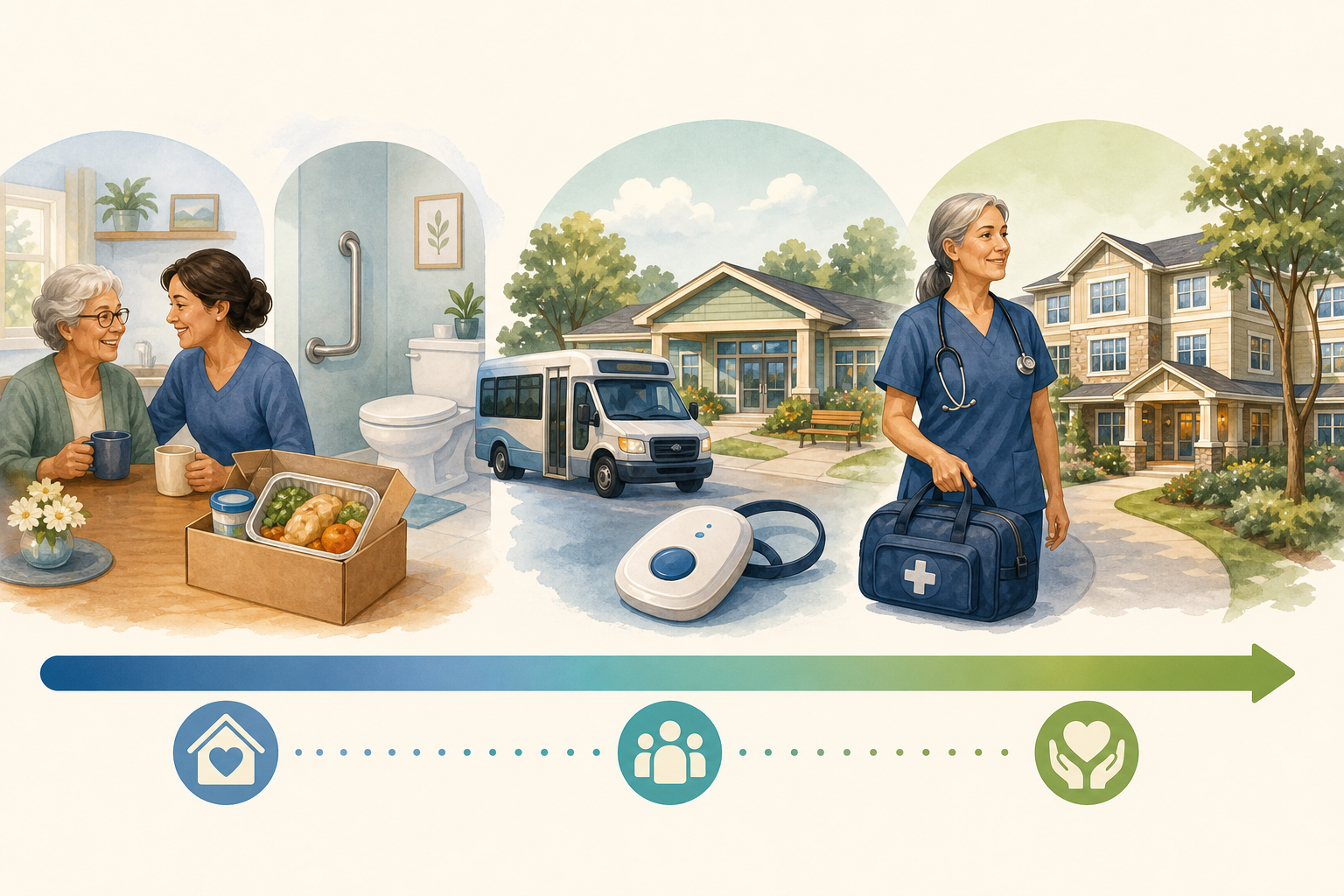
When an aging parent needs help at home, the first question is usually, "What do we do?" The second — often asked in a moment of quiet panic — is, "How do we pay for it?" The numbers can feel staggering. A home health aide averages $20.50 per hour nationally. Assisted living runs $5,511 per month. Round-the-clock in-home care can reach $700 per day. For a family already stretched between work, children, and the emotional weight of caregiving, those figures can land like a physical blow.
The confusion is compounded by a widespread misunderstanding of what Medicare pays for. Most families assume Medicare will cover their parent's long-term personal care needs. It will not. Medicare covers only short-term, skilled home health care ordered by a physician — and only for a limited period. The result is that families often delay planning, pay out of pocket longer than necessary, or miss benefits they are entitled to.
This guide breaks down the real costs of senior help services — by the hour, by the day, and by the month — and walks through every major payment pathway: Medicare, Medicaid Home and Community-Based Services (HCBS) waivers, VA benefits, long-term care insurance, and state and local programs. The goal is not to overwhelm you with numbers. It is to give you a clear, actionable map of what things cost and how to pay for them, so you can make decisions from knowledge rather than fear.
Hourly Rates by Service Type: What You Will Pay Per Hour
The hourly cost of senior help services depends on the type of care required, whether you hire through a licensed agency or independently, and where you live. The three most common hourly service categories are homemaker services, home health aide services, and personal care services. Each serves a different need and carries a different price tag.
| Service Type | National Average Hourly Rate | What It Includes |
|---|---|---|
| Homemaker Services | $20.00 / hour | Light housekeeping, laundry, meal preparation, grocery shopping, errands |
| Home Health Aide | $20.50 / hour | Skilled assistance with bathing, dressing, toileting, medication reminders, vital sign monitoring under a plan of care |
| Personal Care Services | $23 – $30 / hour | Help with activities of daily living (ADLs): bathing, dressing, grooming, toileting, transferring, eating |
Homemaker services are the least expensive option because they do not involve hands-on personal care. A homemaker helps maintain a safe, clean living environment and ensures the older adult has nutritious meals and essential supplies. Home health aide services cost slightly more because the aide is trained to provide basic medical support — such as checking blood pressure or reminding someone to take their medication — under a physician's plan of care. Personal care services, which involve direct assistance with bathing, dressing, and toileting, command the highest hourly rates because they require more specialized training and emotional labor.
Geography matters enormously. In high-cost metropolitan areas, hourly rates for a home health aide can reach $40 per hour. In rural areas with lower labor costs, the same service may be available for $15 to $18 per hour. Agency-provided care typically costs 20% to 30% more than hiring an independent caregiver because the agency handles payroll taxes, workers' compensation insurance, background checks, and backup coverage.
Daily and Monthly Costs: From Adult Day Care to 24/7 Home Care
When care needs extend beyond a few hours per week, the cost picture shifts from hourly rates to daily and monthly commitments. The table below compares the most common daily and monthly care arrangements.
| Care Setting | Daily Cost (National Avg.) | Monthly Cost (National Avg.) | Best For |
|---|---|---|---|
| Adult Day Care | $68 / day | $1,360 – $1,700 / month (5 days/week) | Older adults who need supervision and social engagement during the day while family caregivers work |
| In-Home Care (44 hours/week) | $216 / day (approx.) | $6,481 / month | Families who need part-time daily assistance but not overnight coverage |
| 24/7 In-Home Care | $700 / day | $21,000 / month | Older adults who require constant supervision and hands-on care around the clock |
| Assisted Living | $184 / day (approx.) | $5,511 / month | Seniors who need help with daily activities but do not require 24/7 skilled nursing |
A critical insight emerges from this comparison: full-time in-home care is significantly more expensive than assisted living. At $700 per day, 24/7 in-home care costs roughly $21,000 per month — nearly four times the median cost of assisted living. This is because round-the-clock care requires multiple caregivers working staggered shifts, each paid an hourly wage plus agency overhead. Many families assume that keeping a loved one at home is always the cheaper option. For moderate care needs (20 to 30 hours per week), in-home care can be cost-competitive with assisted living. But once care needs escalate to full-time supervision, the math flips.
Adult day care is the most affordable structured care option at $68 per day. It provides supervision, meals, social activities, and sometimes basic health services in a group setting. For families who work during the day, adult day care can reduce the number of in-home care hours needed — and significantly lower the monthly bill.
What Medicare Actually Covers (and What It Does Not)

This is the single most important financial fact for families to understand: Medicare does not cover long-term personal care. The National Institute on Aging states clearly that Medicare covers only short-term, skilled home health care ordered by a physician and provided by a Medicare-certified agency. This includes services like wound care, physical therapy, occupational therapy, and medication management — but only for a limited period and only when the patient is homebound.
What Medicare does not cover: personal care (bathing, dressing, toileting), companionship, meal preparation, housekeeping, transportation, or any form of custodial care. These are the services that make up the vast majority of what families need for an aging parent. If your mother needs help getting dressed in the morning and someone to sit with her during the day, Medicare will not pay for it.
Medicare also does not cover adult day care, assisted living, or nursing home care beyond a short-term skilled nursing facility stay following a hospitalization. If a senior needs long-term care in any setting, the payment must come from another source — Medicaid, VA benefits, long-term care insurance, or out-of-pocket funds.
Medicaid HCBS Waivers: The Primary Public Payer for Long-Term Personal Care
For seniors with limited income and assets, Medicaid is the primary public payer for long-term personal care at home. But traditional Medicaid coverage for home care is limited. The real access point is through Home and Community-Based Services (HCBS) waivers, also called 1915(c) waivers. These waivers allow states to use Medicaid funds to pay for personal care, homemaker services, respite care, adult day care, and other supports that help seniors remain at home rather than entering a nursing facility.
HCBS waivers are state-specific. Each state determines its own eligibility criteria, services covered, and the number of waiver slots available. Some states have waiting lists that can stretch for months or years. Others offer more generous coverage with shorter wait times. The key takeaway: if your parent has limited financial resources, Medicaid HCBS waivers are worth investigating — but you need to start the process early and understand your state's specific rules.
- Eligibility is based on both financial need (income and asset limits) and functional need (the level of assistance required with daily activities).
- Services covered may include personal care, homemaker services, respite care, adult day care, home modifications, and case management.
- Some states offer Consumer-Directed Attendant Support Services (CDASS) programs, which allow seniors to hire family members — including adult children — as paid caregivers.
- The application process typically requires documentation of income, assets, and a functional assessment by a state-designated evaluator.
VA Aid & Attendance and Other Veteran Benefits
Veterans and surviving spouses who need help with daily activities may qualify for the VA Aid & Attendance pension. This is a monthly, tax-free cash benefit added to an existing VA pension. It is designed to help cover the cost of in-home care, assisted living, or nursing home care for those who meet specific service, health, and financial criteria.
Eligibility for Aid & Attendance requires that the veteran (or surviving spouse) needs help with at least two activities of daily living (bathing, dressing, toileting, eating, transferring), is bedridden, lives in a nursing home due to physical or mental incapacity, or has significantly reduced eyesight. The benefit is not automatic — it requires a formal application with supporting medical documentation.
- The veteran must have served at least 90 days of active duty, with at least one day during a wartime period.
- Surviving spouses of qualifying veterans may also be eligible if they meet the health and financial criteria.
- The benefit amount depends on marital status and whether the veteran has dependents. In 2025, the maximum monthly rate for a married veteran was approximately $2,948; for a surviving spouse, approximately $2,295.
- The VA also offers the Program of Comprehensive Assistance for Family Caregivers, which provides a monthly stipend, training, and respite care to family caregivers of eligible veterans.
Long-Term Care Insurance and State Programs
Long-term care insurance (LTCI) is a private insurance product designed specifically to cover the costs of long-term care services, including in-home personal care, assisted living, and nursing home care. Policies vary widely in what they cover, daily benefit amounts, elimination periods (the waiting time before benefits begin), and inflation protection. A policy purchased in your 50s or early 60s is significantly less expensive than one purchased later in life.
Despite its potential value, few older adults have long-term care insurance. According to an ASPE/HHS issue brief using DYNASIM4 projections, only a small fraction of older adults carry LTCI coverage. The same brief projects that more than half of all adults aged 65 and older will develop serious long-term services and supports (LTSS) needs and use paid services. For families without LTCI, the financial burden falls on Medicaid, VA benefits, or out-of-pocket spending.
State and local programs can also help offset costs. Area Agencies on Aging (AAAs) — funded through the Older Americans Act and overseen by the Administration on Aging — provide information, referrals, and sometimes direct services such as meal delivery, transportation, and caregiver support. Some states offer state-funded home care programs for seniors who do not qualify for Medicaid but still need financial assistance. These programs vary widely in scope and eligibility.
- Contact your local Area Agency on Aging for a personalized benefits screening and referral to state-specific programs.
- Use the National Council on Aging's BenefitsCheckUp.org tool to screen for 2,500+ federal, state, and local benefit programs.
- Check Benefits.gov for a comprehensive list of government assistance programs by category and location.
- Ask your state's Medicaid office about state-funded home care programs for seniors who are near but not at the Medicaid eligibility threshold.
Out-of-Pocket Planning and Cost-Saving Strategies
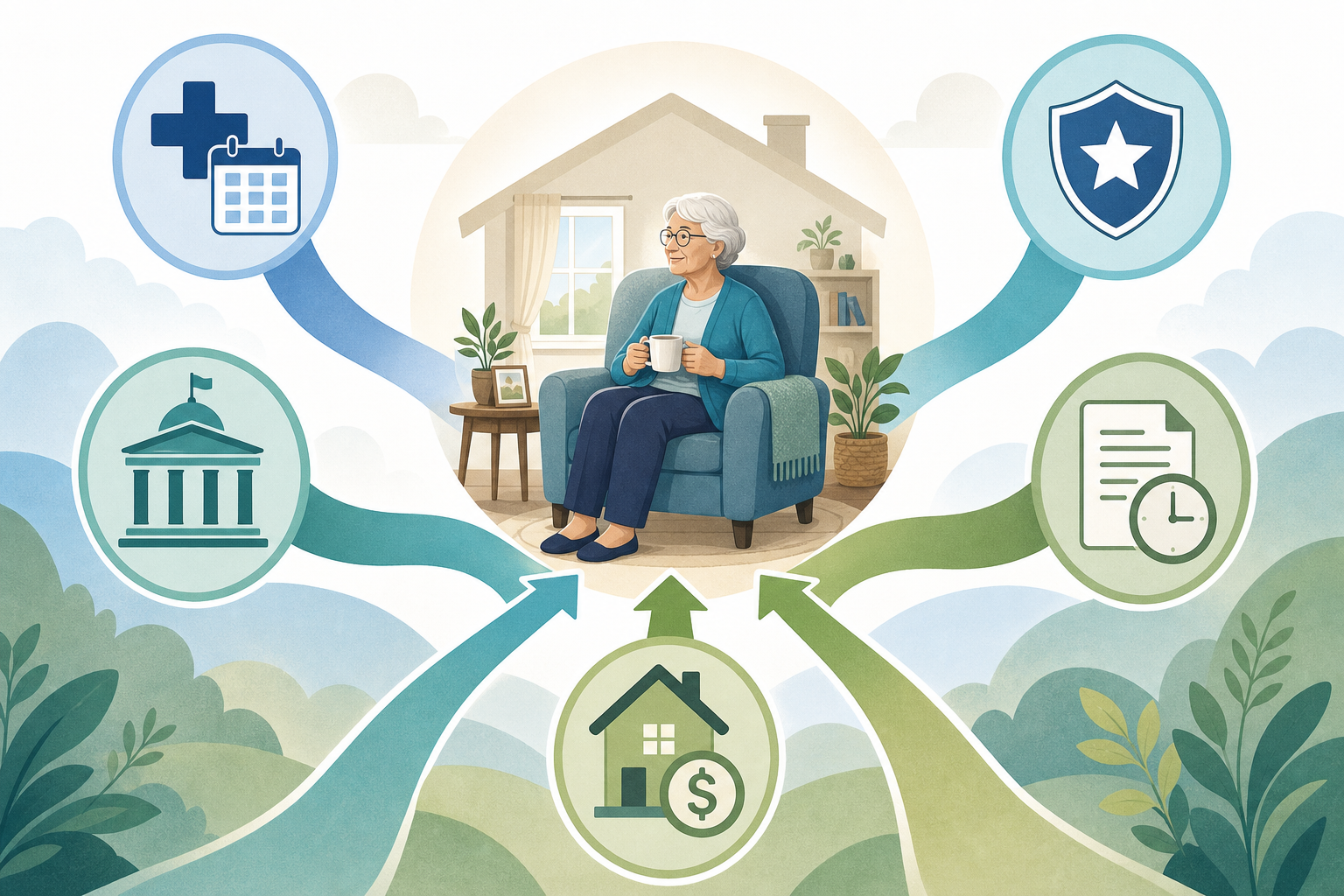
For many families, out-of-pocket spending is unavoidable — at least for a period. The key is to plan strategically so that out-of-pocket dollars stretch as far as possible. The following strategies can reduce the monthly cost of care without sacrificing quality.
- Hire independently rather than through an agency. Independent caregivers typically charge 20% to 30% less because there is no agency markup. You will need to handle payroll taxes, background checks, and backup coverage yourself.
- Use Consumer-Directed Attendant Support Services (CDASS) if available in your state. These programs allow seniors to hire family members as paid caregivers using Medicaid funds.
- Combine adult day care with a few hours of in-home care. Adult day care at $68/day can replace 6 to 8 hours of in-home care, saving $100 to $200 per day.
- Check whether your parent's long-term care insurance policy covers in-home care or adult day care. Many policies do, but policyholders often forget to file claims.
- Explore family caregiver payment programs. Some states and the VA offer stipends or direct payments to family members who provide care.
Another often-overlooked strategy is to plan for the hidden costs of home care — the expenses that do not show up in an hourly rate but add significantly to the monthly total. These include transportation costs for caregivers, supplies (adult briefs, gloves, cleaning products), home modifications (grab bars, ramps, stair lifts), and the cost of backup care when a regular caregiver is unavailable. Our guide on The Hidden Costs of Elderly Home Care walks through these expenses in detail and provides a budgeting framework to anticipate them.
Resources for Personalized Cost Estimates
National averages are a useful starting point, but the actual cost of senior help services in your area — and the benefits your family may qualify for — can only be determined through personalized research. The following resources will help you build a realistic, location-specific cost estimate and identify every potential source of financial assistance.
- Genworth Cost of Care Survey — The most widely cited source for regional cost data on home care, adult day care, assisted living, and nursing home care. Updated annually.
- Benefits.gov — A federal portal that screens for 2,500+ benefit programs across all government agencies, including Medicaid, VA benefits, and SNAP.
- BenefitsCheckUp.org (National Council on Aging) — A free, confidential screening tool that identifies federal, state, and local benefit programs for seniors aged 55 and older.
- Your local Area Agency on Aging — Provides in-person assistance with benefits screening, care planning, and referrals to state-specific programs. Search by zip code at eldercare.acl.gov.
- Your state Medicaid office — For state-specific HCBS waiver eligibility, application procedures, and waiting list information.
- VA benefits hotline (1-800-827-1000) or a local Veterans Service Officer — For personalized guidance on Aid & Attendance, the Program of Comprehensive Assistance for Family Caregivers, and other veteran-specific benefits.
The cost of senior help services is real, and it can be daunting. But knowledge is a form of power in this situation. By understanding what each type of care actually costs — and, more importantly, what payment pathways exist to cover those costs — you can move from shock to a plan. Start with the resources above, build a realistic budget, and explore every benefit program your parent may qualify for. You do not have to navigate this alone.
Questions to bring to a clinician or OT
This is not medical, legal, or a family's final decision — only a framework. Bring these questions to a clinician, occupational therapist, or your local Area Agency on Aging.
Find Local HelpRelated reading
- Options for Elderly Care: A Complete Guide to Paying for Home Care, Assisted Living, and Nursing Homes in 2026
- How to Pay for Senior Health Care Services: A Family Guide to Medicare, Medicaid, Private Pay, and Everything in Between
- How to Find and Pay for Home Help for an Elderly Parent: A Step-by-Step Guide
Noticed something outdated or inaccurate on this page? Flag a correction. We review every report against CDC, NIA, and AARP HomeFit guidance before updating a page.