
Senior Health Services vs. Home Care vs. Home Health vs. Hospice: What's the Difference and How to Choose
clinicalThis guide helps family caregivers distinguish between commonly confused senior care terms — home care, home health, palliative care, hospice, assisted living, and skilled nursing — and provides a decision framework for choosing the right service at the right time.
Why the Terminology Confusion Matters
When a parent is discharged from the hospital after a hip replacement, or a spouse receives a new dementia diagnosis, family caregivers suddenly face a wall of unfamiliar terms: home care, home health, palliative care, hospice, assisted living, skilled nursing. These labels are often used interchangeably in casual conversation, but they describe fundamentally different services with distinct purposes, providers, and payment sources. Mistaking one for the other can lead to denied insurance claims, weeks of delayed care, or thousands of dollars in unnecessary out-of-pocket costs.
The core distinction that trips up most families is the difference between custodial care and skilled care. Custodial care — help with bathing, dressing, eating, and other activities of daily living (ADLs) — is provided by home health aides or personal care attendants and is generally not covered by Medicare. Skilled care — wound care, physical therapy, intravenous medications — must be ordered by a physician and is delivered by licensed nurses or therapists. Medicare covers skilled care under specific conditions, but only when the patient is homebound and the care is part-time or intermittent.
This guide is built around that confusion. Rather than listing every service type in alphabetical order, we will walk through a side-by-side comparison of the major options, a decision framework that maps your situation to the right service, 2026 cost data, and the Medicare and Medicaid rules that determine what is covered and what is not. If you are still learning basic terms, our Navigating Senior Health Care: Key Terms Every Caregiver Should Know glossary is a good companion read.
Senior Health Services: A Side-by-Side Comparison
The table below covers the eight most common service types that families encounter. Use it as a quick reference when you hear a term and need to know what it actually means, who provides it, how long it typically lasts, and who pays.
| Service Type | What It Is | Who Provides It | Typical Duration | Primary Payment Sources |
|---|---|---|---|---|
| Home Care (Custodial) | Non-medical help with ADLs — bathing, dressing, eating, toileting, light housekeeping, companionship. | Home health aides, personal care attendants, companion care agencies. | Ongoing — weeks to years, as long as needed. | Private pay (out-of-pocket), long-term care insurance, some Medicaid waivers (varies by state). Medicare does NOT cover. |
| Home Health (Skilled) | Skilled nursing, physical therapy, occupational therapy, speech therapy, wound care, medication management. Requires a physician's order. | Registered nurses, licensed practical nurses, physical therapists, occupational therapists, speech-language pathologists. Services from a Medicare-certified home health agency. | Short-term, part-time or intermittent. Medicare covers up to 8 hours/day combined, 28–35 hours/week, for a limited period. | Medicare Part A and Part B (if eligible), Medicaid (varies by state), some private insurance. Not for long-term custodial care. |
| Palliative Care | Specialized medical care focused on symptom relief, pain management, and quality of life for anyone with a serious illness. Can be provided alongside curative treatment. | Palliative care physicians, nurse practitioners, social workers, chaplains. Provided in hospitals, outpatient clinics, nursing homes, or at home. | Any stage of serious illness — can last months or years. | Medicare Part B (if provided by a Medicare-enrolled provider), Medicaid, most private insurance. Some services may require copays. |
| Hospice Care | Comfort-focused care for a person with a terminal illness who is expected to live six months or less. Curative treatment is stopped. Includes bereavement support for family. | Hospice team: nurses, doctors, social workers, spiritual advisors, trained volunteers. Provided at home, in a nursing home, hospital, or dedicated hospice center. | Last months of life (prognosis of 6 months or less). Medicare covers two 90-day benefit periods followed by unlimited 60-day periods with recertification. | Medicare Hospice Benefit covers nearly all costs — medications, equipment, nursing visits, respite care (up to 5 consecutive days), and bereavement support. Medicaid and most private insurance also cover hospice. |
| Assisted Living | Housing with personal care support, meals, social activities, and 24-hour supervision. Does NOT provide 24/7 skilled nursing. | Assisted living facility staff — personal care aides, activity coordinators, some on-site nursing (typically limited hours). | Ongoing — months to years. | Private pay (out-of-pocket), long-term care insurance, some Medicaid waivers (limited). Medicare does NOT cover assisted living. |
| Skilled Nursing Facility (SNF) | Short-term rehabilitation or long-term skilled nursing care in a licensed facility. Provides 24/7 nursing care, therapy, and medical monitoring. | Registered nurses, licensed practical nurses, certified nursing assistants, physical/occupational/speech therapists. Medicare-certified SNF. | Short-term (up to 100 days per benefit period after a qualifying hospital stay) or long-term (custodial, private pay or Medicaid). | Medicare Part A covers days 1–20 ($0 after deductible), days 21–100 ($217/day copay in 2026). After 100 days: all costs. Medicaid covers long-term custodial SNF care for those who qualify. |
| Adult Day Care | Structured daytime program providing social activities, meals, and some health services in a community setting. Allows caregivers to work or rest during the day. | Adult day care centers — staffed by activity coordinators, nurses (some centers), and aides. | Part-time — typically a few hours to a full day, several days per week. | Private pay (most common). Some Medicaid waivers cover adult day care. Medicare does NOT cover. |
| PACE (Program of All-Inclusive Care for the Elderly) | Comprehensive medical and social services for frail older adults who are eligible for both Medicare and Medicaid and still live in the community. Includes primary care, therapies, meals, transportation, and day center services. | PACE center interdisciplinary team — physicians, nurses, social workers, therapists, dietitians, drivers. | Ongoing — as long as the participant remains eligible and chooses to stay in the program. | Medicare and Medicaid combined (for dually eligible participants). Private pay for those who are not Medicaid-eligible but can pay the monthly premium. |
If you are trying to decide between home health and home care specifically, our dedicated guide Home Health Care vs. Home Care vs. Assisted Living vs. Nursing Home: How to Choose the Right Senior Health Care Service provides a deeper dive into that four-option comparison.
How to Choose: Matching Your Situation to the Right Service
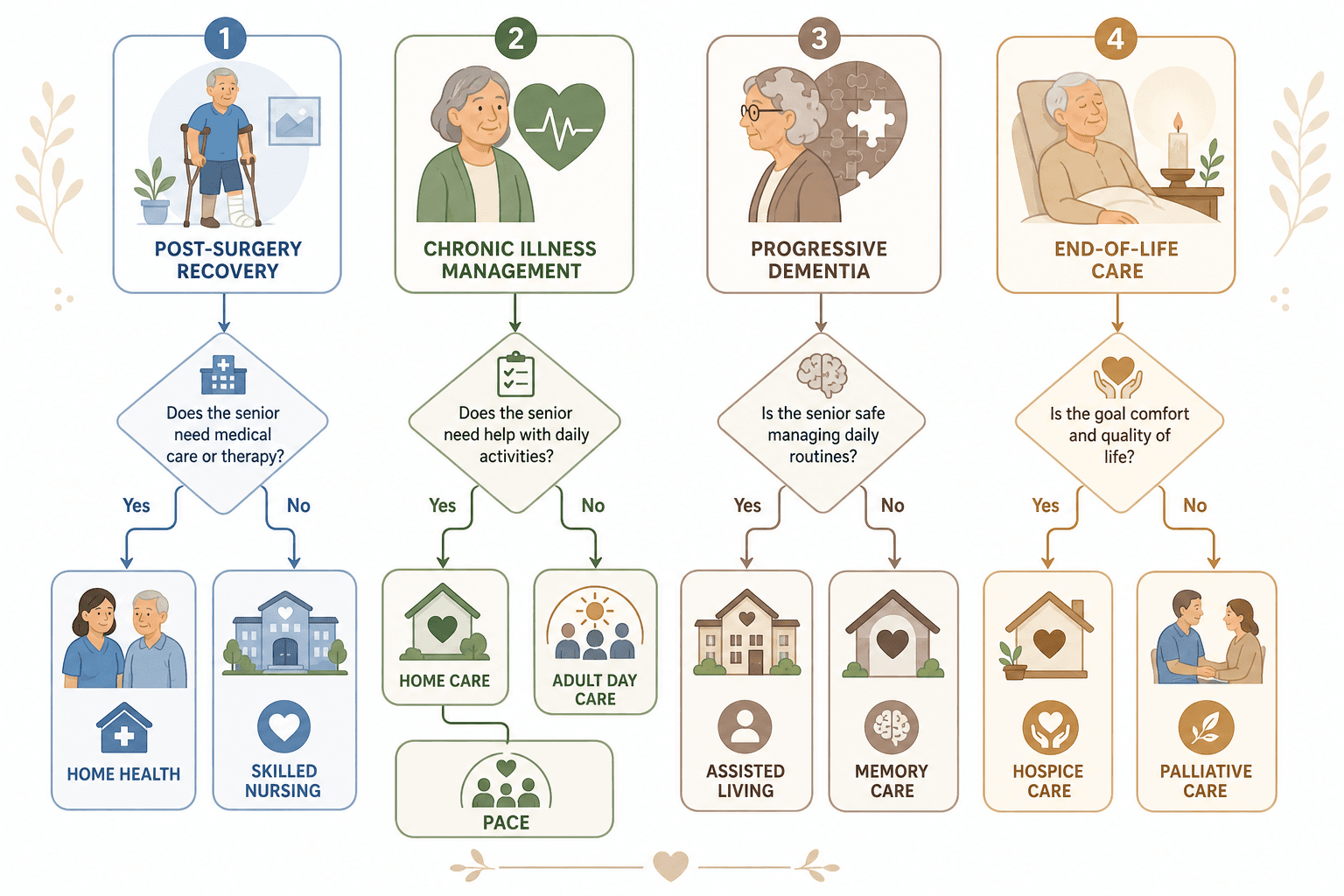
The flowchart above provides a visual guide, but the following decision nodes will help you work through the logic step by step. Start with the person's current medical situation and answer each question honestly.
Scenario 1: Post-Hospital Recovery (e.g., hip replacement, stroke, pneumonia)
- Does the person need skilled nursing or therapy (wound care, physical therapy, IV medications)? If yes, and they are homebound, home health is the right starting point. Medicare covers this for eligible patients.
- Is the person not homebound but still needs daily skilled care? They may need a short-term stay in a skilled nursing facility (SNF) after a qualifying hospital stay of at least 3 days.
- Once skilled needs are met, does the person still need help with bathing, dressing, or meals? Transition to home care (custodial) — paid privately or through long-term care insurance.
Scenario 2: Chronic Illness Management (e.g., heart failure, COPD, diabetes)
- Is the person managing symptoms but still living at home with some independence? Palliative care can be added alongside their regular medical treatment to improve quality of life.
- Do they need help with daily tasks but not 24/7 nursing? Home care or adult day care may be sufficient. Adult day care is often less expensive than in-home care and gives caregivers a break during the day.
- Is the person frail, dually eligible for Medicare and Medicaid, and able to live in the community with comprehensive support? PACE provides an all-in-one solution including medical care, therapies, meals, and transportation.
Scenario 3: Progressive Dementia (e.g., Alzheimer's disease)
- In early to moderate stages, home care with a trained aide can help with ADLs and supervision. Adult day care with dementia programming may also be appropriate.
- As the disease progresses and 24-hour supervision becomes necessary, assisted living with a memory care unit provides a secure environment with lower staff-to-resident ratios and staff trained in dementia care.
- When medical needs become complex (e.g., swallowing difficulties, frequent infections), a skilled nursing facility with a dementia unit may be required.
Scenario 4: End-of-Life Care
- If the person has a serious illness but is still pursuing curative treatment and needs symptom management, palliative care is appropriate. It can be provided alongside chemotherapy, dialysis, or other treatments.
- If the person has a terminal diagnosis with a prognosis of six months or less and has decided to stop curative treatment, hospice care is the right choice. Hospice can be provided at home, in a nursing home, or in a dedicated hospice facility. Medicare covers hospice comprehensively, including medications, equipment, and respite care.
For a broader step-by-step approach to evaluating all options, see How to Choose Senior Care: A Step-by-Step Guide for First-Time Family Caregivers.
2026 Cost Comparison Across Service Types
Cost is often the deciding factor for families. The table below shows national median costs for 2026. Your actual costs will vary by location, level of care needed, and the specific facility or agency.
| Service Type | 2026 National Median Cost | Notes |
|---|---|---|
| Home Health Aide | $220 per day | Based on hourly rates; varies by region and agency. Medicare covers only skilled home health, not custodial aide services. |
| Assisted Living | $6,313 per month ($75,756 per year) | Median for a private one-bedroom unit. Costs surged approximately 10% in 2024 according to industry data. |
| Nursing Home — Semiprivate Room | $328 per day ($9,842 per month) | National median. State range: $5,808/month (Texas) to $32,220/month (Alaska). Annual increase: approximately 7%. |
| Nursing Home — Private Room | $376 per day ($11,294 per month) | National median. State range: $7,519/month (Texas) to $32,220/month (Alaska). Annual increase: approximately 9%. |
| SNF (Medicare-covered, days 21–100) | $217 per day coinsurance | 2026 Medicare rate. Days 1–20: $0 after Part A deductible ($1,736). After day 100: all costs. |
| Adult Day Care | Varies widely ($50–$150 per day) | Typically less expensive than in-home care or nursing home care. Medicare does not cover; some Medicaid waivers do. |
| PACE | Varies (Medicare + Medicaid premium for non-dual eligible) | Comprehensive coverage; most participants are dually eligible and pay no monthly premium. |
For a deeper look at how to plan for these expenses, including the gap between Medicare coverage and actual out-of-pocket costs, read The Medicare Home Health Care Gap: Why Families Pay Out of Pocket and How to Plan Ahead.
Medicare and Medicaid Coverage: What You Need to Know
The single most important thing to understand about Medicare is what it does not cover. Medicare is a health insurance program, not a long-term care program. It covers skilled, short-term, and medically necessary care — but it does not cover custodial care, which is the type of help most older adults need for the longest period of time.
What Medicare Covers
- Home health services: Covers skilled nursing, physical therapy, occupational therapy, speech therapy, and medical social services for eligible homebound beneficiaries. Medicare pays $0 for covered services after the Part B deductible. In most cases, patients can receive up to 8 hours per day combined (skilled nursing + home health aide) for a maximum of 28 hours per week, or up to 35 hours per week for a short time if deemed necessary. Medicare does NOT cover 24-hour-a-day care, home meal delivery, homemaker services, or custodial/personal care when that is the only care needed.
- Skilled nursing facility (SNF) care: Covers up to 100 days per benefit period after a qualifying inpatient hospital stay of at least 3 consecutive days. In 2026: days 1–20 cost $0 after the Part A deductible ($1,736); days 21–100 cost $217 per day coinsurance; after day 100, all costs are the patient's responsibility.
- Hospice care: Covers nearly all hospice-related costs for patients with a terminal prognosis of 6 months or less, including medications, equipment, nursing visits, and respite care (up to 5 consecutive days in a hospital or SNF).
- Palliative care: Covered under Medicare Part B when provided by a Medicare-enrolled provider. Some services may require copays.
What Medicare Does NOT Cover
- Long-term custodial care in a nursing home (beyond 100 days per benefit period).
- Assisted living facility costs.
- Adult day care.
- Home care (custodial) when that is the only care needed.
- 24-hour-a-day in-home care.
What Medicaid Covers
Medicaid is the primary payer for long-term custodial care in the United States. For those who qualify financially, Medicaid covers nursing home care, home and community-based services (including home care and adult day care through waivers), and some assisted living costs. Eligibility and covered services vary significantly by state. Medicaid pays an average of 82 cents per dollar spent on nursing home care nationally, according to SeniorLiving.org data.
For a complete breakdown of payment options, see How to Pay for Senior Care in 2026: A Guide to Medicare, Medicaid, and Other Funding Sources.
How to Transition Between Services as Needs Evolve
The right service today may not be the right service in six months. Care needs change as a person recovers from surgery, as a chronic condition progresses, or as dementia advances. Planning for transitions — rather than reacting to a crisis — can save families significant stress, money, and time.
Common Transition Paths
- Home health → Home care: After a hip replacement, a patient may receive home health (skilled nursing and physical therapy) for 4–6 weeks. Once skilled needs are met, they may still need help with bathing and dressing for several more months. That is when you transition to home care (custodial), which is paid privately or through long-term care insurance.
- Assisted living → Skilled nursing: A person with Parkinson's disease may live in assisted living for years. When they develop swallowing difficulties, frequent falls, or require 24/7 nursing monitoring, a move to a skilled nursing facility becomes necessary. Planning this transition before a crisis (e.g., a fall that requires hospitalization) gives you time to research facilities and manage the move.
- Curative treatment → Palliative care → Hospice: A person with advanced cancer may continue chemotherapy while also receiving palliative care for pain and symptom management. When curative treatment is no longer effective and the prognosis is six months or less, the transition to hospice shifts the focus entirely to comfort. Hospice can be provided at home, which is what most families prefer.
- Home care → Adult day care → Assisted living: A caregiver who is working full-time may start with home care for a few hours a day. As the care recipient's needs increase, adult day care can provide structure and socialization during the day. When 24-hour supervision becomes necessary, assisted living or memory care may be the next step.
If you are facing a sudden crisis — a fall, a stroke, a rapid decline — and need to make a decision quickly, our Senior Care Options: A Practical 3-Step Decision Framework for Families Facing a Crisis guide is designed for exactly that situation.
For a broader framework that covers all elderly care options, see Elderly Care Options: A Complete Decision Framework for Families. And if you are evaluating home-based services specifically, Senior Care at Home Services: A 3-Variable Decision Framework for Families provides a focused approach to choosing between in-home options.
See This Term in Context
- Home Health Care vs. Home Care vs. Assisted Living vs. Nursing Home: How to Choose the Right Senior Health Care Service
A crisis-mode comparison guide for adult children who need to quickly distinguish between the four most commonly confused senior care types — home health care, non-medical home care, assisted living, and nursing homes — using three clear decision dimensions: medical need, living safety, and who pays.
- When 24-Hour Home Care Costs Less Than a Nursing Home — and When It Doesn't: A Family Decision Framework
A data-driven comparison for adult children weighing 24/7 in-home care versus a nursing home. Learn the cost tipping point (40–50 vs. 60+ hours per week), how live-in care fits as a middle option, and which choice makes financial sense for your family.
- Palliative Care for Seniors with Chronic Conditions: When to Start and How It Differs from Hospice
This guide helps adult children of seniors with heart failure, COPD, dementia, or Parkinson's understand why palliative care is appropriate years before hospice becomes relevant, how to advocate for earlier enrollment, and what the interdisciplinary team provides for symptom management and caregiver support.
Also related: Home Health Care vs. Home Care vs. Assisted Living vs. Nursing Home: How to Choose the Right Senior Health Care Service, How to Choose Senior Care: A Step-by-Step Guide for First-Time Family Caregivers, The Medicare Home Health Care Gap: Why Families Pay Out of Pocket and How to Plan Ahead, Senior Care at Home Services: A 3-Variable Decision Framework for Families, Senior Care Options: A Practical 3-Step Decision Framework for Families Facing a Crisis, Elderly Care Options: A Complete Decision Framework for Families, Navigating Senior Health Care: Key Terms Every Caregiver Should Know
Comments
Join the discussion with an anonymous comment.