
Glossary entry
Medicare Advantage In-Home Support Benefits in 2026: What Family Caregivers Need to Know
The 2026 Medicare Advantage Landscape: Why In-Home Support Benefits Matter Now
If you are an adult child helping a parent navigate care at home, you have likely run into a hard wall: Original Medicare (Parts A and B) does not pay for the kind of help most families actually need. It covers skilled nursing, physical therapy, and short-term home health visits after a hospital stay, but it explicitly excludes custodial care — the bathing, dressing, meal preparation, and companionship that make up the bulk of daily support. That gap is the reason families end up paying thousands of dollars out of pocket every year.
But the landscape is shifting. In 2025, more than 34 million Medicare beneficiaries — roughly 54% of all eligible seniors — were enrolled in a Medicare Advantage (Part C) plan. Unlike Original Medicare, these private plans can offer supplemental benefits that go far beyond what the government program covers. And in 2026, a growing number of plans are choosing to invest their extra funding into non-medical in-home support — exactly the kind of help that keeps seniors safe and independent at home.
How Medicare Advantage Plans Can Offer In-Home Support Benefits
The key to understanding why Medicare Advantage plans can cover things like homemaker services and bathroom safety devices — while Original Medicare cannot — lies in how the plans are funded. The federal government pays Medicare Advantage plans a fixed amount per enrollee to cover the cost of providing all Medicare-covered services (Parts A and B). When a plan delivers those services for less than the government payment, it keeps the difference. That surplus is called a rebate, and plans are allowed to spend it on supplemental benefits that improve enrollees' health and well-being.
According to the Medicare Payment Advisory Commission (MedPAC), the average rebate per enrollee in 2026 is approximately $2,664 — more than double what it was in 2018. That growing pool of rebate dollars is what makes it possible for plans to offer non-medical benefits that were virtually unheard of in Medicare a decade ago.
Types of In-Home Support Benefits Available in 2026
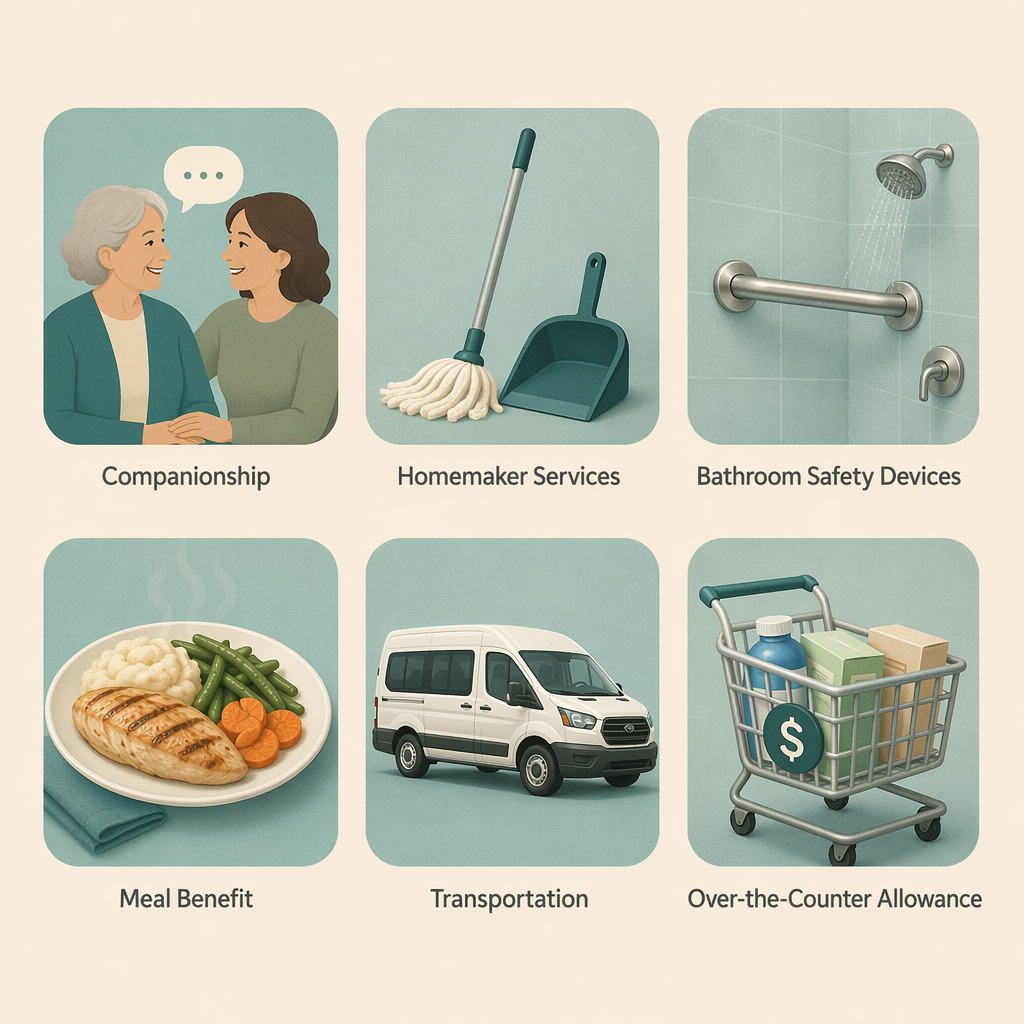
The range of non-medical benefits that Medicare Advantage plans can offer has expanded significantly in recent years. Based on 2026 plan data from the Better Medicare Alliance and the National Council on Aging (NCOA), here are the most common in-home support benefits you may find:
- In-home support services: These include homemaker services (light housekeeping, laundry, meal preparation) and personal care assistance (bathing, dressing, toileting). This is the benefit most directly relevant to family caregivers seeking daily help.
- Adult companionship: Some plans cover non-medical companionship visits, which can provide social interaction, supervision, and respite for family caregivers.
- Bathroom safety devices: Plans may offer allowances for grab bars, shower chairs, raised toilet seats, and other fall-prevention equipment — items that Original Medicare classifies as non-covered custodial supplies.
- Meal benefits: Many plans provide allowances for home-delivered meals or meal delivery services. Note that the share of individual MA plans offering meal benefits has declined slightly from 2025 to 2026, though they remain common.
- Over-the-counter (OTC) allowances: Plans often provide a quarterly or monthly allowance for OTC health products, which can include incontinence supplies, first aid items, and vitamins.
- Transportation: Non-emergency medical transportation to doctor appointments and pharmacies is available in many plans, though the share of plans offering this benefit has also decreased slightly in 2026.
The trend is clear: while traditional supplemental benefits like meal delivery and transportation have seen modest declines, more plans are adding in-home support services and adult companionship benefits in 2026. This shift reflects a growing recognition that keeping seniors at home requires more than just medical care — it requires practical, daily support.
Special Needs Plans (SNPs) and SSBCI: Deeper Benefits for Chronic Conditions
If the older adult you are caring for has a chronic condition — such as diabetes, heart disease, dementia, or COPD — a Special Needs Plan (SNP) may offer significantly more generous in-home support benefits than a standard Medicare Advantage plan.
SNPs are a type of Medicare Advantage plan designed specifically for people with certain chronic illnesses or who are dually eligible for Medicare and Medicaid. In 2026, 87% of SNPs are expected to offer Special Supplemental Benefits for the Chronically Ill (SSBCI). SSBCI benefits can include in-home living support services that go well beyond what standard plans offer — such as home modifications, pest control, and even non-medical transportation to the grocery store.
What to Look for When Comparing Medicare Advantage Plans for In-Home Support
Not all Medicare Advantage plans are created equal when it comes to in-home support. The benefits vary by carrier, plan, and even by county. When evaluating plans during the Annual Enrollment Period (AEP), here are the key features to examine:
| Feature to Evaluate | What to Look For | Why It Matters |
|---|---|---|
| Benefit type and scope | Does the plan list "in-home support services," "adult companionship," or "bathroom safety devices" in its Summary of Benefits? | These are the specific benefits that cover non-medical daily help — the kind Original Medicare excludes. |
| Benefit limits | Dollar allowance (e.g., $500/year for in-home support) or visit limits (e.g., 12 visits per year) | A $500 annual allowance may cover only 15 hours of home care at the national median rate of $34/hour (A Place for Mom, 2026). Know the cap before you need it. |
| Network restrictions | Does the plan require using specific in-network home care agencies? | If your parent already has a trusted home care aide, they may not be covered unless the agency is in the plan's network. |
| Prior authorization requirements | 90% of MA enrollees are in plans that require prior authorization for home health services (KFF, 2026) | Prior authorization can delay access to care. Understand the process and timeline before enrollment. |
| Cost sharing | Copays or coinsurance for in-home support visits | Even with a benefit, there may be out-of-pocket costs per visit. Check the plan's cost-sharing details. |
| Service area | Does the plan cover services in the county where your parent lives? | Medicare Advantage plans are county-specific. A plan available in one county may not be available in the next. |
The most important document to review is the plan's Summary of Benefits. This is a standardized document that every Medicare Advantage plan must provide. It lists all covered benefits, including supplemental benefits, along with any limits, cost-sharing, and network requirements. You can find it on the plan's website or by calling the plan directly.

The Catch: Understanding Benefit Limits and Network Restrictions
It is easy to get excited about the idea of a Medicare Advantage plan covering in-home support — but the practical reality often comes with significant limitations. Understanding these upfront can prevent a costly surprise later.
First, benefit limits are real. A plan may offer a $500 annual allowance for in-home support services. At the national median cost of home care — $34 per hour in 2026 (A Place for Mom data) — that covers roughly 15 hours of care per year. That is meaningful for occasional respite or a few hours of help after a hospital discharge, but it is not a solution for ongoing daily care needs.
Second, network restrictions can limit your options. Many Medicare Advantage plans require you to use specific in-network home care agencies. If your parent already has a trusted aide or agency, switching to an in-network provider may not be possible, or the quality of care may differ. Always verify the plan's network before enrolling.
Third, prior authorization is a major barrier. According to KFF, 90% of Medicare Advantage enrollees are in plans that require prior authorization for home health services. This means that even if a benefit is listed in the plan's Summary of Benefits, you may need to get approval from the plan before services can begin — a process that can take days or weeks and may be denied if the plan determines the service is not medically necessary.
Practical Guidance for Caregivers Navigating the Annual Enrollment Period (AEP)
The Annual Enrollment Period (AEP) runs from October 15 to December 7 each year. This is the window when anyone with Medicare can switch plans, join a plan, or drop a plan. If you are helping a parent evaluate their options for in-home support benefits, here is a step-by-step approach:
- Review the current plan's Summary of Benefits. Log into the plan's member portal or call the number on the back of the insurance card. Ask specifically: "Does my plan cover in-home support services, adult companionship, or bathroom safety devices?" Get the answer in writing.
- Use the Medicare Plan Finder. Go to Medicare.gov and use the Plan Finder tool. Enter the county where your parent lives. Filter by plans that offer supplemental benefits. Look for plans that list "in-home support services" or "adult day health services" in their benefit summary.
- Compare benefit limits. For each plan you are considering, note the dollar allowance or visit limit for in-home support. Calculate how many hours of care that allowance would buy at the local hourly rate. (See our In-Home Senior Care Cost in 2026 guide for state-by-state rates.)
- Check network restrictions. If the plan requires using in-network home care agencies, call the plan and ask for a list of in-network providers in your parent's area. Verify that at least one provider is accepting new clients.
- Contact a SHIP counselor. The State Health Insurance Assistance Program (SHIP) provides free, unbiased counseling to Medicare beneficiaries and their families. A SHIP counselor can help you compare plans and understand the fine print. Find your state's SHIP at shiptacenter.org.
- Consider a Special Needs Plan (SNP). If your parent has a qualifying chronic condition, an SNP may offer significantly more in-home support benefits. Check eligibility requirements carefully.
If your parent's current Medicare Advantage plan does not offer in-home support benefits — or if the benefits are too limited to make a real difference — do not give up. There are other financial assistance programs that can help cover the cost of home care. Our Beyond Medicaid: A Complete Map of Financial Assistance Programs for Senior Care in 2026 guide covers VA benefits, state-funded programs, and nonprofit grants that may fill the gap.
Browse more in the Glossary.