
Glossary entry
How to Pay for In-Home Senior Care: 9 Funding Sources Every Family Should Know
The Cost Reality: Why Most Families Need More Than Savings
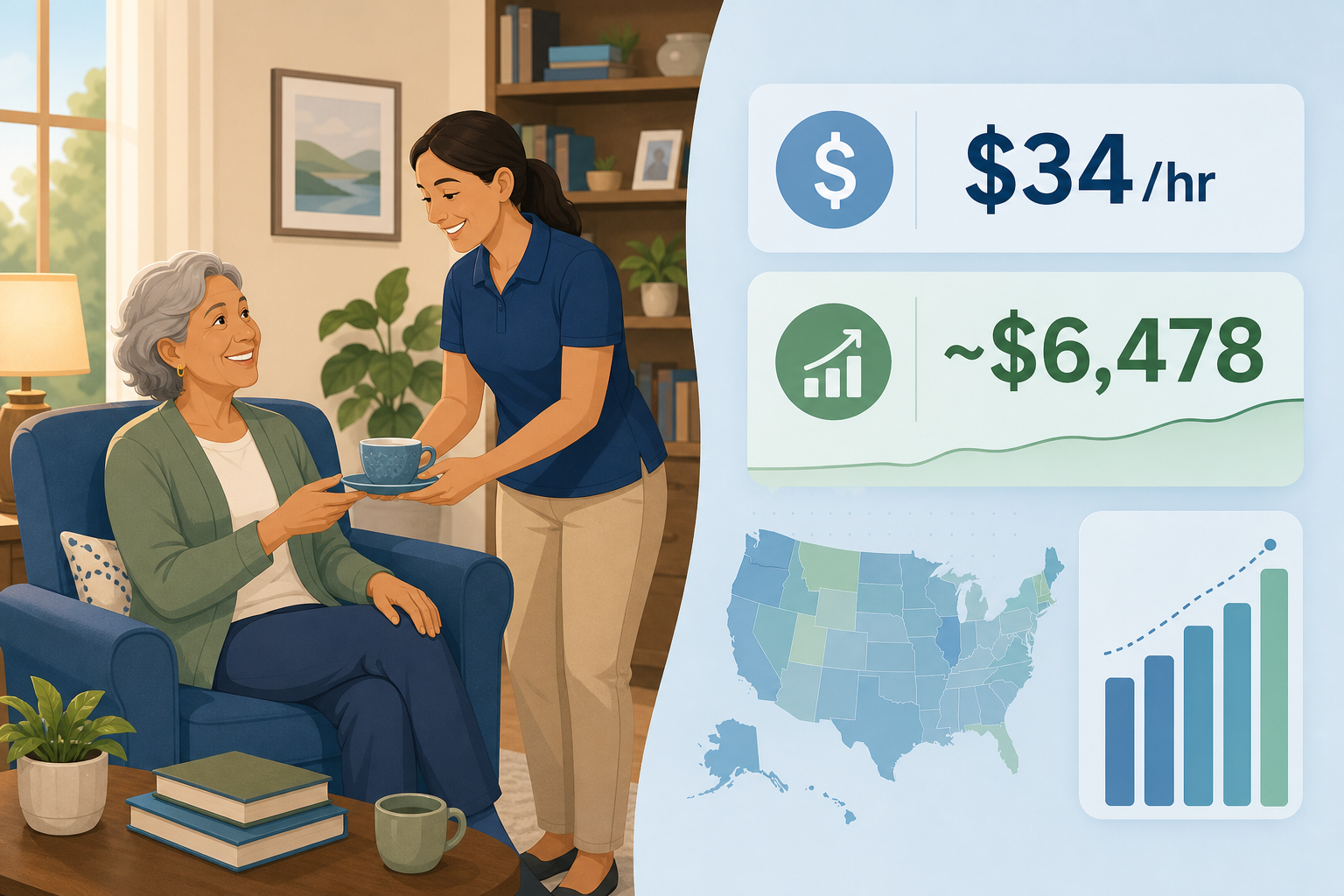
The national median cost of a home care aide in 2026 is $34 per hour, according to data from A Place for Mom. For a family needing 44 hours of care per week — roughly the equivalent of a full-time work week — that adds up to approximately $6,478 per month. A separate 2025 survey by CareScout puts the national median at $35 per hour, reflecting a 3% year-over-year increase. These figures represent a significant financial commitment that most families are not prepared for.
The core problem is not just the cost itself — it is the awareness gap. AARP reports that family caregivers collectively provide over $600 billion worth of unpaid care annually, and the average caregiver spends roughly $7,200 per year out of pocket on caregiving-related expenses. Yet many families are unaware of the government programs, insurance options, and financial tools that can help shoulder this burden. This guide walks through nine funding sources, from the most common to the most overlooked, so you can build a sustainable care plan.
Self-Pay: The Most Common (and Often Unsustainable) Method
The majority of families pay for home care using personal savings, retirement income, or pensions. It is the most straightforward method — no applications, no eligibility requirements, no waiting lists. But it is also the least sustainable for most households over the long term.
Consider the math: at the national median of $34 per hour, 20 hours of weekly care costs roughly $2,720 per month. At 44 hours per week, that figure climbs to nearly $6,500 per month. For a retired couple living on Social Security and a modest pension, those numbers can deplete savings rapidly.
The financial impact extends beyond direct care costs. AARP data shows that approximately 40% of family caregivers reduce their work hours or leave their jobs entirely to provide care. This loss of income, combined with the average $7,200 per year in out-of-pocket expenses, creates a compounding financial strain that self-pay alone cannot sustain.
Medicaid Home and Community-Based Services (HCBS) Waivers
Medicaid Home and Community-Based Services (HCBS) waivers — specifically the 1915(c) waivers — are the most common government source for funding in-home care, and in many states, they can even pay family members to provide that care. This is a critical option that far too few families know about.
Under these waivers, eligible participants can receive personal care services — bathing, dressing, meal preparation, medication reminders — in their own homes rather than in an institutional setting. The National Council on Aging (NCOA) reports that participating states can pay family caregivers $13 to $18 per hour for these services.
Eligibility and Income Limits
Medicaid is a joint federal and state program, so eligibility requirements vary significantly by state. For HCBS waivers, state income limits for 2024 range from approximately $914 per month to $2,742 per month, depending on the state and the specific waiver program. Asset limits also apply, though many states have raised or eliminated asset caps for HCBS waivers in recent years.
A significant challenge is availability. According to a New York Times report cited in industry data, over 800,000 older and disabled people who qualify for Medicaid are on state waiting lists for home care services. Wait times can range from months to years depending on the state.
- Check your state's Medicaid agency website for HCBS waiver availability and income limits.
- Ask specifically about "self-directed" or "consumer-directed" programs that allow you to hire a family member as a paid caregiver.
- Apply even if there is a waiting list — getting on the list early is critical.
- Consult a Medicaid planner or elder law attorney to help structure assets and income for eligibility.
Veterans Benefits: Aid & Attendance, Housebound, PCAFC, and Veteran Directed Care
If the older adult in your care is a veteran or the surviving spouse of a veteran, several Department of Veterans Affairs (VA) programs can help fund in-home care. These benefits are often underutilized because the application process can be complex, but they are worth pursuing.
Key VA Programs for In-Home Care
- Aid and Attendance: Provides additional pension funds for veterans who need help with daily activities. The care must be prescribed by a VHA primary care provider.
- Housebound Benefits: For veterans who are substantially confined to their home due to a permanent disability. Similar to Aid and Attendance but with different eligibility criteria.
- PCAFC (Program of Comprehensive Assistance for Family Caregivers): Available for post-9/11 veterans with a 70% or higher disability rating. This program provides a stipend, training, and respite care to family caregivers.
- Veteran Directed Care: Available in 43 states plus Washington, D.C. This program gives veterans a budget to hire their own caregivers — including family members — and manage their own care schedules.
For all VA programs, the first step is to contact the VHA caregiver support line at 1-855-260-3274 or speak with the social work department at your local VA medical center. The NCOA notes that care must be prescribed by a VHA primary provider, so scheduling that appointment is essential.
PACE: All-Inclusive Care for Seniors Who Want to Stay Home
The Program of All-Inclusive Care for the Elderly (PACE) is a unique model that combines Medicare and Medicaid funding to provide comprehensive medical and personal care services that allow older adults to remain in their homes. According to the National PACE Association, there are approximately 80,000 participants across 33 states.
What makes PACE different is that it covers services that Medicare and Medicaid would not cover individually. This includes adult day care, transportation, home care, meals, physical therapy, and prescription drugs — all coordinated through a single PACE center. The NIH/NIA notes that the program enables most participants to stay at home rather than moving to a nursing facility.
- Eligibility: Must be 55 or older, live in a PACE service area, and meet the state's level of care for nursing home admission.
- Cost: Most participants pay nothing out of pocket if they are enrolled in both Medicare and Medicaid. Those with only Medicare may pay a monthly premium.
- How to find a program: Use the National PACE Association's online locator tool to see if a PACE program operates in your area.
Long-Term Care Insurance and Life Insurance Conversions
Private insurance options are less common but can be transformative for families who have them. The NCOA reports that only about 3% of adults over 50 have long-term care insurance, but for those who do, policies may cover in-home care — and in some cases, even family caregivers.
Long-Term Care Insurance
Policies vary widely. Some cover only skilled nursing care, while others include personal care services at home. Premiums can run "thousands of dollars each year," according to AARP, and policies may exclude companion care or chore services. If the older adult in your care has an existing policy, review the benefit schedule carefully to understand what is covered and what the daily or monthly maximum is.
Life Insurance Conversions
For families without long-term care insurance, an existing life insurance policy can be a source of funding. Two options exist:
- Accelerated death benefits: Many life insurance policies allow the policyholder to access a portion of the death benefit early if they are diagnosed with a chronic or terminal illness. This money can be used to pay for home care.
- Life settlements: The policy is sold to a third party for a lump sum that is less than the death benefit but more than the cash surrender value. The proceeds can be used for any purpose, including care costs.
Medicare: Limited Skilled Care and the GUIDE Dementia Pilot
A common misconception is that Medicare will pay for long-term in-home care. The reality is far more limited. Original Medicare (Part A and Part B) covers only skilled home health care — services provided by a nurse or therapist — and only under specific conditions: the person must be homebound, the care must be prescribed by a doctor, and it must be part of a plan of care. Medicare does not cover non-medical personal care, such as bathing, dressing, or meal preparation, which is what most families need.
One notable exception is the GUIDE dementia pilot program. According to AARP, this program provides $2,500 per year for respite care for Medicare beneficiaries with dementia. While this is a modest amount, it can cover a meaningful number of respite hours for family caregivers who need a break.
Home Equity: Reverse Mortgages, HELOCs, and Loans
For homeowners aged 62 and older, home equity can be a significant source of funding for in-home care. The median home equity for older homeowners is approximately $250,000, according to AARP. Tapping into that equity can provide a lump sum or monthly payments to cover care costs.
Options for Accessing Home Equity
- Reverse mortgage (Home Equity Conversion Mortgage): Available to homeowners 62+. No monthly payments are required; the loan is repaid when the homeowner sells, moves out, or passes away. AARP describes this as a "financial resource of last resort" due to high upfront fees and complexity.
- Home equity line of credit (HELOC): A revolving line of credit secured by the home. You pay interest only on the amount you draw. Requires sufficient income to make payments.
- Home equity loan: A lump-sum loan with fixed monthly payments. Best for families who need a specific amount and can afford the payments.
Tax Credits and Deductions: Reducing the Out-of-Pocket Burden
The federal tax code offers several ways to offset caregiving costs, yet many families miss these opportunities because they do not know what to track or how to claim them. Below is a summary of the most relevant federal tax benefits.
| Tax Benefit | Maximum Value | Key Requirement | Best For |
|---|---|---|---|
| Credit for Other Dependents | Up to $500 per dependent | Dependent must have SSN and live with you more than half the year | Caregivers supporting a parent who is not a child |
| Medical Expense Deduction | Deduct expenses exceeding 7.5% of AGI | Must itemize deductions; includes home care, medical equipment, transportation | Families with high medical and care costs |
| Child and Dependent Care Credit | Up to $3,000 for one person, $6,000 for two or more | Care must enable you to work or look for work | Working caregivers paying for care |
The NCOA also notes that some states offer their own caregiver tax credits. These vary widely — from a few hundred dollars to several thousand — and may have different eligibility rules. Check with your state's department of revenue or a tax professional to see what is available in your state.
Personal Care Agreements: A Legal Tool to Pay Family Caregivers
A personal care agreement — also called a caregiver contract or family care agreement — is a legally binding document between a family and a caregiver (often a family member) that establishes payment for care services at the going market rate. This is one of the most powerful tools for families who want to pay a relative for caregiving without running into legal or financial complications.
The NCOA emphasizes that personal care agreements are critical for future Medicaid eligibility. Without a formal agreement, payments to a family member can be viewed by Medicaid as uncompensated transfers — gifts that trigger a penalty period during which the person is ineligible for benefits. A properly structured agreement avoids this problem by documenting that the payments are for actual services rendered.
What a Personal Care Agreement Should Include
- A detailed description of the services to be provided (e.g., bathing, meal preparation, medication management, transportation)
- The schedule of care (hours per day, days per week)
- The hourly or monthly rate of pay, which should be comparable to what a local agency would charge
- A start date and duration of the agreement
- Provisions for termination or modification
- Signatures from both parties
An elder law attorney should draft or review the agreement to ensure it meets state requirements and does not inadvertently create tax or Medicaid problems. For families considering this route, our guide on Family Caregiver vs. Professional Home Care can help you weigh the decision.
Browse more in the Glossary.