
Caregiver decision guide
Family Caregiver vs. Professional Home Care: When to Hire Help for Your Elderly Loved One
This guide helps adult children caring for an aging parent recognize when their loved one's needs have progressed beyond what family can safely provide, and provides a clear framework for matching the right type of paid caregiver — from companion to registered nurse — to their specific situation.

The Family Caregiver Is the Backbone — But You Don't Have to Do It Alone
If you are reading this, you are likely one of the millions of adult children who have quietly stepped into the role of primary caregiver for an aging parent. You are not alone in this — and the numbers confirm just how common your situation is. According to the Merck Manual, almost 90% of help provided in the home comes from family caregivers. You are the backbone of the entire long-term care system, and that is both a testament to your dedication and a heavy weight to carry.
A 2025 survey of over 1,000 family caregivers by A Place for Mom found that 86% cite a sense of duty as their primary reason for providing care at home. That sense of responsibility is powerful, but it can also make it difficult to recognize when your loved one's needs have grown beyond what even the most devoted family member can safely handle. The goal of this guide is not to diminish the role you play — it is to help you identify the precise moment when adding professional support is the most loving and responsible decision you can make.
How to Know When Your Loved One's Needs Have Outgrown Family Care
The transition from family-only care to a mixed model rarely happens overnight. It creeps in — a missed dose of medication here, a near-fall there, a growing exhaustion that you keep telling yourself is normal. To make an objective assessment, look at four specific areas: safety, medical complexity, your own wellbeing, and skill gaps.
Safety Risks
Has your parent fallen in the past six months? Do they sometimes forget to turn off the stove? Are they confused about their medications — taking doses twice or skipping them entirely? These are not minor inconveniences; they are the leading indicators that the current level of supervision is insufficient. The Merck Manual notes that about 38% of adults aged 80 and older already require routine help with personal care and household tasks, and that figure rises to 76% for those aged 90 and older. If you are seeing safety gaps, you are not failing — the needs have simply progressed.
Medical Complexity
Tasks like wound care, insulin injections, catheter management, or tube feeding require training that most family caregivers do not have. The Pew Research Center's 2026 survey of 8,750 U.S. adults found that 42% of caregivers help with healthcare management — but there is a vast difference between picking up a prescription and managing a complex medication regimen with multiple daily doses and potential interactions. If a mistake could send your parent to the hospital, that task belongs to a trained professional.
Caregiver Burnout
Your own health matters — not just for your sake, but for your parent's. The A Place for Mom survey reports that 75% of family caregivers feel stressed or anxious at least monthly, and 47% say their physical health has declined since becoming a caregiver. If you are experiencing any of these signs — chronic fatigue, irritability, changes in sleep or appetite, withdrawing from friends — it is not a personal weakness. It is a signal that the load is too heavy for one person. Use our Caregiver Burnout Self-Assessment Checklist to evaluate where you stand.
Skill Gaps
The Pew survey also found that 68% of caregivers help with errands and housework, 39% help with finances, and 16% help with personal care like bathing, dressing, and toileting. Personal care is the category where most family caregivers feel the least prepared. Helping a parent with bathing or toileting is emotionally and physically demanding, and many families find that hiring someone to handle these tasks preserves the parent-child relationship in a way that doing it themselves cannot.
The Professional Caregiver Credentialing Ladder: Matching Care Level to Need
One of the most common sources of confusion for families is understanding what different types of paid caregivers actually do. The CaringInfo organization provides a clear credentialing ladder that ranges from non-medical companions to registered nurses. Knowing the difference is the key to paying for the level of care you actually need — and avoiding the trap of hiring someone who is either underqualified or overqualified for the tasks at hand.
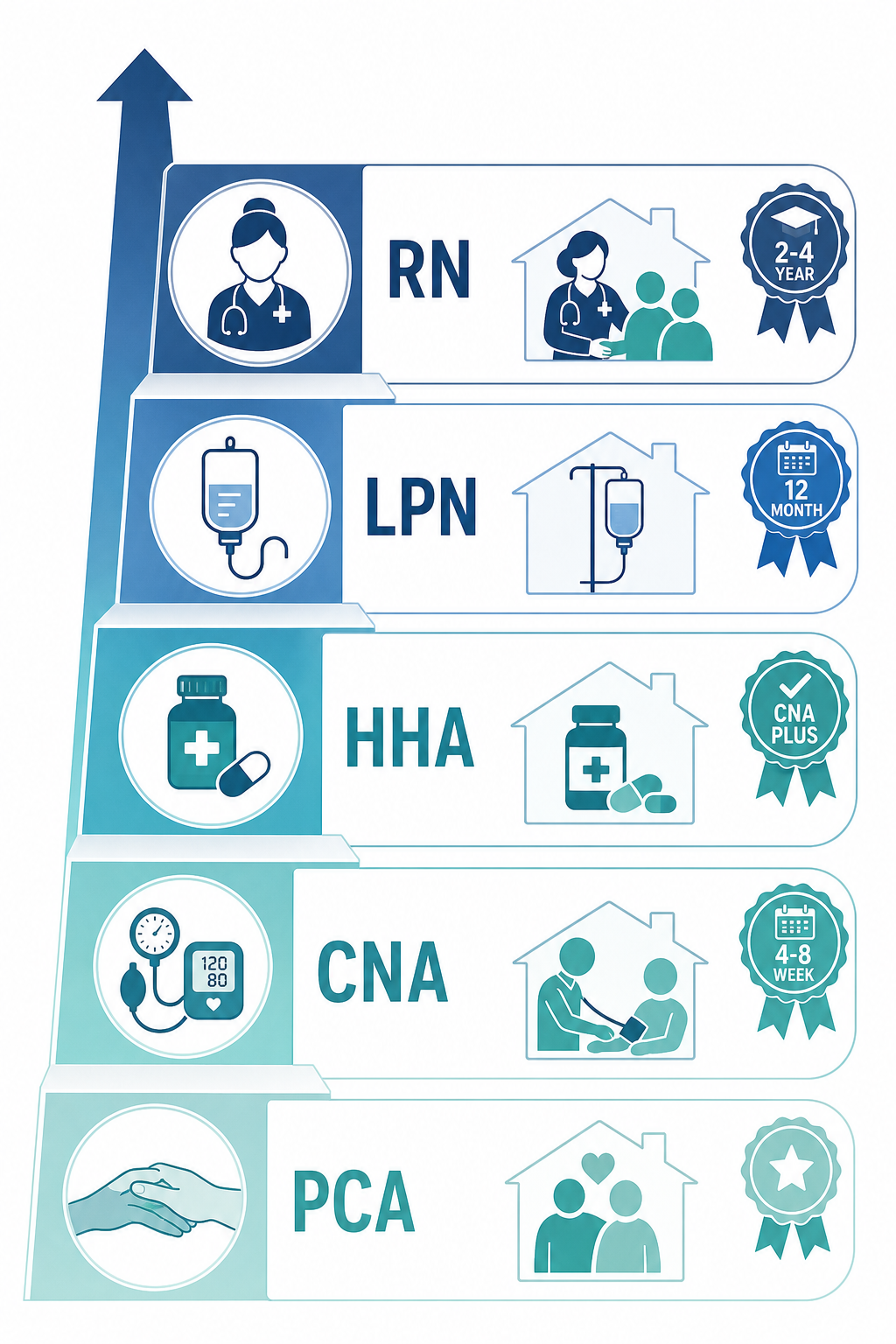
| Credential | Training & Certification | Scope of Care | Typical Cost Range (per hour) | Best Suited For |
|---|---|---|---|---|
| Personal Care Aide / Companion | Minimal formal training; varies by state | Non-medical: companionship, light housekeeping, meal prep, transportation | $15–$25 | Social engagement, errands, supervision for someone who is generally safe alone |
| Certified Nursing Assistant (CNA) | 4–8 week certification; state exam | Personal care (bathing, dressing, toileting) + vital signs | $20–$30 | Hands-on personal care for someone with stable medical needs |
| Home Health Aide (HHA) | CNA certification + additional training; works under RN supervision | Personal care + basic medical tasks (medication reminders, wound checks, catheter care) | $20–$30 | A step above CNA; good for those who need both personal care and light medical oversight |
| Licensed Practical Nurse (LPN) | 12-month vocational program; NCLEX-PN exam | Skilled medical tasks: medications, wound care, injections, monitoring | $35–$50 | Complex medication regimens, chronic condition management, post-hospital recovery |
| Registered Nurse (RN) | 2–4 year degree (ADN or BSN); NCLEX-RN exam | Comprehensive assessment, care planning, complex medical procedures, RN supervision of HHAs | $50–$75 | Unstable medical conditions, care coordination, multiple chronic illnesses |
A common mistake families make is assuming that any paid caregiver can handle any task. In reality, scope of practice is regulated at the state level, and a Personal Care Aide who is wonderful at companionship cannot legally administer medications or change a wound dressing. If your parent needs skilled nursing tasks, you need at least an LPN. If they need comprehensive assessment and care planning — for example, after a hospitalization or a new diagnosis — an RN is the appropriate level.
How to Find and Vet a Paid Caregiver: Agency vs. Private Hire
Once you know what level of care you need, the next decision is whether to go through a home care agency or hire a caregiver directly. Each path has trade-offs that matter for your specific situation.
Working with a Home Care Agency
Agencies handle the administrative and legal burden of employment. They typically conduct background checks, verify credentials, provide training, carry liability insurance and workers' compensation, and have backup caregivers available if your regular aide is sick. The trade-off is cost: agencies charge a premium (often 30–50% above the caregiver's wage) to cover these services. For families who do not want to become employers, an agency is the safer and simpler choice.
Hiring Privately
Hiring a caregiver directly — sometimes called private-pay or independent hiring — gives you more control over scheduling and a lower hourly rate because there is no agency markup. However, it also makes you the employer. That means you are responsible for running background checks, verifying credentials, withholding payroll taxes, carrying workers' compensation insurance, and following labor laws. If the caregiver is injured in your home, you could be liable. This path can save money, but it requires significant time and legal diligence.
Questions to Ask When Vetting a Caregiver or Agency
- What specific training and certifications does the caregiver hold? Can you provide copies of their CNA, HHA, LPN, or RN license?
- Have you conducted a national background check? Does it include a criminal history, sex offender registry check, and a search of the state's nurse aide registry?
- Can you provide at least two references from current or recent clients whose care needs were similar to ours?
- What is your scope of practice? Are there specific medical tasks you cannot perform under state law?
- If you work for an agency: What is your backup plan if the assigned caregiver is unavailable? Do you carry liability insurance and workers' compensation?
- If you are hiring privately: Do you have a written care agreement that outlines duties, schedule, pay, and termination terms? Have you set up payroll tax withholding with your state's labor department?
Combining Family and Professional Care: A Division of Roles That Works
Bringing in a paid caregiver does not mean you stop being a caregiver. In most successful arrangements, the family caregiver shifts from doing everything to doing what they do best — while the professional handles the tasks that require training or that have become too emotionally difficult.
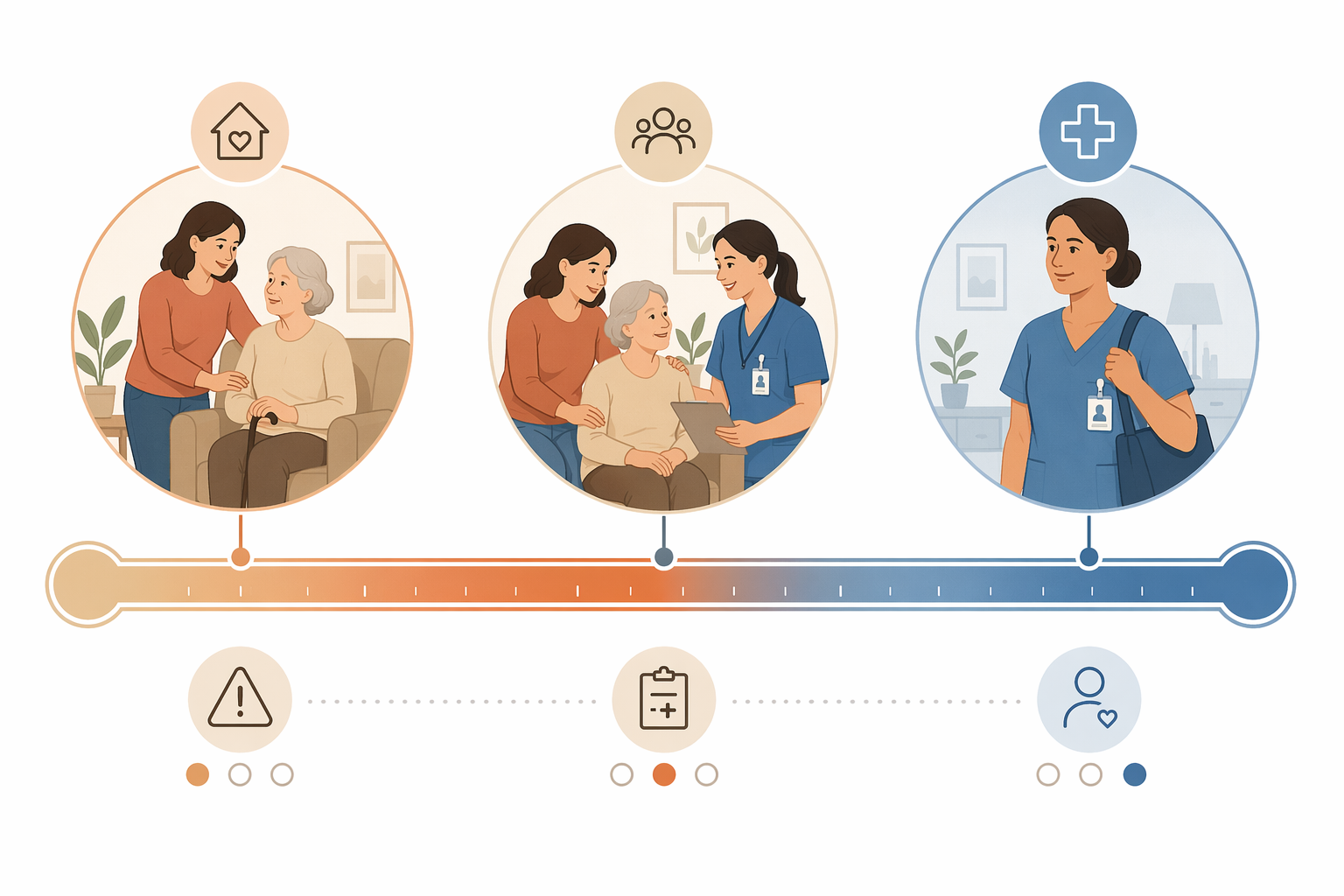
Here is a practical division of roles that many families find sustainable:
- Family caregiver continues to handle: companionship, meal preparation (if the parent enjoys your cooking), transportation to appointments, emotional support, care coordination with doctors and the agency, and being the primary decision-maker.
- Professional caregiver handles: personal care (bathing, toileting, dressing), skilled medical tasks (medication administration, wound care), overnight care so you can sleep, and respite coverage so you can take breaks.
This division is not just practical — it is protective. The Pew 2026 survey found that women caregivers for aging parents are significantly more likely than men to report negative impacts on emotional well-being (47% vs. 30%) and physical health (38% vs. 26%). Sharing the load with a professional is one of the most effective ways to prevent the kind of burnout that can take you out of the caregiving role entirely.
Financial Considerations: What Professional Care Costs and How to Pay for It
Cost is often the biggest barrier to hiring professional help, and it is important to be realistic about what different levels of care cost. The ranges in the table above are national estimates — your actual costs will depend on your region, the local labor market, and whether you hire through an agency or privately.
Here are the main funding pathways that can help offset these costs:
- Medicaid Home and Community-Based Services (HCBS) waivers: These waivers allow states to use Medicaid funds to pay for in-home care, including personal care aides and home health aides, for individuals who meet financial and functional eligibility criteria. Availability and coverage vary significantly by state.
- VA Aid and Attendance benefits: Veterans and surviving spouses who need help with daily activities may qualify for a monthly pension supplement to pay for in-home care, including home health aides and companions.
- Long-term care insurance: If your parent has a long-term care insurance policy, it may cover a portion of in-home care costs, including home health aides and skilled nursing. Check the policy for elimination periods, daily benefit caps, and covered services.
- Private pay: Many families pay out of pocket, at least initially. The A Place for Mom survey found that family caregivers lose an average of $21,500 per year in income due to caregiving demands, which makes the financial trade-off of hiring help a complex calculation.
Red Flags: When the Current Care Arrangement Isn't Working
Even with the best intentions, care arrangements can fail. Recognizing the warning signs early allows you to make a change before a crisis occurs.
- Repeated falls or injuries: If your parent has fallen more than once in the past three months, the current level of supervision or mobility assistance is insufficient.
- Unexplained weight loss or dehydration: These are often signs that meal preparation, feeding assistance, or hydration reminders are not happening consistently.
- Missed or incorrect medications: If medications are being skipped, doubled, or taken at the wrong time, you need a caregiver who can manage medications — at least an LPN level.
- Caregiver exhaustion affecting your own health: If you are missing work, skipping your own medical appointments, or feeling constantly depleted, the arrangement is not sustainable.
- Signs of abuse or neglect by a hired caregiver: Unexplained bruises, changes in your parent's mood around the caregiver, or the caregiver being dismissive or impatient are serious red flags that require immediate action.
- Your parent expresses a desire for more help: Sometimes the person receiving care knows best. If your parent is telling you they need more assistance, listen.
Decision Checklist: Is It Time to Hire Professional Help?
Use this checklist to assess your own situation. Answer each question honestly. If you check "yes" to any item in the Safety or Medical Complexity categories, or to two or more items in any other category, it is time to start the conversation about professional care.
Safety
- Has your parent fallen in the past six months?
- Do they sometimes forget to turn off the stove or leave water running?
- Are they confused about their medications — taking doses twice or skipping them?
- Do they wander or become disoriented when left alone?
Medical Complexity
- Does your parent need wound care, injections, catheter management, or tube feeding?
- Do they have a complex medication regimen with multiple daily doses and potential interactions?
- Have they been hospitalized recently and need skilled follow-up care at home?
- Do they have a chronic condition (diabetes, heart failure, COPD) that requires daily monitoring?
Caregiver Wellbeing
- Do you feel exhausted, irritable, or overwhelmed most days?
- Have you missed your own medical appointments or stopped exercising since becoming a caregiver?
- Are you sleeping poorly or experiencing changes in appetite?
- Have you withdrawn from friends, hobbies, or activities you used to enjoy?
Skill Gaps
- Are you uncomfortable helping your parent with bathing, toileting, or dressing?
- Do you lack the training to perform medical tasks your parent needs?
- Is the physical demand of transferring or lifting your parent causing you pain or risking injury?
Financial Readiness
- Have you explored whether your parent qualifies for Medicaid HCBS waivers, VA Aid and Attendance, or long-term care insurance?
- Have you calculated the cost of hiring a caregiver at the level you need and compared it to your current out-of-pocket expenses and lost income?
- Are you open to starting with a few hours per week of professional care and scaling up as needs change?
If you checked "yes" to any safety or medical complexity item, or to two or more items in any other category, the evidence is clear: it is time to begin the conversation about professional care. Start by discussing it with your parent, then with their primary care provider, and then use the credentialing ladder in this guide to match the right type of caregiver to their specific needs. You have been the backbone of their care — now let a professional share the weight.
Questions to bring to a clinician or OT
This is not medical, legal, or a family's final decision — only a framework. Bring these questions to a clinician, occupational therapist, or your local Area Agency on Aging.
Find Local HelpRelated reading
Noticed something outdated or inaccurate on this page? Flag a correction. We review every report against CDC, NIA, and AARP HomeFit guidance before updating a page.