
Durable Power of Attorney for Health Care vs. Health Care Proxy: Key Terms Explained for Family Caregivers (DPOA)
legal-financialConfused about the difference between a durable power of attorney for health care and a health care proxy? This glossary-style guide defines these and related legal terms — advance directive, living will, springing POA — with a quick-comparison table and state-specific resources for family caregivers.
Why These Terms Matter for Your Parent's Care
When a parent can no longer communicate their own medical wishes — due to a stroke, dementia, or sudden critical illness — the family is left guessing. And the guesses are often wrong. According to the National Institute on Aging (NIA), in one study people made incorrect end-of-life decisions for their loved one nearly one out of three times. That is not a reflection of carelessness; it is the predictable result of having to make heart-wrenching choices without clear guidance.
Legal documents exist to close that gap — but the terminology around them is confusing even for experienced caregivers. A 2020 Merrill Lynch report cited by AARP found that 43% of Americans age 55 or older worry they lack an advocate, yet only one-third have a durable power of attorney in place. That mismatch between worry and action often stems from not knowing which document does what — or even what the terms mean.
Advance Directive and Living Will: The Umbrella and the Written Wishes
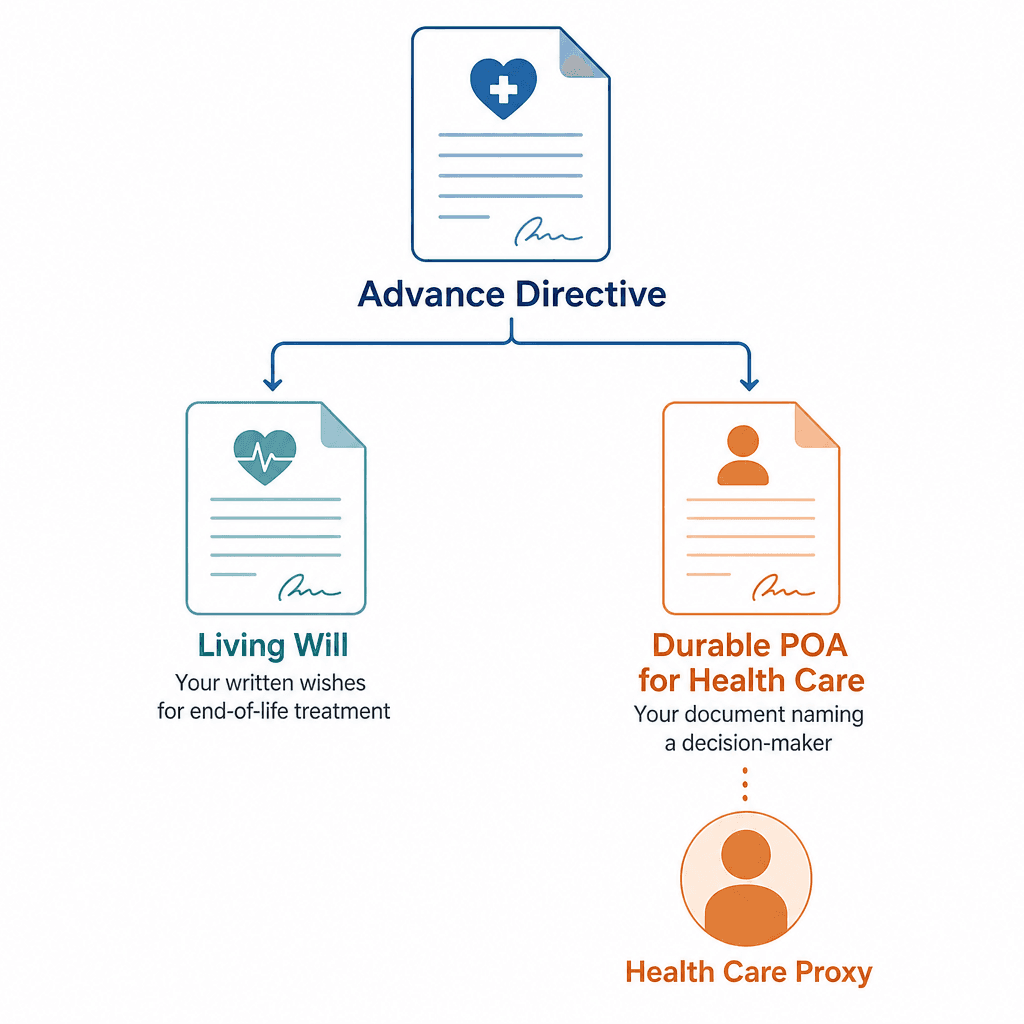
"Advance directive" is the broad term that covers two separate legal documents: the living will and the durable power of attorney for health care. The NIA defines advance directives as "legal documents that only go into effect if you cannot communicate your own wishes." Think of the advance directive as the folder that holds both your treatment preferences and your appointed decision-maker's name.
A living will is a written statement of the kinds of life-sustaining treatment you would want — or not want — if you become terminally ill, permanently unconscious, or are in the end stage of a fatal illness. It typically addresses CPR, mechanical ventilation, tube feeding, dialysis, antibiotics, comfort care, and organ donation. According to the Mayo Clinic, advance directives should be reviewed every 10 years or after major life changes such as marriage or a new diagnosis. The living will only applies in those dire situations; it does not cover routine medical decisions.
Durable Power of Attorney for Health Care (The Document)
This is the legal document that authorizes someone else — your health care proxy — to make medical decisions for you when you cannot. The word "durable" is critical: it means the authority continues even after you become incapacitated. A standard (non-durable) power of attorney automatically ends at incapacity, which defeats the entire purpose of health care planning.
The document is also called a medical power of attorney, health care power of attorney, or health care surrogate designation, depending on your state. It covers all medical decisions — not just end-of-life ones — including consent to surgery, choice of doctors or facilities, access to medical records, and decisions about ongoing care. According to the Ohio State Bar Association, a health care power of attorney applies in all situations where you cannot decide for yourself, whereas a living will only covers terminal or permanently unconscious conditions.
Health Care Proxy (The Person You Name)
The health care proxy is the individual you appoint in the durable power of attorney for health care document. The proxy is also called a health care agent, surrogate, representative, or attorney-in-fact, depending on your state. Their job is to talk with doctors, review medical records, and make decisions that align with your known wishes.
According to the NIA, the proxy must be at least 18 years old (19 in Alabama and Nebraska) and cannot be your health care provider or an employee of the facility where you are receiving care (unless they are a relative). The proxy has no authority until you are unable to communicate, and they must follow your instructions, not their own preferences. You can change your proxy at any time. The appointment must be in writing, witnessed or notarized per state law, and shared with your doctor and any family members who might otherwise assume they are the default decision-maker.
Key Distinctions: Durable vs. Springing, Health Care vs. Financial POA
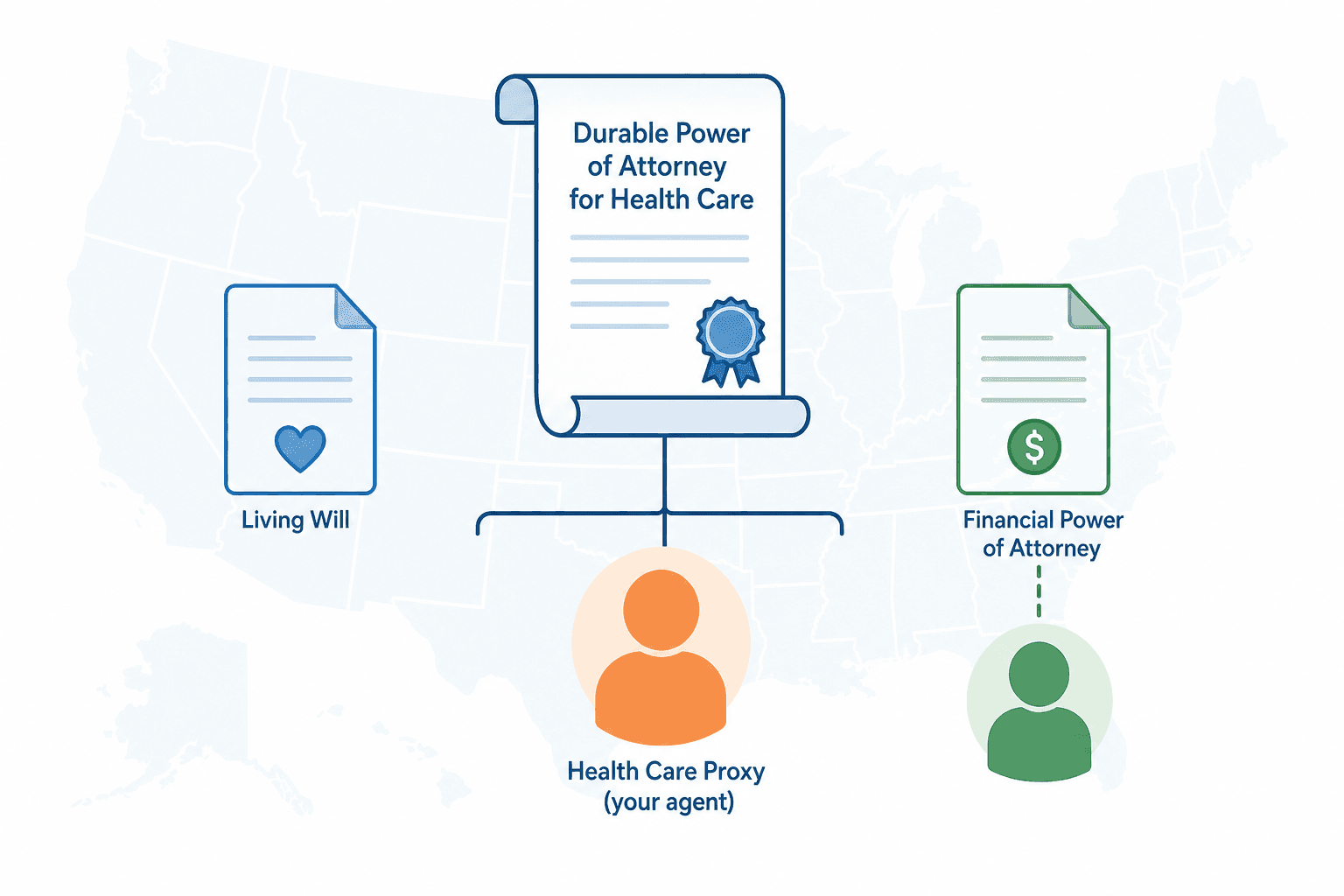
The most common point of confusion among caregivers is mixing up two separate dimensions: when the authority starts (durable vs. springing) and what domain it covers (health care vs. financial). Both matter, and they are handled by entirely separate documents.
Quick-Comparison Table
| Term | What It Is | When It Takes Effect | Key Point |
|---|---|---|---|
| Advance Directive | Umbrella term for all legal documents that express your health care wishes ahead of time | Only if you cannot communicate your own wishes | Includes both a living will and a durable POA for health care |
| Living Will | Written statement of your treatment preferences for end-of-life situations (terminal, permanent unconsciousness) | Only when you are in the specified medical condition | Does not cover routine decisions; does not name a person |
| Durable Power of Attorney for Health Care | Legal document that authorizes a named person to make all health care decisions for you | Immediately upon signing (if durable) or upon physician certification of incapacity (if springing) | Remains effective after incapacity; covers all medical decisions |
| Health Care Proxy | The individual you appoint in the durable POA for health care | Only when you are unable to communicate | Must be 18+, cannot be your doctor or facility employee (with exceptions) |
| Financial Power of Attorney | Separate document authorizing someone to manage your money and property | Depends on whether it is durable or springing | Does not grant any health care decision authority |
What Happens If No Documents Are in Place?
When an older adult becomes incapacitated without a valid advance directive, the state steps in with default rules. Typically, a spouse, adult children, or parents are given decision-making authority — in that order, depending on the state. The NIA notes that this can exclude an unmarried partner, a close friend who has been the primary caregiver, or even a sibling if the hierarchy does not include them. If no suitable family member is available or if family members disagree, the court may appoint a guardian or conservator — a public, time-consuming, and expensive process that strips the family of control.
There is also the HIPAA barrier. CaringInfo explains that without a health care power of attorney, doctors and hospitals may refuse to speak with anyone except the patient, even close family. This is not rudeness; it is federal privacy law. A signed health care POA includes a HIPAA authorization that explicitly grants the proxy access to protected health information.
State Variations and Where to Get Free Forms
Terminology and legal requirements vary significantly by state. What is called a "health care proxy" in one state may be called a "health care surrogate" or "patient advocate" in another. The requirements for witnesses, notarization, and who can serve as a proxy also differ. This glossary does not constitute legal advice. You should consult an attorney licensed in your parent's state of residence for individual guidance.
Free state-specific forms are available from trusted national organizations:
- NIA's Advance Care Planning page: provides downloadable advance directive forms and guides for every state.
- AARP's Advance Directive Forms by State: free, state-specific living will and health care power of attorney forms.
- CaringInfo (National Hospice and Palliative Care Organization): offers free, state-specific advance directive forms and a comprehensive guide to the process.
- For a deeper dive into all types of power of attorney — including financial, limited, and general — see our separate article Power of Attorney for Elderly Parents: Types Defined and What Caregivers Need to Know.
Related terms that caregivers often encounter alongside these documents include HIPAA authorization (the legal permission that allows your proxy to access medical records), POLST or MOLST (medical orders for life-sustaining treatment, typically used for people with serious illness), and DNR order (do-not-resuscitate). For definitions of POLST and DNR, see our Hospice and Palliative Care Glossary. If you are caring for a parent with dementia, the Middle-Stage Alzheimer's Care: A Decision Timeline can help you know when to initiate these conversations. For those managing a parent's care from a distance, the Long-Distance Caregiving Guide covers coordinating legal documents across state lines.
See This Term in Context
- Power of Attorney for Elderly Parents: Types Defined and What Caregivers Need to Know
A plain-language glossary reference covering all five types of Power of Attorney relevant to eldercare — durable, healthcare, financial, springing, and limited — with guidance on the legal capacity window, what happens without a POA in place, and the specific steps caregivers need to take before a crisis removes the option.
- DME (Durable Medical Equipment): What It Means, What Medicare Covers, and What Surprises Families
DME — Durable Medical Equipment — is the Medicare regulatory term for home-use medical equipment like walkers, wheelchairs, and oxygen devices, but its eligibility rules, cost structure, and surprising exclusions routinely catch families off guard at hospital discharge. This plain-language glossary entry explains what qualifies, how Medicare Part B pays in 2026, what is commonly assumed covered but is not, and what steps caregivers need to take before equipment arrives home.
- Hospice and Palliative Care Glossary: Key Terms for Family Caregivers
A thematically organized, plain-language reference of 40-plus hospice and palliative care terms — grouped by the decisions families actually face, from understanding care types and Medicare eligibility through legal documents, the care team, end-of-life signs, and grief — so caregivers can decode clinical language and advocate effectively at every stage of the hospice journey.
Also related: Power of Attorney for Elderly Parents, Hospice and Palliative Care Glossary, Middle-Stage Alzheimer's Care, Long-Distance Caregiving
Comments
Join the discussion with an anonymous comment.