
Glossary entry
The Medicare Home Health Care Gap: Why Families Pay Out of Pocket and How to Plan Ahead

The Medicare Surprise: Why Most Families Assume Coverage Exists
The phone call usually comes after a hospital discharge. A parent has had a hip replacement, a stroke, or a serious infection. The hospital social worker says, "Medicare will cover home health care." The family exhales. They assume the hardest part is over.
Then the home health aide stops coming after three weeks. The visiting nurse discharges the patient because vital signs are stable. And the family discovers that the daily help their parent still needs — bathing, dressing, meal preparation, walking to the bathroom — is not covered. It never was.
This is the Medicare surprise. It is not a paperwork error or a denied claim. It is the fundamental structure of the benefit. Medicare's home health program is a post-acute, skilled-care benefit. It pays for a visiting nurse to change a wound dressing, a physical therapist to retrain gait, a speech therapist to address swallowing. It does not pay for the custodial care — the hands-on help with activities of daily living — that makes aging in place possible for most older adults.
The gap between what families expect and what Medicare delivers is not a minor misunderstanding. It is a structural feature of the American long-term care system. And for long-distance caregivers and adult children doing proactive planning, understanding this gap early is the single most important step toward avoiding a financial and emotional crisis later.
The Coverage Gap Quantified: What Medicare Authorizes vs. What Seniors Actually Need
Medicare's home health benefit is not stingy on paper. The law allows up to 28 hours per week of combined skilled nursing and home health aide services, and up to 35 hours per week for a short period if the provider deems it necessary. There is no fixed limit on the number of visits as long as the patient continues to meet coverage criteria.
But here is the catch: those hours are only available when the patient is also receiving skilled care. The home health aide component — the part that helps with bathing, dressing, and toileting — is a rider on the skilled nursing or therapy benefit. Once the skilled need ends, the aide hours end too.
Meanwhile, a typical older adult aging in place with moderate functional decline needs far more than 28 hours of support per week. The National Institute on Aging and other authorities on activities of daily living (ADLs) estimate that seniors requiring assistance with multiple ADLs — bathing, dressing, transferring, toileting, eating — plus instrumental activities like meal preparation, medication management, and transportation, need 44 or more hours per week of supervision and hands-on help.
| Care Scenario | Hours per Week | Who Pays |
|---|---|---|
| Medicare authorization (skilled + aide combined) | 28–35 hours | Medicare ($0 to patient) |
| Typical need for aging in place with ADL assistance | 44+ hours | Usually private-pay or Medicaid |
| What agencies actually deliver (median) | 3 or fewer aide visits/week | Often private-pay after Medicare ends |
| Full-time live-in care | 168 hours | Almost always private-pay |
The 28-to-35-hour authorization is a ceiling that few families ever reach. In practice, the average Medicare home health patient receives far fewer hours of aide time, and the benefit is typically measured in weeks, not months or years.
The Financial Impact: What Private-Pay Home Care Costs in 2026
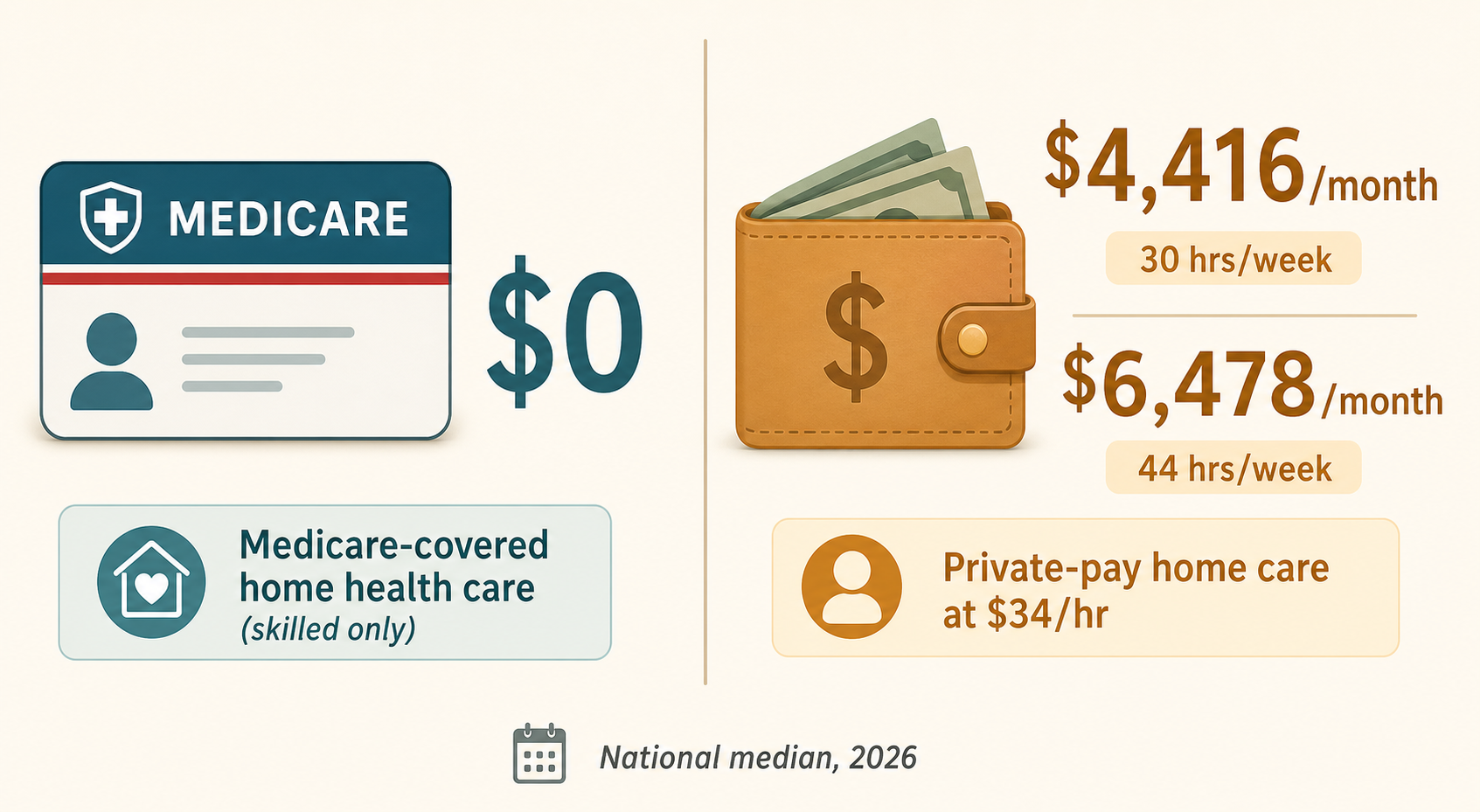
Once the Medicare-covered home health period ends, families face a stark choice: pay out of pocket, find a family member to provide the care, or pursue Medicaid. The financial numbers are sobering.
According to A Place for Mom's 2026 Costs of Long-Term Care and Senior Living Report, the national median cost of private nonmedical in-home care is $34 per hour. State medians range from $25 per hour in Mississippi to $44 per hour in South Dakota. At the national median, the monthly costs add up quickly.
| Hours per Week | Monthly Cost (National Median $34/hr) |
|---|---|
| 7 hours/week | $1,031/month |
| 15 hours/week | $2,208/month |
| 30 hours/week | $4,416/month |
| 44 hours/week | $6,478/month |
Compare those figures to the $0 the family pays for Medicare-covered home health services. The difference is not marginal — it is the difference between a manageable expense and a financial shock that can deplete retirement savings within months.
For a long-distance caregiver managing a parent's finances from another state, these numbers often arrive as a crisis. The parent's monthly Social Security benefit — typically $1,500 to $2,500 — covers only a fraction of 30 hours of home care. The gap must be filled from savings, family contributions, or a Medicaid spend-down.
Why Agencies Deliver Far Less Than Medicare Authorizes
Even when a patient qualifies for Medicare home health and a physician orders a specific number of aide hours, the agency may not deliver them. This is not a rare exception — it is a systemic pattern documented by patient advocacy organizations.
In a 2016 survey conducted by the Center for Medicare Advocacy, researchers contacted 74 home health agencies across seven states (California, Connecticut, Georgia, Illinois, Ohio, and others) to ask whether they would provide 20 hours per week of home health aide services to a Medicare-eligible patient. The results were stark:
- Only 6 agencies (8%) were willing to offer up to 20 hours per week of aide.
- 39 agencies (52%) offered 3 or fewer aide visits per week.
- The vast majority said Medicare was not available for the requested care and reported that care would be available for only 30 to 60 days.
The survey is a decade old, but advocacy organizations continue to cite it as reflective of ongoing problems. The gap between what Medicare law authorizes and what agencies actually provide has not closed. Agencies cite low Medicare reimbursement rates, staffing shortages, and administrative burdens as reasons for limiting aide hours.
The practical consequence for families is that even a Medicare-certified agency with a physician's order may not provide the hours needed. The family is then left to fill the gap with private-pay hours from the same agency or a separate home care company — at $34 per hour or more.
Filling the Gap: Medicaid HCBS, Medicare Advantage, PACE, and Long-Term Care Insurance
For families who discover the Medicare gap before a crisis, several alternatives exist. Each has distinct eligibility rules, coverage limits, and availability constraints. Understanding them early — before the hospital discharge — is the key to avoiding a scramble.
| Option | What It Covers | Eligibility | Key Limitation |
|---|---|---|---|
| Medicaid HCBS Waivers | Personal care, homemaker services, adult day care, respite | Income ≤ ~$2,901/month; assets ≤ ~$2,000 (varies by state) | Waiting lists in many states; state-by-state variation; pending federal budget cuts |
| Medicare Advantage (2026) | Some plans offer in-home support, meals, transportation, adult companions | Must enroll in a Medicare Advantage plan that offers these benefits | Only 12% of individual plans offer SSBCI; benefits vary widely by plan and county |
| PACE Programs | Comprehensive medical and long-term care (adult day center, home care, transportation) | Must be 55+, eligible for nursing home level of care, live in a PACE service area | Limited geographic availability; requires dual eligibility (Medicare + Medicaid) |
| Long-Term Care Insurance | Custodial care at home, in assisted living, or in nursing homes | Must purchase before needing care; medical underwriting required | Premiums are high; many policies have elimination periods and daily caps |
Medicaid Home and Community-Based Services (HCBS)
Medicaid is the primary public payer for long-term care in the United States, covering two-thirds of all home care spending as of 2022. About 4.5 million people receive Medicaid-covered home care annually through a patchwork of state programs.
Most states offer home care through 1915(c) waivers (47 states), 1115 waivers (14 states), personal care as a state plan benefit (34 states), or the Community First Choice option (10 states). Eligibility is income- and asset-based. Typical limits are income at or below $2,901 per month and assets at or below $2,000, though these vary by state and by waiver type.
Medicare Advantage In-Home Support Benefits (2026)
Medicare Advantage plans are increasingly offering non-medical supplemental benefits. In 2026, 12% of individual Medicare Advantage plans and 87% of Special Needs Plans (SNPs) are expected to offer Supplemental Benefits for the Chronically Ill (SSBCI), which may include in-home living support services such as adult companions at no cost for a certain number of hours per month.
However, the landscape is shifting. According to KFF, fewer plans in 2026 are expected to include meal, nutrition, and transportation benefits compared to 2025. The percentage of plans offering meal benefits dropped from 65% in 2025 to 57% in 2026. Families should review plan-specific benefits during open enrollment and not assume that a Medicare Advantage plan automatically covers custodial care.
PACE Programs
The Program of All-Inclusive Care for the Elderly (PACE) is an often-overlooked option that integrates Medicare and Medicaid funding to provide comprehensive medical and long-term care services. PACE participants receive care in an adult day center setting, with additional in-home and transportation services as needed. Eligibility requires being 55 or older, eligible for nursing home level of care, and living in a PACE service area.
PACE is available only in certain geographic areas, and participants must be dually eligible for Medicare and Medicaid or willing to pay a private premium. For those who qualify and live in a service area, PACE can cover the full spectrum of custodial and medical care that Medicare alone does not.
Long-Term Care Insurance and Hybrid Policies
Traditional long-term care insurance policies cover custodial care at home, in assisted living, or in nursing homes. However, premiums have risen sharply in recent years, and medical underwriting means policies must be purchased before care is needed — ideally in one's 50s or early 60s.
Hybrid policies that combine life insurance with a long-term care rider have become more popular, offering a death benefit if care is not needed. These policies can provide a dedicated pool of funds for home care, but they require a significant upfront or ongoing premium investment.
A Practical Planning Timeline: What to Do Now, Next Year, and Before a Crisis
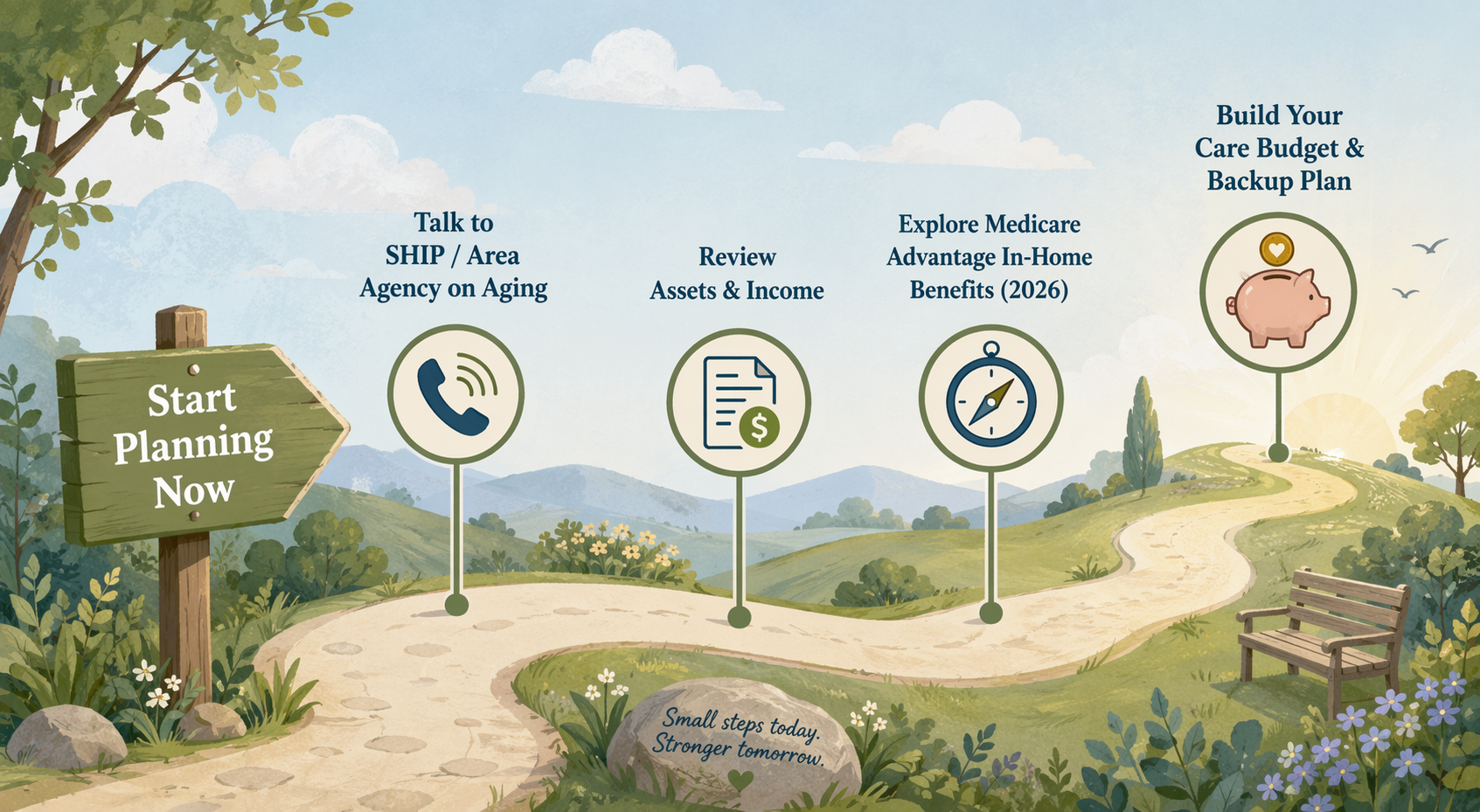
The most dangerous time to learn about the Medicare gap is during a hospital discharge. The second most dangerous time is when the home health aide stops coming. The best time is now — before a crisis forces rushed decisions.
Here is a practical timeline for long-distance caregivers and adult children who want to plan ahead.
Now (Before Any Crisis)
- Start the conversation. Talk with your parent about their preferences for aging in place, their financial resources, and their willingness to accept help from paid caregivers. This is the hardest step and the most important one.
- Gather financial documents. Collect bank statements, investment accounts, Social Security statements, pension documents, and any existing long-term care insurance policies. You need a clear picture of monthly income and total assets.
- Contact your local SHIP (State Health Insurance Assistance Program). SHIP offers free, unbiased Medicare counseling. An advisor can explain the difference between Original Medicare and Medicare Advantage options in your parent's county, including which plans offer in-home support benefits.
- Contact your local Area Agency on Aging. They can provide information about Medicaid HCBS programs, PACE availability, and other state-specific resources. Ask about waiting lists for home care waivers — some states have multi-year waits.
Next Year (During Open Enrollment)
- Review Medicare Advantage plans. During the annual open enrollment period (October 15 to December 7), compare plans available in your parent's county. Look specifically for plans that offer in-home support services, meal delivery, and transportation benefits. Use the Medicare Plan Finder tool on Medicare.gov.
- Evaluate Medicaid eligibility. If your parent's income and assets are near the threshold, consult with a Medicaid planner or elder law attorney. Some states allow a "spend-down" of excess assets to qualify for HCBS. Do not attempt this without professional guidance — mistakes can delay eligibility for months.
- Consider long-term care insurance. If your parent is still insurable (typically under age 75 and in good health), a hybrid life insurance/LTC policy may be worth exploring. Premiums are high, but the benefit can cover years of home care.
Before a Hospital Discharge
- Build a private-pay backup fund. Based on the cost estimates above, calculate how many months of 30-hours-per-week care your family could cover from savings. Aim for at least three to six months of private-pay capacity as a bridge while Medicaid applications or other arrangements are processed.
- Identify home care agencies in advance. Research Medicare-certified home health agencies and private-pay home care companies in your parent's area. Ask about their policies on aide hours, weekend coverage, and how they handle transitions from Medicare to private pay.
- Prepare legal documents. Ensure that a durable power of attorney for healthcare and a financial power of attorney are in place. Without these, a long-distance caregiver cannot make decisions or access funds to pay for care. See our Long-Distance Caregiver's Legal and Financial Startup Kit for a complete checklist.
Key Terms to Know: Homebound, Intermittent Care, Custodial Care, and More
Navigating Medicare's home health benefit requires understanding a specific vocabulary. These terms appear in eligibility criteria, coverage determinations, and denial letters. Knowing them is the first step toward advocating effectively for a parent's care.
- Homebound: A Medicare requirement meaning the patient cannot leave home without considerable and taxing effort, and typically does not leave home except for medical appointments or short, infrequent trips. This is the most commonly contested eligibility criterion.
- Intermittent care: Care that is needed on a part-time, not continuous, basis. Medicare defines this as up to 8 hours per day and 28 hours per week (35 hours in exceptional cases). It does not mean occasional — it means not 24/7.
- Custodial care (or personal care): Hands-on help with activities of daily living — bathing, dressing, toileting, transferring, eating. Medicare explicitly excludes custodial care when it is the only care needed. This is the root of the coverage gap.
- Skilled care: Medical care that must be provided by a licensed professional — a registered nurse, physical therapist, occupational therapist, or speech-language pathologist. Medicare covers skilled care to improve, maintain, or slow decline of a condition (per the Jimmo v. Sebelius settlement).
- Medicare-certified agency: A home health agency that meets federal requirements and is approved to bill Medicare. Only care provided by a Medicare-certified agency counts toward the home health benefit.
- HCBS (Home and Community-Based Services): Medicaid programs that provide long-term care services in a person's home or community rather than in an institution. Available through waivers that vary by state.
- PACE (Program of All-Inclusive Care for the Elderly): A combined Medicare-Medicaid program that provides comprehensive medical and long-term care services, including adult day care, home care, and transportation.
- ADLs (Activities of Daily Living) and IADLs (Instrumental Activities of Daily Living): ADLs are basic self-care tasks (bathing, dressing, toileting, transferring, eating). IADLs are more complex tasks (meal preparation, medication management, housekeeping, transportation). The number of ADLs a person needs help with determines their level of care need.
For a complete reference of these and other eldercare terms, visit our Eldercare & Caregiving Glossary. For a detailed Q&A on Medicare home health eligibility, see our companion guide: Does Medicare Cover Home Health Care? A Caregiver's Guide to Eligibility, Costs, and Coverage Gaps in 2026.
Browse more in the Glossary.