
Glossary entry
Does Medicare Cover Home Health Care? A Caregiver's Guide to Eligibility, Costs, and Coverage Gaps in 2026
What Is Medicare Home Health Care — and How Is It Different From 'Home Care'?
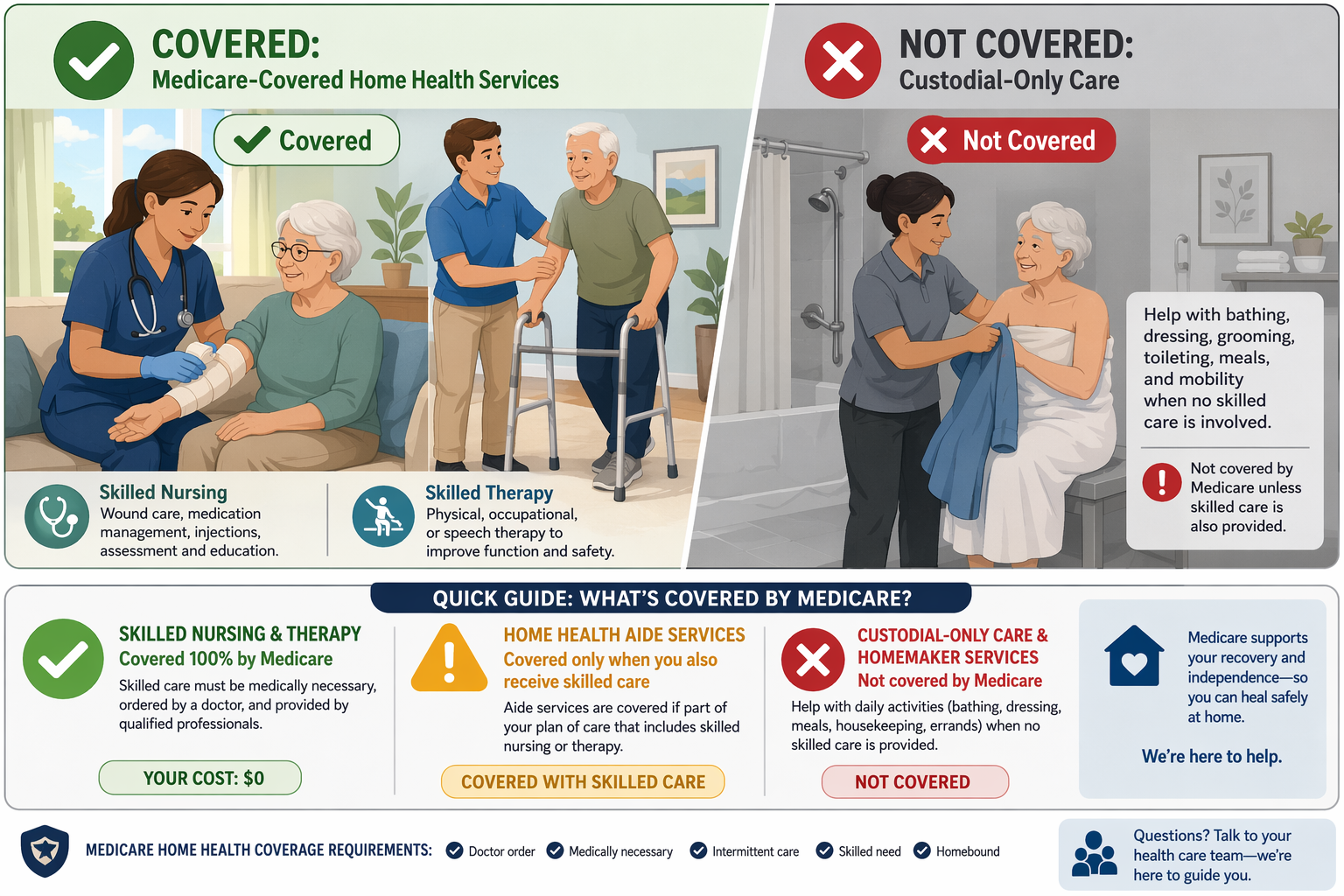
The single most important distinction for any family caregiver to understand is the difference between "home health care" and "home care." These terms are not interchangeable, and confusing them is the leading reason families discover — often after a hospital discharge — that Medicare will not pay for the help they assumed was covered.
Medicare home health care is a skilled, medical benefit. It covers services like part-time skilled nursing (wound care, injections, patient and caregiver education, IV therapy, monitoring), physical therapy, occupational therapy, speech-language pathology, and medical social services. These services must be ordered by a doctor and provided by a Medicare-certified home health agency. The goal is to treat a medical condition, help you recover from an illness or injury, or maintain your current level of function or slow decline.
In contrast, "home care" — also called custodial or personal care — refers to non-medical assistance with activities of daily living (ADLs) such as bathing, dressing, toileting, eating, and transferring. It also includes homemaker services like shopping, cleaning, and laundry. Medicare does not cover these services when they are the only care needed.
Who Qualifies? The Four Eligibility Requirements for Medicare Home Health Coverage
Medicare's home health benefit is not available to everyone who needs help at home. To qualify, a beneficiary must meet all four of the following requirements. Missing even one means Medicare will not cover the services.
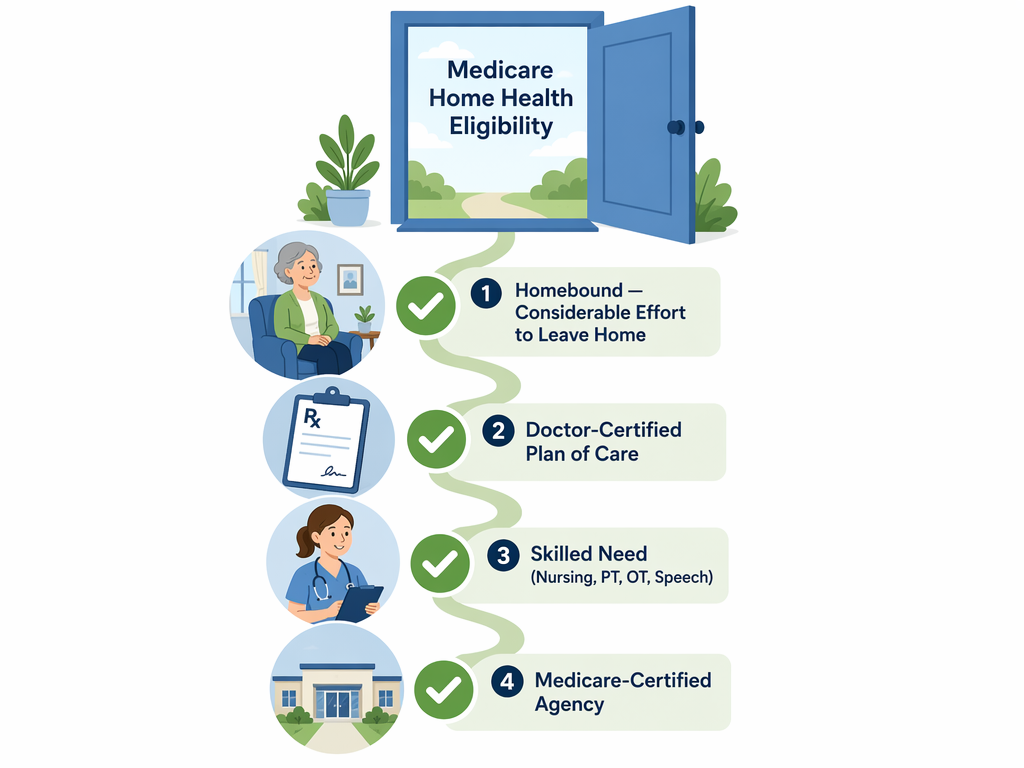
- You must be homebound. This is the most common barrier. Medicare defines homebound as needing considerable and taxing effort or the aid of another person or a supportive device (like a walker or wheelchair) to leave home. Leaving home for medical appointments, adult day care, or religious services is allowed, but the absences must be infrequent and of short duration.
- You must need part-time or intermittent skilled care. This means you need skilled nursing care (at least once every 60 days) or physical, occupational, or speech therapy. The care must be part-time (fewer than 7 days per week or less than 8 hours per day over a period of up to 21 days, extendable if the doctor predicts an end date) and intermittent.
- You must have a doctor-certified plan of care. A physician or other health care provider must certify your need for home health services through a face-to-face encounter that occurs within 90 days before or 30 days after the start of care. The plan of care must be reviewed and signed by the doctor every 60 days.
- You must receive care from a Medicare-certified home health agency. The agency must be approved by Medicare. You cannot hire an independent aide or a private agency that is not Medicare-certified and expect the services to be covered.
What Services Does Medicare Cover at Home?
When all eligibility requirements are met, Medicare covers a specific set of services. Understanding what is included — and the conditions attached to each — is essential for planning care.
| Service | Covered? | Key Conditions |
|---|---|---|
| Skilled Nursing (part-time or intermittent) | Yes | Wound care, injections, IV therapy, patient/caregiver education, monitoring. Must be ordered by a doctor. |
| Physical Therapy, Occupational Therapy, Speech-Language Pathology | Yes | Covered to restore function, maintain current function, or slow decline. No improvement requirement. |
| Home Health Aide Services | Yes, but only with skilled care | Covered only when the patient is also receiving skilled nursing or therapy. Cannot be the only service. |
| Medical Social Services | Yes | Counseling and help finding community resources. Must be part of the plan of care. |
| Durable Medical Equipment (DME) | Yes, with 20% coinsurance | Includes walkers, wheelchairs, hospital beds, oxygen equipment. 20% of Medicare-approved amount after Part B deductible. |
| Medical Supplies | Yes | Supplies needed for skilled care (e.g., wound dressings, catheters). Included in the home health benefit. |
| Injectable Osteoporosis Drugs for Women | Yes | Covered when a doctor certifies the patient is homebound and has a bone fracture related to post-menopausal osteoporosis. |
The most frequently misunderstood item on this list is the home health aide benefit. Many families assume that if a parent qualifies for home health, Medicare will pay for an aide to help with bathing and dressing every day. In reality, aide services are only covered when skilled care is also being provided. Once the skilled nursing or therapy ends, the aide visits stop as well.
What Medicare Does NOT Cover at Home (The Biggest Surprise for Families)
The services Medicare does not cover at home are just as important to know as the ones it does. This list is where families most often discover a gap in their care plan — and their budget.
- 24-hour-a-day care. Medicare explicitly does not pay for around-the-clock care at home. The benefit is limited to part-time, intermittent care.
- Custodial or personal care alone. Help with bathing, dressing, toileting, eating, or transferring is not covered when that is the only care needed. This is the single most misunderstood aspect of the benefit.
- Homemaker services. Shopping, cleaning, laundry, and meal preparation are not covered, even if the patient is homebound and receiving skilled care.
- Home-delivered meals. Programs like Meals on Wheels are not covered by Medicare.
- Adult day care and transportation. These services are not part of the home health benefit.
How Much Does Medicare Home Health Care Cost in 2026?
For covered home health services, the cost to the beneficiary is $0. There is no deductible and no coinsurance for the skilled nursing, therapy, home health aide, medical social services, or medical supplies provided under the home health benefit. This is true under both Original Medicare and Medicare Advantage.
However, there are costs for Durable Medical Equipment (DME). After the Part B deductible is met, you pay 20% of the Medicare-approved amount for items like walkers, wheelchairs, hospital beds, and oxygen equipment.
| Service | Your Cost | Notes |
|---|---|---|
| Skilled Nursing (part-time/intermittent) | $0 | No deductible or coinsurance for the service itself. |
| Physical, Occupational, Speech Therapy | $0 | No deductible or coinsurance for the therapy itself. |
| Home Health Aide (with skilled care) | $0 | Covered only when skilled care is also being provided. |
| Medical Social Services | $0 | Included in the home health benefit. |
| Medical Supplies | $0 | Supplies needed for skilled care are included. |
| Durable Medical Equipment (DME) | 20% of Medicare-approved amount | After the Part B deductible is met. |
| 24-hour care, custodial care alone, homemaker services, meal delivery | Full cost | Not covered by Medicare. |
There are also limits on how much care Medicare will cover. Skilled nursing and home health aide services combined are limited to a maximum of 8 hours per day and 28 hours per week. In short-term, intensive situations, this can be increased to 35 hours per week if the doctor determines it is necessary. Medicare does not cover 24-hour care.
Does Medicare Advantage Cover Home Health Differently?
Medicare Advantage (Part C) plans must cover the same home health services as Original Medicare. However, the way they deliver that coverage can differ significantly.
- Narrower networks. Medicare Advantage plans typically have a limited network of home health agencies. You may not be able to use the agency your parent prefers or the one the hospital recommends.
- Prior authorization requirements. Many plans require prior authorization before home health services can begin. This can delay the start of care.
- Supplemental in-home support benefits. Some Medicare Advantage plans offer additional benefits that Original Medicare does not. In 2026, 7% of individual Medicare Advantage plans and 25% of Special Needs Plans (SNPs) offer in-home support services as a supplemental benefit, according to KFF and NCOA. These benefits may include help with bathing, dressing, meal preparation, and light housekeeping.
- Caregiver support benefits. In 2026, 16% of SNPs offer caregiver support benefits, up from 5% in 2025. These may include respite care, caregiver training, and counseling.
What Happens When Medicare Doesn't Cover Enough? Filling the Gaps
For most families, the biggest challenge is not understanding what Medicare covers — it is figuring out how to pay for the care Medicare does not cover. If your parent needs custodial or personal care (bathing, dressing, toileting) beyond what the home health benefit provides, or if they need 24-hour supervision, you will need to look elsewhere for funding.
- Medicaid Home and Community-Based Services (HCBS) Waivers. These state-specific programs can cover personal care, homemaker services, and other supports that allow seniors to remain at home. Eligibility is based on income and assets, and many states have waiting lists. Contact your state Medicaid office for details.
- Long-Term Care Insurance. If your parent has a long-term care insurance policy, it may cover custodial care at home. Check the policy's benefit triggers and daily benefit amount.
- Veterans Benefits. The VA Aid and Attendance benefit can provide monthly payments to eligible veterans and their surviving spouses to help pay for home care.
- Private Pay. Many families end up paying for home care out of pocket. Understanding the costs of aging in place is critical for financial planning.
- State Health Insurance Assistance Program (SHIP). SHIP provides free, unbiased counseling to Medicare beneficiaries and their families. They can help you understand your coverage options and find local resources.
Summary Checklist: What to Do Next as a Caregiver
If you are reading this because your parent has just been discharged from the hospital or their condition has declined, here is a step-by-step checklist to help you navigate the Medicare home health process.
- Confirm homebound status. Does your parent need considerable effort or assistance to leave home? If yes, document this with the doctor.
- Get a doctor's certification. The doctor must certify the need for home health services through a face-to-face visit (within 90 days before or 30 days after the start of care).
- Find a Medicare-certified home health agency. Use Medicare's Home Health Compare tool or ask the hospital discharge planner for a list of certified agencies.
- Understand the plan of care. The agency will develop a plan of care that lists the services to be provided. Review it carefully. Make sure it includes all the skilled care your parent needs.
- Verify coverage with the agency. Ask the agency what services are covered, how many hours per week of aide time are authorized, and whether there are any arbitrary limits.
- Plan for uncovered costs. If your parent needs custodial care beyond what Medicare covers, explore Medicaid HCBS waivers, long-term care insurance, VA benefits, or private pay options.
- Contact SHIP for free counseling. Your local State Health Insurance Assistance Program can provide unbiased guidance on Medicare coverage and help you navigate appeals if services are denied.
Browse more in the Glossary.