
Clinical term
Navigating Senior Health Care: Key Terms Every Caregiver Should Know
Introduction: Why This Glossary Exists
If you have recently stepped into a caregiving role — whether for a spouse, a parent, or another loved one — you have likely encountered a wall of unfamiliar acronyms and insurance jargon within the first few conversations with doctors, social workers, or billing departments. Terms like "ADLs," "Medigap," "SNF," and "spend-down" are thrown around as if everyone already knows what they mean. The reality is that the U.S. health care system is notoriously difficult to navigate, and older adults feel it acutely.
According to a September 2024 survey by the John A. Hartford Foundation and Age Wave, 56% of older adults say the health care system is difficult and stressful to navigate. Even more concerning, 55% mistakenly believe Medicare will cover a long-term stay in a nursing home — a misconception that can lead to devastating financial surprises. The CDC also reports that about 80% of older adults struggle to use medical documents like forms or charts. When you cannot understand the paperwork, you cannot advocate effectively.
This glossary is designed to cut through that confusion. It is organized by theme — insurance, care settings, provider roles, clinical terms, legal and financial documents, and support programs — so you can find what you need quickly. Each entry includes a plain-language definition plus one to two sentences of caregiver context, because knowing what a term means is only half the battle. Knowing what to do with that information is what makes the difference.

Insurance Terms: Medicare, Medicaid, and What They Actually Cover
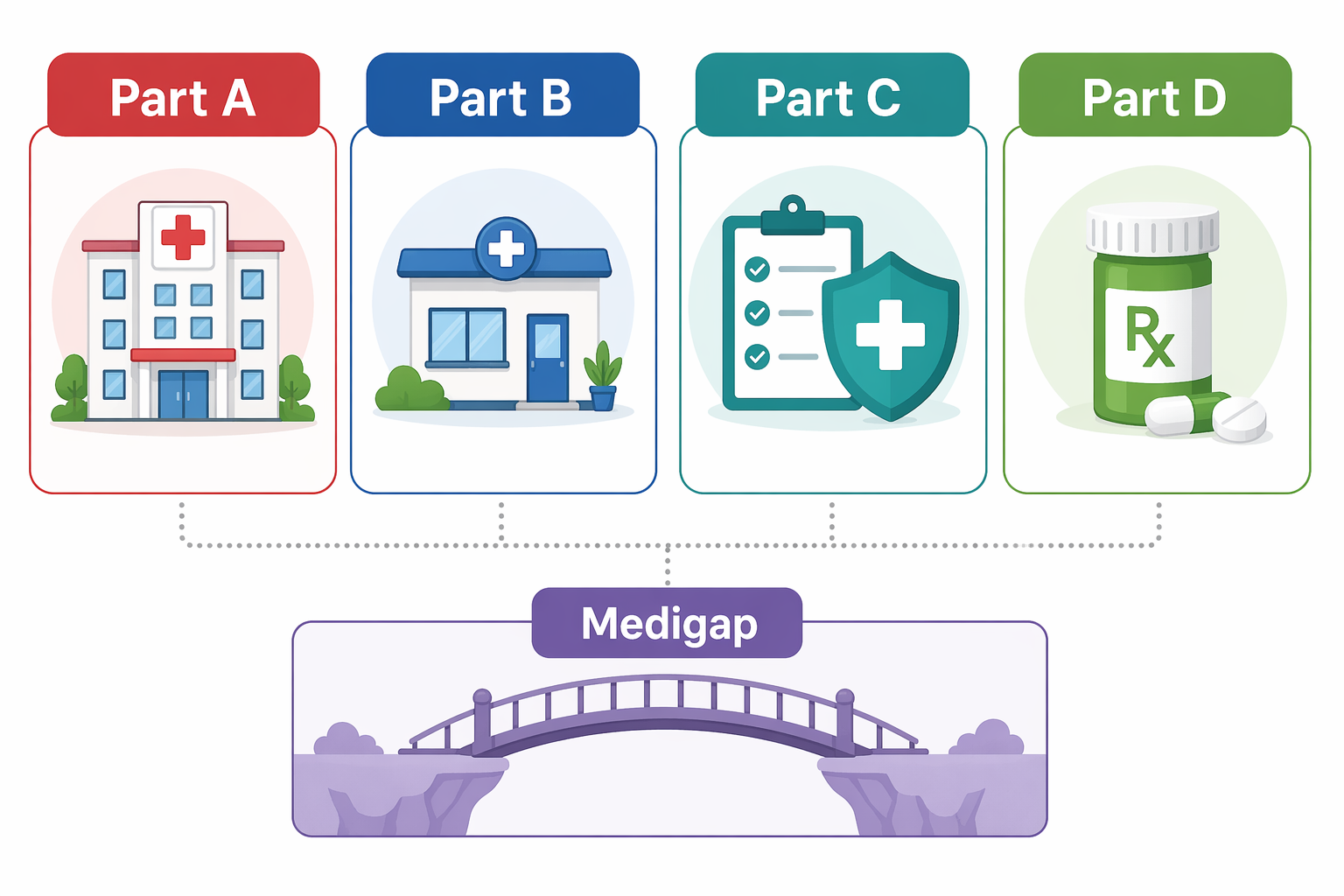
Health insurance is the most common source of confusion for new caregivers. The alphabet soup of Medicare parts, supplemental plans, and income-based surcharges can feel designed to exclude rather than inform. Below are the essential terms, with the most current 2026 figures where available.
| Term | Definition | Caregiver Context |
|---|---|---|
| Medicare Part A | Hospital insurance covering inpatient stays, skilled nursing facility care (limited), hospice, and some home health care. Most people pay no premium if they or their spouse paid Medicare taxes for 10+ years. | Part A covers the hospital stay itself, but not the doctor's fees during that stay (those fall under Part B). The 2026 inpatient deductible is $1,736 per benefit period. |
| Medicare Part B | Medical insurance covering doctor visits, outpatient care, preventive services, and some home health care. Requires a monthly premium. | The standard 2026 Part B premium is $202.90 per month, up from $185 in 2025. The annual deductible is $283. If your loved one's income is above $109,000 (individual), they pay an IRMAA surcharge on top. |
| Medicare Part C (Medicare Advantage) | An alternative to Original Medicare (Parts A + B) offered by private insurers. Plans often include Part D drug coverage and extra benefits like dental, vision, or gym memberships. | Advantage plans can have lower premiums but narrower networks. The 2026 maximum out-of-pocket for these plans drops to $9,250. If your loved one travels frequently or has complex specialists, Original Medicare plus Medigap may be a better fit. |
| Medicare Part D | Prescription drug coverage, available as a stand-alone plan (with Original Medicare) or bundled into a Medicare Advantage plan. | The 2026 out-of-pocket cap for Part D is $2,100, up from $2,000 in 2025. Insulin is capped at $35 per month. Starting January 2026, ten commonly prescribed drugs for conditions like arthritis and diabetes have lower negotiated prices, saving beneficiaries an estimated $1.5 billion in out-of-pocket costs. |
| Medigap (Medicare Supplement) | A private insurance policy that covers costs Original Medicare does not, such as copayments, coinsurance, and deductibles. | Medigap plans are standardized by letter (Plan G, Plan N, etc.). They do not cover prescription drugs (you need Part D for that). The best time to buy is during the 6-month Medigap Open Enrollment Period when you cannot be denied for pre-existing conditions. |
| Medicaid | A joint federal and state program that covers health care costs for people with limited income and assets. Eligibility and benefits vary significantly by state. | Medicaid is the largest payer for long-term nursing home care in the U.S. — not Medicare. If your loved one's assets are limited, a Medicaid spend-down may be necessary to qualify. Consult a certified elder law attorney before transferring assets. |
| Dual Eligible | A person who qualifies for both Medicare and Medicaid. Medicaid typically covers Medicare premiums, deductibles, and copayments. | Dual-eligible beneficiaries often have the most comprehensive coverage. They may qualify for a Special Needs Plan (SNP) that coordinates both benefits. |
| IRMAA (Income-Related Monthly Adjustment Amount) | An extra surcharge added to Medicare Part B and Part D premiums for beneficiaries with higher incomes. | In 2026, the IRMAA threshold for individuals is $109,000 (up from $106,000 in 2025). If your loved one's income exceeds this, they will pay more each month — even if they are on a Medicare Advantage plan. |
| Part D Donut Hole (Coverage Gap) | A temporary limit on what the drug plan will cover. After you and your plan spend a certain amount on covered drugs, you enter the gap. | The donut hole was effectively closed by the Inflation Reduction Act. In 2026, once a beneficiary reaches $2,100 in out-of-pocket costs, catastrophic coverage kicks in with no additional cost-sharing. |
| PACE (Program of All-Inclusive Care for the Elderly) | A Medicare and Medicaid program that provides comprehensive medical and social services to frail older adults who qualify for nursing home care but want to remain in the community. | PACE covers everything from primary care and medications to adult day care and transportation. It is available only in certain states and service areas. If your loved one is eligible, it can simplify coordination dramatically. |
For a deeper look at how these insurance options translate into actual payment strategies, see our guide on How to Pay for Senior Caregiver Services, which walks through Medicare, Medicaid, VA benefits, and out-of-pocket options step by step.
Care Settings: Where Care Happens and What Each Setting Provides
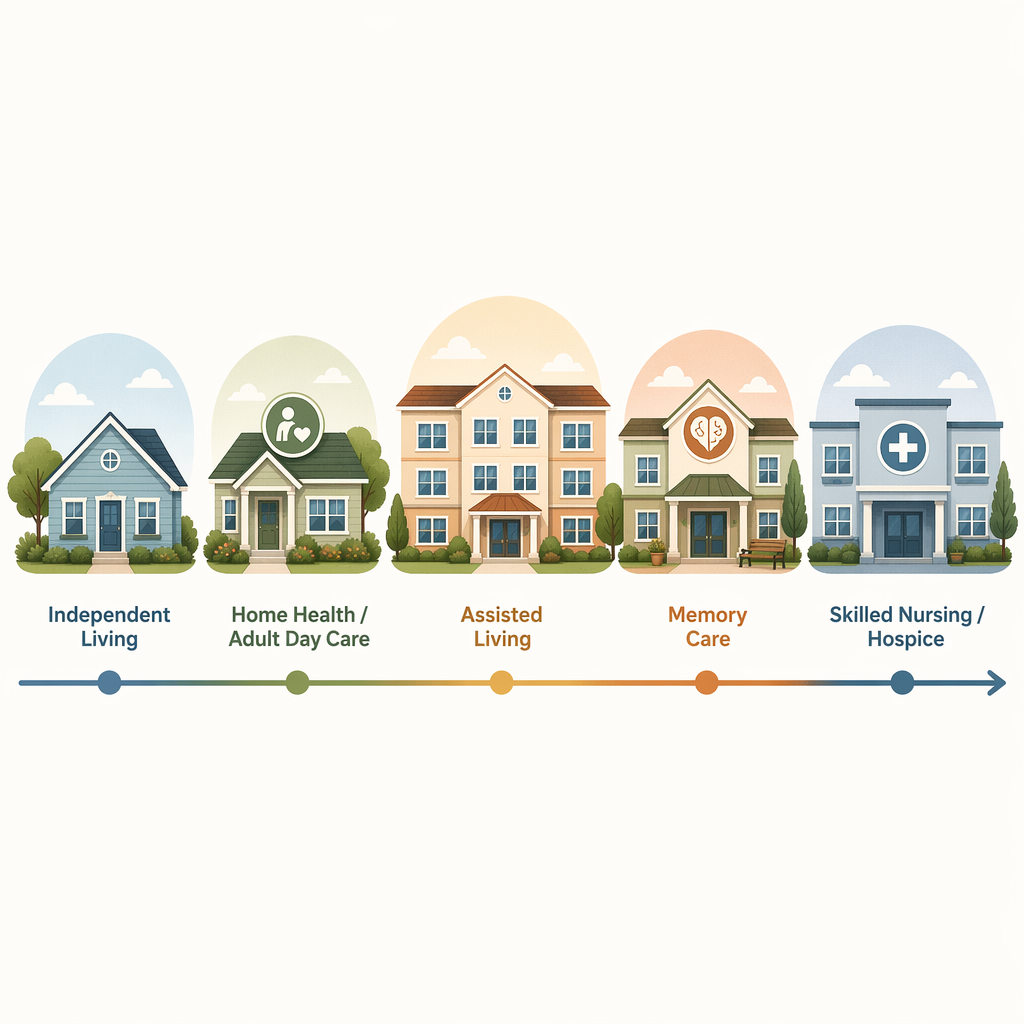
One of the most common points of confusion for caregivers is the difference between "home health care" and "home care." They sound similar but serve very different purposes. The same confusion applies across the full spectrum of care settings. Understanding the distinctions helps you match the right level of care to your loved one's needs — and avoid paying for services you do not need or missing services you do.
| Setting | What It Is | Who Pays | Caregiver Context |
|---|---|---|---|
| Home Health Care | Skilled medical care provided at home by licensed professionals (RNs, PTs, OTs, SLPs). Typically short-term and ordered by a doctor. | Medicare Part A or B covers it if the person is homebound and needs intermittent skilled care. No coverage for 24/7 care. | This is not custodial care. A home health aide can help with bathing and dressing only if the person is also receiving skilled nursing or therapy. Once the skilled need ends, so does Medicare coverage. |
| Home Care (Non-Medical) | Non-medical assistance with activities of daily living — bathing, dressing, meal prep, light housekeeping, companionship. | Almost always out-of-pocket. Some long-term care insurance policies cover it. Medicaid HCBS waivers may help in some states. | This is what most families mean when they say "we need help at home." It is not covered by Medicare. For a full breakdown of the clinical vs. non-medical distinction, see our |
| Hospice Care | Comfort-focused care for people with a terminal illness (typically 6 months or less to live). Focuses on pain management, symptom control, and emotional/spiritual support — not curative treatment. | Medicare Part A covers hospice comprehensively: nursing, medications, equipment, and bereavement support. No copay for most services. | Hospice can be provided at home, in a nursing home, or in a dedicated hospice facility. Choosing hospice does not mean giving up — it means prioritizing quality of life. 94% of older adults say maintaining quality of life is more important than living as long as possible. |
| Palliative Care | Specialized medical care focused on symptom relief and quality of life for people with serious illness. Unlike hospice, it can be provided alongside curative treatment at any stage. | Medicare Part B covers palliative care consultations. Some Medicare Advantage plans offer palliative care benefits. | Palliative care is appropriate for conditions like advanced heart failure, COPD, or cancer — even if the person is still pursuing treatment. It is often delivered by a team that includes a doctor, nurse, and social worker. |
| Adult Day Care | Structured daytime programs in a community setting that provide supervision, meals, activities, and some health services. Typically operates during business hours. | Almost always out-of-pocket. Some Medicaid HCBS waivers cover it. Medicare does not pay for adult day care. | Adult day care can be a lifeline for working caregivers. It provides social engagement for the older adult and a predictable break for the caregiver. For help matching care intensity to hours of need, see our |
| Skilled Nursing Facility (SNF) | A residential facility that provides 24/7 skilled nursing care and rehabilitation services. Often used after a hospital stay. | Medicare Part A covers up to 100 days per benefit period after a qualifying 3-day inpatient hospital stay. Days 1–20 are fully covered; days 21–100 require a daily copay ($200.50 in 2025). | This is short-term rehabilitation, not long-term custodial care. If the person needs only custodial care (help with bathing, dressing, eating), Medicare does not pay. That is when Medicaid or private pay kicks in. |
| Assisted Living | A residential setting for people who need help with some daily activities but do not require 24/7 skilled nursing. Offers private or semi-private apartments with meals, housekeeping, and personal care. | Almost always out-of-pocket. Some long-term care insurance policies cover it. Medicaid HCBS waivers may help in limited states. | Assisted living is not covered by Medicare. Costs vary widely by state and level of care. It is a good option for someone who values independence but needs help with medication management or bathing. |
| Memory Care | A specialized form of assisted living designed for people with Alzheimer's disease or other dementias. Features secured environments, structured routines, and staff trained in dementia care. | Almost always out-of-pocket. Some long-term care insurance policies cover it. Medicaid may cover it in certain states through HCBS waivers. | Memory care units are more expensive than standard assisted living because of the higher staff-to-resident ratio and specialized training. If wandering is a concern, a secured memory care environment may be the safest option. |
| Independent Living | A residential community for older adults who are fully independent but want a maintenance-free lifestyle with social activities and amenities. No personal care or medical services are included. | Out-of-pocket. Not covered by Medicare or Medicaid. | Independent living is essentially a retirement community with age-restricted housing. It is not a care setting in the medical sense — it is a lifestyle choice. If your loved one needs help with daily activities, they need assisted living or home care instead. |
| Respite Care | Short-term, temporary care provided to give the primary caregiver a break. Can be provided at home, in an adult day center, or in a residential facility. | Some Medicaid HCBS waivers cover respite. The National Family Caregiver Support Program (NFCSP) may provide limited funding. Medicare does not cover respite except as part of hospice. | Respite is not a luxury — it is a necessity for preventing caregiver burnout. Even a few hours a week can make a significant difference. For a decision framework on short-term vs. long-term care, see our |
Provider Roles: Who Does What on the Care Team
A single older adult may interact with a dozen different health professionals in a given year. Knowing who does what — and when to ask for a specialist — can save time, reduce frustration, and ensure your loved one receives appropriate care. This is especially important given the severe shortage of geriatricians in the United States.
According to a 2024 article in npj Aging, there are only about 7,300 certified geriatricians in the U.S. — but an estimated 30,000 are needed by 2030. The number of geriatricians actually dropped 28% from 2000 to 2022, while the 65+ population rose 60%. Only 10% of medical schools require a geriatrics rotation, compared to 96% that require pediatrics. This means your loved one's primary care doctor may have minimal training in the specific needs of older adults.
| Role | What They Do | When to Involve Them |
|---|---|---|
| Geriatrician | A medical doctor with specialized training in the care of older adults. Expert in managing multiple chronic conditions, medication interactions, and age-related changes. | If your loved one has multiple chronic conditions, takes 5+ medications, or has complex care needs, a geriatrician is worth seeking out — even if there is a waitlist. |
| Geriatric Care Manager (Aging Life Care Professional) | A professional (often a nurse or social worker) who assesses your loved one's needs, coordinates services, and advocates on their behalf. Can be hired privately. | Ideal for long-distance caregivers or families who are overwhelmed by coordination. They know the local resources and can save you hours of research. |
| Primary Care Physician (PCP) | The main doctor responsible for overall health care. Manages chronic conditions, orders tests, and refers to specialists. | Every older adult should have a PCP who coordinates their care. If the PCP is not asking about what matters to your loved one (only 58% of older adults say their providers do), consider switching. |
| Nurse Practitioner (NP) / Physician Assistant (PA) | Advanced practice clinicians who can diagnose, treat, and prescribe medications. Often work under a physician's supervision but may practice independently in some states. | NPs and PAs are increasingly the primary providers for older adults, especially in rural areas. They often have more time for patient education than physicians. |
| Home Health Aide (HHA) | A trained aide who provides personal care: bathing, dressing, grooming, toileting, and light housekeeping. Works under the supervision of a nurse. | HHAs are the backbone of in-home care. They are not licensed to perform medical tasks (like giving injections). For non-medical help at home, an HHA is the right role. |
| Licensed Practical Nurse (LPN) / Licensed Vocational Nurse (LVN) | A nurse who provides basic medical care: taking vital signs, changing wound dressings, administering medications. Works under an RN or physician. | LPNs are common in nursing homes and home health agencies. They can handle tasks an HHA cannot, like catheter care or medication administration. |
| Registered Nurse (RN) | A nurse who assesses health status, develops care plans, administers complex treatments, and coordinates with physicians. Has more training and authority than an LPN. | An RN is typically the case manager for home health care. They will visit your loved one, assess their condition, and adjust the care plan as needed. |
| Social Worker | A professional who helps families navigate the health care system, find community resources, and address psychosocial needs. Often employed by hospitals, home health agencies, or Area Agencies on Aging. | Social workers are invaluable for discharge planning (getting your loved one out of the hospital safely) and for connecting you to financial assistance programs. |
| Occupational Therapist (OT) | A therapist who helps people regain or maintain the ability to perform daily activities (bathing, dressing, cooking). Focuses on adapting the environment and teaching new techniques. | If your loved one is struggling with ADLs after a stroke, hip fracture, or cognitive decline, an OT can recommend adaptive equipment (grab bars, shower chairs) and strategies to maintain independence. |
| Physical Therapist (PT) | A therapist who helps people improve mobility, strength, balance, and gait. Focuses on exercise, gait training, and fall prevention. | PT is essential after a fall, joint replacement, or any event that affects mobility. The CDC reports that 1 in 4 older adults falls each year — PT can significantly reduce that risk. |
| Speech-Language Pathologist (SLP) | A therapist who addresses communication disorders (speech, language, cognitive-communication) and swallowing difficulties (dysphagia). | SLPs are critical after a stroke or in the later stages of dementia when swallowing becomes unsafe. They can recommend modified diets and exercises to maintain function. |
Clinical & Health Terms: Understanding Your Loved One's Condition
When you walk into a doctor's appointment, you will hear clinical terms that describe your loved one's functional status, health conditions, and risk factors. Understanding these terms helps you ask better questions and track changes over time.
The prevalence of chronic conditions among older adults is striking. According to CDC data published in April 2025 and cited by the National Council on Aging, 93% of adults age 65 and older have at least one chronic condition, and 79% have two or more. The top conditions include high blood pressure (61%), high cholesterol (55%), arthritis (51%), obesity (40%), and diabetes (24%). Medicare beneficiaries with four or more chronic conditions account for 94% of total Medicare spending, with average annual expenditures of $21,342 per person compared to $2,025 for those with none.
- ADLs (Activities of Daily Living): The basic self-care tasks everyone needs to perform daily: bathing, dressing, grooming, using the toilet, eating, and transferring (moving from bed to chair). The ability to perform ADLs independently is the gold standard for measuring functional status. If your loved one needs help with one or more ADLs, they likely qualify for in-home care or assisted living.
- IADLs (Instrumental Activities of Daily Living): More complex tasks needed for independent living: managing finances, handling transportation, shopping, preparing meals, using the telephone, managing medications, and housework. Difficulty with IADLs often appears before difficulty with ADLs and can be an early warning sign of cognitive decline.
- Polypharmacy: The use of five or more medications at the same time. According to a 2024 study in npj Aging, polypharmacy increased from 31.4% of older adults in 1999–2000 to 35.8% in 2011–2012. More medications mean higher risk of adverse drug interactions, falls, and hospitalizations. Ask the doctor to review the full medication list at every visit — including over-the-counter drugs and supplements.
- Comorbidities: The presence of two or more chronic conditions in the same person. Comorbidities complicate treatment because medications for one condition may worsen another. For example, some blood pressure medications can worsen incontinence.
- Chronic Disease: A long-lasting condition that generally cannot be cured but can be managed. Common examples include hypertension, diabetes, heart disease, COPD, and arthritis. 27% of the U.S. adult population has multiple chronic conditions, costing the health care system over $1 trillion each year.
- Hypertension (High Blood Pressure): Affects 61% of adults 65+ (CDC data). It is a major risk factor for heart disease, stroke, and kidney disease. CDC data from 2021–2023 shows prevalence of 72.8% in men 60–69 and 72.6% in men 70+; for women, 64.8% in those 60–69 and 76.6% in those 70+.
- Diabetes: Affects 24% of adults 65+. Diabetes management becomes more complex with age due to changes in kidney function, vision, and the risk of hypoglycemia. The 2026 Medicare negotiated drug prices include several diabetes medications, which may lower out-of-pocket costs.
- COPD (Chronic Obstructive Pulmonary Disease): A progressive lung disease that makes breathing difficult. Affects 12% of adults 65+. It is the fourth leading cause of death in the U.S. (after heart disease, cancer, and stroke).
- Dementia: An umbrella term for a decline in cognitive function severe enough to interfere with daily life. Alzheimer's disease is the most common type (60–80% of cases). Other types include vascular dementia, Lewy body dementia, and frontotemporal dementia. Alzheimer's is the fifth leading cause of death among older adults.
- Falls: 1 in 4 older adults falls each year. Falls send 3 million older adults to emergency departments annually. The death rate from falls rose from 55.3 per 100,000 in 2012 to 78.0 per 100,000 in 2021. Falls cost $50 billion a year to treat, with 75% paid by Medicare and Medicaid. Fall prevention is one of the most impactful things a caregiver can address.
- Incontinence: The loss of bladder or bowel control. It affects millions of older adults and is a leading reason for admission to nursing homes. It is often treatable or manageable with pelvic floor therapy, medications, or absorbent products — do not assume it is a normal part of aging.
- Sundowning: Increased confusion, agitation, and restlessness in the late afternoon and evening, common in people with dementia. Triggers include fatigue, low lighting, and disruption of the body's internal clock. Non-pharmacological strategies (increasing daytime activity, reducing evening stimulation) are the first-line approach.
Legal & Financial Terms: Protecting Your Loved One's Wishes and Assets
Legal and financial documents are the foundation of a caregiving plan. Without them, families can face court proceedings, financial losses, and agonizing disagreements about what their loved one would have wanted. The CDC reports that about 80% of older adults struggle to use medical documents — but that statistic refers to understanding forms, not having them in place. The first step is ensuring the documents exist at all.
- Power of Attorney (POA): A legal document that gives someone (the "agent") the authority to make decisions on behalf of another person (the "principal"). A financial POA covers property and financial matters. A healthcare POA (also called a health care proxy) covers medical decisions. A "durable" POA remains in effect even if the principal becomes incapacitated. This is the single most important document to have in place before a crisis.
- Advance Directive: A broader term that includes a living will and a health care proxy. It documents a person's wishes about medical treatment if they become unable to communicate. Without an advance directive, doctors may be legally required to provide life-sustaining treatment even if the family believes the person would not have wanted it.
- Living Will: A written statement that specifies what medical treatments a person wants or does not want if they are terminally ill or permanently unconscious. It typically addresses life support, tube feeding, and pain management.
- Do Not Resuscitate (DNR) Order: A medical order signed by a doctor that instructs health care providers not to perform CPR if the person's heart stops or they stop breathing. A DNR is different from a living will — it applies only to CPR, not to other treatments.
- Health Care Proxy: A specific type of advance directive in which the person names someone to make health care decisions on their behalf. In some states, this is the same as a health care POA. In others, it is a separate document.
- Conservator / Guardian: A person appointed by a court to manage the affairs of someone who is incapacitated and has not executed a POA. Conservatorship is a last resort — it is expensive, public, and removes the person's legal rights. Having a POA in place avoids this.
- Reverse Mortgage: A loan that allows homeowners age 62+ to convert part of their home equity into cash without selling the home. The loan is repaid when the homeowner dies, sells, or moves out permanently. Reverse mortgages can provide income for care but also reduce the inheritance and can be costly.
- Life Settlement / Viatical Settlement: The sale of an existing life insurance policy to a third party for a lump sum payment. A viatical settlement applies when the policyholder is terminally ill (typically life expectancy of 2 years or less). A life settlement applies when the policyholder is not terminally ill but is older and no longer needs or can afford the policy. These are complex financial products — consult a fee-only financial advisor before proceeding.
Support Programs: Where to Turn for Help
No caregiver should navigate this alone. A network of federal, state, and local programs exists to provide information, financial assistance, and direct services. The challenge is knowing which programs exist and how to access them.
- Area Agency on Aging (AAA): A local organization that provides information and referrals on senior services — meal programs, transportation, caregiver support, insurance counseling, and more. There are over 600 AAAs across the country. Call the Eldercare Locator at 1-800-677-1116 to find the AAA in your area. This should be your first call after reading this article.
- State Health Insurance Assistance Program (SHIP): A free, unbiased counseling service that helps Medicare beneficiaries and their families understand their coverage options, compare plans, and resolve billing issues. SHIP counselors are trained volunteers — they do not sell insurance. Every state has a SHIP program.
- Home and Community-Based Services (HCBS) Waivers: Medicaid waivers that allow states to provide home- and community-based services to people who would otherwise need nursing home care. Services can include personal care, respite, home modifications, and adult day care. Availability and eligibility vary by state — contact your state Medicaid office or AAA for details.
- Meals on Wheels: A national program that delivers nutritious meals to homebound older adults. Many programs also offer wellness checks and social connection. Call 888-998-6325 to find a local program. Meals on Wheels is often funded through the Older Americans Act and local donations.
- National Family Caregiver Support Program (NFCSP): A federal program that provides grants to states to support family caregivers. Services can include information, counseling, respite care, and supplemental services. Contact your local AAA to learn what is available in your area.
- Supplemental Security Income (SSI): A federal program that provides monthly cash payments to older adults and people with disabilities who have very limited income and assets. SSI is administered by the Social Security Administration. In 2025, the maximum federal benefit is $967 per month for an individual.
- Social Security Disability Insurance (SSDI): A federal program that provides monthly benefits to people who have worked enough years and then become disabled before reaching full retirement age. SSDI is different from SSI — it is based on work history, not financial need.
- CHAMPVA: A health insurance program for the spouses and dependents of veterans who are permanently and totally disabled due to a service-connected condition, or who died from a service-connected condition. If your loved one is a veteran's spouse, they may qualify for CHAMPVA coverage.
- TRICARE: The health insurance program for active-duty and retired military personnel and their families. If your loved one is a military retiree or the spouse of one, TRICARE may provide coverage alongside or instead of Medicare.
For a step-by-step framework on where to start when you feel overwhelmed, see our guide: Where to Start When Your Aging Parent Needs Help: A 5-Step Triage Framework for New Caregivers. It walks through the first five actions every new caregiver should take.
Putting It All Together: A Caregiver's Next Steps
You do not need to memorize every term in this glossary. The goal is to have a reference you can return to when you encounter an unfamiliar word in a doctor's office, an insurance form, or a conversation with a social worker. Bookmark this page. Print it out. Keep it in the folder you bring to appointments.
Here is a summary of the most important actions to take based on what you have learned:
- Start with insurance literacy: Confirm what Medicare parts your loved one has. Check if they have a Medigap or Medicare Advantage plan. Understand that Medicare does not cover long-term custodial care. If assets are limited, explore Medicaid eligibility.
- Identify the right care setting: Match your loved one's functional needs (ADLs and IADLs) to the appropriate setting — home care, adult day care, assisted living, or skilled nursing. Use the table in the Care Settings section as a starting point.
- Build the care team: Identify the key providers your loved one needs — PCP, geriatrician (if available), OT/PT, social worker. Do not be afraid to ask for referrals to specialists.
- Document legal wishes early: If your loved one is still cognitively intact, schedule a meeting with an elder law attorney to execute a durable POA, health care proxy, and advance directive. Do not wait.
- Use support programs: Call the Eldercare Locator (1-800-677-1116) to find your local Area Agency on Aging. Contact SHIP for free Medicare counseling. Ask about HCBS waivers and the National Family Caregiver Support Program.
For a deeper dive into the financial side of caregiving, read our guide on How to Pay for Senior Caregiver Services. And if you are still deciding between different care options, the Short-Term Care vs. Long-Term Care for Seniors decision framework can help clarify the trade-offs.
You are not expected to know everything on day one. Every experienced caregiver started where you are now — confused by the jargon, overwhelmed by the options, and unsure where to begin. The fact that you are reading this glossary means you are already taking the most important step: educating yourself so you can advocate effectively for the person you care for.
Browse more in the Glossary.