
Clinical term
Senior Health Care Services: A Complete Taxonomy and Decision Framework for Family Caregivers
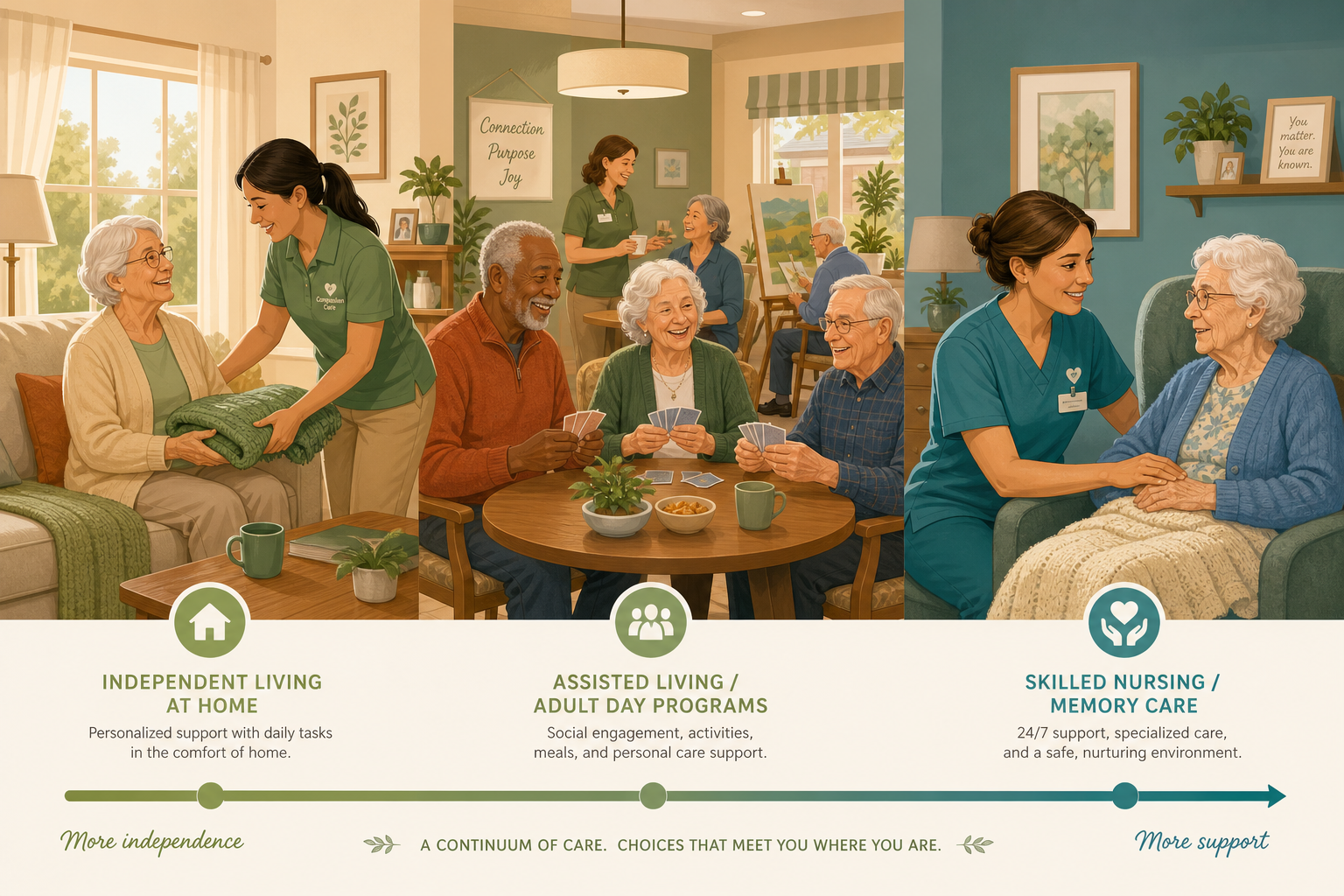
Why Understanding the Full Service Spectrum Matters Before a Crisis
Most families begin exploring senior health care services only after a specific event — a fall, a hospitalization, a dementia diagnosis that suddenly feels unmanageable. In that moment, the landscape looks like a set of binary choices: home care or a facility? Assisted living or a nursing home? The problem is that this framing misses almost everything that matters.
The reality is that senior care is not a single decision but a system of combinable services that can be layered together to match a person's evolving needs. According to AARP's 2026 report, 59 million family caregivers in the U.S. provided 49.5 billion hours of unpaid care in 2024, valued at over $1 trillion. That unpaid care is the backbone of the system, but it cannot cover every gap — and most families discover those gaps only when a crisis forces a rushed decision.
This guide provides a different framework. Instead of asking "home care or facility?", it asks: What services exist, where are they delivered, and how can they be combined into a personalized care stack? The goal is to give you a complete taxonomy — organized by setting, by service type, and by payment source — so you can make informed decisions before, not during, a crisis.
Taxonomy of Senior Health Care Services by Setting
The most intuitive way to organize senior services is by where care is delivered. Each setting has a distinct role, cost structure, and regulatory environment. Understanding this landscape is the first step toward building a care stack that fits.
In-Home Services
In-home services allow older adults to remain in their own residence while receiving support. This category includes both medical and non-medical care:
- Home care (non-medical): Personal care assistance (bathing, dressing, toileting), homemaker services (meal preparation, light cleaning), and companionship. National median cost is $35 per hour in 2026, according to the CareScout 2025 Cost of Care survey cited by U.S. News.
- Home health care (medical): Skilled nursing, physical and occupational therapy, wound care, and medication management. This is prescribed by a doctor and covered by Medicare under specific conditions.
- Personal Emergency Response Systems (PERS): Wearable or home-based devices that allow the user to call for help at the press of a button. Some include automatic fall detection.
- Meal delivery: Programs like Meals on Wheels provide nutritious meals to homebound seniors, addressing food insecurity — which affected 7.4 million adults age 60+ in 2023, per the America's Health Rankings 2026 Senior Report.
Community-Based Services
Community-based services provide care and social engagement outside the home but not in a residential facility. They are often the most underutilized category because families simply do not know they exist.
- Adult day care: Structured programs offering supervision, meals, activities, and sometimes health services during daytime hours. Cost averages $95 per eight-hour day in 2026 (CareScout). Half-day programs run approximately $75.
- Senior transportation: Rides to medical appointments, grocery stores, and community centers. Often provided by local Area Agencies on Aging or nonprofit organizations.
- Senior centers: Social, educational, and recreational programs for older adults. Typically low-cost or free.
Residential Settings
Residential settings provide housing plus varying levels of care. They range from independent living with minimal support to memory care units designed specifically for dementia.
- Independent living: Age-restricted housing with amenities and social activities but no personal care. Median cost $3,523 per month in 2026.
- Board and care homes (residential care homes): Small group homes offering personal care, meals, and supervision. Private rooms average $7,300 per month; shared rooms $6,000 per month.
- Assisted living: Apartment-style residences with personal care, meals, and 24-hour supervision. Median cost $6,200 per month in 2026.
- Memory care: Specialized units within assisted living or stand-alone facilities for individuals with Alzheimer's or other dementias. Median cost $7,645 per month in 2026.
Facility-Based Care
Facility-based care provides the highest level of medical supervision and is typically used for post-hospital recovery or advanced chronic conditions.
- Skilled nursing facilities (nursing homes): 24-hour skilled nursing care, rehabilitation therapy, and medical monitoring. Semi-private rooms average $9,581 per month; private rooms $10,798 per month in 2026.
- Inpatient rehabilitation: Intensive physical, occupational, and speech therapy after a major event like a stroke or joint replacement. Typically short-term (2–3 weeks).
For a deeper comparison of each care type, see our complete guide to senior care options.
Taxonomy of Senior Health Care Services by Type
A parallel way to organize services is by what they provide. This medical-versus-non-medical distinction matters enormously for payment, because Medicare and private insurance draw a hard line between the two.
Medical Services (Skilled Care)
Medical services require a physician's order and are delivered by licensed professionals. They include:
- Skilled nursing care: Wound care, medication administration, IV therapy, catheter care, and monitoring of vital signs.
- Physical therapy: Restoring mobility, strength, and balance after injury or surgery.
- Occupational therapy: Adapting daily activities and the home environment to maintain independence.
- Speech therapy: Addressing swallowing difficulties and communication deficits after stroke or neurological conditions.
- Medical social services: Counseling and connection to community resources for patients and families navigating complex health situations.
Non-Medical Services (Custodial Care)
Non-medical services address the activities of daily living (ADLs) and instrumental activities of daily living (IADLs) that enable a person to function independently. These are often called "custodial care" — and they are the services that Medicare explicitly does not cover.
- Personal care: Assistance with bathing, dressing, toileting, transferring, and eating. In residential care settings, bathing is the most common ADL deficit (75% of residents), followed by ambulating (71%) and dressing (60%), according to SingleCare's analysis of long-term care data.
- Homemaker services: Meal preparation, light housekeeping, laundry, and grocery shopping.
- Companionship: Social interaction, conversation, and engagement to reduce isolation.
- Transportation: Rides to appointments, errands, and social activities.
- Care coordination: A geriatric care manager or care coordinator who assesses needs, arranges services, and monitors the overall plan.
| Service Type | Medical or Non-Medical | Who Provides It | Typical Payment Source |
|---|---|---|---|
| Skilled nursing | Medical | RN or LPN | Medicare, Medicaid, private insurance |
| Physical therapy | Medical | Licensed PT | Medicare, Medicaid, private insurance |
| Home health aide (part-time) | Medical (when part of a skilled plan) | Certified home health aide | Medicare (if skilled need exists) |
| Personal care (bathing, dressing) | Non-medical | Home care aide, family caregiver | Private pay, Medicaid waiver, LTC insurance |
| Homemaker services | Non-medical | Home care aide | Private pay, some Medicaid waivers |
| Adult day care | Non-medical (social model) or medical (health model) | Adult day center staff | Private pay, some Medicaid waivers, VA |
| Companionship | Non-medical | Home care aide, volunteer | Private pay |
| Meal delivery | Non-medical | Meals on Wheels, similar programs | Donations, some government funding |
For a detailed breakdown of in-home skilled nursing, including Medicare coverage rules, see our guide to in-home nursing care for the elderly.
How Services Layer Together: Building a Care Stack
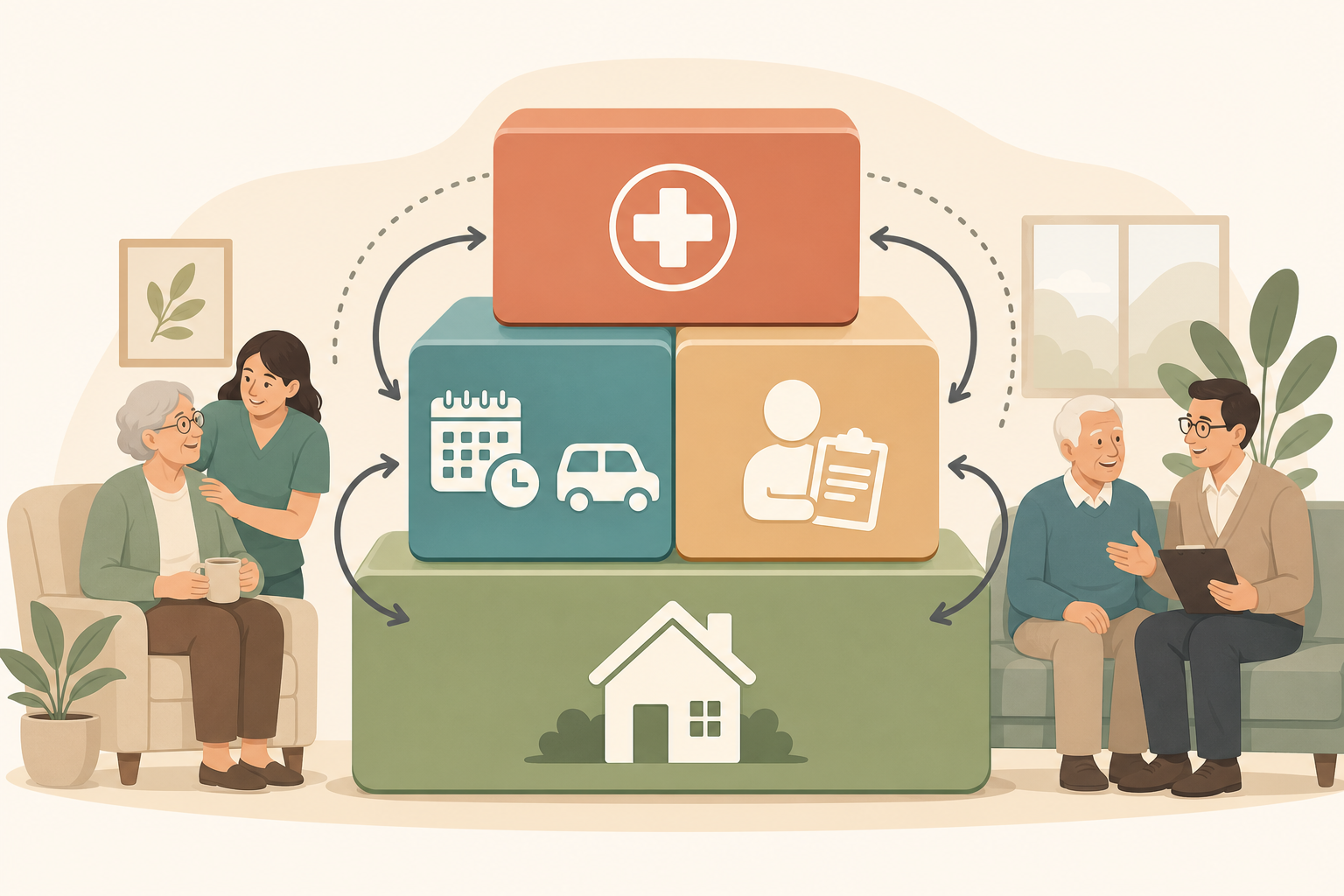
The most important shift in thinking about senior care is moving from "either/or" to "and." Most families need multiple services running simultaneously, not a single option. We call this a care stack — a combination of services layered together to meet a person's full range of needs.
Here are three common care stacks for different scenarios:
Scenario 1: Early-Stage Dementia with a Spousal Caregiver
- Adult day care (3 days/week): Provides structured activity and supervision, giving the spousal caregiver respite. Cost: ~$95 per day.
- PERS device: Worn by the person with dementia in case they wander or fall when the spouse is momentarily occupied.
- Home care (2 mornings/week): Helps with bathing and dressing, which the spouse may find physically difficult or emotionally stressful.
- Geriatric care manager (monthly check-in): Monitors the evolving care plan and coordinates with the neurologist.
Scenario 2: Post-Hospital Recovery After Hip Replacement
- Home health care (short-term): Skilled nursing for wound care and physical therapy for mobility. Covered by Medicare for up to 8 hours/day (28–35 hours/week) if the patient is homebound.
- Home care (daily for 4–6 weeks): Personal care and meal preparation while the patient cannot bear weight. Paid privately or through LTC insurance.
- Medical alert system: Provides a safety net if the patient attempts to walk unassisted.
- Meal delivery (temporary): Ensures nutritious meals without requiring the caregiver to cook.
Scenario 3: Progressive Mobility Decline with a Working Adult Child Caregiver
- Home care (morning and evening): Assistance with transfers, toileting, and medication reminders during the hours the adult child is at work.
- Adult day care (5 days/week): Safe, supervised environment during the workday.
- Home modification: Grab bars, a walk-in shower, and a stair lift to reduce fall risk and make caregiving tasks easier.
- Occupational therapy evaluation: One-time assessment to recommend adaptive equipment and home safety changes.
Cost Comparison Across Service Types (2026 Data)
Cost is often the deciding factor in care decisions, but comparing costs across service types is not straightforward. The table below uses national median figures from the CareScout 2025 Cost of Care survey, as reported by U.S. News and SingleCare. These are 2026 figures.
| Service Type | Unit Cost | Annualized Cost (Est.) | Notes |
|---|---|---|---|
| Home care (non-medical) | $35/hour | $80,080 (44 hrs/week) | Cost varies $25–$44/hr by state |
| Adult day care | $95/day (full day) | $24,700 (5 days/week) | Half-day ~$75 |
| Independent living | $3,523/month | $42,276/year | Housing only; no personal care |
| Board and care (private room) | $7,300/month | $87,600/year | Small group home; includes meals and supervision |
| Board and care (shared room) | $6,000/month | $72,000/year | Shared room reduces cost |
| Assisted living | $6,200/month | $74,400/year | Apartment + personal care + meals |
| Memory care | $7,645/month | $91,740/year | Specialized dementia unit |
| Nursing home (semi-private) | $9,581/month | $114,975/year | 24-hour skilled nursing |
| Nursing home (private room) | $10,798/month | $129,575/year | Private room premium |
| Respite care | $350/day | Varies | Short-term stay for caregiver relief |
Note that the annualized cost for home care at 44 hours per week ($80,080) actually exceeds the cost of assisted living ($74,400). This is the well-known "40-hour rule" inflection point: when a senior needs roughly 40 or more hours of paid home care per week, a residential setting may be cost-comparable or cheaper. However, this comparison does not account for the value of remaining at home, the emotional preference of the older adult, or the fact that many families combine home care with unpaid family caregiving to reduce hours.
Medicare, Medicaid, and Insurance: What Covers What
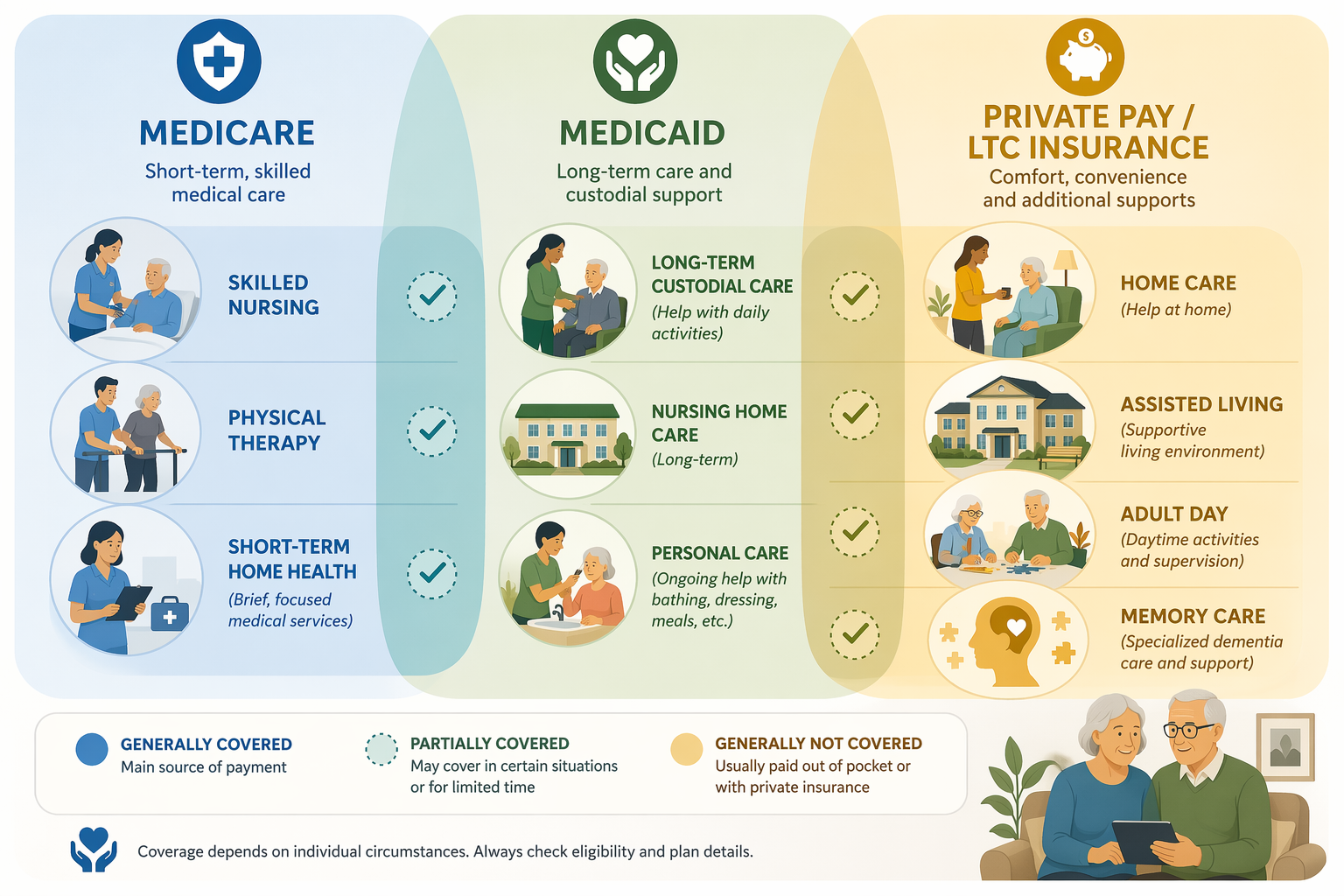
The single most common mistake families make is assuming that Medicare covers long-term custodial care. It does not. Understanding what each payment source covers — and what it explicitly excludes — is essential to building a realistic care stack.
Medicare
Medicare covers only medically necessary, short-term, skilled care. According to Medicare.gov, covered home health services include skilled nursing care, physical/occupational/speech therapy, medical social services, and part-time home health aide care — but only for individuals who are homebound and need part-time or intermittent skilled services with a doctor's order.
Medicare explicitly does NOT cover:
- 24-hour-a-day care at home
- Home meal delivery
- Homemaker services (shopping, cleaning) when those are the only care needed
- Custodial or personal care when that is the only care needed
For skilled nursing facility stays, Medicare pays 100% of costs for days 1–20, then approximately 80% for days 21–100, and nothing after day 100 — and only after a qualifying hospital stay of at least three days. This is a critical gap that most families discover too late.
Medicaid
Medicaid is the largest payer for long-term care in the United States. According to the Congressional Research Service (CRS), Medicaid spent $257 billion on long-term services and supports (LTSS) in 2023, accounting for 46% of all LTSS spending. Approximately 60% of nursing home residents are covered by Medicaid, per KFF data.
Medicaid covers a broader range of long-term care services than Medicare, including:
- Nursing home care (the largest category of Medicaid LTSS spending)
- Home and community-based services (HCBS) waivers, which can cover personal care, homemaker services, adult day care, and respite care
- Some assisted living costs, depending on the state's Medicaid program
However, Medicaid eligibility is income- and asset-based, and rules vary significantly by state. Most families must "spend down" their assets to qualify, which is a complex legal and financial process.
Private Pay and Long-Term Care Insurance
Out-of-pocket spending on LTSS totaled $81 billion in 2023, approximately 14% of all LTSS spending. This is the primary payment source for home care, assisted living, adult day care, and board and care homes.
Long-term care insurance can help offset these costs, but premiums range from $900 to $7,225 per year depending on age, health, and coverage level. Approximately 1 in 5 people turning 65 today will face more than $200,000 in long-term care costs over their lifetime, according to SingleCare's analysis of ASPE data.
| Payment Source | Covers | Does Not Cover | Key Limitation |
|---|---|---|---|
| Medicare (Part A & B) | Short-term skilled nursing, home health (skilled only), therapy, hospice | Custodial care, home care, assisted living, adult day (non-medical), long-term nursing home | Requires homebound status and skilled need; time-limited |
| Medicaid | Nursing home care, HCBS waivers (personal care, adult day, respite), some assisted living | Most assisted living (varies by state), independent living, private home care (without waiver) | Income/asset limits; state-specific rules; spend-down required |
| Private pay (out-of-pocket) | Home care, assisted living, adult day, board and care, memory care | None (if you can afford it) | Unlimited cost exposure; $81B spent in 2023 |
| Long-term care insurance | Home care, assisted living, nursing home (depends on policy) | Pre-existing conditions (during elimination period), non-covered services | Premiums $900–$7,225/yr; ~1 in 5 will exceed $200K in LTC costs |
| VA benefits | Aid and Attendance, homemaker/home health aide, adult day, respite | Assisted living (unless VA-contracted), some private home care | Requires veteran or surviving spouse status; income/asset limits |
Step-by-Step Framework for Assessing Needs and Choosing Services
With the taxonomy and cost landscape in mind, here is a practical six-step framework for building a care stack that fits your family's specific situation.
Step 1: Assess Current Functional Status and Medical Needs
Begin by documenting what the older adult can and cannot do independently. Use the ADL and IADL frameworks as a checklist, but do not stop there. Also assess:
- Medical complexity: Chronic conditions, medications, recent hospitalizations. 92% of residential care residents have at least one chronic condition; 55% have 2–3 chronic conditions (SingleCare).
- Cognitive status: Memory loss, judgment, safety awareness. An estimated 7.2 million Americans 65+ are living with Alzheimer's in 2026 (1 in 9).
- Fall risk: History of falls, balance issues, home hazards.
- Caregiver capacity: How many hours per week can the family caregiver provide? 57% of family caregivers are in high-intensity roles, averaging 27 hours of care per week (AARP).
Step 2: Identify Gaps in the Current Care Arrangement
Compare what the older adult needs with what is currently being provided — by family caregivers, by existing services, or by the older adult themselves. Common gaps include:
- Unmet personal care needs (bathing, toileting)
- Social isolation and lack of meaningful activity
- Unsafe home environment (fall hazards, cluttered pathways)
- Caregiver burnout (the most common reason for facility placement)
- Unmanaged medical conditions or medication complexity
Step 3: Map Potential Services by Setting and Type
Using the dual taxonomy from this guide, list the services that could address each gap. For each gap, consider both a home-based option and a community-based or residential option. For example, if the gap is "unsafe during the day while the adult child works," the options might include adult day care, an in-home companion, or a PERS device with remote monitoring.
Step 4: Layer Services into a Care Stack
Combine services that work together. Do not assume you must choose one. A care stack might include:
- A foundation layer of personal care and homemaker services (daily or several times per week)
- A safety layer of PERS or passive home monitoring
- A social engagement layer of adult day care or senior center programs
- A medical layer of home health, therapy, or telehealth as needed
- A coordination layer of a geriatric care manager or care coordinator
Step 5: Evaluate Costs and Payment Sources
Calculate the total monthly cost of your proposed care stack. Then map each service to a payment source using the table in the previous section. Key questions:
- Is the older adult eligible for a Medicaid HCBS waiver in their state?
- Do they have long-term care insurance, and what does it cover?
- Are they a veteran or surviving spouse who qualifies for VA Aid and Attendance?
- What is the realistic out-of-pocket budget?
Step 6: Implement, Monitor, and Reassess Regularly
A care stack is not a one-time decision. Needs change as health conditions progress, caregiver capacity shifts, and financial circumstances evolve. Schedule a formal reassessment every 3–6 months, or immediately after any significant health event (hospitalization, fall, diagnosis change).
Glossary of Key Senior Health Care Service Terms
The terminology of senior care can be confusing, especially when similar-sounding terms describe very different services. Here are the essential terms every family caregiver should know:
- Home care vs. home health: Home care is non-medical (bathing, meals, companionship). Home health is skilled medical care (nursing, therapy) prescribed by a doctor. Medicare covers home health, not home care.
- Custodial care vs. skilled care: Custodial care helps with daily living activities (bathing, dressing, eating). Skilled care requires licensed medical professionals. This distinction determines what Medicare will pay for.
- PERS (Personal Emergency Response System): A wearable or home-based device that allows the user to call for help. Some include automatic fall detection.
- Adult day care: A structured daytime program offering supervision, meals, activities, and sometimes health services. Provides respite for family caregivers.
- Board and care home (residential care home): A small group home (typically 4–10 residents) providing personal care, meals, and supervision. Less expensive than assisted living and more home-like.
- Assisted living: Apartment-style residence with personal care, meals, 24-hour supervision, and social activities. For individuals who need help with daily tasks but not 24-hour skilled nursing.
- Memory care: A specialized unit or facility for individuals with Alzheimer's or other dementias. Features secured exits, specially trained staff, and structured routines.
- Skilled nursing facility (SNF): A nursing home providing 24-hour skilled nursing care and rehabilitation therapy. For individuals with complex medical needs who cannot be cared for at home.
- LTSS (Long-Term Services and Supports): The broad category of services that help individuals with chronic conditions or disabilities maintain independence. Includes both medical and non-medical care across all settings.
- Medicaid HCBS waiver: A state-level Medicaid program that allows individuals to receive long-term care services at home or in the community rather than in a nursing home. Eligibility and covered services vary by state.
- Geriatric care manager: A professional (often a social worker or nurse) who assesses needs, coordinates services, and monitors the care plan. Especially valuable for long-distance caregivers.
For a complete reference of 50+ essential eldercare terms, see our comprehensive eldercare glossary.
Browse more in the Glossary.