
Glossary entry
Senior Care Options: A Complete Comparison of 9 Types of Care for Older Adults
Understanding the Senior Care Continuum: From Home-Based to Residential Care
When a parent's health begins to decline, the range of care options can feel overwhelming. The landscape is not simply "home care versus a nursing home." In reality, there are at least nine distinct types of senior care, each designed for a specific level of functional ability and medical need. These options exist on a continuum — from a few hours of weekly help at home to full-time skilled nursing in a facility.
The central challenge for families is not finding a single "best" option. It is matching the right care setting to the older adult's current functional status, medical complexity, and personal preferences — and doing so before a crisis forces a rushed decision. This guide profiles all nine options with 2026 cost data, explains how to assess your loved one's needs using the activities of daily living (ADL) framework, and provides a decision flowchart to help you narrow the field.
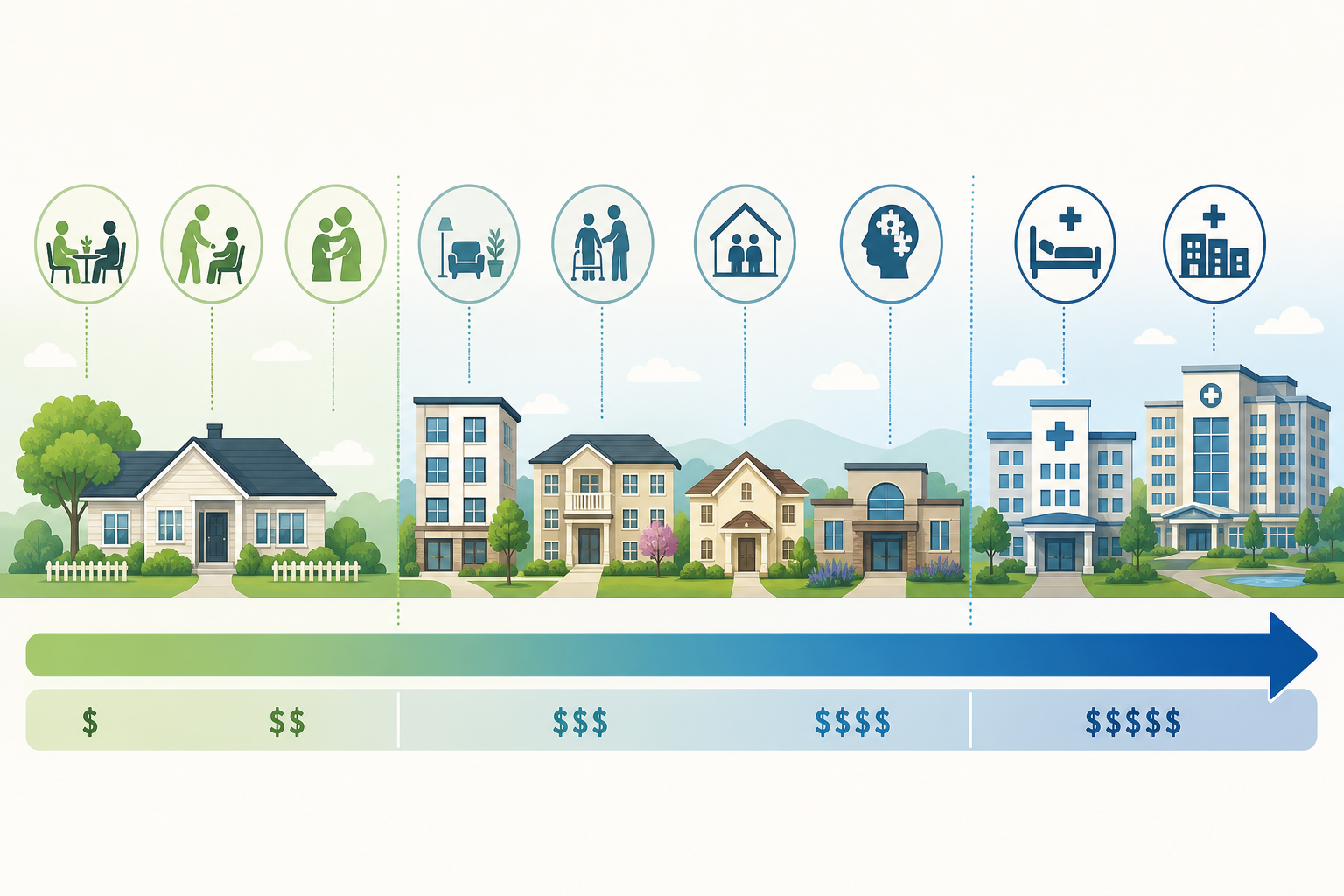
The 9 Senior Care Options: Individual Profiles with 2026 Costs
Below is a detailed look at each care type, including who it serves, what services are typically included, and the latest cost data. For a quick-reference definition of each term, see the complete glossary of senior care types.
1. Adult Day Services
Adult day centers provide supervised care, social activities, and meals during daytime hours. They are designed for older adults who need some supervision or assistance but do not require 24-hour care. This option allows family caregivers to continue working while ensuring their loved one is in a safe, engaging environment.
2026 cost: Approximately $95 per eight-hour day, according to CareScout's 2025 Cost of Care Survey and U.S. News estimates. This makes adult day services the most affordable option on the continuum, particularly for families who only need coverage during work hours.
2. Independent Living
Independent living communities — also called retirement communities or 55+ housing — are designed for seniors who can manage their own daily activities but want a maintenance-free lifestyle with social opportunities. These communities typically offer apartments or cottages, shared amenities, and optional services like meals and housekeeping. They do not provide personal care or medical supervision.
2026 cost: U.S. News estimates the national median at $3,523 per month. This figure is a U.S. News estimate rather than a primary survey result, so families should verify local pricing.
3. Home Care (Non-Medical)
Home care provides non-medical assistance with activities of daily living — bathing, dressing, meal preparation, light housekeeping, and companionship. It is delivered by trained caregivers in the older adult's own home. Home care is distinct from home health care, which involves skilled nursing or therapy services ordered by a physician.
2026 cost: CareScout reports a national median of $35 per hour for a non-medical caregiver. At 44 hours per week — roughly full-time weekday coverage — this amounts to about $6,478 per month, or $80,080 annually. A Place for Mom notes that home care is usually cheaper than a nursing home when fewer than 40–50 hours of care are needed per week. At 60 or more hours per week, home care becomes significantly more expensive than a semi-private nursing home room.
4. Respite Care
Respite care provides temporary, short-term relief for primary family caregivers. It can be arranged in the home, at an adult day center, or in a residential facility. Respite stays typically last from a few days to several weeks. This option is essential for preventing caregiver burnout and can also serve as a trial period for a senior considering a move to assisted living or a nursing home.
2026 cost: U.S. News estimates $350 per day for residential respite care. Costs vary widely by location and setting.
5. Assisted Living
Assisted living communities provide housing, meals, personal care assistance, and 24-hour supervision for seniors who need help with daily activities but do not require skilled nursing care. Residents typically live in private or semi-private apartments and receive a personalized care plan. Services often include medication management, housekeeping, transportation, and social activities.
2026 cost: CareScout reports a national median of $6,200 per month ($74,400 annually). This represents a 5% year-over-year increase from 2024 to 2025.
6. Board and Care Homes (Residential Care Homes)
Board and care homes — also called residential care homes or group homes — are small, family-style facilities that house 4 to 10 residents. They offer personal care, meals, and supervision in a more intimate setting than a large assisted living community. They are often less expensive than traditional assisted living and can be a good fit for seniors who prefer a home-like environment.
2026 cost: U.S. News reports a range of $6,000 per month for a shared room to $7,300 per month for a private room. For a deeper look at this often-overlooked option, see our guide to residential care homes.
7. Memory Care
Memory care is a specialized form of assisted living for individuals with Alzheimer's disease or other forms of dementia. These units or communities feature enhanced security to prevent wandering, specially trained staff, and structured programming designed to reduce agitation and support cognitive function. Memory care costs approximately 23% more than standard assisted living due to these additional requirements.
2026 cost: U.S. News estimates $7,645 per month. This figure is a U.S. News estimate and should be verified against local provider pricing.
8. Skilled Nursing Facilities (Nursing Homes)
Skilled nursing facilities provide 24-hour medical care and rehabilitation services for seniors with complex medical needs or significant functional impairment. They are staffed by registered nurses, licensed practical nurses, and certified nursing assistants. Nursing homes serve two primary populations: short-stay residents recovering from a hospitalization (often covered by Medicare) and long-stay residents who require ongoing custodial care.
2026 cost: Data varies by source. CareScout's 2025 survey reports a semi-private room median of $9,581 per month and a private room median of $10,798 per month. SeniorLiving.org's May 2026 data reports a semi-private median of $9,842 per month and a private room median of $11,294 per month. The national median annual increase is 7% for semi-private rooms and 9% for private rooms, according to SeniorLiving.org.
9. Continuing Care Retirement Communities (CCRCs)
CCRCs — also called life plan communities — offer a full spectrum of care on a single campus, from independent living to assisted living to skilled nursing. Residents typically pay a large entrance fee plus monthly fees, and in return they have guaranteed access to higher levels of care as their needs change without having to move to a different community. This "aging in place" model is attractive but comes with significant upfront costs.
2026 cost: Entrance fees range from approximately $100,000 to over $2 million, depending on the community, location, and contract type. Monthly fees typically range from $3,000 to $8,000. CCRCs are primarily accessible to higher-income seniors due to the substantial entrance fee requirement.
2026 Cost Comparison Table: All 9 Options Side by Side
The following table provides a side-by-side comparison of all nine senior care options. Use it to quickly assess cost ranges and the level of care each option provides.
| Care Type | 2026 Cost (National Median) | Typical Level of Care | Key Services Included |
|---|---|---|---|
| Adult Day Services | $95 per day | Supervision, social engagement | Meals, activities, some personal care |
| Independent Living | $3,523 per month | Minimal assistance needed | Housing, amenities, optional meals |
| Home Care (Non-Medical) | $35 per hour (~$6,478/mo at 44 hrs/wk) | Personal care, companionship | Bathing, dressing, meals, housekeeping |
| Respite Care | $350 per day | Temporary relief for caregivers | Short-term residential or in-home care |
| Assisted Living | $6,200 per month | Personal care, 24-hour supervision | Meals, medication management, activities |
| Board & Care Homes | $6,000–$7,300 per month | Personal care in small home setting | Meals, supervision, personal care |
| Memory Care | $7,645 per month | Specialized dementia care | Secure environment, cognitive programming |
| Skilled Nursing (Semi-Private) | $9,581–$9,842 per month | 24-hour skilled medical care | Nursing, therapy, full custodial care |
| Skilled Nursing (Private) | $10,798–$11,294 per month | 24-hour skilled medical care | Private room, nursing, therapy |
| CCRC (Life Plan Community) | $100K–$2M entrance + $3K–$8K/mo | Full continuum of care | Independent living through skilled nursing |
Matching Care to Functional Need: Using the ADL Framework
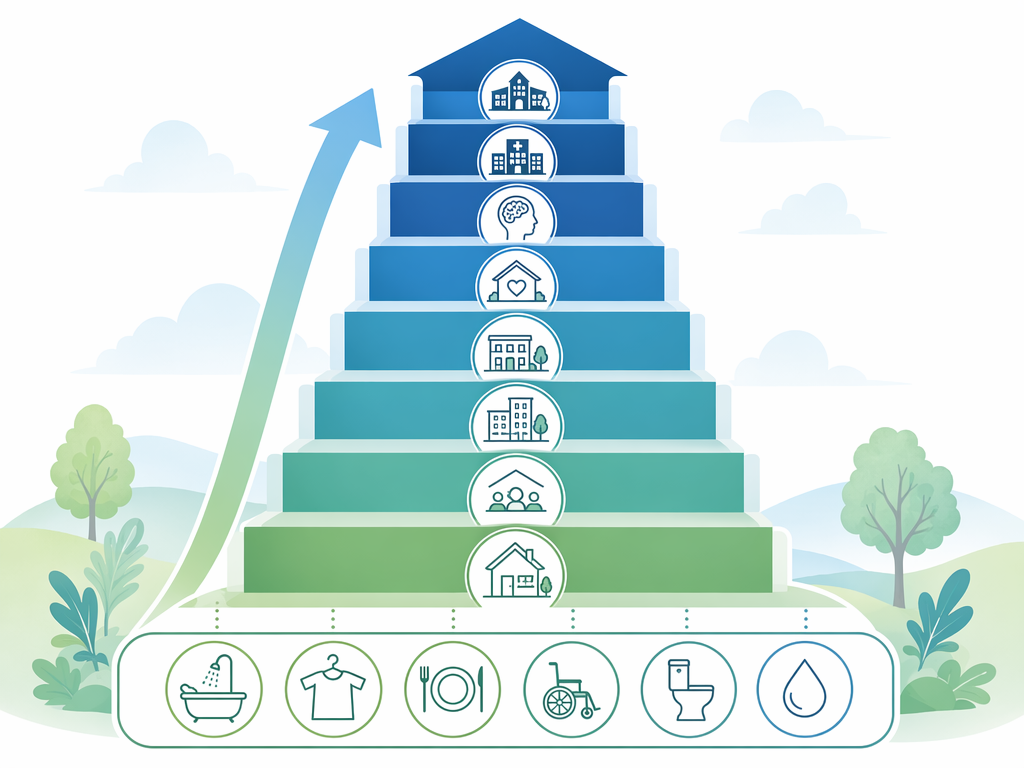
The most effective way to match a senior to the right care setting is to assess their functional ability using the activities of daily living (ADLs) and instrumental activities of daily living (IADLs) frameworks. ADLs are the basic self-care tasks: bathing, dressing, eating, transferring (moving from bed to chair), toileting, and continence management. IADLs are more complex skills needed for independent living: managing medications, preparing meals, handling finances, using transportation, and performing housework.
The number of ADLs a person needs help with is the strongest predictor of the level of care required. The table below maps ADL dependency to appropriate care types.
| ADL Dependency Level | Typical Number of ADLs Needing Help | Appropriate Care Options |
|---|---|---|
| Minimal | 0–1 ADLs; some IADL help needed | Independent living, adult day services, limited home care |
| Moderate | 2–3 ADLs; multiple IADLs | Home care (10–40 hrs/wk), assisted living, board & care |
| High | 3–4 ADLs; dementia-related needs | Memory care, assisted living with enhanced care, board & care |
| Very High | 4–6 ADLs; complex medical needs | Skilled nursing facility, CCRC skilled nursing level |
For a more detailed framework on matching care to mobility and independence levels, see our decision framework for senior home living options. If you are unsure when to transition to a higher level of care, our long-term care timing guide can help.
How to Pay for Senior Care: Medicare, Medicaid, VA Benefits, LTC Insurance, and Private Pay
Understanding how to pay for care is often the most stressful part of the decision. The reality is that most families rely on a combination of sources. Here is how the major payment options work for each care type.
Medicare
Medicare covers almost no long-term custodial care. Its primary coverage for senior living is short-term skilled nursing care after a qualifying hospital stay: Part A covers days 1–20 at $0, days 21–100 with a copay of up to $217 per day in 2026, and coverage ends after 100 days. Medicare also covers limited home health care (skilled nursing or therapy, not custodial care) if it is ordered by a physician and provided by a Medicare-certified agency. It does not cover assisted living, memory care, or long-term nursing home stays.
The 2026 Medicare Part A deductible is $1,736.
Medicaid
Medicaid is the primary payer for long-term nursing home care in the United States. Nationally, Medicaid paid for 82 cents of every dollar spent on nursing home care, according to SeniorLiving.org. Eligibility is based on income and assets, and rules vary significantly by state. Some states also offer Medicaid waivers that cover home care or assisted living for eligible seniors, but these programs have waiting lists in many areas.
VA Benefits
The VA Aid & Attendance benefit provides monthly payments to qualifying veterans and their surviving spouses who need assistance with daily activities. According to the American Council on Aging, 2026 rates are: up to $2,424 per month for a single veteran, up to $2,874 per month for a married veteran, and up to $1,558 per month for a surviving spouse. These funds can be used for home care, assisted living, or nursing home care.
Long-Term Care Insurance
Long-term care insurance policies pay a daily or monthly benefit toward covered care services. Payouts typically range from $2,000 to $10,000 per month, depending on the policy. Most policies cover home care, assisted living, memory care, and nursing home care. However, policies must be purchased before a person needs care, and premiums can be expensive for older buyers.
Private Pay and Other Sources
For many families, private pay — using personal savings, retirement funds, or proceeds from selling a home — is the default option, at least initially. Other potential sources include reverse mortgages, life insurance conversions, and bridge loans. For a comprehensive look at all available funding sources, see our guide on how to pay for elderly care and our financial roadmap for hidden costs.
| Payment Source | Covers | Does Not Cover | Key Limitation |
|---|---|---|---|
| Medicare | Short-term skilled nursing (up to 100 days), limited home health | Long-term custodial care, assisted living, memory care | Requires qualifying hospital stay; copays after day 20 |
| Medicaid | Nursing home care (82% of national spend), some home care waivers | Most assisted living (varies by state) | Income and asset limits; state-specific rules |
| VA Aid & Attendance | Home care, assisted living, nursing home care | Non-qualifying veterans or spouses | Requires VA pension eligibility and medical assessment |
| Long-Term Care Insurance | Home care, assisted living, memory care, nursing home | Pre-existing conditions if not covered at purchase | Must be purchased before care is needed |
| Private Pay | Any care type | None | Depletes savings rapidly at $6,000–$11,000+/mo |
Decision Flowchart: Which Senior Care Option Is Right for Your Family?
Use the following step-by-step process to narrow the nine options down to two or three viable candidates for your family's situation.
- Assess hours of care needed per week. If fewer than 10 hours, adult day services or limited home care may suffice. If 40–50+ hours, compare the cost of full-time home care against assisted living or board & care.
- Count the ADLs requiring assistance. Use the ADL table above to identify which care types match the current dependency level. If memory loss or wandering is present, prioritize memory care or a secure dementia unit.
- Evaluate medical complexity. If the senior needs daily skilled nursing (wound care, IV medications, ventilator support), a skilled nursing facility is the only appropriate option. If medical needs are stable, home care or assisted living may work.
- Determine the budget and available payment sources. Calculate monthly income (Social Security, pensions, VA benefits) and available assets. If the senior qualifies for Medicaid, nursing home care is covered. If they have long-term care insurance, check the policy's daily benefit and covered settings.
- Consider future needs. If the senior's condition is likely to progress (e.g., Parkinson's disease, dementia), a CCRC or a facility that offers multiple levels of care may prevent a disruptive move later.
- Visit and compare. Once you have identified 2–3 viable options, tour facilities or interview home care agencies. Ask about staff-to-resident ratios, caregiver training, and how they handle emergencies.
For a more detailed step-by-step decision process, see our guide for first-time family caregivers.
Frequently Asked Questions About Senior Care Options
Is home care always cheaper than a nursing home?
No. Home care is cheaper than a nursing home only when fewer than 40–50 hours of care are needed per week. At 44 hours per week, home care costs approximately $6,478 per month, compared to $9,581–$9,842 for a semi-private nursing home room. However, at 60+ hours per week, home care becomes significantly more expensive than a nursing home, according to A Place for Mom's analysis.
Does Medicare pay for assisted living?
No. Medicare does not cover the cost of assisted living, memory care, or any long-term custodial care. Medicare only covers short-term skilled nursing care (up to 100 days) after a qualifying hospital stay and limited home health care for skilled services.
What is the difference between a board and care home and assisted living?
Board and care homes are smaller (typically 4–10 residents), operate in a residential house setting, and are often less expensive ($6,000–$7,300 per month) than traditional assisted living ($6,200 per month median). Assisted living communities are larger, more regulated, and offer more amenities and activities. Board and care homes can be a good fit for seniors who prefer a quieter, more intimate environment.
Can a CCRC be a good value?
Yes, for seniors who can afford the entrance fee ($100,000 to over $2 million) and who will likely need multiple levels of care over time. The value of a CCRC is that residents do not have to move to a different community as their needs increase. However, the high upfront cost makes CCRCs inaccessible to most families, and contract types vary — some offer limited refunds of the entrance fee, while others are non-refundable.
What if my parent needs care now and I don't know where to start?
Start with a functional assessment by the primary care physician or a geriatric care manager. Determine how many ADLs require assistance and whether there are any medical needs that require skilled nursing. Then use the decision flowchart above to narrow the options. If the situation is urgent, respite care can provide immediate temporary support while you evaluate longer-term options. Our step-by-step guide for first-time caregivers is designed for exactly this situation.
Browse more in the Glossary.