
Protect Seniors from Falls When Air Quality Alerts Arrive
Poor air quality from wildfire smoke and heat waves raises seniors' fall risk through dizziness and reduced oxygen. This guide explains how to prepare your home and adjust routines during alerts to protect against both breathing issues and falls.
When an air quality alert hits your phone, the first instinct is usually respiratory: close the windows, run the filter, keep the older adult inside. That is necessary, but it is not enough. For a senior who already uses a cane, gets lightheaded when standing, takes blood pressure medication, or has been a little more forgetful lately, a smoky day can also become a fall day.
The strongest reason to take that seriously is a 2025 Maturitas study of 9,869 participants using Chinese CHARLS cohort data. It found that moderate-to-high PM2.5 exposure was associated with 16% to 29% higher odds of falls, with higher risk among women, adults over 60, and people with cognitive impairment.[1] That does not mean every U.S. household should apply the exact same exposure levels to its own ZIP code. It does mean fine-particle pollution belongs in the same practical conversation as loose rugs, poor lighting, and rushed bathroom trips.
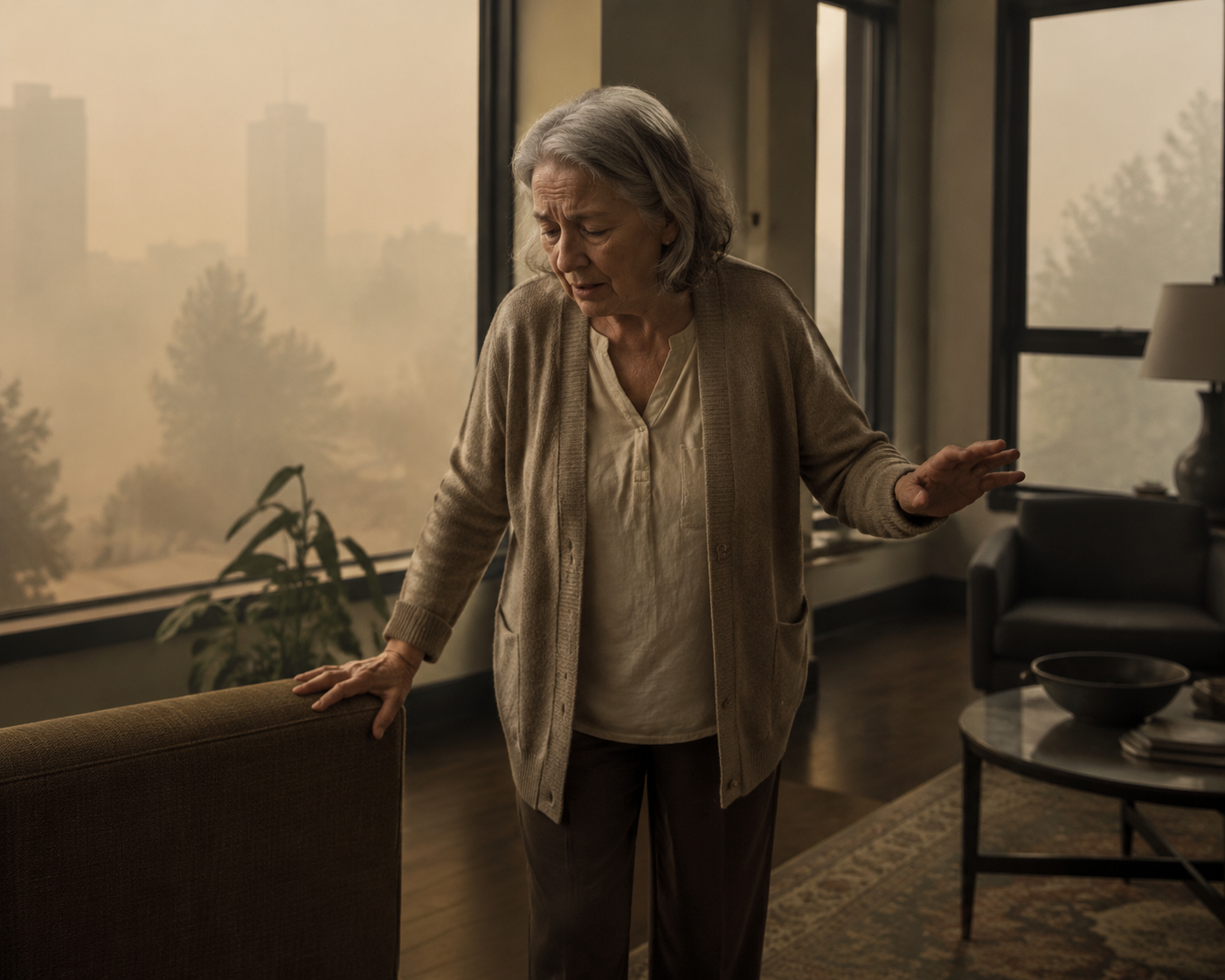
Wildfire smoke gives that risk a U.S. scale. A 2024 NBER analysis estimated that wildfire smoke causes about 191,541 excess emergency department visits and about 10,070 premature deaths each year among Americans over 65, based on Medicare data from 2008 through 2018.[2] That time window matters because wildfire seasons have not become calmer since then. Even if those estimates are treated as a conservative baseline, they make one point hard to ignore: smoke days are not a nuisance for older adults. They are health events.
Falls are already shaped by the home environment. One review found that environmental hazards account for about 31% of falls in older adults.[3] Air quality is not the kind of hazard you trip over, but it can make the person more likely to trip over what was already there.
Why smoky air can turn into a fall risk
PM2.5 refers to fine particles small enough to be inhaled deeply. During wildfire smoke events, those particles can worsen breathing, strain the heart and lungs, and leave an older adult moving through the day with less reserve. Fall prevention is often about reserve: enough oxygen, enough balance, enough attention, enough leg strength to recover when something goes slightly wrong.
Dizziness is the most obvious bridge. Dizziness and vertigo are directly involved in about 13% of falls.[1] On a bad air day, a senior may stand up from a chair and feel a little off, not dramatically ill. That is exactly the kind of symptom that gets dismissed until it shows up at the doorway, the bathroom threshold, or the step into the garage.
Reduced oxygen saturation can also change how steady someone feels. If a person with COPD, asthma, heart disease, or recent respiratory illness is working harder to breathe, walking across the kitchen may take more effort than it did yesterday. The fall risk is not just the smoke itself. It is the extra pause at the counter, the hurried reach for a chair, the decision to skip the walker because it is across the room.
Fatigue matters more than caregivers are usually told. Weakness after a poor night of sleep, dehydration during a heat wave, or the simple drag of breathing smoky air can make ordinary routines less safe. A senior who normally walks to the mailbox may be fine on a clear morning and unsteady on a smoky afternoon. The routine did not change. The margin of safety did.
Confusion is another pathway, but it needs careful handling. Research on air pollution and cognition is still emerging, and it should not be stretched into a simple dementia claim. For fall prevention, the practical issue is narrower: on a poor air day, some older adults may seem foggier, slower to react, or less aware of where the walker, oxygen tubing, slippers, or pets are. That reduced situational awareness is enough to matter.
Medication can add another layer. Antihypertensives, diuretics, sedatives, and some other drugs can contribute to lightheadedness, dehydration, sleepiness, or slower reaction time. Poor air does not have to be the only cause. It can be the extra stressor that makes an already delicate balance problem show itself.
Before an alert: prepare as if balance will be worse
The best time to handle an air quality alert is before anyone is dizzy, coughing, hot, or tired. If the person you care for is already at fall risk, add air quality to the same home-safety routine you use for lighting, grab bars, shoes, clutter, and medication review. The CDC’s STEADI approach is built around identifying fall risks before the injury happens; poor air quality fits naturally into that prevention mindset.[4]
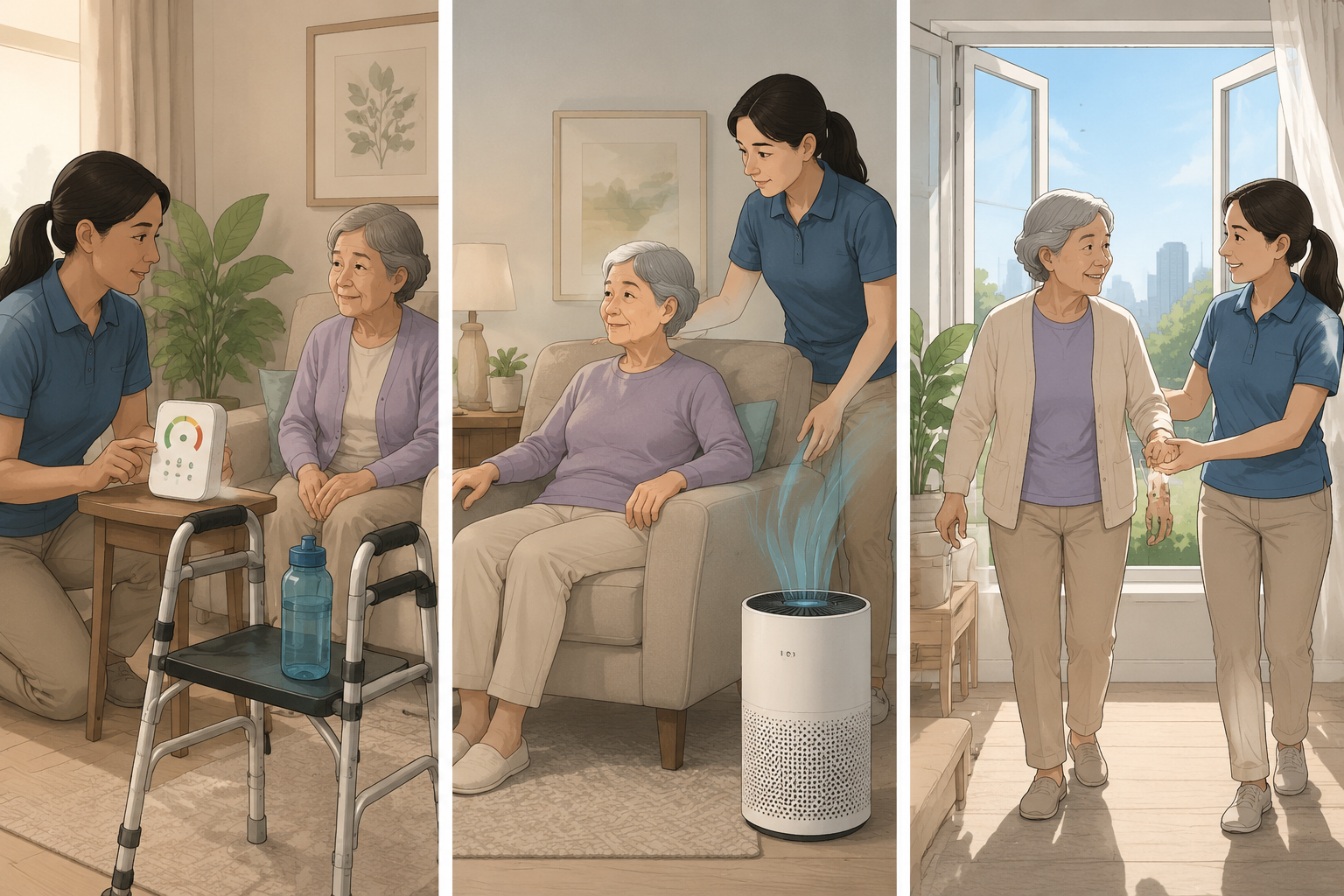
Start with the walking paths, not the gadget shelf. Clear the route from bed to bathroom, chair to kitchen, and entryway to favorite seat. Put the walker, cane, glasses, phone, water, rescue inhaler, and any prescribed oxygen equipment where they will actually be used. A device in the closet is not part of the safety plan.
- Check that night-lights work in the bedroom, hallway, and bathroom.
- Move throw rugs, cords, pet bowls, and low stools out of high-traffic routes.
- Place sturdy seating near areas where the person may need to pause.
- Keep supportive shoes or nonskid slippers ready; smoky days are not the day for loose socks.
- Make sure mobility aids are close before bedtime, not after the first unsteady trip.
Then look at air readiness. A HEPA air purifier can help reduce indoor particles in the room where the senior spends the most time, and an air quality monitor can help a caregiver notice when indoor air is not improving. Those are categories, not brand recommendations. If you are deciding what is worth buying, use product-neutral criteria such as room size, filter type, maintenance cost, visibility of readings, and whether the older adult can operate it safely. Our home safety products guide for seniors is a better place for that decision than a rushed purchase during a smoke plume.
Medication planning belongs in the same preparation step. Keep a 7- to 10-day supply of routine medications when possible, especially during wildfire season or heat waves, so a pharmacy trip does not become unavoidable on the worst air day. If the person uses a rescue inhaler or other breathing treatment, it should be visible, current, and easy to reach. If medication side effects have already caused dizziness or near-falls, ask the clinician or pharmacist what symptoms should trigger a call during poor air quality.
During an alert: shrink the day
On alert days, the goal is not to keep life perfectly normal indoors. The goal is to reduce the number of moments when a tired, under-oxygenated, distracted person has to improvise. That may mean fewer trips across the house, fewer stairs, shorter showers, seated grooming, and postponing chores that require bending, carrying, or reaching.
| Usual routine | Safer alert-day adjustment |
|---|---|
| Morning walk outside | Indoor walking in short intervals near stable furniture or with a mobility aid |
| Long shower while standing | Seated shower, shorter bathing, or sponge bath if the person is tired |
| Laundry, trash, or garage tasks | Delay the task or have someone else do it |
| Multiple trips for water, phone, glasses, or medications | Set up a small station near the main chair |
| Stairs used out of habit | Keep the day on one level when possible |
The symptom check should be fall-specific, not just breathing-specific. Coughing and wheezing matter, but so do the signs that someone should not be walking alone right now: new dizziness, unusual sleepiness, confusion, slower responses, a shuffling gait, reaching for walls, sudden weakness, or saying, “I just feel off.” That last phrase deserves attention. Older adults often describe instability in plain language before it becomes a fall.
Heat makes this harder. Air quality alerts often arrive with hot weather, and heat can worsen dehydration, fatigue, and lightheadedness. Encourage fluids if medically appropriate, keep the room cool, and watch for the person trying to “just get one thing done” before sitting down. That is a familiar setup for a fall: a small task, done quickly, when the body has less reserve than usual.
If the senior has cognitive impairment, simplify the environment rather than adding instructions. Put the walker in front of the chair. Put the water within reach. Close doors to rooms that do not need to be used. Keep the main path bright. A person who is foggy or anxious may not remember a warning, but they can still benefit from a home arranged so the safer choice is the easiest one.
For caregivers who cannot be there in person, the check-in script should be concrete. Instead of asking, “Are you okay?” ask, “Did you feel dizzy when you stood up today?” “Are you using your walker every time?” “Is your inhaler next to your chair?” “Have you been to the bathroom safely?” The answers are more useful, and the questions remind the older adult which risks matter today.
When to escalate
Call the person’s clinician, nurse line, or emergency services according to their care plan if breathing becomes difficult, chest pain appears, oxygen levels drop below the threshold their clinician has set, confusion is new or worsening, the person cannot walk safely to the bathroom, or a fall or near-fall occurs. A near-fall counts. If someone had to grab a wall, furniture, or another person to stay upright, the day’s plan needs to change.
After an alert: do not rush the rebound
The first clearer day can be misleading. The alert may end before the older adult’s energy, breathing, sleep, and confidence are fully back. This is when caregivers often reopen the normal routine too fast: a full shower, errands, stairs, laundry, and a walk all return at once. If the person has been sitting more than usual for a few days, leg strength and stamina may be lower.
Bring activity back in layers. Start with short indoor walks, then essential outdoor trips, then longer errands or exercise. Watch the first few transfers of the day: bed to standing, toilet to standing, chair to walking. Those moments reveal whether the person is truly back to baseline or just eager to be done with the alert.
This is also the right time to review what almost went wrong. Did the walker end up across the room? Was the air purifier too loud, too heavy, or placed where it created a cord hazard? Did the senior avoid drinking water to reduce bathroom trips? Did a phone call reveal confusion that was not obvious in person? Those are not failures. They are instructions for the next alert.
Add air quality to the fall-prevention checklist you already use
Most fall-prevention checklists already ask the right kind of questions: Is the path clear? Is the lighting good? Are medications causing dizziness? Is the person using the right mobility aid? An air quality alert adds one more layer: will today’s air make those same risks worse?
If you already use a STEADI-style home review, do not build a separate smoke-day system. Extend the one you have. The room-by-room approach in our CDC STEADI fall prevention checklist for home can carry the air-quality layer: bedroom setup before sleep, bathroom safety during fatigue, kitchen paths when visibility and attention are worse, and entryway decisions when outside air is unhealthy.
- Bedroom: walker, phone, water, glasses, and light within reach before bedtime.
- Bathroom: grab bars, nonskid surface, seated bathing option, and no rushed trips.
- Kitchen: clear route, stable chair nearby, frequently used items moved to waist height.
- Living room: cords managed, purifier placed without creating a trip hazard, mobility aid nearby.
- Entryway: outdoor errands delayed, shoes supportive, masks or supplies reachable if a trip is medically necessary.
The point is not to panic every time the air quality index changes color. It is to stop treating poor air as only a lung problem. For an older adult with limited balance reserve, smoke, heat, fatigue, and medication effects can stack up quickly.
When an air quality alert arrives, treat it the way you would treat a home-hazard alert: clear the path, slow the routine, watch the first signs of unsteadiness, and restart normal activity gradually. The day is already full. This is one more risk worth making visible before someone is on the floor.
References
- Maturitas 2025 study, Maturitas, November 2025.
- Health Consequences of Wildfire Smoke, NBER, 2024.
- Environmental hazards and falls in older adults, PMC.
- CDC STEADI fall prevention model, CDC.
Related reading
Noticed something outdated or inaccurate on this page? Flag a correction. We review every report against CDC, NIA, and AARP HomeFit guidance before updating a page.
Part of the Fall Prevention section.