
Air Quality Alert Safety Checklist for Seniors
When an air quality alert is issued, seniors face heightened risks from wildfire smoke and pollution. This checklist walks family caregivers through advance preparation, protective steps during an alert, and when to seek emergency care.
If an air quality alert just appeared on your phone and a senior is at home, start with the house, not the sky. The goal is simple: reduce how much polluted outdoor air gets inside, give the person one cleaner room to spend time in, avoid adding particles indoors, and watch for symptoms early enough that a bad breathing day does not become an emergency room visit.
Older adults are treated as a higher-risk group in federal air-quality guidance because aging lungs, heart disease, asthma, COPD, diabetes, weaker immune response, and some medication burdens can make smoke and pollution harder to tolerate. AirNow’s color-coded AQI is useful because it is already on weather apps, but for a senior, the safer interpretation is conservative: yellow means start paying attention, orange means change the day’s plan, and red or worse means keep the person in the cleanest indoor air you can create.[1]
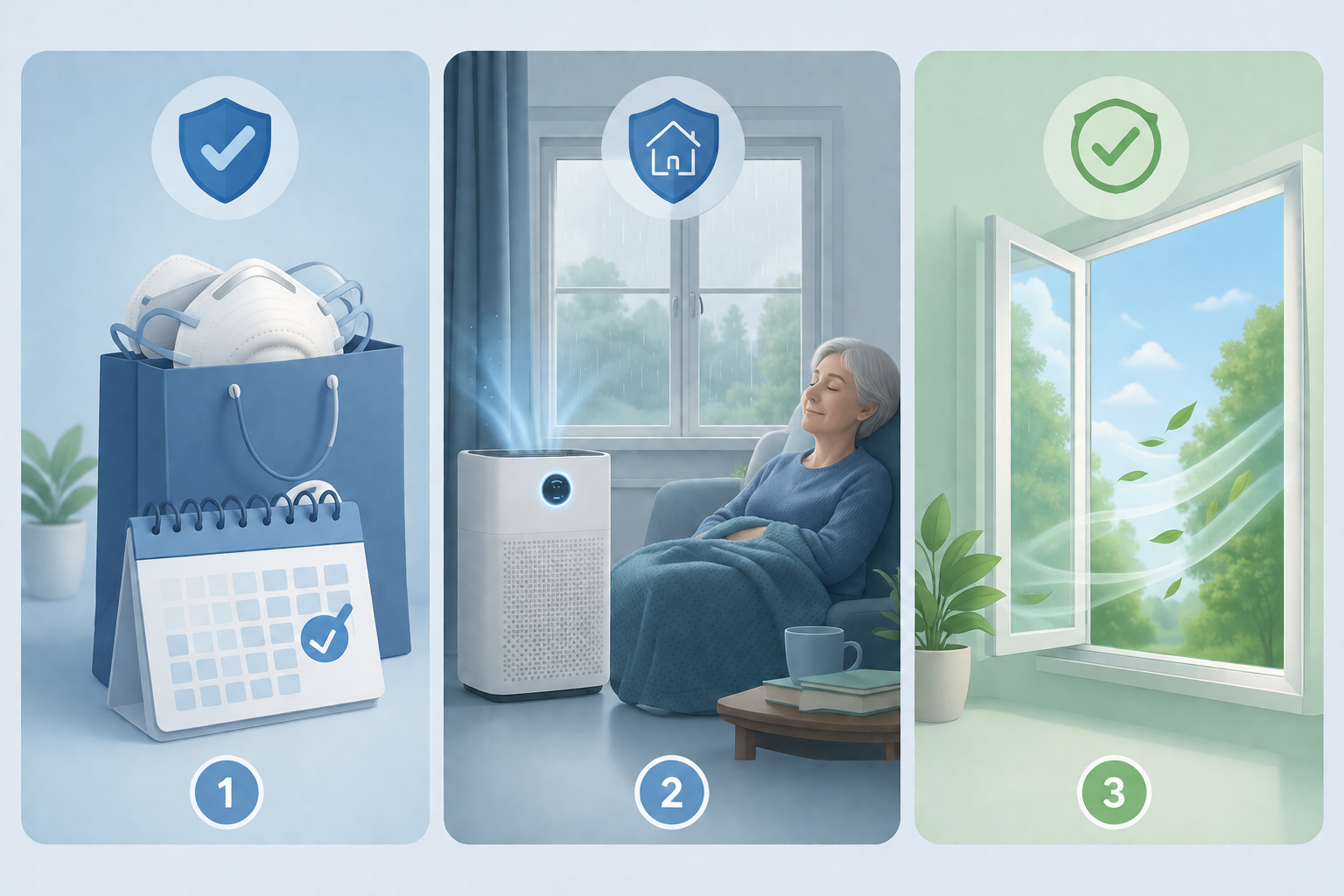
Read the Alert Like a Caregiver
The AQI color is not a mood ring. It is a decision aid. A healthy adult may look at orange and think about shortening a run. A caregiver should look at orange and ask whether the parent with COPD, heart failure, dementia, or recent pneumonia should be walking to the mailbox, sitting near an open window, or waiting until tomorrow for errands.
| AQI Color on the App | Caregiver Interpretation for a Senior at Home |
|---|---|
| Green | Normal routines are usually reasonable, but keep medications, inhalers, and emergency contacts easy to find. |
| Yellow | Begin checking symptoms and shorten optional outdoor time, especially for asthma, COPD, heart disease, or recent respiratory illness. |
| Orange | Treat the senior as sensitive. Move exercise and chores indoors, close windows, and prepare the clean room. |
| Red | Keep the senior indoors as much as possible, use filtered air, and avoid indoor particle sources such as frying, candles, and vacuuming. |
| Purple or Maroon | Use the clean room as the default living space, cancel non-urgent outings, and have a low threshold for medical advice if symptoms appear. |
The reason to take the orange-and-above range seriously is not theoretical. During wildfire smoke days when AQI was above 101, asthma-associated emergency department visits were 17% higher than expected nationwide in CDC surveillance published in 2023.[2] That does not mean every older adult will have an asthma emergency. It does mean a smoke alert can turn into a same-day medical problem for people whose lungs are already vulnerable.
Before an Alert: Build the Plan You Cannot Improvise
The most useful air quality alert safety steps for seniors are boring before they are urgent. A filter is already in the closet. The respirator is already the right kind. The oxygen concentrator has a backup plan. The neighbor knows which door to use. That preparation matters because by the time smoke is visible or the alert turns red, the caregiver may be at work, the pharmacy may be busy, and the parent may already be coughing.
Stock the Small Supplies First
- NIOSH-approved N95 respirators or P100 respirators in the senior’s size, stored where a helper can find them.
- A working pulse oximeter if the senior’s clinician already uses oxygen saturation as part of their care plan.
- Current inhalers, nebulizer supplies, oxygen tubing, CPAP supplies, and written instructions for when to use rescue medications.
- A 7- to 10-day supply of needed prescriptions when possible, so a smoke alert does not force a pharmacy trip.[3]
- Printed emergency contacts, medication list, diagnoses, pharmacy number, primary care number, and preferred hospital.
If the family already keeps an emergency contact binder for aging parents, add an air-quality page to it: where the masks are, which room becomes the clean room, which windows are hard to latch, whether the HVAC can run on recirculate, and what oxygen or CPAP backup exists. If there is no binder yet, one sheet taped inside a kitchen cabinet is still better than instructions buried in a group text.
Choose the Clean Room
Pick one room before the alert, preferably a bedroom or den with few exterior leaks, a door that closes, enough space to sit or sleep, and an outlet that can safely handle an air purifier. A clean room is not a sterile room. It is the room where the household concentrates its best filtration and keeps extra particle sources out.
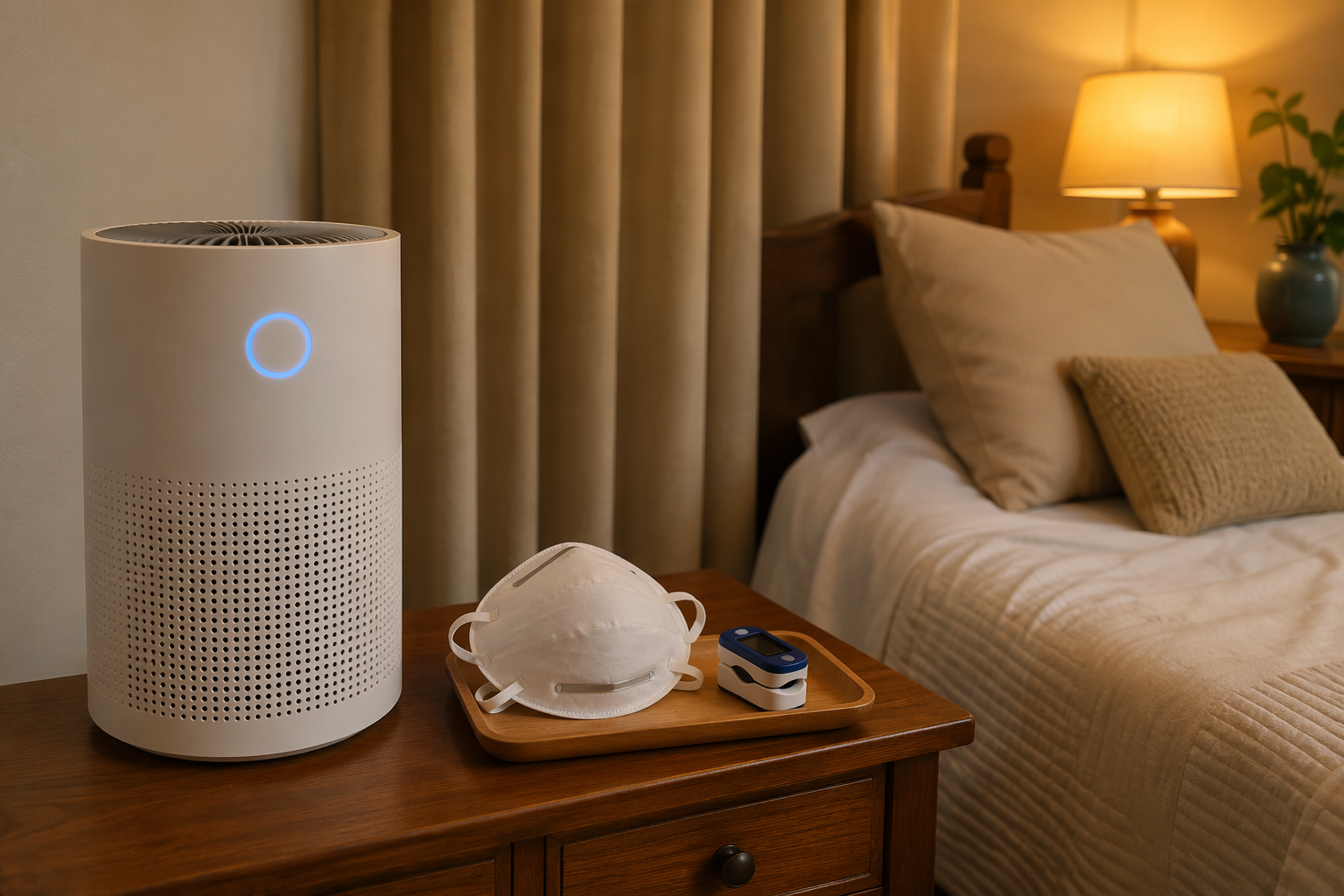
EPA guidance describes creating a clean room with closed windows and doors and portable air cleaning when available. Evidence cited in EPA’s clean-room guidance reports that a designated clean room with HEPA filtration can reduce indoor particle levels by up to 45% during smoke events.[4] That is a meaningful reduction, not a guarantee. On a heavy smoke day, the clean room may still contain more fine particles than anyone would like, but it is usually better than letting the whole house breathe outdoor air.
- Place a true HEPA portable air cleaner in the room if the household has one.
- Check that the device is sized for the room and that the filter is not overdue for replacement.
- Remove candles, incense, aerosol sprays, and unnecessary clutter that collects dust.
- Keep medications, water, phone charger, glasses, hearing aids, mobility aids, and a light blanket within reach.
- If dementia is part of the care picture, add a familiar chair, clock, family photo, or other cue that makes the room feel normal rather than punitive.
Check the House Systems
The HVAC system does not need to be perfect to be useful. Check the filter size before smoke season or before forecasted bad-air days. If the system can safely use a higher-efficiency filter, upgrade before the alert rather than during it. If a clinician, HVAC professional, or equipment manual warns against a certain filter because it restricts airflow, follow that instruction; a struggling system is not a safety plan.
- Find the thermostat setting for recirculate or fan-only operation, if available.
- Replace visibly dirty HVAC filters before the smoke season or when an alert is forecast.
- Seal obvious gaps in the clean room with temporary weatherstripping or a rolled towel if smoke odor enters.
- Do not plug an oxygen concentrator, CPAP, space heater, and purifier into an overloaded power strip.
- Confirm where backup batteries, extension cords approved for the device, or generator instructions are kept.
For seniors who depend on oxygen concentrators, powered hospital beds, CPAP, BiPAP, refrigerated medication, or other electric medical equipment, call the utility before the emergency season and ask about medical baseline or medical needs registration. It will not prevent every outage, but it can put the household in the right category before a smoke event overlaps with heat, wind, or power shutoff risk.
Long-distance caregivers need one more layer: a named local checker. If you cannot get to the home when the alert worsens, decide now who can close windows, turn on the purifier, verify the senior is in the clean room, and report symptoms. A first-hour emergency response plan for long-distance caregivers is especially useful when the person at risk insists they are “fine” while standing outside watering plants.
During an Alert: Tighten the Home Routine
Once the alert is active, the household rule changes from “normal day with caution” to “fewer particles in, fewer particles made indoors, fewer reasons to go outside.” This is where vague advice fails. Someone needs to close the window in the spare room, switch the air setting, move the parent’s book and water into the clean room, and cancel the errand that can wait.
- Check AirNow.gov or a trusted local AQI source and note whether the color is worsening, improving, or holding steady.[1]
- Close windows and exterior doors. Check the bathroom, laundry room, basement, and any room the senior does not usually enter.
- Run central air on recirculate if the system allows it, and use the clean-room HEPA purifier continuously.
- Move the senior’s daytime routine into the clean room: phone, medications, water, tissues, eyeglasses, hearing aids, walker, and charger.
- Postpone outdoor chores, non-urgent appointments, and errands until AQI improves.
- Check symptoms at set times rather than waiting for the senior to complain.
Stop Adding Particles Indoors
A closed house can still become irritating if the household creates particles inside it. During an alert, pause the chores and comforts that make the air worse, even if they are harmless on an ordinary day.
- Do not burn candles, incense, wood, or gas logs.
- Avoid frying, broiling, or high-heat cooking that produces smoke or strong fumes.
- Do not vacuum unless the vacuum has a high-efficiency filter and the task cannot wait.
- Skip aerosol sprays, harsh cleaning fumes, and hobby materials with strong odors.
- Keep pets brushed and active play out of the clean room if dust and dander trigger symptoms.
Meals can be simple on bad-air days: microwave, slow cooker, cold plates, sandwiches, reheated soup, or anything that does not fill the kitchen with smoke. This is not the day to deep-clean the carpet before company arrives.
If the Senior Must Go Outside
Some trips cannot be avoided: a medical appointment, a power outage, a pet emergency, a mailbox with medication delivery. Keep the trip brief, reduce exertion, and use the right face covering. Cloth masks and ordinary surgical masks are not considered effective protection against fine particle pollution from smoke; NIOSH-approved N95 or P100 respirators are the meaningful options described in medical and consumer health guidance.[5][6]
- Use a NIOSH-approved N95 or P100 respirator, not a loose cloth face covering.
- Check the seal: the mask should cover nose and mouth and fit snugly against the face.
- Do not use a respirator that makes breathing feel harder for a person who has been told by a clinician to avoid tight masks.
- Use the car’s recirculate setting and keep windows closed during the drive.
- Bring rescue medication, phone, water, and a written medication list if the trip is medical.
A respirator is not a permission slip for yard work. It is a backup layer for necessary movement.
Watch the Person, Not Just the Number
AQI tells you about outdoor conditions. It does not tell you whether your father is breathing comfortably in the recliner or whether your mother with dementia is more confused because she is short of breath, dehydrated, frightened, or off her routine. During an alert, check the person directly.
- Coughing that is new, worsening, or not settling indoors.
- Wheezing, chest tightness, or needing rescue inhaler more often than usual.
- Shortness of breath while resting, speaking, walking to the bathroom, or lying down.
- Unusual fatigue, dizziness, shakiness, or poor appetite.
- Confusion, agitation, sleepiness, or behavior that is worse than the senior’s usual baseline.
- Pulse oximeter readings that are lower than the person’s usual baseline, if the family has been taught how to use the device.
Families already managing cognitive decline have a special reason to be cautious without turning one study into a certainty. A 2024 JAMA Neurology study reported that higher wildfire PM2.5 exposure was associated with increased odds of dementia diagnosis among adults 60 and older, including an 18% increase in odds per 1 microgram per cubic meter increase in wildfire PM2.5 exposure. The study shows an association, not proof that smoke directly causes dementia in an individual person, but it supports a conservative approach for seniors whose cognition is already fragile.[7]
When to Seek Emergency Care
Do not negotiate with severe breathing symptoms during an air quality alert. Move the person indoors to the cleanest air available while arranging help, but do not wait for perfect indoor air to fix a medical emergency.
- Call emergency services for chest pain, pressure, or pain spreading to the arm, jaw, back, or shoulder.
- Call emergency services for breathing difficulty that does not improve after moving indoors and using prescribed rescue treatment.
- Call emergency services for blue or gray lips, gasping, inability to speak in full sentences, or severe weakness.
- Call emergency services for dizziness, fainting, or confusion that is new or clearly worse than baseline.
- Call emergency services for a pulse oximeter reading below 90%, or a significant drop from the senior’s usual baseline if a clinician has given a different threshold.
- Call the clinician promptly for worsening cough, wheezing, increased rescue inhaler use, fever, or lingering shortness of breath even if symptoms are not yet severe.
For a senior with COPD, asthma, heart failure, recent pneumonia, or oxygen use, ask the primary care clinician ahead of time what “too low” means for that person’s oxygen saturation and when to use rescue medication. Put that instruction in plain language where the spouse, adult child, aide, or neighbor can read it.
After the Alert: Reopen Carefully and Check for Lingering Problems
When the AQI improves, do not throw every window open just because the smoke smell has faded. Check a trusted AQI source first. If outdoor air has improved and local guidance no longer warns sensitive groups to stay inside, ventilate the home in a controlled way: open windows for cross-ventilation, then close them again if smoke odor returns or AQI worsens.
- Replace or check HVAC filters and portable purifier filters according to the device instructions.
- Wipe dust from hard surfaces with a damp cloth rather than dry-dusting particles back into the air.
- Wash bedding or blankets used near open windows, smoky entryways, or the clean room if they smell smoky.
- Ask about cough, wheeze, chest tightness, sleep quality, appetite, dizziness, and energy over the next day or two.
- Contact the primary care provider if breathing symptoms, unusual fatigue, or confusion persist after the air improves.
If this alert exposed gaps in the care plan, fix them while the memory is fresh: buy the correct respirators, replace the missing filter, add backup power notes, update the medication list, and decide who checks the house next time.
References
- Older Adults and Air Quality — AirNow.gov
- Asthma-Associated Emergency Department Visits During a Wildfire Smoke Event — United States, April-August 2023 — CDC MMWR — August 2023
- Air Quality and Health — Johns Hopkins Medicine
- Create a Clean Room to Protect Indoor Air Quality During a Wildfire — EPA
- How to Protect Yourself From Wildfire Smoke — AARP
- Air Quality and Health — Johns Hopkins Medicine
- Wildfire Smoke Exposure and Dementia Risk — JAMA Neurology — 2024
Related reading
Noticed something outdated or inaccurate on this page? Flag a correction. We review every report against CDC, NIA, and AARP HomeFit guidance before updating a page.
Part of the Fall Prevention section.