
The Contractor's Guide to a Bathroom Remodel That Actually Prevents Falls
Most bathroom remodels for elderly safety fail because they focus on surface features instead of structural foundations. This guide provides the contractor-level knowledge adult children need to ensure a remodel truly prevents falls, covering wall blocking, DCOF-rated flooring, curbless showers, and proper lighting.
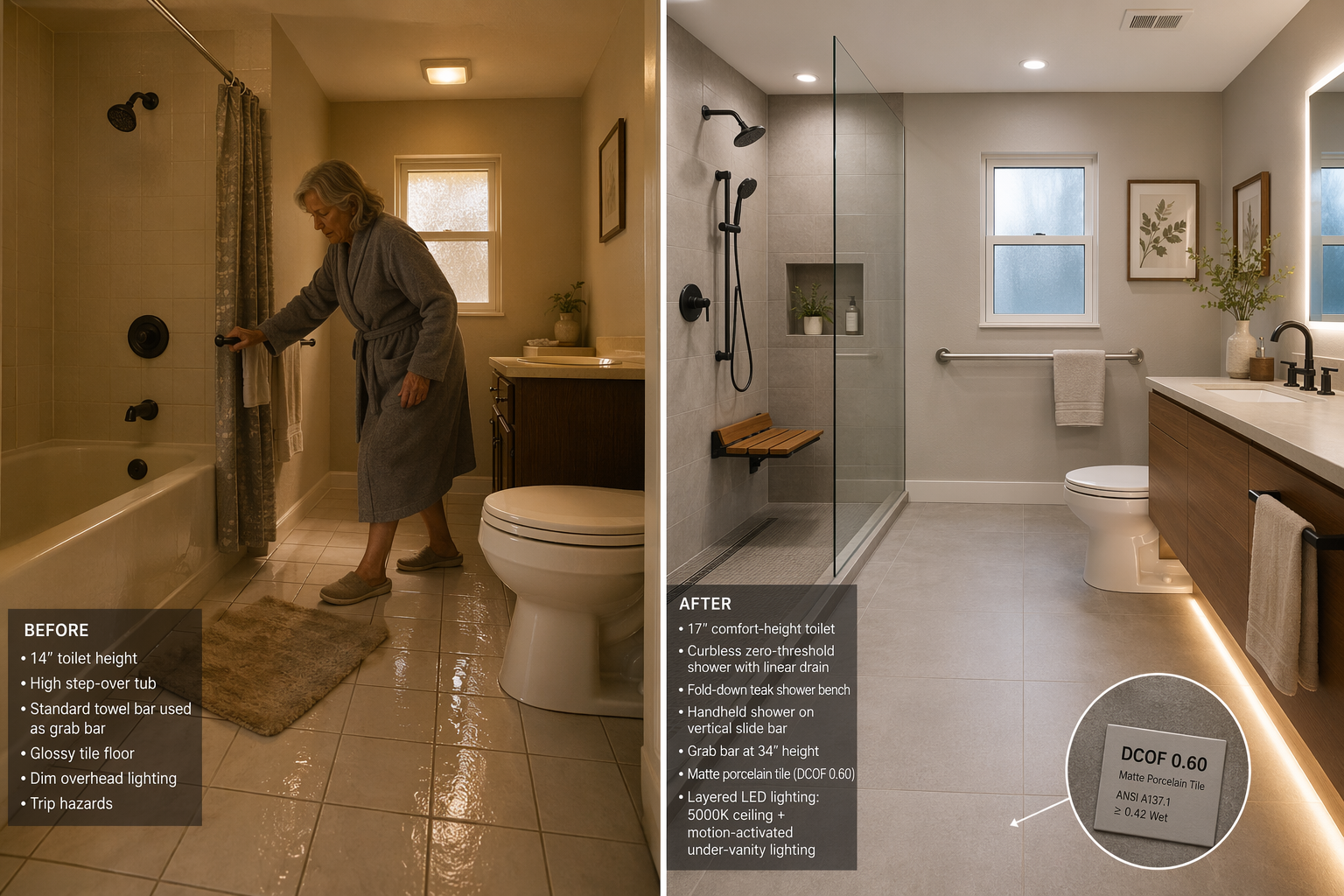
Why Bathroom Falls Happen — and Why Most Remodels Miss the Mark
Every year, approximately 235,000 older adults in the United States visit emergency rooms because of bathroom-related falls, according to CDC data. That is roughly 640 people per day — and the actual number is likely higher, since many falls go unreported. Bathrooms are the most dangerous room in the house for an older adult, and the reasons are not mysterious: hard, wet surfaces, awkward transfer movements, and poor visibility combine to create a perfect environment for a fall.
What is surprising is how many of these falls happen in homes that have already been modified. A 2021 study published in BMC Geriatrics analyzed data from 2,404 Medicare beneficiaries aged 65 and older who had experienced at least one fall. The researchers found that 55.5% of those individuals already had some form of bathroom modification in place. Yet 40.2% of those who had experienced repeated falls — two or more — had no bathroom modifications at all. That represents roughly 1.9 million older adults nationwide.
The gap between those two numbers tells a story. Having a grab bar or a non-slip mat is not the same as having a bathroom that is structurally safe. Many modifications are installed incorrectly — towel bars used as grab bars, mats that shift underfoot, lighting that leaves shadows across the shower threshold. The problem is not a lack of effort. It is a lack of structural thinking.
A truly fall-proof bathroom is built from the studs out, not from the fixture catalog in. That means planning for wall blocking before the tile goes up, specifying flooring by its coefficient of friction rather than its marketing label, and engineering the shower entry so there is no threshold to step over. These are decisions that must be made during the renovation planning phase — not added on afterward. This guide walks through each of those structural decisions in the order a contractor would address them.
The Structural Backbone: Wall Blocking and Grab Bars
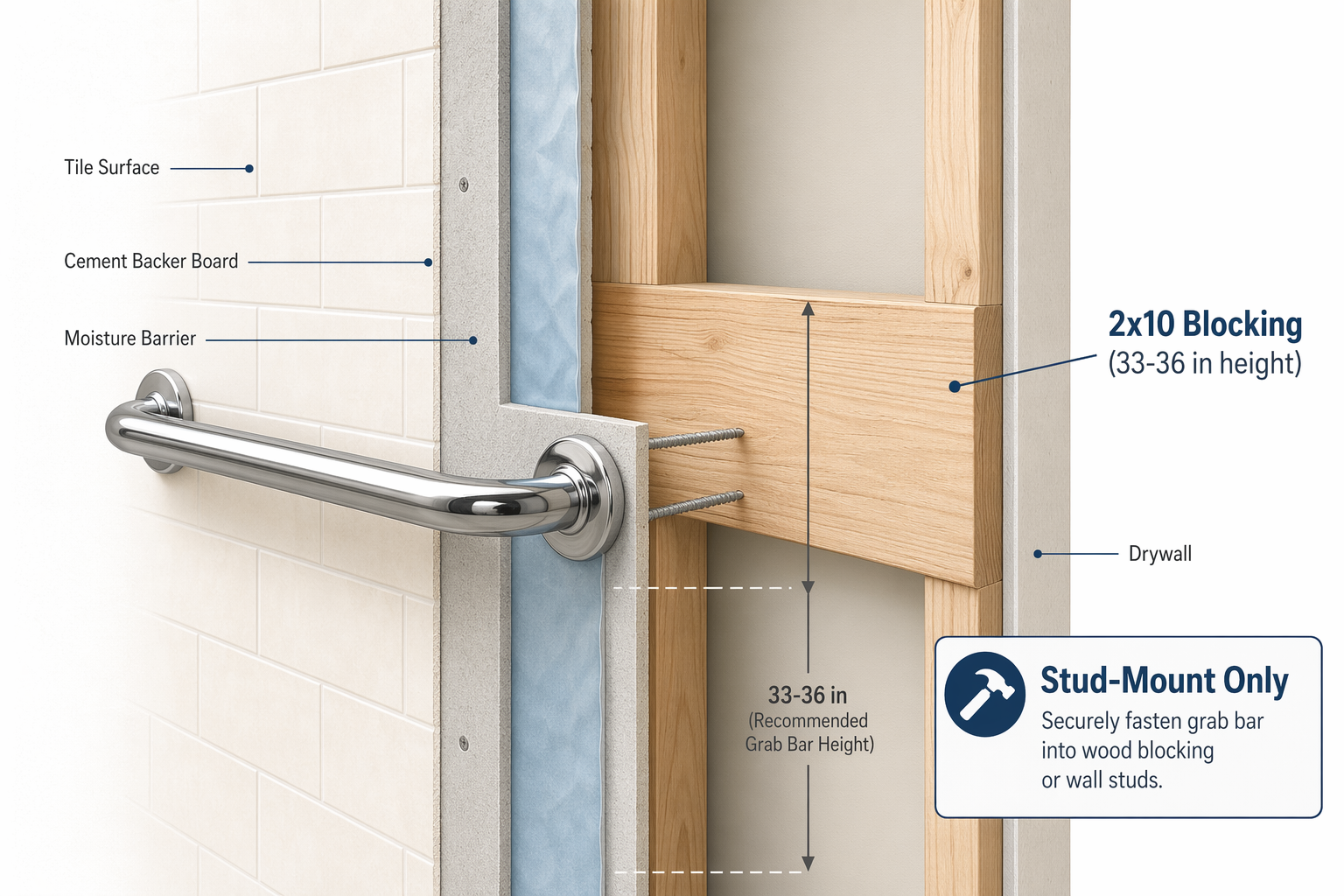
A grab bar is the single most important safety device in a bathroom — but only if it is installed correctly. A grab bar screwed into drywall with toggle bolts will pull out under load. A grab bar screwed into a stud will hold. A grab bar screwed into engineered blocking between studs will hold a person's full body weight under any angle of force.
The standard for safe installation, as outlined by the U.S. Access Board's ADA guidelines and reinforced by contractor best practices, is as follows:
- Install 2x10 horizontal blocking between wall studs at a height of 33 to 36 inches above the finished floor. This is the range that accommodates most standing and seated adults.
- Use grab bars rated for a minimum of 400 pounds of vertical or horizontal force. Many residential-grade bars are rated for 250 pounds, which is the ADA minimum for commercial applications. For an older adult who may fall and grab the bar suddenly, 400 pounds provides a meaningful safety margin.
- Choose bars with a diameter of 1.25 to 1.5 inches. This diameter provides the best grip for arthritic hands. Bars that are thinner or thicker reduce grip effectiveness.
- Mount bars into the blocking using screws that penetrate at least 1.5 inches into solid wood. Surface-mount flanges must be secured with corrosion-resistant fasteners.
- Position bars near the toilet (on the side wall and, if space allows, behind) and on both the inside and outside of the tub or shower area.
The blocking must be installed before the wall is closed up. If you are working with an existing bathroom that has already been tiled, a contractor can install blocking by cutting access holes in the drywall or cement board, but this adds labor cost and requires patching and refinishing. The most cost-effective time to install blocking is during the rough-in phase of a remodel, before any wall surface goes on.
If you are hiring a contractor, put the blocking specification in writing. Ask for 2x10 blocking at 34 inches on center in every wall where a grab bar might ever be needed — even if you are not installing a bar there yet. Future-proofing costs very little during construction and a great deal afterward.
Flooring: Why DCOF 0.60+ Is the Only Standard That Matters
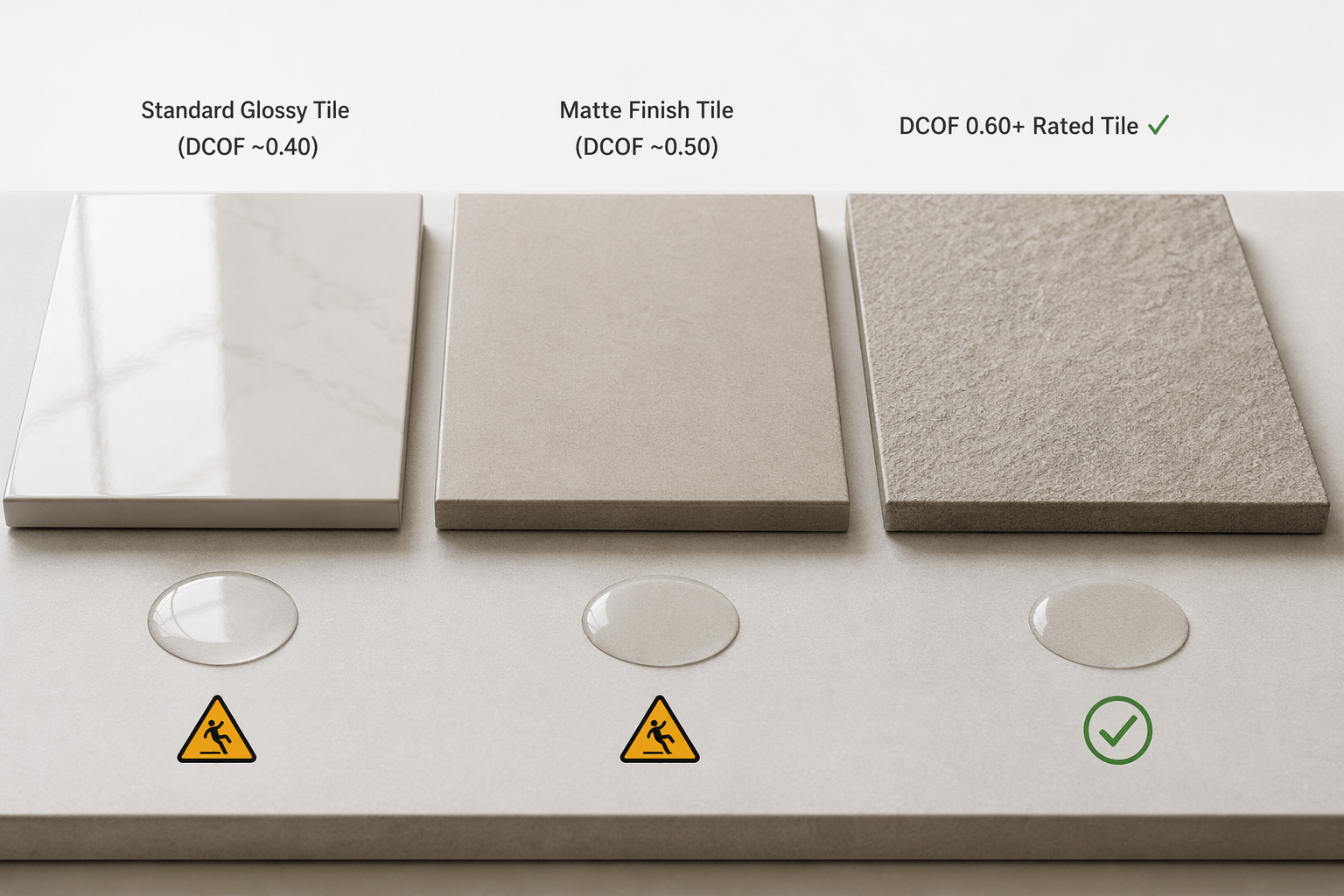
The term "non-slip" on a tile box is a marketing claim, not a measurement. The actual standard for slip resistance is the Dynamic Coefficient of Friction, or DCOF. This is a laboratory measurement of how much friction a tile surface provides when wet. The higher the number, the more slip-resistant the surface.
For bathroom flooring in a home where an older adult lives, the minimum acceptable DCOF rating is 0.60 or higher. This is the threshold recommended by the Tile Council of North America for commercial wet areas, and it is the standard that contractor guides for senior safety consistently cite. Tiles with a DCOF below 0.60 — including most polished porcelain, many large-format glazed tiles, and nearly all glossy finishes — become dangerously slippery when wet.
| Tile Surface Type | Typical DCOF Rating | Safety for Senior Bathroom |
|---|---|---|
| Polished porcelain (glossy) | 0.35 – 0.45 | Unsafe when wet |
| Smooth matte finish | 0.45 – 0.55 | Marginal; may be slippery with soap or water |
| Textured matte porcelain | 0.60 – 0.70 | Safe; recommended for wet areas |
| Mosaic tile (2x2 inch or smaller) | 0.60+ (with grout lines) | Safe; grout lines add traction |
| Natural stone with textured finish | 0.65 – 0.80 | Safe; requires sealing and maintenance |
There is a common misconception that matte-finish tile is automatically slip-resistant. It is not. A smooth matte tile can have a DCOF as low as 0.45 — barely better than polished porcelain. The texture of the tile surface, not its gloss level, determines its friction coefficient. Look for tiles that are explicitly rated as DCOF 0.60 or higher by the manufacturer.
For shower floors specifically, 2x2 inch mosaic tiles are the preferred choice. The grout lines between small-format tiles create hundreds of small ridges that provide additional traction underfoot. Large-format tiles in a shower floor reduce the number of grout lines, which reduces traction. The trade-off is aesthetic — some homeowners prefer the look of large tiles — but in a senior safety remodel, traction should take priority.
Curbless Showers: Eliminating the Highest Tripping Hazard
The single most dangerous movement in a bathroom is stepping over a tub wall or shower curb. It requires lifting the foot 6 to 12 inches, shifting weight to the standing leg, and maintaining balance while the other foot clears the obstacle — all on a surface that may be wet. For an older adult with reduced leg strength, poor balance, or arthritis, this movement is a fall waiting to happen.
A curbless shower — also called a zero-threshold or roll-in shower — eliminates this hazard entirely. The shower floor is level with the bathroom floor, with no step or lip to cross. Water is contained by the slope of the floor and the placement of the drain, not by a physical barrier.
The engineering of a curbless shower requires three elements:
- A linear drain installed along one wall of the shower. Unlike a traditional center drain, a linear drain allows the entire floor to slope in one direction, which makes it possible to keep the shower entry at the same level as the bathroom floor.
- A one-way slope of at least 1/4 inch per foot from the entry edge toward the drain. This slope must be engineered into the subfloor during construction, which often requires recessing the shower area into the floor joists.
- A minimum interior dimension of 30 inches deep by 60 inches wide, per ADA guidelines for a roll-in shower. This provides enough space for a shower chair or transfer bench and allows a caregiver to assist if needed.
Curbless showers are often compared to walk-in tubs, which also eliminate the step-over entry. However, the two options serve different needs. A walk-in tub requires the user to sit down inside a sealed tub, fill it with water, bathe, drain the water, and then stand up and step out — a process that can take 20 to 30 minutes and leaves the user sitting in cooling water. A curbless shower allows the user to stand or sit on a shower chair, control water temperature continuously, and exit at any time.
A curbless shower conversion from an existing tub typically costs between $3,000 and $15,000, depending on whether the drain location needs to be moved and whether the subfloor requires modification. This is one of the highest-impact investments in a senior safety remodel.
Toilet Height, Lighting, Vanity, and Anti-Scald Protection
Beyond the structural elements of grab bars, flooring, and shower entry, several other features determine whether a bathroom is truly safe for an older adult. These are the details that often get overlooked in a standard remodel but make the difference between a bathroom that works and one that creates new hazards.
Toilet Height and Configuration
Standard toilets have a seat height of approximately 14 to 15 inches. For an older adult with reduced leg strength or hip mobility, sitting down and standing up from this height requires significant effort and increases fall risk. A comfort-height toilet — also called an ADA-height toilet — has a seat height of 17 to 19 inches, which is approximately the height of a standard chair. This reduces the range of motion required to sit and stand.
An elongated bowl is also recommended over a round bowl. The elongated shape provides a larger seating surface and makes it easier to use a raised toilet seat or transfer aid if needed in the future. The additional 2 to 3 inches of length can significantly improve comfort and stability for larger individuals.
Lighting: The Invisible Fall Hazard
A 65-year-old needs approximately four times more light than a 20-year-old to see clearly. Yet most bathrooms are lit by a single overhead fixture that casts shadows across the shower, toilet, and vanity areas. Inadequate lighting is an invisible fall cause — the person does not see the hazard because the light is not there.
The recommended lighting strategy for a senior-safe bathroom includes three layers:
- Overhead lighting at 5000K color temperature (daylight white). This provides bright, even illumination that closely matches natural daylight. Avoid warm 2700K-3000K bulbs in the main fixture — they create shadows and reduce contrast.
- Motion-activated night strips installed along the baseboard or under a floating vanity. These provide low-level illumination during nighttime bathroom trips without requiring the user to find a switch. The light should be warm (2700K) to avoid disrupting sleep patterns.
- Task lighting at the vanity mirror, positioned to eliminate shadows on the face. Side-mounted sconces or a lighted mirror are more effective than an overhead light alone.
All light switches should be located at the bathroom entrance, and at least one switch should be a glow-in-the-dark or illuminated type so it can be found in the dark.
Vanity Knee Clearance and Mirror Placement
If the bathroom user may eventually need to sit while using the sink — whether in a wheelchair, a rollator, or a shower chair — the vanity must provide knee clearance. The standard is a minimum of 27 inches of clear space from the floor to the underside of the vanity, with the sink drain offset to the back or side so it does not interfere with the user's knees.
A wall-mounted or floating vanity is the easiest way to achieve this clearance. Pedestal sinks and cabinet-base vanities with toe kicks do not provide adequate knee space. The mirror should be mounted low enough — or on a tilting bracket — so that a seated user can see their reflection without straining.
Anti-Scald Protection
Older adults have thinner skin and reduced sensitivity to temperature, which puts them at higher risk for scalding injuries. A thermostatic anti-scald valve should be installed on the shower and sink supply lines. These valves maintain a consistent water temperature regardless of pressure changes (such as when a toilet is flushed or a washing machine cycles).
The valve should be set to a maximum output temperature of 102°F (approximately 39°C). The U.S. Access Board recommends a maximum of 120°F at the fixture for general safety, but for a senior bathroom where the user may have reduced mobility or sensation, 102°F provides an additional safety margin. Lever-style handles are preferred over cross-handles or knobs, as they require less grip strength and can be operated with a closed fist or elbow.
| Feature | Specification | Why It Matters |
|---|---|---|
| Toilet height | 17-19 inches (comfort height) | Reduces sit-to-stand effort and fall risk |
| Toilet bowl shape | Elongated | Larger surface area; accommodates raised seat if needed |
| Lighting color temperature | 5000K overhead + 2700K night strips | Daylight overhead for visibility; warm night lights for sleep |
| Vanity knee clearance | 27 inches minimum | Allows seated use of sink |
| Mirror | Tilting or low-mounted | Accessible from seated position |
| Anti-scald valve | Thermostatic, set to 102°F | Prevents burns; compensates for pressure changes |
| Faucet handles | Lever-style | Operable with limited grip strength |
What This Remodel Costs — and How to Pay for It
A bathroom remodel for senior safety is an investment. The total cost depends on the scope of work, the region, and whether structural changes (subfloor modification, wall relocation) are required. The following table provides national average cost ranges based on 2026 data from multiple contractor and remodeling sources.
| Modification | National Average Cost Range (2026) | Notes |
|---|---|---|
| Grab bar installation (per bar) | $200 – $600 | Includes blocking if installed during construction; higher if retrofitted |
| Non-slip flooring (per square foot) | $6,400 – $11,000 (full bathroom) | DCOF 0.60+ rated tile; includes labor and subfloor prep |
| Comfort-height toilet (installed) | $300 – $1,200 | Includes removal of old toilet and wax ring replacement |
| Curbless shower conversion (tub to shower) | $3,000 – $15,000 | Linear drain, subfloor modification, tile, glass enclosure |
| Walk-in tub (installed) | $2,000 – $20,000 | Wide range based on features (jets, heated surfaces, door type) |
| Full accessible bathroom remodel | $8,000 – $28,000 | National average; includes all modifications listed above |
| Full primary bathroom remodel (non-specialty) | $18,000 – $80,000 | General remodeling cost; senior safety features add to this base |
The financial case for a bathroom remodel is strong when compared to the cost of alternative care arrangements. A $25,000 renovation can offset an estimated $240,000 to $480,000 in assisted living costs over five years, based on national median assisted living rates. But the upfront cost is still a barrier for many families.
Funding Sources: What Medicare Covers and What It Does Not
Medicare does not cover bathroom remodels. Original Medicare (Parts A and B) considers bathroom modifications to be home improvements, not medical care. There is a narrow exception: Medicare Part B may cover 80% of the cost of durable medical equipment (DME) if it is deemed medically necessary and prescribed by a physician. A grab bar could potentially qualify as DME if prescribed for a specific medical condition, but walk-in tubs, curbless showers, and flooring modifications are very unlikely to be covered.
Medicare Advantage (Part C) plans offer more flexibility. In 2020, only 148 of 3,148 Medicare Advantage plans offered in-home support services, but that number has been growing. Some plans now offer supplemental benefits that can be applied to home safety modifications. Coverage varies by plan and by year, so verification with the specific plan is essential.
| Funding Source | What It Covers | Key Limitations |
|---|---|---|
| Medicare Part B | Durable medical equipment (grab bars if prescribed) | Does not cover structural modifications; requires physician prescription |
| Medicare Advantage (Part C) | Varies by plan; some cover home safety items | Must verify with specific plan; benefits change annually |
| Medicaid HCBS Waivers | Home modifications (state-dependent) | Multi-year waitlists in many states; eligibility varies |
| VA Specially Adapted Housing Grant | Up to $117,014 (2026) for adaptive housing | Must be a qualifying veteran with service-connected disability |
| USDA Rural Repair and Rehabilitation Grant | Up to $10,000 for very low-income homeowners 62+ | Limited to rural areas; income-restricted |
| Tax deduction (medical expenses) | Costs exceeding 7.5% of adjusted gross income | Requires itemizing deductions; must be deemed medically necessary |
For families without access to these funding sources, the most practical approach is often to phase the remodel. Start with the structural elements that are most difficult to retrofit — wall blocking, subfloor preparation for a curbless shower, and electrical rough-in for lighting — and add fixtures and finishes as the budget allows. A contractor can install blocking behind the wall during a partial remodel even if the grab bars are not purchased until later.
The Complete Bathroom Safety Checklist
Use this checklist when meeting with a contractor to ensure every structural and equipment requirement is addressed. Print it out and bring it to the consultation.
- Wall blocking: 2x10 blocking installed between studs at 33-36 inches in all walls where grab bars may be needed (toilet, shower, tub).
- Grab bars: 400lb-rated, 1.25-1.5 inch diameter, stud-mounted into blocking. Positioned near toilet (side and rear) and inside/outside shower.
- Flooring: DCOF 0.60+ rated tile throughout. Shower floor uses 2x2 inch mosaic tiles for grout-line traction.
- Shower entry: Curbless (zero-threshold) with linear drain and one-way slope of 1/4 inch per foot. Minimum interior dimensions 30x60 inches.
- Shower features: Handheld showerhead on a vertical slide bar, fold-down or transferable shower seat, lever-style controls.
- Toilet: Comfort-height (17-19 inch seat), elongated bowl. Installed with 12-inch rough-in or as specified by local code.
- Lighting: 5000K daylight LED overhead fixture. Motion-activated night strips along baseboard or under vanity. Illuminated or glow-in-the-dark light switch at entrance.
- Vanity: Wall-mounted or floating with 27-inch knee clearance. Offset drain. Tilting or low-mounted mirror.
- Anti-scald: Thermostatic mixing valve set to 102°F maximum output. Lever-style handles on all faucets.
- Doorway: Minimum 32 inches clear width (36 inches preferred). Lever-style door handle.
- Electrical: GFCI-protected outlets within 3 feet of water sources. All outlets at least 12 inches above finished floor.
- Ventilation: Exhaust fan rated for the bathroom square footage, vented to exterior (not attic). Timer switch recommended.
Related reading
Noticed something outdated or inaccurate on this page? Flag a correction. We review every report against CDC, NIA, and AARP HomeFit guidance before updating a page.
Part of the Fall Prevention section.