
How to Talk to Your Aging Parent About Fall Risk and Home Safety Without Damaging Their Independence
A staged communication framework for adult children who need to discuss fall risks and home safety with a parent — without triggering resistance or conflict. Includes evidence-based script starters, guidance for responding to the "I'm fine" response, and a post-conversation action plan.

Why the Conversation Is Harder Than the Fix
You have seen the signs: a cluttered walkway, expired medication bottles on the counter, a slight unsteadiness when your mother stands up from the sofa. You know that more than 1 in 4 older adults falls every year and that falls cause more than 95% of hip fractures. You also know that the fix — a grab bar in the shower, better lighting on the stairs, a cleared hallway — is relatively simple. Yet you have not brought it up. You are not alone.
The National Council on Aging identifies this exact hesitation as one of the most persistent myths about older adult falls: “I don’t need to talk to my parent, spouse, or other older adult if I’m concerned about their risk of falling. It will hurt their feelings.” The reality, as NCOA states, is that fall prevention is a team effort, and raising the topic is an act of support — not criticism.
The stress that makes this conversation feel impossible is also well-documented. Research by Schulz et al. (2012) found that nearly half of all caregivers report that they had no choice in taking on the caregiving role, and that lack of perceived choice is associated with increased burden and depression. When you feel forced into the role of “the one who has to say something,” the conversation carries extra emotional weight. This guide is designed to lighten that weight — not by avoiding the topic, but by giving you a clear, evidence-based framework for approaching it.
The Recognize–Validate–Involve–Act Framework
Rather than walking into the conversation with a list of complaints or a pre-made plan, use a staged approach that respects your parent’s autonomy while addressing real risks. The framework has four stages:
- Recognize: Observe and document specific fall risks without generalizing or accusing.
- Validate: Acknowledge your parent’s feelings, autonomy, and desire to remain independent.
- Involve: Collaborate on solutions rather than dictating them.
- Act: Take concrete, shared next steps together.
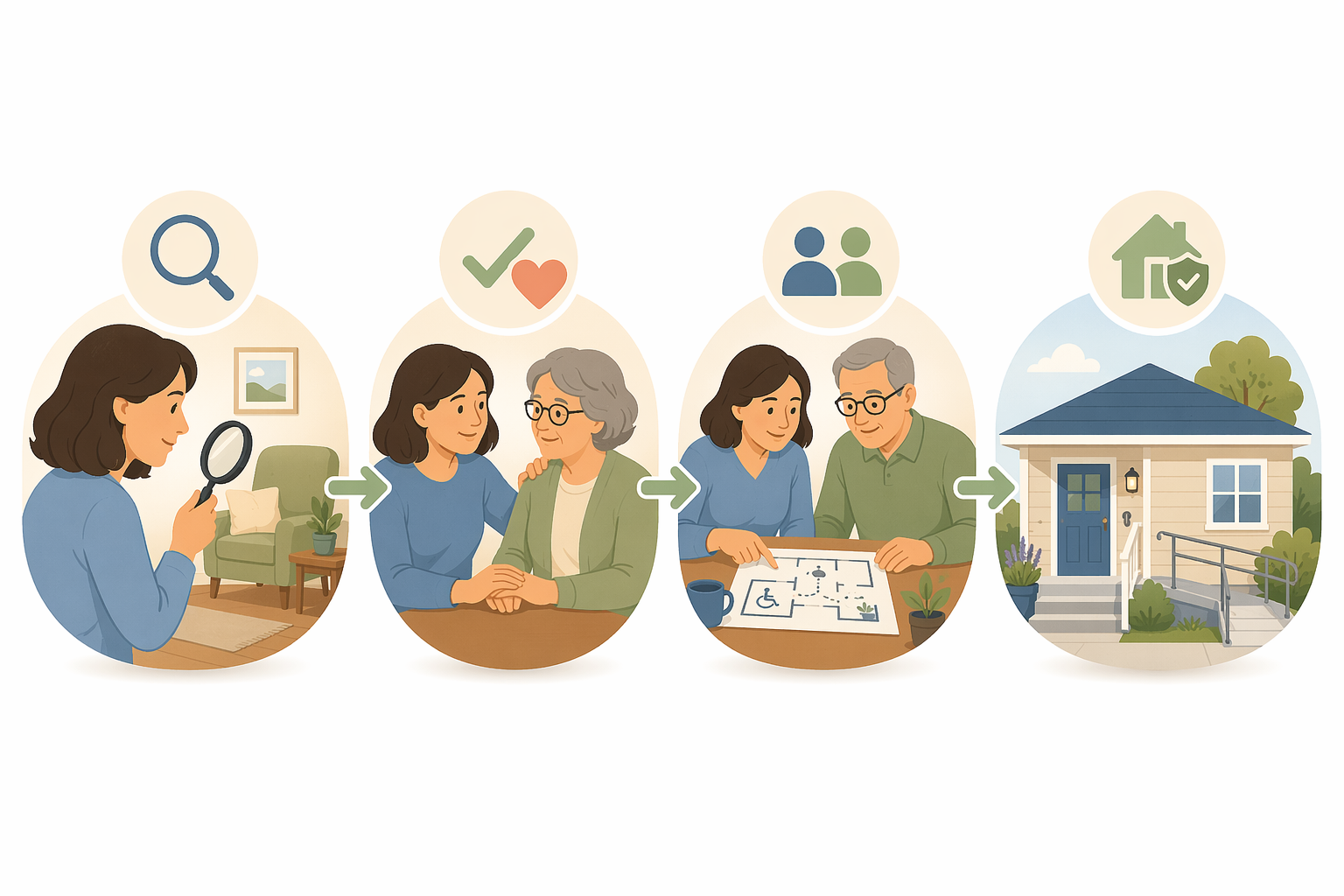
Each stage builds on the previous one. Skipping a stage — for example, jumping from Recognize straight to Act without validating your parent’s perspective — is what triggers resistance. The framework is designed to keep your parent as an active participant in the process, not a passive recipient of your concerns.
Stage 1: Recognize — What to Look for Before You Speak
Before you say a word, spend time observing. The goal is not to build a case against your parent — it is to gather specific, observable information that will help you frame the conversation constructively. The National Institute on Aging recommends watching for changes in the home and in daily behavior that may signal a need for help.
Signs to Document
- Clutter in walkways: Stacked newspapers, shoes, or cords in paths your parent uses daily.
- Medication management: Expired prescriptions, unopened pill bottles, or confusion about dosages.
- Changes in mobility: Hesitation when standing, shorter stride, or reaching for walls or furniture for support.
- Unopened mail or unpaid bills: May indicate difficulty with vision, cognition, or executive function.
- Poor lighting: Burnt-out bulbs in hallways, bathrooms, or stairways.
- Lack of safety equipment: No grab bars in the shower or toilet area, no non-slip mats, no nightlights.
Write down what you see, but keep the list to yourself for now. The purpose is to help you speak from observation rather than anxiety. When you say, “I noticed the hallway light is out and the path to the bathroom is dark,” you are describing a specific, solvable problem. When you say, “I’m worried you’re going to fall,” you are expressing an emotion that your parent may interpret as criticism of their competence.
Stage 2: Validate — Starting the Conversation Without Sounding Critical
The opening lines of the conversation set the tone for everything that follows. The NIA provides a model for this: “Mom, it looks like you don’t have much food in the house. Are you having trouble getting to the store?” The key is to frame the concern around a specific observation and a question, not a judgment.
Script Starters for Three Common Scenarios
Scenario 1: After a fall or near-fall
“Dad, I’m glad you weren’t hurt when you tripped on the rug yesterday. That scared me, and I know it probably scared you too. Can we talk about what happened and see if there’s a simple way to make sure it doesn’t happen again?”
Scenario 2: Noticing clutter, medication issues, or other home safety hazards
“Mom, I noticed the path from your bedroom to the bathroom is a little crowded with boxes. I’m worried you might trip in the dark. Would you be open to me helping you clear a path and maybe adding a nightlight? I want you to be able to move around safely so you can keep living here comfortably.”
Scenario 3: When the parent has already refused help
“I know you said you don’t need any help around the house, and I respect that. But I also know that you value your independence, and I want to help you keep it. Would you be willing to let me just look at a few things with you — not to change anything, just to understand how things are going?”
Stage 3: Involve — What to Say When They Say ‘I’m Fine’
“I’m fine” is the most common response to a concerned family member. It is not necessarily denial — it is often a reflex. Your parent may genuinely believe they are managing, or they may be afraid that admitting a problem will lead to losing their independence. The NCOA’s 10 Myths About Older Adults and Falls provides a useful framework for responding to specific objections.
| Common Objection | The Myth It Reflects | What You Can Say |
|---|---|---|
| “I don’t need to talk to my doctor about falls.” | Myth #6: Only people who have already fallen need to worry about fall prevention. | “Actually, the CDC says only 1 in 4 older adults who fall tell their doctor. Falls cause more than 95% of hip fractures. A quick checkup could catch something before it becomes a problem.” |
| “I’m not going to fall. I’m careful.” | Myth #1: Falling is not a major concern for older adults. | “I know you’re careful, but more than 1 in 4 older adults fall every year. It’s not about being careless — it’s about small hazards we don’t notice. Over half of all falls happen at home.” |
| “I don’t want you to worry about me.” | Myth #10: Talking about fall risk will hurt feelings. | “I’m going to worry anyway. I’d rather worry with you and do something about it than worry alone and hope nothing happens. Let’s figure this out together.” |
| “I’ve been fine for 80 years. Why change now?” | Myth #3: Fall prevention is too expensive or complicated. | “Most fixes are simple and cheap — a nightlight, a non-slip mat, clearing a hallway. Let’s start with one small thing and see how it feels.” |
Stage 4: Act — Bringing in Third Parties When the Conversation Stalls
Sometimes, no matter how carefully you frame the conversation, your parent will not hear it from you. That is not a failure of your approach — it is a natural dynamic. A neutral third party can often say what a family member cannot, without triggering the same resistance.
Who to Involve and When
- Primary care provider: The Mayo Clinic recommends making an appointment specifically to discuss fall prevention. The doctor can review medications (including sedatives, antihistamines, and some antidepressants that increase fall risk), check vision, and recommend physical activity. A doctor’s recommendation carries authority that a family member’s concern often does not.
- Occupational therapist: An OT can conduct a home safety assessment and recommend specific modifications — grab bar placement, shower chair type, lighting changes — based on your parent’s actual mobility and daily routines. This is not about “fixing” your parent; it is about matching the environment to their needs.
- Geriatric care manager: For complex situations involving multiple health issues, family disagreement, or long-distance caregiving, a geriatric care manager can serve as a neutral coordinator. They can assess the situation, recommend resources, and facilitate conversations.
- Area Agency on Aging: Your local AAA can connect you with fall prevention programs, home modification resources, and caregiver support services. Many offer free or low-cost assessments.
When you suggest involving a third party, frame it as a team effort: “Mom, I think it would be helpful to have a professional look at the house with fresh eyes. They do this every day and can spot things we might miss. It’s not about me telling you what to do — it’s about getting expert advice so we can make the best decisions together.”
The Post-Conversation Action Plan
A successful conversation does not end with agreement — it ends with a plan. The goal is to move from discussion to action while keeping your parent engaged as a partner, not a passenger. Here is a sequence of steps to follow after the conversation:
- Follow up within 48 hours. Send a brief, warm note or make a quick call: “I was thinking about our conversation and I’m glad we talked. I’d love to take that first step together this weekend if you’re up for it.” This reinforces that you are serious but not pushy.
- Schedule a doctor’s appointment. If your parent agreed to a checkup, help them make the appointment. Offer to drive and sit in the waiting room — not in the exam room unless they want you there. The goal is to make it easy, not to control the visit.
- Conduct a joint walk-through. Use the site’s room-by-room fall prevention checklist as a guide. Walk through the house together, room by room, and note hazards. Let your parent lead the walk-through; you are there to observe and support, not to direct.
- Identify one small, low-cost modification to start with. A nightlight in the hallway. A non-slip bath mat. Clearing a path from the bedroom to the bathroom. Starting small builds momentum and shows that changes are manageable, not overwhelming.
- Check in on your own wellbeing. These conversations are emotionally draining. The Caregiving in the US 2025 report found that 56% of caregivers report they had no choice in becoming a caregiver, and nearly half report at least one negative financial impact. If you are feeling burned out, recognizing the warning signs early can help you sustain your caregiving role over the long term.
When the Conversation Doesn’t Go as Planned
Not every conversation succeeds on the first attempt. Your parent may become defensive, dismissive, or angry. When that happens, the most important skill is knowing when to pause.
If the conversation starts to escalate, de-escalate. Say something like: “I can see this is upsetting for you. I don’t want to fight about it. Let’s take a break and talk again another time. I love you and I’m not going anywhere.” Then follow through — give it a few days or a week before revisiting the topic.
The goal is progress, not perfection. A single conversation rarely resolves everything. Each conversation builds a foundation of trust and familiarity with the topic. Over time, your parent may become more open to discussing specific risks and solutions.
Remember: you are not trying to win an argument. You are trying to keep your parent safe while preserving their dignity and your relationship. The Recognize–Validate–Involve–Act framework gives you a structure for doing both. Use it, adapt it, and come back to it as many times as you need.
Related reading
Noticed something outdated or inaccurate on this page? Flag a correction. We review every report against CDC, NIA, and AARP HomeFit guidance before updating a page.
Part of the Fall Prevention section.