
STEADI: Assess
COVID Symptoms in Elderly Parents Aren't Always Obvious
COVID often doesn't look like COVID in older adults: no fever, no cough, but a parent who is suddenly confused, falling, or not eating. Learn which atypical warning signs warrant a quick test and a call to the doctor — and which emergency symptoms mean 911.
Reviewed by Maria Chen, RN, BSN, CAPS. Last reviewed: August 25, 2026. This article is for education and caregiver decision support only; it is not a diagnosis or a substitute for medical advice from your parent’s clinician.
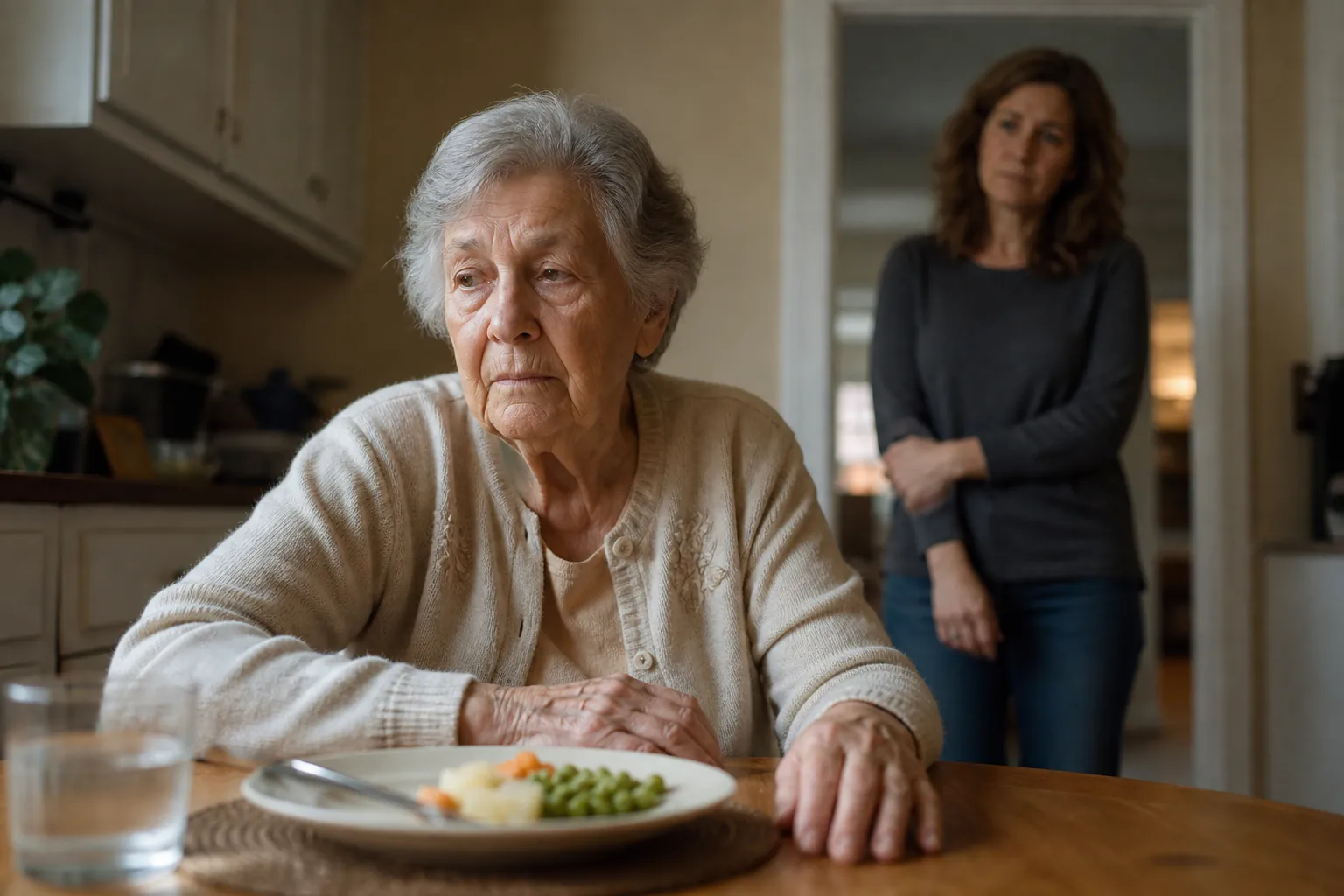
An elderly parent can have COVID without looking like the symptom checklist in your head. No obvious fever. No loud cough. No dramatic shortness of breath. Just a mother who leaves breakfast untouched, a father who needs the wall to get down the hallway, or a parent with dementia who is suddenly more confused than usual.
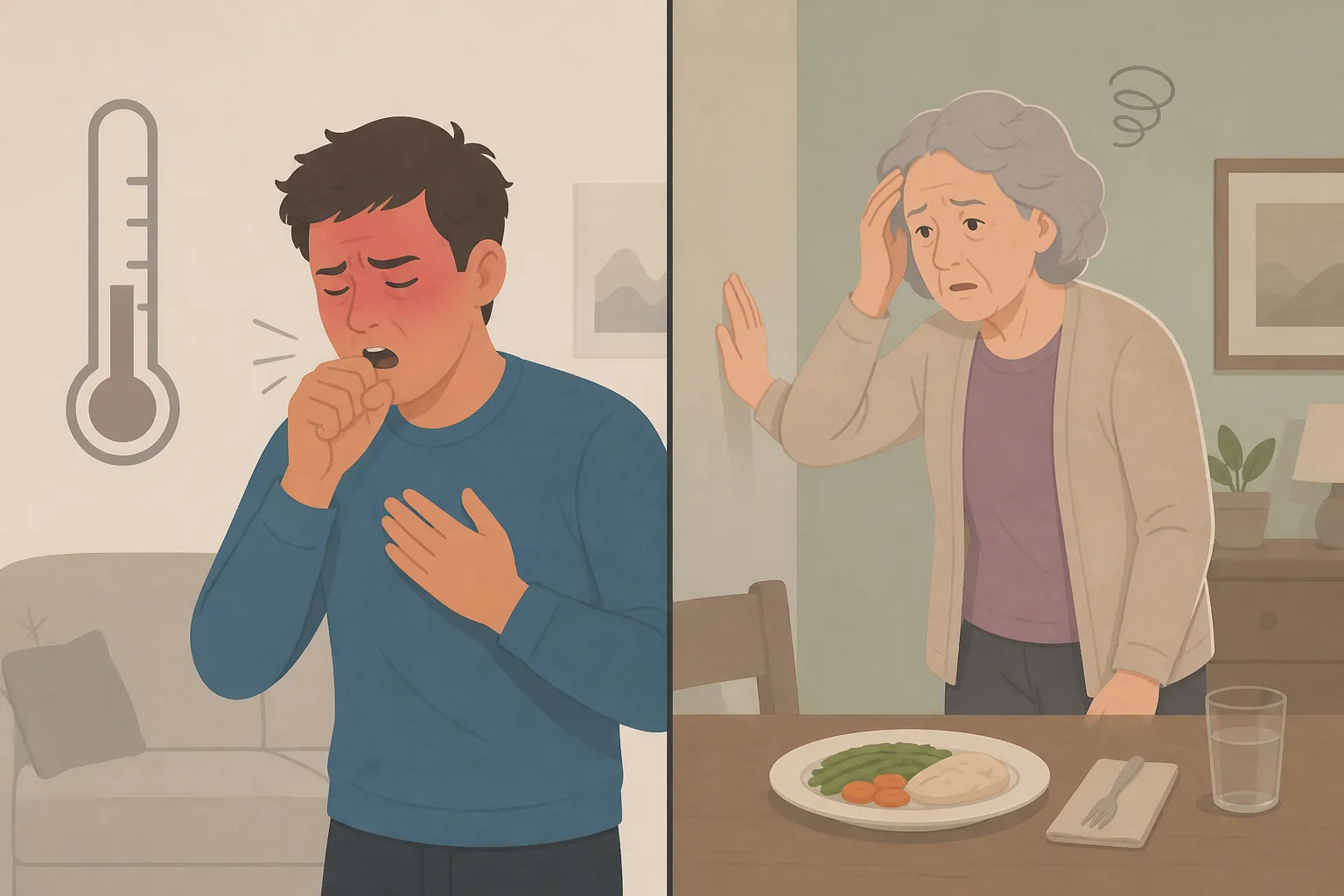
The usual COVID symptoms still matter. The CDC lists symptoms such as fever or chills, cough, shortness of breath, sore throat, congestion, fatigue, muscle or body aches, headache, new loss of taste or smell, nausea or vomiting, and diarrhea, while noting that symptoms can vary by variant and vaccination status [1]. But in older adults, that list should be a starting point, not a filter that rules COVID out.
If your parent is “not themselves,” COVID belongs on the short list
A large scoping review of 61 studies on COVID in older adults found 58 atypical symptoms across the literature. The review estimated atypical presentation at 29% ± 18.45%, with study estimates ranging from 7.96% to 73.9% [2]. That range is wide because the studies used different settings, definitions, and early-pandemic cohorts; it should not be read as a neat prediction for one parent in 2026.
What the range does say is practical: unusual changes are common enough that a caregiver should not wait for a textbook fever-and-cough pattern before testing or calling the doctor, especially when the parent is over 80, has dementia, or already lives with several chronic conditions.
The same review found that the most prevalent geriatric syndromes reported with COVID were delirium at 37.1% across studies, anorexia or loss of appetite at 27.25%, and falls at 16.78%, again with wide ranges across studies [2]. It also reported that atypical symptoms were associated with delayed recognition and poorer outcomes; in cohort studies included in the review, mortality among atypical presenters was about 34%, compared with about 11% in a general older-adult review cited by the authors [2]. Those figures come largely from 2020–2021 evidence, before today’s vaccination and variant landscape, but the caregiving lesson remains hard to ignore.
COVID symptoms in elderly parents: what to watch for
These warning signs do not prove COVID. They are reasons to test early, watch closely, and contact a clinician when the change is new, persistent, or clearly outside your parent’s usual pattern.
1. New confusion, delirium, or a sudden change in mental sharpness
New confusion is one of the most important atypical COVID signals in older adults because it is easy to explain away. A parent may answer slowly, forget where they are, become unusually agitated, seem drowsy, or stop following a familiar routine. In a parent with dementia, the clue may be a sudden worsening from their own baseline rather than confusion appearing for the first time.
In the scoping review, delirium was the most frequently reported geriatric syndrome associated with COVID, with a pooled prevalence of 37.1% across included studies and a range from 9.1% to 67.1% [2]. A Danish retrospective cohort of patients age 80 and older, cited in the review and geriatric guidance, reported confusion in 29% of COVID presentations [2].
This is not a reason to label every confused moment as COVID. Medication effects, dehydration, urinary infections, low blood sugar, pain, and many other problems can look similar. The point is that new confusion in an older adult is not a small symptom just because there is no cough.
2. A new fall, near-fall, or sudden walking difficulty
A new fall in an otherwise stable parent should make you ask two questions at once: “Are they injured?” and “Why did this happen today?” COVID is one possible answer, particularly when the fall comes with weakness, dizziness, poor intake, or mental changes.
Falls appeared in the scoping review as a geriatric syndrome associated with COVID, with a pooled prevalence of 16.78% and study ranges from 3.8% to 36% [2]. In the Danish 80-plus cohort, walking difficulty was reported in 13% of presentations and falls in 8% [2].
If your parent has fallen, handle the fall itself first: check for injury, do not rush them up if there may be pain or head trauma, and seek urgent help when needed. For detailed fall-specific guidance, use the site’s fall prevention FAQ and the caregiver fall prevention handout. Once immediate injury is addressed, a new fall can also be a reason to test for COVID and call the doctor, especially if your parent is also not eating, sleeping more, or thinking less clearly.
3. Loss of appetite, skipped meals, or not drinking enough
An untouched plate can be more useful than a temperature reading when it is a real change. A parent who normally eats breakfast but now pushes food around, refuses dinner, or drinks very little may be showing an early illness signal.
The scoping review identified anorexia as one of the most common geriatric syndromes in older adults with COVID, with a pooled prevalence of 27.25% and a wide study range from 2.1% to 61.3% [2]. The Danish 80-plus cohort reported anorexia in 30% of COVID presentations [2].
Poor intake also creates its own risk. Less fluid can worsen dizziness and weakness, and weakness can raise the chance of a fall. If the pattern is new and lasts into a second day, it is reasonable to test and call the clinician rather than waiting for a respiratory symptom to appear.
4. Lethargy, sleeping much more, or unusual apathy
Families often describe this as “she just won’t get up” or “he’s there, but not really engaged.” The change may look like extra naps, staying in bed, not wanting to talk, skipping hobbies, or seeming unusually passive.
A Northwell Health and Feinstein Institutes study of 4,961 hospitalized older adults found that classic symptoms were still common: shortness of breath appeared in 50%, fever or chills in 38%, and cough in 26%. But functional decline appeared in 25%, altered mental status in 11%, and 49% of patients with atypical presentations had atypical symptoms alone, without classic symptoms [3].
Physician reporting from KFF Health News in April 2020 described older adults with COVID who slept more, stopped eating, became apathetic or confused, or became dizzy and fell [5]. Those were pre-vaccination anecdotes, not population estimates. They are still recognizable to anyone who has watched an older parent become ill before the illness has a name.
5. New weakness or a sudden drop in ordinary function
Functional decline means the daily things suddenly take more help: getting out of a chair, walking to the bathroom, dressing, preparing food, using the phone, or managing medication. In an older adult, that kind of decline may be the symptom that shows up before anyone says “I feel sick.”
British Geriatrics Society guidance, citing geriatric experts, lists generalized weakness, malaise, functional decline, anorexia, dizziness, delirium, falls, diarrhea, nausea, and vomiting among atypical COVID presentations in older people [4]. This is expert guidance rather than a single population study, but it matches the broader pattern seen across cohorts: COVID in older adults can arrive as a loss of reserve.
6. Dizziness, vertigo, or needing the wall to walk
Dizziness is easy to dismiss if a parent already has balance problems. The useful question is whether it is new, worse, or paired with other changes: eating less, drinking less, sleeping more, walking differently, or thinking less clearly.
The Danish cohort of patients age 80 and older reported vertigo in 15% of COVID presentations [2]. British Geriatrics Society guidance also includes dizziness among atypical presentations in older people [4]. Again, dizziness has many causes; COVID is one possibility that should not be missed when it appears with a broader “something is wrong” pattern.
7. A low-grade temperature change, even without a classic fever
A missing fever is not reassuring in the same way it might be for a younger adult. British Geriatrics Society guidance, citing the Regional Geriatric Program of Toronto, notes that only 20% to 30% of infected geriatric patients mount a fever and suggests a lower fever threshold of 37.5°C, or 1.5°C above the person’s usual baseline [4].
That threshold is guidance, not a diagnostic rule. Many families do not know an older parent’s true baseline temperature, and temperature alone cannot tell you whether the cause is COVID, another infection, dehydration, a medication problem, or something else. But “no fever” should not be the reason you ignore new confusion, a fall, weakness, or loss of appetite.
Why early testing matters when the first signs are subtle
The most useful reason to notice atypical symptoms is timing. The scoping review found that atypical symptoms may precede respiratory symptoms by a mean of about six days across the reviewed literature [2]. That is not a promise that every parent will follow a six-day sequence. It is a warning that waiting for cough or shortness of breath can cost time.
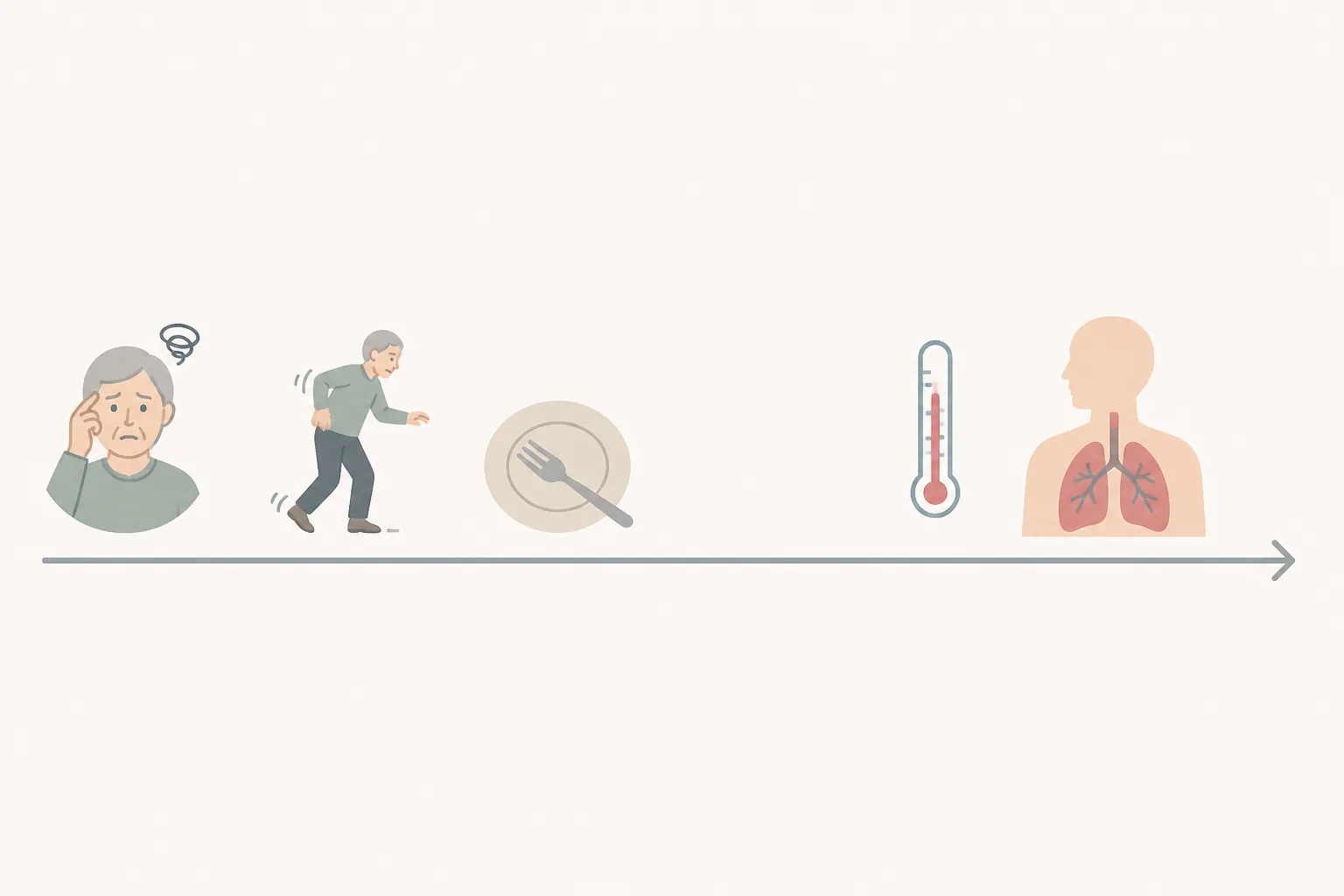
That lost time matters because outpatient COVID treatments are time-limited. CDC treatment information, as of mid-2025, says antiviral treatment must be started within 5 to 7 days of symptom onset, depending on the medication, and that treatment can reduce the risk of hospitalization by more than 50% in people at higher risk [6]. If the first symptom was not cough but two days of not eating and sleeping in a chair, the clock may already be running.
A practical caregiver rule is this: if an older parent has been unlike themselves for a couple of days, especially with confusion, a fall, weakness, dizziness, or poor intake, do a COVID test and call their doctor’s office. Say what changed, when it started, what their temperature and oxygen level are if you have them, and whether they are eating, drinking, urinating, walking, and thinking normally.
If the first test is negative but the change is real and continuing, do not let the negative test end the conversation. Ask the clinician whether and when to retest, and what else needs to be checked. The goal is not to make COVID the answer to every change. The goal is to keep COVID from being missed because it failed to announce itself in the usual way.
When it is not a watch-and-call situation: call 911
Some symptoms should not wait for a home test, a portal message, or a next-day appointment. The CDC says to seek emergency medical care immediately or call 911 if someone has trouble breathing; persistent chest pain or pressure; new confusion; inability to wake or stay awake; or pale, gray, or blue-colored skin, lips, or nail beds, depending on skin tone [1].
If you call 911, tell the dispatcher that COVID is possible and describe the specific change you are seeing. “New confusion since yesterday,” “unable to stay awake,” or “blue lips” is more useful than “not doing well.”
What to tell the doctor when the symptoms do not sound classic
When you call, lead with the change from baseline. Clinicians can do more with “she normally walks to the kitchen alone, but today she grabbed the wall twice and left lunch untouched” than with “she seems off.”
- When the change began, even if it was subtle.
- Whether there is new confusion, sleepiness, weakness, dizziness, walking difficulty, a fall, or loss of appetite.
- Whether classic symptoms are present or absent: fever, cough, sore throat, congestion, shortness of breath, vomiting, diarrhea, or loss of taste or smell.
- Temperature, oxygen level, heart rate, and blood pressure if you can measure them safely.
- Whether your parent is drinking, urinating, taking medications, and able to get to the bathroom safely.
- COVID test results, exposure history, vaccination status, and any high-risk conditions the doctor should factor into treatment timing.
If you are worried enough to keep checking on your parent, that concern itself is worth naming. You are not diagnosing COVID by noticing that something is wrong. You are giving the clinician the information that older adults often cannot package into a clean symptom list.
References
- Symptoms of COVID-19, Centers for Disease Control and Prevention.
- Atypical Presentations of COVID-19 in Older Adults: A Scoping Review, Gerontology, 2023.
- COVID-19 Study: Prevalence of Unusual Symptoms in Older Adults, Feinstein Institutes for Medical Research.
- Atypical COVID-19 presentations in older people – the need for continued vigilance, British Geriatrics Society.
- Seniors With COVID-19 Show Unusual Symptoms, Doctors Say, KFF Health News, April 2020.
- Types of COVID-19 Treatment, Centers for Disease Control and Prevention.
Related reading
Noticed something outdated or inaccurate on this page? Flag a correction. We review every report against CDC, NIA, and AARP HomeFit guidance before updating a page.
Part of the Fall Prevention section.