
STEADI: Intervene
Cyclosporiasis Prevention Plan for Senior Travelers
A before-during-after protection plan that shows older travelers exactly what to do to avoid cyclosporiasis during the 2026 outbreak season — from pre-trip recall checks and medication review to bottled-water and food-safety rules abroad. It also covers the symptoms that typically appear 2–14 days after exposure and when to seek testing.
Start this plan at the kitchen table, while passports, pill organizers, and restaurant reservations are still changeable. For an older traveler, cyclosporiasis prevention is not a last-minute reminder to “be careful with food.” It is a short chain of decisions made before the suitcase closes: check active recalls, decide what foods will be refused, review medication issues, and pack enough hydration support that a stomach bug does not turn into a nighttime fall risk.

Cyclospora is especially unhelpful for travelers because symptoms usually do not announce themselves at the meal that caused the problem. CDC describes cyclosporiasis symptoms as starting about one week after contaminated food or water is swallowed, with a range from about 2 days to more than 2 weeks; untreated illness can last from several days to a month or longer and may seem to go away and then come back. [1]
That delay is why a senior travel plan has to be boringly specific. By the time watery diarrhea, cramping, nausea, fatigue, or appetite loss appears, the traveler may be far from home, trying to manage unfamiliar bathrooms, hot weather, changed meal times, and a medication schedule that was already complicated.
Before departure, do the unglamorous work
The pre-trip job is not to memorize parasite biology. It is to remove easy mistakes before tired people start making decisions in airports, buffets, cruise ports, and resort dining rooms.
- Check current FDA and CDC outbreak or recall pages for foods connected to Cyclospora before buying airport snacks, packing road-trip produce, or planning the first meals after return.
- Look at the food pattern for the destination, not just the destination name. A resort with buffet salads, smoothies, cut fruit, fresh herbs, and iced drinks requires different rules than a trip built around cooked meals served hot.
- Ask the clinician or pharmacist, before travel, what to do if persistent diarrhea starts after the trip and whether the usual cyclosporiasis treatment would create problems with current medications.
- Pack a hydration-and-mobility backup: oral rehydration packets, a refillable bottle for safe water, easy-to-open snacks, a small flashlight or night light, and whatever mobility aid the traveler actually uses at home.
Do not let anyone wave away the water question with “we’ll buy drinks there.” For Cyclospora, CDC says routine chemical disinfection or sanitizing of food and water is unlikely to kill the parasite. [2] That makes the usual casual travel habits—ice in the glass, rinsed berries, a quick sink wash of lettuce—less reassuring than they sound.
For travel to areas where food and water safety may be uncertain, UKHSA’s 2026 travel advice is clear enough to print: use bottled or boiled water for drinking and toothbrushing, avoid ice, eat freshly cooked food served hot, choose pasteurized dairy, and be cautious with berries, salads, herbs, smoothies, and juices. [3]
The recall check is part of the travel plan
A recall check sounds like something for the grocery store, not a vacation. In 2026, it belongs on the same list as passports and prescription refills. FDA investigated a 9-state Cyclospora outbreak linked to iceberg lettuce in July 2026, and Taylor Farms de Mexico issued a recall on July 17, 2026, during that investigation. [4]
The useful habit is simple: before leaving, check whether any fresh produce, bagged salad, herbs, berries, or ready-to-eat items in the refrigerator match an active recall or investigation. If they do, do not pack them for the road, serve them to house guests, or leave them waiting for an older adult to eat after returning tired from travel. For a fuller recall-response routine, use the site’s food recall safety steps for seniors.
Medication review is not overcautious
Cyclosporiasis is commonly treated with trimethoprim-sulfamethoxazole, often shortened to TMP-SMX, but that is exactly why the conversation should happen before travel rather than during a sick call from another time zone. AARP’s older-adult guidance flags the need to review sulfa allergy, kidney function, potassium-affecting drugs, blood thinners, and some diabetes medications before assuming treatment will be straightforward. [5]
The goal is not to get a just-in-case antibiotic from a drawer. The goal is to know who to call, which medication list to send, whether sulfa allergy is on the chart, and which drug interactions the pharmacist wants checked if testing confirms Cyclospora.
Why the 2026 numbers deserve attention, not panic
Outbreak counts are moving targets, and they do not all measure the same thing. CDC’s Health Alert Network notice reported 1,645 confirmed domestically acquired cyclosporiasis cases across 34 states since May 1, 2026, with a median age of 44 years, 9% hospitalized, and no deaths, as of July 14, 2026. [6]
That median age matters because it keeps the risk claim honest: the available surveillance does not prove that older adults are the largest case group. The senior-specific concern is practical, not invented epidemiology. Older travelers are more likely to have medication complexity, less reserve when dehydration hits, and more to lose from dizziness in an unfamiliar bathroom or hotel room.
Travel-linked data add another reason to plan before departure. UKHSA reported 67 Cyclospora cases in returning travelers from April 30 through July 15, 2026; among the 48 cases with known travel information, all were linked to Mexico, especially the Riviera Maya and Cancún, including all-inclusive hotels. [7] That is UK surveillance, not a U.S. senior-traveler rate, but it is still a useful warning about buffet, beverage, and produce habits during resort travel.
At the resort table, choose food and water the boring way

The safest travel rules are not elegant, but they are easy to remember when everyone at the table is hungry.
- Drink sealed bottled water or water that has been boiled.
- Use bottled or boiled water for toothbrushing, not just drinking.
- Skip ice unless there is reliable confirmation it was made from safe water.
- Choose food cooked thoroughly and served hot.
- Choose fruit you peel yourself.
- Choose pasteurized dairy.
- Be cautious with leafy salads, fresh herbs, berries, smoothies, juices, and cut fruit.
The awkward part is that “fresh” often sounds healthier than “cooked.” On this trip, for this specific risk, hot and plain usually beats raw and pretty. A steaming cooked entrée is easier to trust than a beautiful salad that may have been rinsed in unsafe water, handled repeatedly, or mixed with fresh herbs that are hard to clean thoroughly.
This does not mean every salad, berry, or smoothie is contaminated. It means the traveler cannot fix uncertain sourcing at the table with a napkin, a squeeze of lime, or a hopeful rinse. Cyclospora has been associated with fresh produce outbreaks, and routine sanitizing is not a dependable rescue step.
The edge cases people mishandle
- Toothbrushing: if the water is not safe enough to drink, it is not the water for rinsing a toothbrush.
- Ice: a sealed bottle loses its advantage if the glass is filled with ice from uncertain water.
- Smoothies and juices: they may include unsafe water, ice, raw produce, or fruit handled after cutting.
- Garnishes: fresh herbs, lettuce, berries, and decorative fruit still count as raw produce.
- Buffet timing: food that was hot when cooked is not the same as food kept lukewarm for a long time.
- “Washed” produce: washing helps with many ordinary dirt and handling concerns, but it is not a guarantee against Cyclospora.
Someone in the family should be allowed to be the tedious person who says, “No ice,” “whole banana instead,” or “let’s order the hot entrée.” That is not spoiling the trip. It is keeping the trip from being reorganized around diarrhea, weakness, and bathroom logistics.
If symptoms start during the trip
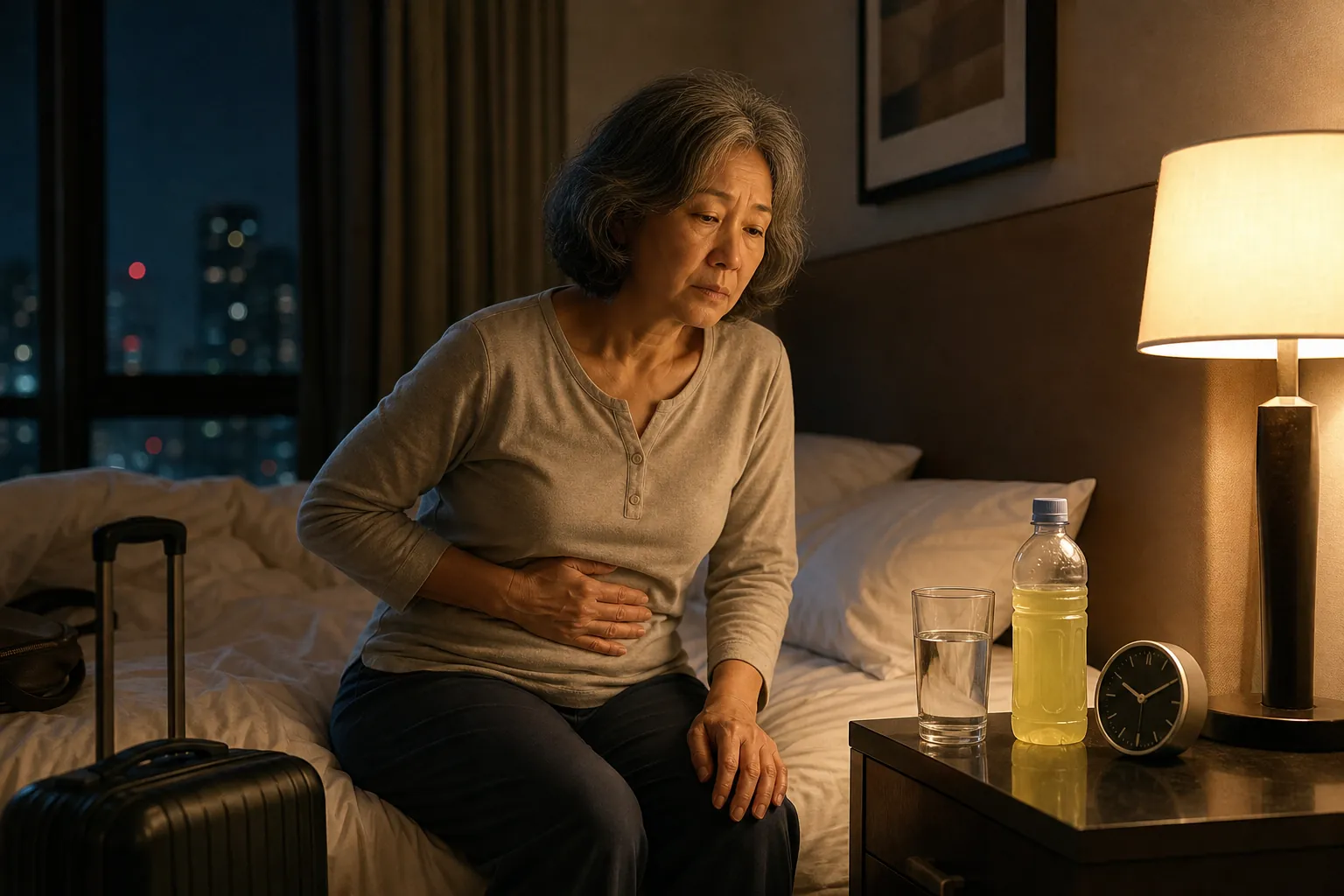
Cyclospora does not always match the neat vacation calendar. Symptoms may begin after the traveler is home, or they may begin near the end of a longer trip. Watch especially for watery diarrhea, appetite loss, weight loss, stomach cramping, bloating, increased gas, nausea, fatigue, and sometimes vomiting, body aches, headache, fever, or other flu-like symptoms. [1]
The waxing-and-waning pattern is the trap. A parent may say, “It’s better today,” then be back in the bathroom all night. Do not let a temporary improvement erase the exposure history, especially after a resort trip, a cruise stop, travel to a higher-risk region, or a recalled-food exposure.
For older adults, the immediate fall-prevention issue is fluid loss. Diarrhea can lead to dehydration; dehydration can lead to weakness, dizziness, and hurried bathroom trips. In a hotel room, rental home, or cruise cabin, that means the person is moving through unfamiliar space at the exact moment balance may be worse. If illness is already underway and you need the crisis path rather than the travel-planning path, use the site’s cyclospora outbreak fall-safety guide instead of trying to improvise at 2 a.m.
The after-travel symptom window
For two weeks after a trip, keep Cyclospora on the short list if diarrhea starts, especially if there were raw produce, salad, berries, fresh herbs, smoothies, juices, uncertain water, or ice. Do the same after a known recalled-food exposure even if there was no international travel.
| Timing | What to watch | What to tell the clinician |
|---|---|---|
| During travel | Watery diarrhea, fatigue, cramping, nausea, appetite loss, weakness | Where the traveler is, what foods and water were consumed, current medications, and whether dehydration or dizziness is developing |
| 2 days to more than 2 weeks after exposure | Symptoms that start late, improve, and return | Ask whether Cyclospora testing is appropriate after travel or recalled-food exposure |
| If diarrhea persists or keeps returning | Weight loss, worsening fatigue, reduced intake, repeated bathroom trips | Mention Cyclospora by name; routine parasite testing may not be enough |
Ask for the right test, not just “a stool test”
This is the sentence to put in the notes app before travel: “Could this be Cyclospora, and does the lab need a specific test for it?” CDC’s clinical guidance says routine ova-and-parasite exams may miss Cyclospora unless the clinician and laboratory are looking for it, and molecular tests such as PCR have improved detection. [8]
That testing prompt matters because the illness can look like other causes of traveler’s diarrhea. The exposure history gives the clinician something useful: where the traveler went, whether there was resort or buffet dining, whether raw produce or iced drinks were consumed, whether anyone else was sick, and whether there was a recall involving food eaten at home before or after the trip.
Treatment decisions belong with the clinician. CDC identifies TMP-SMX as the treatment of choice and says no highly effective alternative has been identified for people who cannot take sulfa drugs; it also notes that metronidazole, azithromycin, and doxycycline are ineffective against cyclosporiasis. [8] For the family organizer, the practical job is to make sure the medication list, allergy list, kidney-function concerns, diabetes drugs, blood thinners, and potassium-affecting drugs are not discovered after the prescription is already being discussed.
A simple before–during–after card
| When | Do this | Why it matters |
|---|---|---|
| Before the trip | Check current FDA/CDC recalls and outbreak notices for produce, salad products, berries, herbs, and ready-to-eat items. | A recalled food at home or on the road can create the same post-trip diarrhea problem as a risky meal abroad. |
| Before the trip | Review the medication list with a clinician or pharmacist, including sulfa allergy, kidney function, blood thinners, diabetes medications, and potassium-affecting drugs. | If cyclosporiasis is suspected later, treatment decisions may be complicated by interactions or allergies. |
| Before the trip | Pack oral rehydration packets, safe-water plans, medication copies, and mobility basics. | Diarrhea plus dehydration can become dizziness and fall risk, especially in unfamiliar rooms. |
| During the trip | Use bottled or boiled water for drinking and toothbrushing; skip ice. | Unsafe water can undo an otherwise careful food plan. |
| During the trip | Choose hot cooked food, pasteurized dairy, and fruit you peel yourself. | These choices reduce reliance on rinsed raw produce and uncertain handling. |
| During the trip | Be cautious with salads, herbs, berries, smoothies, juices, garnishes, and cut fruit. | These are the foods travelers often treat as harmless because they look fresh. |
| After the trip | Watch for watery diarrhea and fatigue for at least two weeks, and remember symptoms may fade and return. | Delayed symptoms are easy to mislabel as a random stomach bug. |
| After the trip | If symptoms fit, ask specifically whether Cyclospora testing is needed. | Routine ova-and-parasite testing may miss it unless the lab is directed. |
This is enough of a plan. It does not turn the trip into a medical project; it gives the older traveler fewer bad decisions to make when tired, hungry, or unwell. Cyclosporiasis prevention for senior travelers is a sequence: check first, choose carefully, hydrate early, preserve the medication facts, and name Cyclospora if the delayed diarrhea pattern appears.
References
- Signs and Symptoms of Cyclosporiasis, CDC.
- Preventing Cyclosporiasis, CDC.
- Cyclospora: what it is and how can you protect yourself when travelling?, UKHSA Blog, July 30, 2026.
- Investigation of 9-State Outbreak of Cyclospora Illnesses: Iceberg Lettuce (July 2026), FDA, July 2026.
- What Older Adults Should Know About Cyclospora, AARP, updated July 27, 2026.
- CDC HAN-00531, CDC Health Alert Network, July 14, 2026.
- Sharp rise in Cyclospora infections linked to Mexico travel, GOV.UK, July 30, 2026.
- Clinical Overview of Cyclosporiasis, CDC.
Related reading
Noticed something outdated or inaccurate on this page? Flag a correction. We review every report against CDC, NIA, and AARP HomeFit guidance before updating a page.
Part of the Fall Prevention section.