
STEADI: Intervene
Prevent Falls in Seniors During the Cyclospora Outbreak
During the summer 2026 Cyclospora outbreak, dehydration from the infection can quickly lead to dizziness and falls in older adults. This act-now checklist covers warning signs, when to call 911 vs. the doctor, and bathroom fall-proofing steps to keep a senior safe at home.
If an older adult develops watery diarrhea during the 2026 Cyclospora outbreak, the immediate safety question is not only, “Is this the parasite?” It is also, “Can this person get to the bathroom safely for the next several hours?” Fluid loss can become dizziness, weakness, a rushed walk across the hall, and a fall before anyone has a lab result.
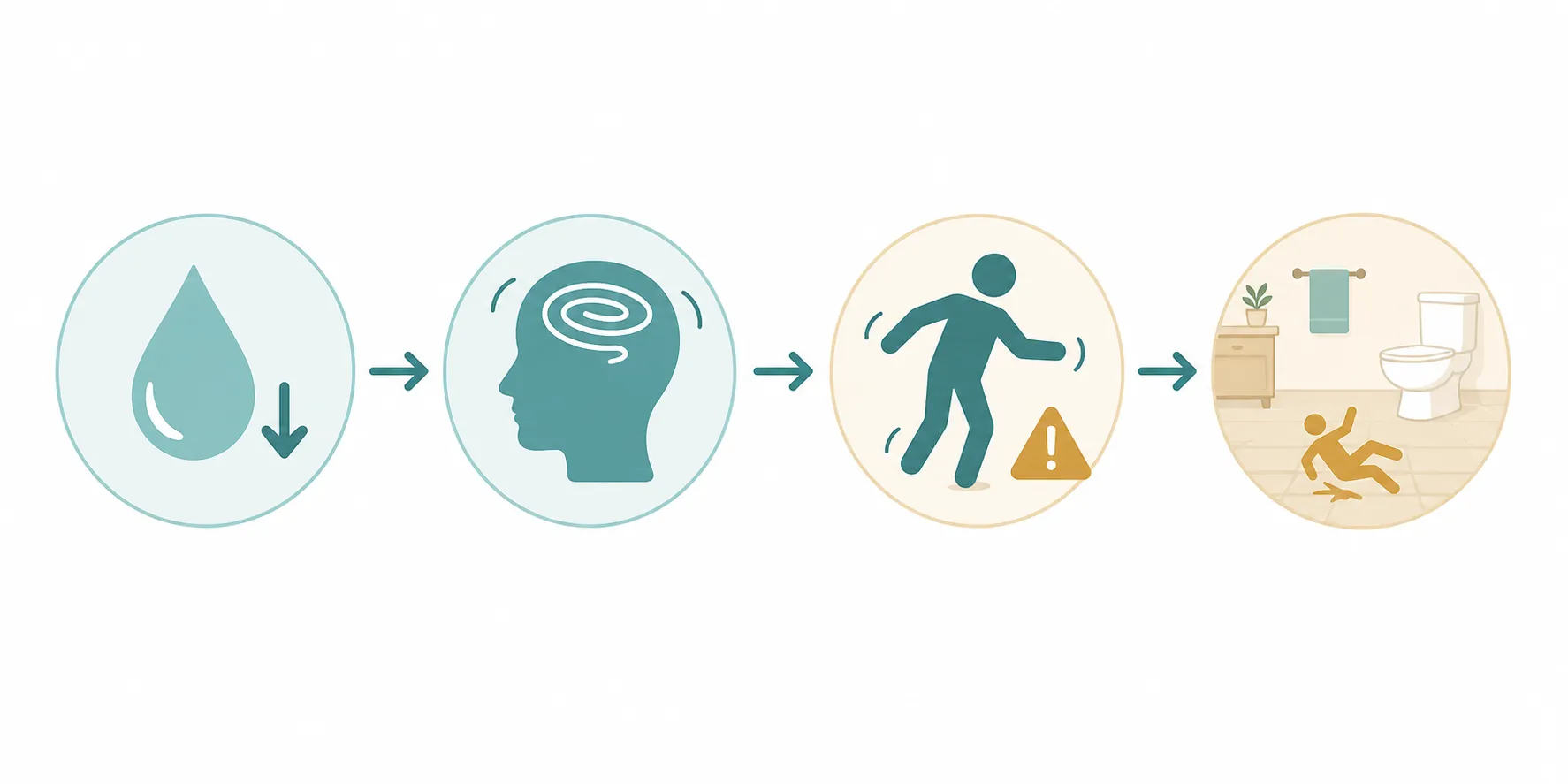
That is the practical frame for cyclospora outbreak safety tips for elderly people and their caregivers: steady the person, watch for dehydration, make the bathroom safer before the next episode, and decide whether the next step is 911, a same-day doctor call, or close monitoring.
Why this matters now
This article was last verified on August 1, 2026. CDC’s July 2026 investigation update reported 1,947 outbreak-associated cyclosporiasis cases and 98 hospitalizations, while CDC’s health advisory reported 6,707 confirmed domestically acquired cases since May 1, 2026, and awareness of more than 11,500 cases overall. Those numbers are live and should be rechecked on CDC’s outbreak pages at the time you are making decisions. [1][2]
The FDA investigation connected a 9-state outbreak to recalled iceberg lettuce from Taylor Farms de Mexico. If you are checking food in the refrigerator, use the FDA page and any recall notice or lot information rather than guessing by appearance; contaminated lettuce will not look reliably different. [3] For a practical recall-checking process, see CareWise Guide’s recall-lot safety guide.
This is not an “older adults are the main case group” story. CDC’s advisory reported a median case age of 44. The senior-specific concern is what diarrhea does to a body that may already have lower fluid reserve, balance problems, medications that affect blood pressure or kidneys, or a bathroom route that is not forgiving. [2]
The first hour: treat fluid loss as a mobility problem
AARP’s caregiver-facing report quotes clinicians warning that diarrhea can dehydrate older adults and that dehydration may show up as dizziness, confusion, decreased urination, dry mouth, rapid heartbeat, weakness, or falls. The same report includes clinician guidance to call when diarrhea continues beyond a couple of days, becomes very frequent, or is accompanied by those dehydration signs. [4]
That warning matters because falls are already a major threat for adults 65 and older. CDC reports that falls are the leading cause of injury death in this age group and that more than 38,000 older adults died from falls in 2021. [5] CDC does not publish cyclospora-specific fall statistics; the fall connection here is clinician-informed risk reasoning: diarrhea can drain fluid, fluid loss can unsteady a person, and urgency sends people into the bathroom faster than their legs may safely manage.
In the first hour after concerning symptoms appear, do four things in parallel:
- Have the older adult sit down or stay near a stable chair until you know whether they are dizzy when standing.
- Start tracking diarrhea frequency, urination, fluid intake, dizziness, confusion, and whether they are walking normally.
- Make the path to the bathroom safer before the next urgent trip, not after a near-fall.
- Choose the right escalation path: 911 for immediate danger, a doctor call for warning signs or persistent illness, and close monitoring only when the person is stable and improving.
911, doctor call, or close monitoring?
Use this as a safety triage guide, not a diagnosis rule. A caregiver at home cannot confirm Cyclospora by symptoms alone, and an older adult can be medically fragile even when the illness looks like “just diarrhea.”
| Situation | Action now | Why it matters |
|---|---|---|
| Fainting, near-fainting, new confusion, inability to stand or walk safely, severe weakness, or signs that the person may fall on the way to the bathroom | Call 911 or emergency services. If you go to the ER, bring a medication list, recent food history, and notes on diarrhea frequency and urination. | These are immediate safety problems, not just stomach symptoms. The fall risk may be urgent even before a stool test is done. |
| Dizziness, dry mouth, decreased urination, rapid heartbeat, diarrhea lasting more than a couple of days, or very frequent diarrhea such as roughly 6 to 8 episodes in a day | Call the doctor, urgent care, or nurse line the same day. Mention possible Cyclospora exposure and ask whether specific Cyclospora testing is needed. [4] | Clinicians quoted by AARP identify these as warning thresholds for older adults and caregivers; they are not universal rules, but they are strong reasons not to wait. [4] |
| Watery diarrhea but the person is alert, drinking, urinating, walking steadily, and symptoms are not frequent or prolonged | Monitor closely, increase bathroom safety, keep fluids available, and call sooner if dizziness, weakness, confusion, decreased urination, or worsening diarrhea appears. | Cyclospora symptoms can persist or come and go, so a stable morning can still turn into an unsafe evening. [6] |
If the 911 branch is even a possibility, do not spend ten minutes searching the internet while the person is trying to get up alone. Keep them seated, keep the phone nearby, and use CareWise Guide’s hospital emergency safety checklist to gather medications, glasses, hearing aids, mobility devices, and basic notes if emergency care is needed.
Recognize the symptom pattern, but do not wait for a perfect match
Cyclospora infection often causes watery diarrhea. CDC says symptoms typically begin about 1 week after exposure, but the range can be from 2 days to 2 weeks or more. CDC also notes that diarrhea may go away and then come back. [6]
That delayed timing is one reason families miss the connection to food. Someone may have eaten lettuce days earlier, felt fine, and then suddenly started making repeated bathroom trips. For symptom-pattern recognition and what to ask for when testing is discussed, use the CareWise Guide companion page, Could that diarrhea be cyclospora? Signs in older adults.
At home, though, the safer move is not to wait until the pattern is textbook. If an older adult is weak or dizzy, the fall-prevention response starts now while the medical question is being sorted out.
When you call the doctor, ask about the right test
Do not assume a routine stool workup will automatically look for Cyclospora. CDC’s 2026 health advisory tells clinicians that testing for Cyclospora should be specifically requested; where available, PCR-based methods can be used, and routine ova-and-parasite testing may miss Cyclospora unless the laboratory is asked to look for it. [2]
A practical call script is short:
- “My parent is 65 or older and has watery diarrhea.”
- “They may have eaten recalled iceberg lettuce or were exposed during the current Cyclospora outbreak.”
- “They have had about this many episodes today: ___.”
- “They are / are not dizzy, confused, urinating less, dry-mouthed, weak, or walking unsteadily.”
- “Should we be seen today, and should the lab specifically test for Cyclospora?”
If the older adult does not want “a fuss,” the test question can feel like overkill. It is not. CDC’s point is narrow and important: the clinician may need to request the right test by name. [2]
Make the bathroom safer before the next urgent trip

During a diarrheal illness, the bathroom becomes the danger zone because urgency shortens judgment. People skip slippers, leave lights off, turn too fast, or try to make it without their cane or walker. Do the bathroom reset while the person is seated and before the next wave of urgency.
Clear the route
- Move laundry baskets, shoes, cords, small rugs, pet bowls, and low stools out of the bedroom-to-bathroom path.
- Park the walker or cane where the person will actually use it, not across the room.
- If the person is weak, do not let pride decide the route. Offer an arm, supervise the walk, or use a bedside commode if one is already available and safe to use.
Control water and slick surfaces
- Put a non-slip mat where feet land, but remove any mat that curls, slides, or bunches.
- Wipe splashes around the toilet and sink quickly. A caregiver may see “just a few drops”; a dizzy person may experience it as a skid.
- Keep disposable gloves, wipes, and a trash bag within reach so cleanup does not require repeated bending or carrying items across the room.
Light the nighttime path
Nighttime diarrhea is a fall setup: half-awake, dehydrated, and rushing. Turn on hallway lights before sleep, use night lights along the route, and keep eyeglasses, hearing aids, slippers with tread, and the mobility aid on the same side of the bed every time. If sleep disruption is already a problem, the same nighttime fall logic in CareWise Guide’s daylight saving time fall-risk guide applies here too: grogginess and darkness make small hazards larger.
Keep help within reach
- Place a charged phone within reach of the toilet area or have the person wear an alert device if they already use one.
- Do not close the bathroom door in a way that blocks access if the person falls against it.
- If the older adult lives alone, arrange check-ins during the day and overnight until diarrhea and dizziness have clearly improved.
- If the person is lightheaded when standing, have them pause seated at the bed or chair before walking.
This is the same dehydration-to-dizziness pattern caregivers see during extreme heat. If heat is also affecting the home, use the additional safety steps in Heat Dome Fall Prevention for Elderly Parents and How Florida Heat Waves Can Trigger Falls in Seniors. Heat plus diarrhea is not a good time to test someone’s balance.
Hydration help without creating a new hazard
Offer fluids in small, frequent amounts if the person can drink safely and has not been told to restrict fluids. Keep water or an oral rehydration drink near the chair, not across the room. The goal is to reduce repeated get-ups while still watching for the warning signs that mean a clinician should be involved.
Do not turn hydration into a tug-of-war. Many older adults resist being monitored because it feels infantilizing. A calmer approach is to track visible facts: number of bathroom trips, whether urine is decreasing, whether the mouth looks dry, whether standing causes dizziness, and whether walking looks different from yesterday.
If the person has heart failure, kidney disease, fluid restrictions, or takes diuretics, ask the clinician how to handle fluids. The home safety point still stands: any plan that includes more bathroom trips needs a safer route to the bathroom.
If treatment is discussed, bring the medication list
CDC identifies trimethoprim-sulfamethoxazole, often abbreviated TMP-SMX, as the first-line treatment for cyclosporiasis, typically for 7 to 10 days. [2] That does not mean a caregiver should push for it without a clinician’s review. For older adults, the medication list matters.
AARP’s report flags interaction concerns with warfarin, some diabetes medications, and drugs that affect potassium or kidney function. [4] Cleveland Clinic also notes that people with sulfa allergy may have limited alternative treatment options. [7] The safe action is simple: bring or send the complete medication list, including over-the-counter medicines and supplements, when you call or go in.
- Warfarin or other blood thinners
- Diabetes medications
- Diuretics or blood pressure medicines
- Kidney-related medications
- Potassium supplements or medicines that affect potassium
- Any known sulfa allergy
Food handling: do not try to rescue recalled lettuce
If lettuce is part of the recall or is otherwise identified by the FDA as affected, discard it according to the recall instructions. Washing is not a reliable fix for recalled produce. Cooking can kill Cyclospora at sufficient temperatures; Cleveland Clinic states that heating to 158°F kills the parasite. [7] But iceberg lettuce involved in a recall is not something to salvage for a medically vulnerable household.
After discarding affected food, wash hands, clean refrigerator surfaces that touched the product, and check whether any prepared foods were stored with it. These steps do not replace medical care for symptoms, but they reduce the chance that the same exposure stays in the kitchen.
The safest next action
During this outbreak, do not wait for an older adult to “look sick enough” before acting. Watery diarrhea plus age, frailty, balance problems, or medications is enough reason to treat fluid loss as a fall risk. Seat the person, watch dehydration signs, make the bathroom route safer, call promptly for warning symptoms, and ask about Cyclospora-specific testing when medical advice is needed.
Source currency: outbreak counts and recall details were checked against CDC and FDA materials available as of August 1, 2026. Recheck the linked CDC and FDA pages for current status. This article is for fall-prevention and caregiver education and is not a substitute for medical advice, diagnosis, or treatment. Clinical reviewer and review date should be displayed on this page.
References
- CDC Investigation Update July 2026, Centers for Disease Control and Prevention, July 2026.
- Domestically Acquired Cyclosporiasis Cases in Multiple U.S. States, 2026, Centers for Disease Control and Prevention.
- Investigation of 9-state Outbreak of Cyclospora Illnesses: Iceberg Lettuce, July 2026, U.S. Food and Drug Administration, July 2026.
- What Older Adults Should Know About Cyclospora, AARP.
- About Older Adult Fall Prevention, Centers for Disease Control and Prevention.
- About Cyclosporiasis, Centers for Disease Control and Prevention.
- Cyclosporiasis, Cleveland Clinic.
Related reading
Noticed something outdated or inaccurate on this page? Flag a correction. We review every report against CDC, NIA, and AARP HomeFit guidance before updating a page.
Part of the Fall Prevention section.