
How Daylight Saving Time Affects Seniors with Dementia
This article explains why the semi-annual clock change disrupts circadian rhythms in dementia, worsening sundowning and sleep fragmentation. It provides a practical pre-transition plan caregivers can start days ahead to reduce confusion, agitation, and health risks.
When a parent with dementia becomes more confused, restless, wakeful, or irritable right after the clock changes, it is not always “just daylight saving time” in the casual sense. The time change can push on a system that was already struggling to keep day and night in order. Spring and fall do it differently: spring forward steals sleep and compresses the morning; fall back can make darkness arrive before the household is ready for it, which is exactly when many families already brace for sundowning.
That distinction matters because the best preparation is not one generic reminder to “keep a routine.” A routine helps only if it is moved gently before the clock moves abruptly. For many families, the useful work starts several days ahead: meals, bedtime, wake time, light exposure, and evening quiet all shift by small amounts while the person with dementia still feels anchored.
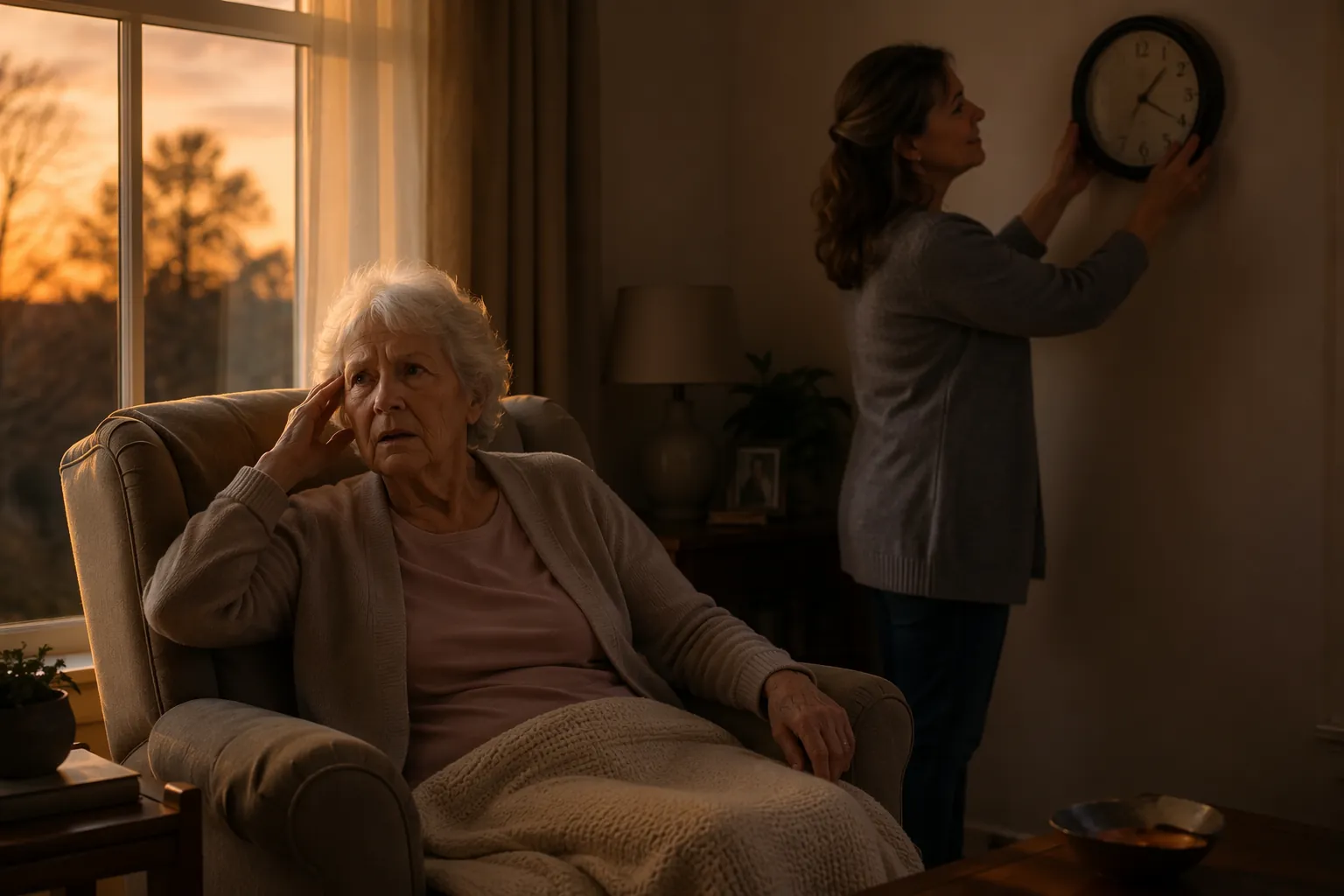
Why the clock change hits dementia harder
Everyone has a body clock, but dementia makes that clock less reliable. Aging already changes sleep timing and makes adaptation slower; older adults tend to need more time to adjust after the daylight saving transition than younger adults, and the average person loses about 40 minutes of sleep on the Monday after spring daylight saving time begins.[1][2] In a person whose sleep is already fragmented, that is not a tidy 40-minute inconvenience. It can be the difference between a manageable morning and a day that starts with confusion.
Dementia adds another layer. The disease process can interfere with the brain systems that coordinate sleep, wakefulness, alertness, and the interpretation of environmental cues. Caregivers often see the result before they can name it: a nap that runs too late, a parent who asks to go home at dusk, a spouse who wakes at 2 a.m. convinced it is morning, or an aide who says the person was “off” all afternoon.
Light is part of the problem and part of the solution. Morning light helps tell the brain that the day has started. Evening darkness tells the body to wind down. But older eyes may receive and transmit light cues differently, and dementia can make those cues harder to interpret. When the legal clock jumps while the sun, meals, medications, and household noise do not all move cleanly together, the person with dementia may lose the pattern that was doing quiet work in the background.
Spring forward is a sleep-loss problem
The spring transition is the sharper physiological hit. The clock moves forward by one hour, but the person’s internal timing has not politely agreed to follow. Breakfast may come earlier, morning medications may be offered earlier, the aide may arrive by the new clock, and everyone may be short on sleep. For a person with dementia, that pileup can look like sudden worsening: more repetitive questions, more resistance to care, more pacing, more daytime sleepiness, or more nighttime waking.
A 2024 BMJ Medicine time-series study gives this concern more weight than caregiver anecdotes alone can carry. Researchers analyzed 13.9 million deaths in the United States and found that dementia mortality increased after the spring daylight saving transition, with the increase reported up to five weeks afterward and a rate ratio of 1.050 in the fifth week.[3] That number should not be turned into a prediction for one household. It does not mean a parent is destined for a crisis because the clocks changed. It does mean the spring transition is not medically neutral for dementia at the population level.
At home, the spring goal is to reduce the abruptness of the lost hour. The caregiver is trying to avoid a sudden mismatch between what the clock says and what the person’s body expects. The more fragile the sleep pattern already is, the less room there is for improvising on Sunday night.
Fall back is usually an earlier-darkness problem
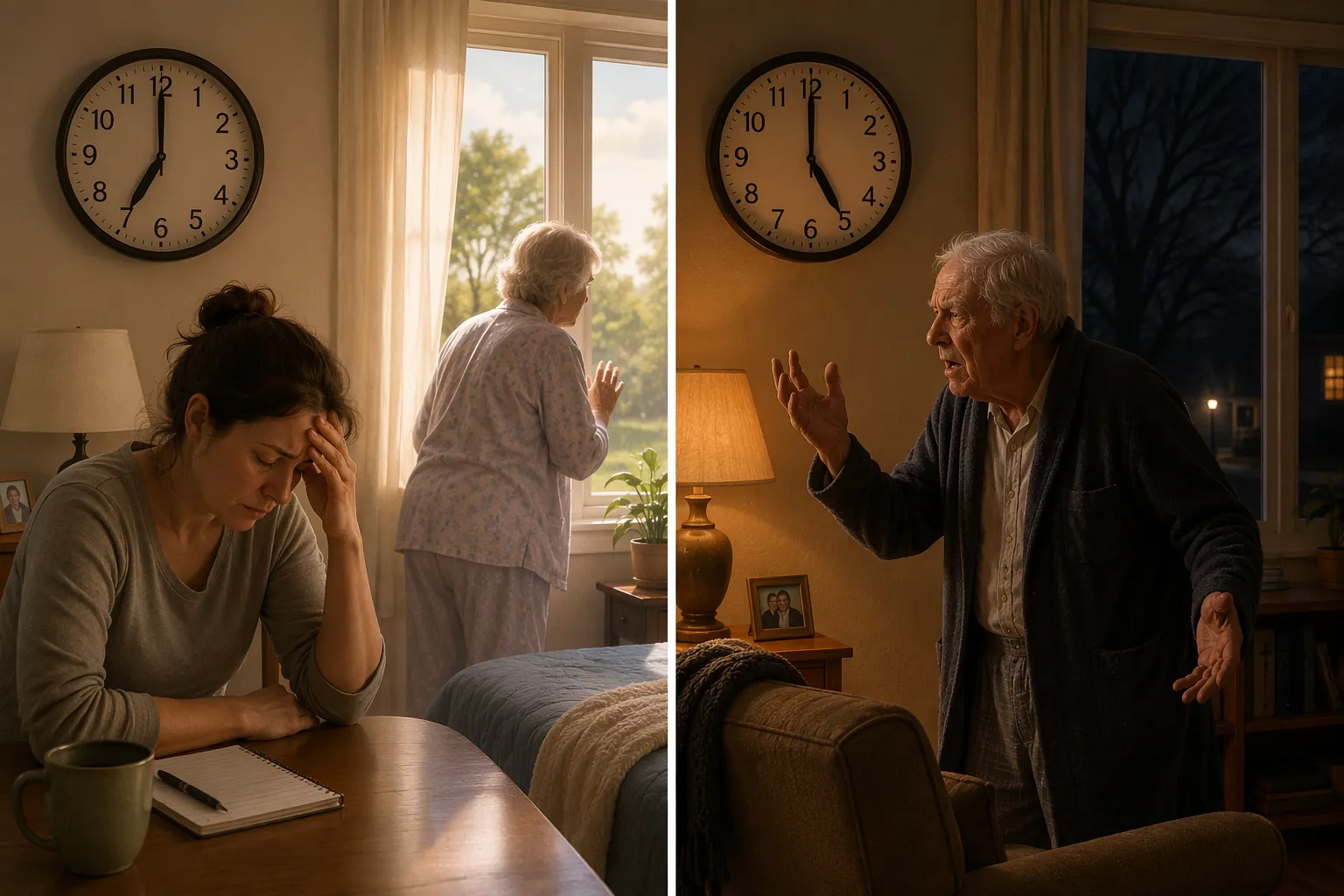
The fall transition feels kinder because people talk about “getting an extra hour.” For some older adults, the return to standard time may indeed be less harmful than spring forward. The BMJ Medicine study found an apparent protective effect after the autumn transition, especially among adults age 75 and older.[3] That finding matters, and it is one reason not to flatten every daylight saving discussion into the same warning.
But fall can still be hard inside a dementia household. The issue is not only total sleep. It is the timing of darkness. When the evening turns dark earlier by the clock, the person who already becomes anxious, suspicious, or disoriented at dusk may start that pattern before dinner is ready, before the caregiver has finished work, or before the evening aide has settled in. The household’s hardest hours move into a more crowded part of the day.
The Alzheimer’s Association specifically advises maintaining structure and adjusting for earlier darkness during daylight saving transitions for people living with Alzheimer’s disease and related dementias.[4] That is a practical point, not a decorative one. If darkness is a trigger, then lighting, activity, dinner timing, and noise level need to be planned before the first difficult evening arrives.
Start shifting three to five days before the change
The most useful preparation is small enough that the person with dementia barely notices it. Move the day by 10 to 15 minutes at a time for three to five days before the transition. The point is not to create a perfect laboratory schedule. It is to keep meals, light, activity, rest, and caregiving handoffs from all changing at once.
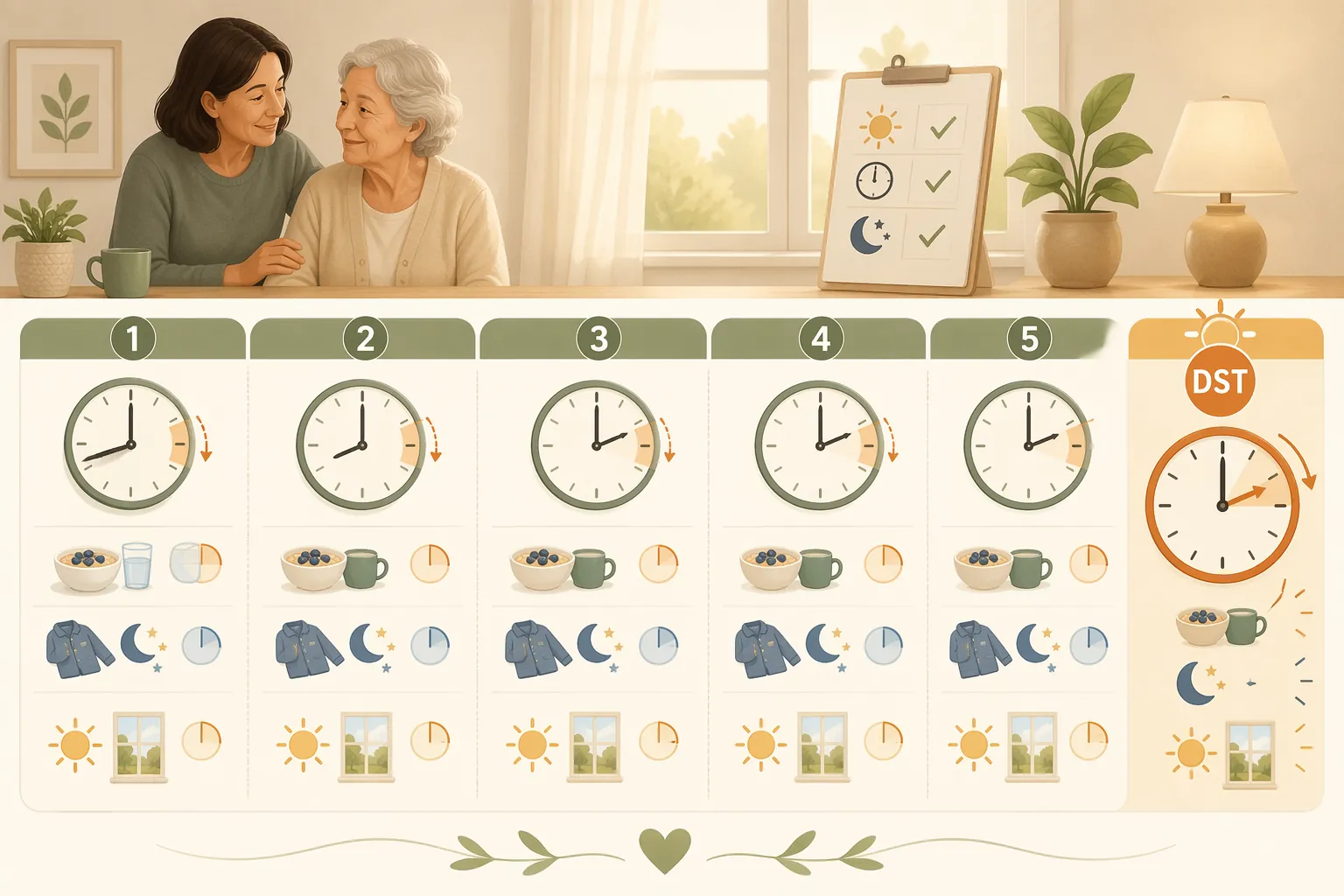
| Care task | Spring forward | Fall back |
|---|---|---|
| Wake time | Move 10–15 minutes earlier each day before the change | Move 10–15 minutes later only if it does not increase morning confusion |
| Morning light | Get bright natural light soon after waking to help reset the day | Keep morning light consistent so the day does not drift |
| Meals | Shift breakfast, lunch, and dinner earlier in small steps | Shift meals later carefully, but protect the late afternoon from hunger |
| Evening routine | Begin quieting earlier so bedtime does not feel sudden | Turn on indoor lights before dusk and reduce stimulation before agitation starts |
| Medication timing | Ask the clinician or pharmacist before changing timing | Ask the clinician or pharmacist before changing timing |
Medication timing deserves special caution. Some drugs are tied closely to meals, sleep, blood pressure, diabetes management, pain control, or behavior symptoms. A caregiver can shift dinner by 10 minutes without a committee meeting. Medication changes should be cleared with the prescribing clinician or pharmacist, especially if the person takes sedating medications, insulin or other glucose-lowering drugs, heart medications, or dementia-related prescriptions.
If spring forward is coming
Begin moving the morning earlier before the official clock change. If the person usually wakes at 7:30 a.m., breakfast happens at 8, and the first real light exposure is after breakfast, start nudging that whole sequence earlier in small increments. The order matters: wake, light, food, hygiene, movement. A parent who is woken earlier and then left in a dim room may only become more confused.
- Open curtains or use a bright, safe indoor area soon after waking.
- Offer breakfast at the shifted time instead of delaying food until the old schedule.
- Avoid long late-day naps during the adjustment period.
- Move the bedtime routine earlier gradually, including bathing, pajamas, music, and lights-down cues.
- Keep the Sunday and Monday after the change lighter than usual when possible; do not stack appointments, visitors, and errands onto an already strained schedule.
The first workday after spring forward is often where families get caught. The caregiver is tired too. The aide may be arriving at the usual clock time, which is now earlier to the person’s body. If bathing or dressing is usually difficult, this is not the morning to rush. Build in more time, reduce choices, and keep the voice and room calm even if the schedule is not.
If fall back is coming
For fall, watch the late afternoon. Hunger, shadows, glare, household transitions, television noise, and caregiver fatigue can arrive together. The clock may say there is plenty of evening left, while the person’s brain reads the room as unsafe or unfamiliar.
Turn on indoor lights before the room begins to dim, not after agitation has already started. Close curtains if reflections in dark windows are disturbing. Serve dinner before the person becomes overtired, or offer a substantial snack if dinner must be later. Keep the environment active enough to signal “day,” then deliberately quieter as bedtime approaches. The transition from afternoon to evening should feel like a slope, not a drop.
- Plan the hardest care tasks earlier in the day when possible.
- Use warm, even lighting in hallways, bathrooms, and the main sitting area.
- Reduce background noise before dusk, especially competing TV, kitchen, and phone sounds.
- Ask aides and relatives to avoid shift changes or emotionally charged conversations during the most vulnerable window.
- Keep familiar objects visible: the same chair, blanket, clock, calendar, family photos, or simple orientation board.
What to track during the transition week
A short log can prevent the usual family argument about whether things are “really worse.” It does not need to be elaborate. Write down wake time, nap length, meals, bowel changes if relevant, medication timing, outdoor or bright-light exposure, agitation window, bedtime, night wakings, and anything unusual: pain, infection symptoms, a missed dose, a visitor, a loud evening, or a skipped meal.
The log helps in two ways. First, it shows whether the daylight saving shift is the likely trigger or whether something else is happening at the same time. Second, it gives the clinician something better than a panicked summary. “She was up three times every night for four nights after the clock change, and agitation began around 4:45 p.m. instead of 6” is much more useful than “she has been terrible since Sunday.”
For families already dealing with nighttime wandering, unsafe transfers, repeated calls, or severe sundowning, daylight saving time can expose a care gap that was already forming. A deeper nighttime plan may help; this guide to overnight care for elderly people with dementia covers non-medication safety strategies for the hours when supervision, sleep, and agitation collide.
When it is more than a clock-change reaction
A few rough nights after the transition are common enough to plan for. Sudden or severe changes should not be blamed on daylight saving time without checking for medical causes. Call the clinician promptly if confusion is abrupt, agitation is extreme, the person is unusually sleepy or hard to wake, there is a fall, fever, new pain, shortness of breath, signs of dehydration, urinary symptoms, missed medications, hallucinations that are new or frightening, or behavior that creates immediate safety risk.
If the person does not return near baseline after the transition week, the clock change may have revealed that the current care setup is too thin. That does not mean the family failed. It may mean the disease has moved, the spouse caregiver is no longer getting enough sleep to stay safe, or the home schedule depends on one person absorbing too many nights in a row. Families trying to match care to current symptoms may need to revisit senior care options by dementia stage; if nighttime safety and supervision are becoming unmanageable, it may also be time to compare home care and memory care with the actual nights, not the hopeful version of them, in mind.
Where the broader daylight saving debate fits
There is a larger public-health debate about daylight saving time, permanent standard time, sleep loss, cardiovascular risk, and how society should set clocks. Some of that research is important, and some newer findings complicate older claims about heart attack spikes. But for dementia care at home, the immediate question is narrower: what happens to this person’s sleep, light cues, agitation window, and caregiver coverage when the clock changes?
Caregivers cannot make daylight saving time harmless. They can make it less abrupt. Start several days ahead, shift the schedule in 10- to 15-minute steps, protect morning light, soften the evening, and get medical guidance before changing medication timing or dismissing severe symptoms. The clock may change in one night, but a dementia household usually does better when the body is given several days to follow.
References
- Daylight Saving Time, IU School of Medicine
- The dark side of daylight saving time, Harvard Health
- Daylight saving time transitions and mortality in the USA: a nationwide time series study, BMJ Medicine, 2024
- Daylight Saving Time and Alzheimer's, Alzheimer's Association
Related reading
Noticed something outdated or inaccurate on this page? Flag a correction. We review every report against CDC, NIA, and AARP HomeFit guidance before updating a page.
Part of the Fall Prevention section.