
STEADI: intervene
Earthquake Preparedness Tips for Dementia Caregivers at Home
Standard earthquake advice assumes everyone can follow instructions, but cognitive impairment changes everything. This article provides caregiver-focused earthquake preparedness: how to redesign the home environment, pack a dementia-specific emergency kit, manage wandering risk during a disaster, and recognize post-earthquake distress in a loved one with Alzheimer's or related dementia.
Most elderly earthquake preparedness tips at home begin with a command: drop, cover, and hold on. That is reasonable advice for an older adult who can hear the instruction, understand what is happening, move toward cover, and stay there. Dementia changes that equation. A person with Alzheimer’s or another cognitive impairment may freeze, stand up at the worst moment, try to leave the room, refuse shoes, cry for a long-dead parent, or be unable to explain their name after the shaking stops.
This is why earthquake planning for dementia belongs next to fall prevention, but it is not a standard fall-risk checklist. The problem is broader than loose rugs or poor lighting. An earthquake breaks routine, blocks familiar paths, moves furniture, cuts power, frightens the caregiver, and may turn a usually manageable home into a confusing place full of new hazards.
The safer question is not, “How do I teach Mom the earthquake plan?” It is, “What can I set up now so the plan still works when Mom cannot remember it?”
Start With the Failure Point: Memory Cannot Carry the Plan
Standard senior earthquake planning often assumes cooperation. Keep supplies in one place. Practice the drill. Know the evacuation route. Have a communication plan. Those steps still matter, but they cannot be the load-bearing pieces when the person at home cannot reliably follow directions under stress.
For dementia caregiving, the plan has to move outward: into the furniture layout, the shoes by the chair, the identification bracelet that is already being worn, the emergency card already laminated, the photo already printed, the caregiver’s grab-and-go kit already stocked. The less the plan depends on a frightened person making a good decision in the moment, the stronger it becomes.
That does not mean excluding the person with dementia from every preparation. If a simple familiar ritual is comforting—putting a favorite blanket in the emergency bag, sitting in the same safe chair during practice, hearing the same calm phrase from the caregiver—it can be worth keeping. But the safety system cannot depend on the person remembering the ritual when the room is shaking.
Redesign the Home Before You Try to Rehearse the Emergency
The first dementia-specific earthquake task is to reduce decisions. During a quake, the caregiver should not be deciding where the flashlight went, whether the walking path is clear, which shoes are safest, or how to stop someone from heading toward a broken doorway. Those choices need to be made while everyone is calm.
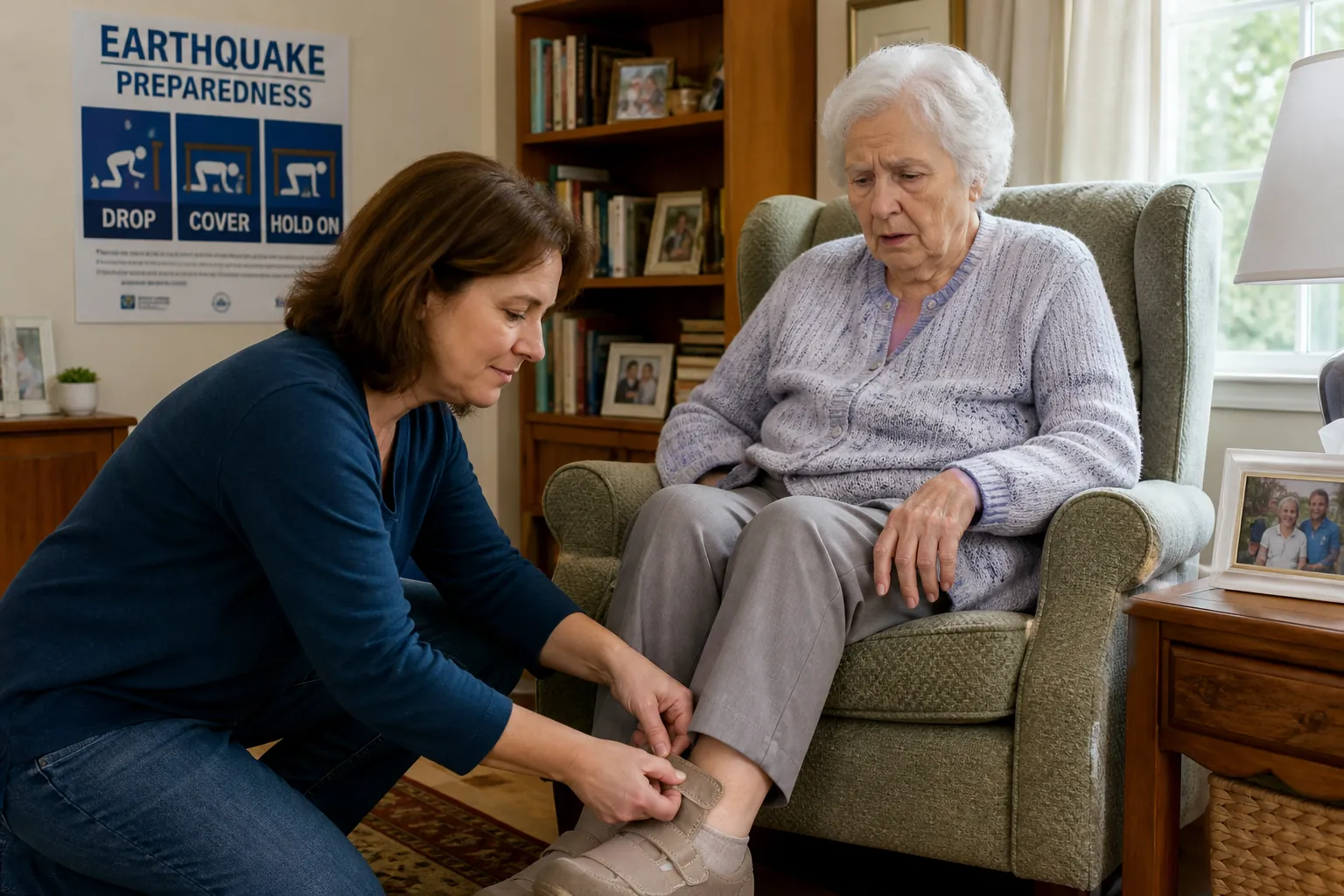
Look at the rooms where the person with dementia actually spends time, not the rooms where a preparedness checklist imagines they will be. If they nap in a recliner, watch television from one chair, or pace between the bedroom and kitchen, those are the earthquake-planning zones. Secure heavy furniture, remove objects that can fall near the usual seat or bed, keep walking paths open, and place sturdy shoes where the caregiver can reach them without leaving the person alone.
Illinois emergency guidance for seniors emphasizes preparing the home before an earthquake by securing hazards and knowing safe places in each room, along with the general “drop, cover, and hold on” guidance when shaking begins.[1] In a dementia household, the same idea needs a more practical translation: the safe place should be obvious to the caregiver, reachable from the person’s usual position, and not dependent on a debate in the moment.
- Choose one or two realistic safe spots near the person’s normal seating and sleeping areas.
- Keep the path to those spots free of cords, low tables, clutter, and unstable furniture.
- Store Velcro-closure or slip-resistant shoes within caregiver reach, not in a distant closet.
- Move breakable objects away from the person’s usual chair, bed, and pacing route.
- Keep a small light source near the bed and main seating area in case power fails at night.
If wandering, nighttime pacing, or exit-seeking are already part of daily life, earthquake planning should build on the same home modifications used for dementia safety. A room that is easier to navigate on an ordinary Tuesday is also easier to manage when the power is out and the caregiver is shaken. For layout ideas that are broader than earthquake preparation, see the dementia-friendly home modifications guide.
Build the Kit for the Person You Actually Care For
A three-day emergency kit is usually described in terms of water, food, medications, batteries, and documents. Those basics matter. But a dementia-specific kit has another job: it must help a frightened person stay identifiable, calmer, cleaner, warmer, and easier to move when routine has collapsed.
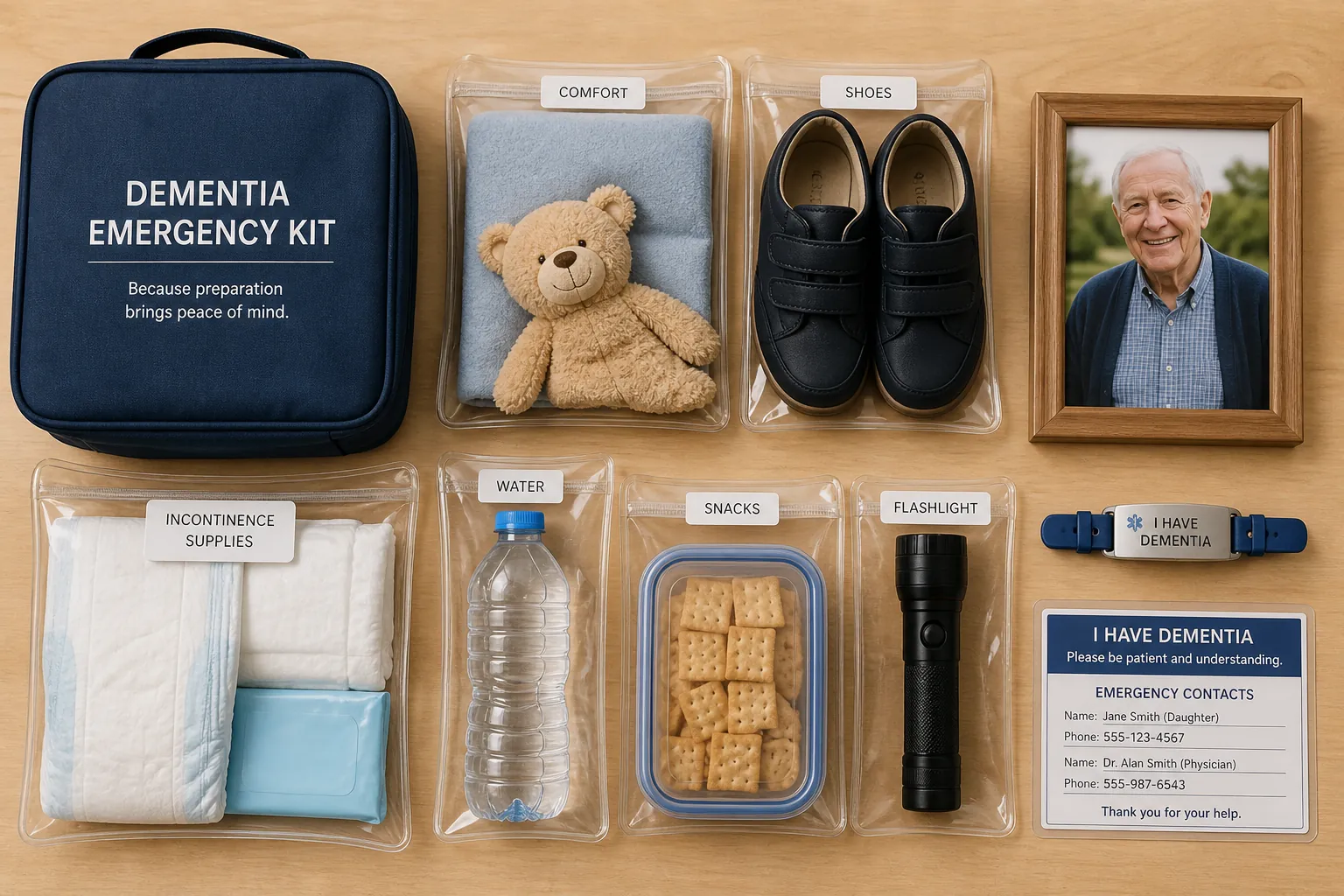
The Alzheimer’s Association’s disaster preparedness guidance tells caregivers to prepare emergency supplies and include dementia-specific items such as copies of important documents, medications, a recent photo, extra clothing, incontinence products, and comfort items.[2] That list is worth treating as a caregiving tool, not a storage project. If the bag is too heavy, hidden, expired, or missing the one object that settles the person at 2 a.m., it will not work when needed.
| Kit item | Why it matters in a dementia earthquake plan |
|---|---|
| Recent printed photo | Helps neighbors, responders, or shelter staff identify the person if they wander or become separated. |
| Extra ID and emergency contact card | Works when the person cannot state their name, address, diagnosis, medications, or caregiver contact. |
| Medical ID bracelet or necklace | Keeps identification on the person instead of only inside a bag that may be left behind. |
| Comfort object | A familiar blanket, sweater, soft item, or music source may reduce distress when routine is gone. |
| Velcro-closure shoes | Makes leaving unsafe debris or broken glass less dependent on tying laces or negotiating footwear. |
| Incontinence supplies and extra clothing | Protects dignity and reduces caregiver improvisation during long waits, evacuation, or sheltering. |
| Favorite shelf-stable snacks | Can be more useful than unfamiliar emergency food for someone who refuses to eat under stress. |
| Medication list and copies of documents | Gives another adult enough information to help if the primary caregiver is injured or separated. |
Put the most dementia-specific items in clear pouches or labeled bags. The goal is not a beautiful kit. The goal is that another family member, neighbor, or first responder can open it and understand what they are looking at without a long explanation from an exhausted caregiver.
Add a one-page caregiver note in plain language. It can say: “My husband has dementia. He may say he needs to go home even when he is home. He is calmer if you speak slowly, use his first name, and give him his blue blanket. He may resist changing clothes. He wears hearing aids. He cannot safely leave alone.” This is not oversharing in a disaster. It is a substitute memory for a person who may not be able to explain their own needs.
For a broader look at emergency-kit gaps that often get missed for older adults, including dementia-related concerns, the senior storm preparedness checklist gaps article is a useful companion. Storms and earthquakes are different events, but caregiving failures often happen in the same places: missing identification, inaccessible supplies, unfamiliar foods, toileting problems, and plans that assume a calm, cooperative older adult.
Identification Should Be Worn, Printed, and Registered
In many households, identification is treated like paperwork. It sits in a drawer, a binder, or the caregiver’s phone. That is too fragile for dementia earthquake planning. If the person leaves through a damaged doorway, follows another evacuee, or is moved by someone else while the caregiver is dealing with gas, glass, or injury, identification needs to travel with the person.
The Alzheimer’s Association recommends MedicAlert + Alzheimer’s Association Safe Return for people living with dementia who may wander or become lost.[2] Registration does not prevent wandering, and it does not replace supervision. Its value is that it gives police, emergency responders, or a good neighbor a way to connect an unidentified or confused person back to the caregiver.
- Have the person wear medical identification daily, not only during “high-risk” outings.
- Keep a recent printed photo in the emergency kit, caregiver wallet, and phone.
- Place a plain-language dementia ID card in the person’s jacket, walker pouch, or go-bag.
- Update emergency contacts when phone numbers, addresses, caregivers, or medications change.
There is a hard truth here: the ID bracelet that is “saved for emergencies” may not be on the wrist when the emergency happens. If the person tolerates it, daily use is safer than occasional use.
During the Shaking, Shorten the Caregiver’s Job
When shaking starts, the caregiver’s first job is immediate safety, not perfect instruction. If the person can be guided to cover without a struggle, use the simplest cue possible: “Sit here,” “Stay with me,” “Hold this.” If a full explanation increases panic, skip the explanation. A person with dementia may respond better to tone, touch, and familiar words than to emergency vocabulary.
Do not count on a drill to appear in the person’s memory under stress. The drill may still help the caregiver practice where to move, what to grab, and which words to use. That is valuable. But the rehearsal is mainly for the caregiver and the environment.
| If the person... | The plan should already allow for... |
|---|---|
| Refuses to move | A safer nearby seating area rather than a plan that requires crossing the room. |
| Tries to stand or walk | Clear paths, shoes nearby, and fewer objects that can fall into the pacing route. |
| Cannot understand the instruction | One-step cues, familiar wording, and caregiver positioning instead of repeated explanations. |
| Becomes incontinent | Supplies in the kit and a change of clothing that does not require searching. |
| Cries, shouts, or withdraws | A comfort item, calm voice, and reduced demands once immediate danger has passed. |
After the shaking stops, resist the urge to make the person “understand what happened” before moving to practical safety. Check for injuries, shoes, broken glass, gas smells, blocked exits, and whether the person is trying to leave. The explanation can be brief and repeated: “There was an earthquake. You are safe with me. We are putting on shoes.”
Plan for Wandering as a Disaster Risk, Not a Side Issue
Wandering is where many general preparedness articles become dangerously thin. They may tell families to stay together, check on neighbors, or go to an evacuation site. Those instructions assume the person understands the emergency and wants to remain with the caregiver. Dementia does not always cooperate with that assumption.
The Alzheimer’s Association states that 60% of people living with dementia will wander at least once, and its safety materials warn that people who are not found quickly can face serious injury or death.[2] The exact risk language should be checked against the current source when it will be quoted in formal guidance, but the caregiving implication is already clear: wandering cannot be treated as an unlikely complication during a disaster.
Earthquake conditions can increase the practical danger even if the person has wandered before without injury. Doors may be open. Fences may be damaged. Elevators may be out. Usual landmarks may look wrong. Neighbors may assume another family member is supervising. The caregiver may be forced to choose between checking the house for hazards and keeping eyes on the person every second.
Before the earthquake
- Tell trusted neighbors that the person has dementia and may appear purposeful while being unsafe alone.
- Keep current photos available in print and on the caregiver’s phone.
- Register identification through MedicAlert + Safe Return if appropriate for the person’s situation.
- Decide who searches inside, who watches exits, and who calls for help if more than one caregiver is present.
- Identify the places the person usually tries to go: a former home, workplace, church, school, bus stop, or relative’s house.
Immediately after the earthquake
Put eyes on the person before inspecting the whole home, unless there is an immediate life-threatening hazard. If they are mobile, place yourself between them and the most likely exit while keeping your voice low. Avoid long arguments about whether it is safe to leave. A simple sentence repeated consistently often works better than a detailed correction: “We are staying together. I have your shoes. Come with me.”
If the person is missing, start with the predictable places instead of assuming a random route. Check former routines, favorite exits, nearby streets, stairwells, garages, and places connected to the phrase they were repeating. Give responders a recent photo, diagnosis, clothing description, communication limits, and likely destinations. If a GPS or alert device is part of the household plan, make sure more than one caregiver knows how to access it.
Technology can help, but it should not be the only barrier between the person and a disaster scene. Batteries fail, cellular service can be disrupted, and devices may be removed. For families comparing GPS, door alerts, bed sensors, and other tools, the dementia monitoring systems guide explains where these systems help and where they still need human backup.
Sheltering or Evacuating Requires a Dementia Translation
Evacuation routes are useful, but dementia caregiving adds questions that a route map will not answer. Can the person walk over debris? Will they refuse a car ride with a neighbor? Do they become more agitated in crowds? Can they tolerate a shelter bathroom? Who can stay with them if the main caregiver needs medical attention?
When planning where to go, choose options in layers. A nearby room or yard may be enough after a minor quake. A neighbor’s home may be better than a public shelter if the structure is safe and the neighbor understands dementia. A formal evacuation site may be necessary in a larger event, but it is rarely the easiest environment for a person who depends on routine.
- Pre-arrange at least one nearby person who can sit with the person with dementia while the caregiver handles urgent tasks.
- Keep the go-bag where it can be taken without leaving the person unsupervised for long.
- Pack noise reduction, familiar clothing, and comfort items if crowds or sirens trigger distress.
- Write down mobility limits plainly: needs walker, cannot use stairs safely, resists wheelchair, tires quickly.
- Bring identification even for a short move outside; separation can happen close to home.
The caregiver also needs permission to choose the less elegant plan that works. If the formal plan says “evacuate to the community center” but the person is calmer and safer in a neighbor’s undamaged single-story home while officials assess the area, the real measure is safety, supervision, and access to help—not whether the family followed the prettiest version of the checklist.
Watch for Distress That Does Not Look Like a Simple Memory Problem
After the earthquake, a person with dementia may not be able to give a clear account of what they felt or feared. That does not mean the event left no mark. The American Association for Geriatric Psychiatry describes how disasters can disrupt routines and trigger confusion, withdrawal, agitation, emotional outbursts, and rapid physical decline in older adults, including those with cognitive impairment.[3]
The same AAGP guidance discusses observational case evidence from events including the 1995 Kobe earthquake and 9/11, noting that cognitively impaired older adults may retain traumatic emotional memories even when recent recall is poor.[3] That should not be turned into a universal prediction. Not every person will respond the same way. But it is enough evidence to take post-disaster behavior seriously instead of dismissing it as “just the dementia getting worse.”
| After the earthquake, notice... | Possible caregiver response |
|---|---|
| New withdrawal or silence | Reduce stimulation, keep routines simple, and monitor eating, drinking, sleep, and pain. |
| Agitation, pacing, or repeated attempts to leave | Check for injury, toileting needs, hunger, noise, unfamiliar people, and blocked routines before arguing. |
| Crying, fear, or repeated phrases | Use the same calm reassurance and familiar object rather than trying to force a full explanation. |
| Sudden physical decline | Treat it as a medical concern, especially if there may have been a fall, dehydration, missed medication, or hidden injury. |
| Worse confusion after relocation | Restore familiar cues where possible: photos, blanket, regular snacks, known caregiver voice, and predictable timing. |
This is where routine becomes more than a comfort preference. Meals, toileting, medication timing, sleep cues, and familiar voices can keep a hard day from becoming several worse days. The caregiver may not be able to restore the house immediately, but small recognizable anchors can reduce the number of new things the person has to process.
A Practical Home Earthquake Plan for Dementia Care
A dementia-ready earthquake plan does not need to be complicated. It needs to be real enough to survive fear, refusal, fatigue, and confusion. One page is often better than a binder if the page tells a substitute caregiver what to do first.
| Before the earthquake | During and after the earthquake |
|---|---|
| Secure furniture and falling hazards around the person’s usual chair, bed, and walking routes. | Guide the person with one-step cues and move toward the nearest realistic safe spot. |
| Keep Velcro shoes, flashlight, and go-bag within caregiver reach. | Put shoes on before walking through debris or leaving the home. |
| Pack dementia-specific supplies: recent photo, ID, comfort object, incontinence products, snacks, clothing, medications, and caregiver note. | Use the comfort object and familiar wording to reduce distress instead of relying on explanation. |
| Arrange medical identification and consider MedicAlert + Safe Return registration. | If separated, give responders the photo, diagnosis, communication limits, and likely destinations. |
| Tell trusted neighbors how dementia may look in an emergency. | Ask one person to watch the person with dementia while another handles hazards or calls. |
| Plan for wandering routes and monitoring backup. | Check exits, usual destinations, stairwells, garages, and nearby streets quickly if the person is missing. |
| Write down mobility limits and calming strategies. | Treat sudden agitation, withdrawal, or decline as possible disaster distress or medical concern. |
No home plan can make earthquakes safe. No checklist can make dementia predictable. But a caregiver can remove some of the brittle assumptions: that the person will remember, that they will cooperate, that the right shoes will be easy to find, that identification will be in the right pocket, that a stranger will know how to help.
When memory cannot carry the emergency plan, the environment, kit, identification systems, and caregiver response have to carry it instead.
References
- Earthquake Preparedness for Seniors, Illinois Emergency Management Agency and Office of Homeland Security, https://iemaohs.illinois.gov/preparedness/earthquake-seniors.html
- In a Disaster, Alzheimer’s Association, https://www.alz.org/help-support/caregiving/safety/in-a-disaster
- Older Adults and Disaster Preparedness and Response, American Association for Geriatric Psychiatry, https://www.aagponline.org/patient-article/older-adults-and-disaster-preparedness-and-response/
Related reading
Noticed something outdated or inaccurate on this page? Flag a correction. We review every report against CDC, NIA, and AARP HomeFit guidance before updating a page.
Part of the Fall Prevention section.