
Caregiver decision guide
Storm Prep for Older Adults Misses These 7 Checklist Gaps
Standard emergency checklists miss critical supplies for older adults with medical needs, mobility challenges, and cognitive conditions. This guide identifies 7 specific gaps — from backup power for medical devices to wandering prevention tools — so caregivers can build a storm kit that actually meets their older relative's needs.
You can do the responsible thing — print the standard emergency checklist, buy the flashlight batteries, set aside water, pack canned food — and still have a storm kit that fails the older adult in your care.
That gap usually shows up in the items generic lists do not make you picture: Dad’s CPAP when the power is out, Mom’s insulin routine when the pharmacy is closed, the walker glide that cracks during evacuation, the incontinence supplies that run out after two days, the dementia-related wandering risk that gets worse when sirens, crowds, and relocation disrupt every familiar cue.
General storm preparedness tips for older adults should still start with the basics from Ready.gov or the Red Cross: water, food, lights, radio, batteries, first aid, evacuation planning. But for older adults with chronic illness, mobility limitations, medical equipment, continence needs, or cognitive impairment, the missing categories are not comfort items. After a storm, they can become health risks.
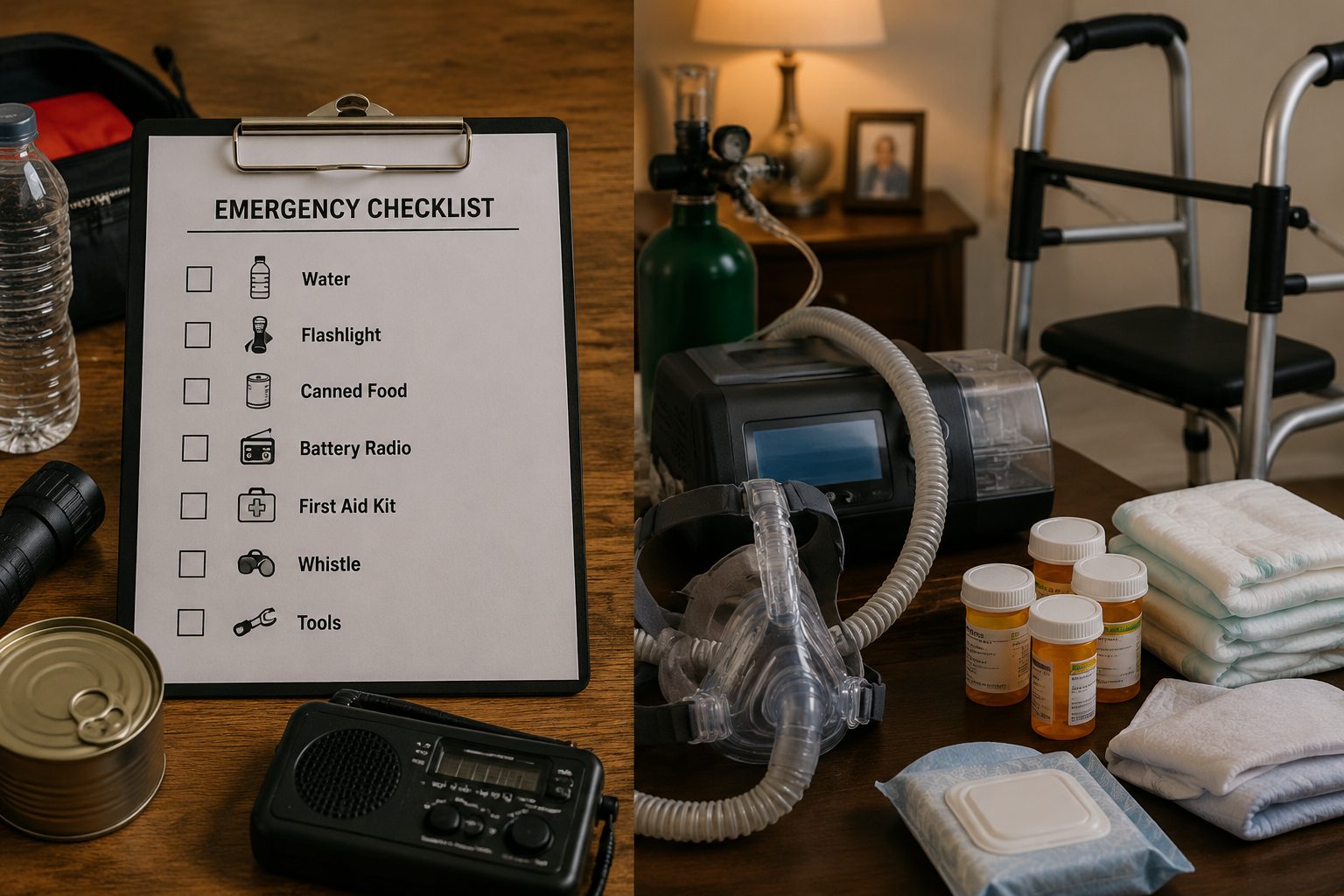
Older adults are overrepresented in some severe-weather death tolls. Fox Weather reported that 60% of Hurricane Ian victims were age 60 or older, and that 60% of deaths in the Texas winter storm were people age 60 or older.[1] Those figures do not mean every older person is fragile, and they do not prove one missing kit item caused one death. They do show why a caregiver’s checklist has to be more specific than “three days of supplies.”
Use the seven gaps as an audit, not a guilt list
Not every older adult needs every item below. A healthy 68-year-old who drives, manages medications independently, and uses no medical equipment has different risks than an 89-year-old with oxygen, dementia, and a walker. The useful question is not “Did I buy everything?” It is: “Which missing category would create a real problem for this specific person if roads, power, pharmacies, caregivers, or cell service were disrupted?”
| Checklist gap | Who it matters for | Failure point it prevents |
|---|---|---|
| 30-day medication continuity plan | Older adults taking daily prescriptions, insulin, cardiac medications, psychiatric medications, inhalers, or other time-sensitive drugs | Running out when pharmacies, roads, mail delivery, or prescribers are unavailable |
| Backup power for medical devices | People using CPAP, oxygen equipment, glucose monitors, power wheelchairs, rechargeable hearing devices, or other powered equipment | Loss of treatment, monitoring, communication, or mobility during an outage |
| Mobility-aid redundancy | People using walkers, canes, wheelchairs, scooters, braces, or transfer equipment | Being unable to evacuate, toilet, transfer, or move safely if equipment breaks or is left behind |
| Incontinence and hygiene supplies | People using briefs, pads, wipes, barrier cream, catheters, ostomy supplies, or bedside toileting supplies | Skin breakdown, infection risk, dehydration from avoiding fluids, and caregiver crisis in shelters or outages |
| Dementia wandering prevention tools | People with Alzheimer’s disease or other dementia, especially those who pace, exit-seek, become agitated, or get disoriented | A missing-person emergency during evacuation, sheltering, noise, darkness, or routine disruption |
| Non-app communication access | Older adults without internet access, smartphones, reliable charging, or comfort using emergency apps | Missing evacuation orders, boil-water notices, shelter updates, or family instructions |
| Waterproof legal and insurance documents | Anyone whose caregiver may need to speak for them, arrange care, replace medications, file claims, or manage hospitalization | Delays proving identity, authority, coverage, prescriptions, or medical wishes |
1. Medication continuity: plan for weeks, not a long weekend
This is the first place many general kits underprepare older adults. A three-day bag may be reasonable for granola bars and flashlight batteries. It is a thin margin for blood pressure medication, anticoagulants, seizure medication, insulin, inhalers, Parkinson’s medication, mood stabilizers, eye drops, or pain regimens that cannot simply pause until the neighborhood reopens.
The Red Cross recommends that older adults keep at least a 30-day supply of medication, along with a list of medications, dosages, allergies, and doctors.[2] That single recommendation should change how caregivers pack. The medication part of the kit is not a small zip bag tossed in the side pocket; it is a rotation system.
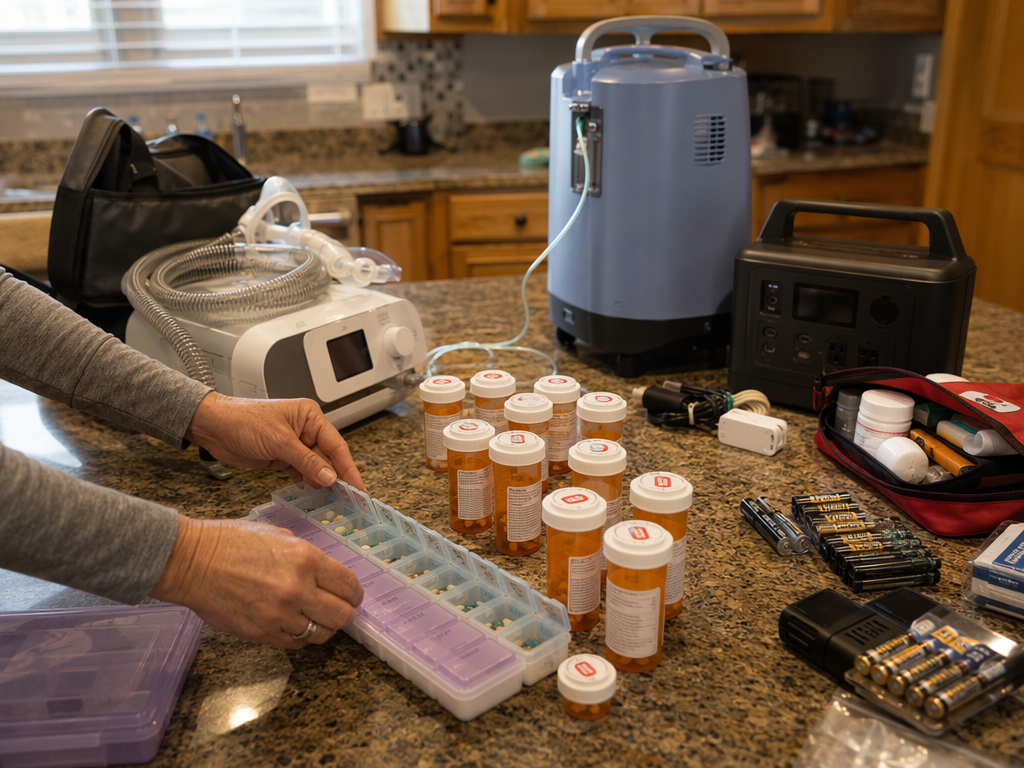
The workable version looks like this: keep the current medication list printed and stored in the kit; include the prescribing doctors and pharmacy; add allergies and major diagnoses; rotate extra medication before it expires; and write down what must be refrigerated, taken with food, taken at exact times, or not stopped abruptly. If insurance rules or refill timing make a full 30-day reserve difficult, ask the prescriber and pharmacist what emergency refill options are available before storm season, not while the power is already out.
Insulin, liquid antibiotics, and other temperature-sensitive medications need a separate plan. A cooler is not a plan by itself unless someone knows how long it can maintain a safe temperature, where ice can be replaced, and what to do if evacuation takes longer than expected. If the older adult has diabetes supplies, include backup meter supplies or sensor supplies, written dosing instructions, and a way to track readings if the usual app, receiver, or charger is unavailable.
If you want a broader medical-needs framework, this deeper guide to severe weather safety for elderly people with medical needs can sit alongside the medication list. The point here is narrower: do not let the medication plan be sized for the same time window as the snack supply.
2. Backup power for medical devices: write down the device, the battery, and the hours
Power-dependent care is where generic storm advice often sounds calmest and fails fastest. “Charge devices” is not enough when the device is a CPAP machine, oxygen concentrator, nebulizer, power wheelchair, refrigerated medication system, glucose monitor, hearing aid charger, hospital bed, lift chair, or communication device.
The Red Cross specifically notes that emergency shelters may not have durable medical equipment.[2] AgingCare gives the same practical warning: shelters do not provide CPAP machines, oxygen, or mobility aids, so caregivers must bring the older adult’s equipment.[3] That matters because many families assume a shelter will function like a clinic. Most shelters are not stocked to replace home medical equipment.
Make a device inventory before storm season. For each item, write three things on paper and keep it with the kit:
- What the device does: breathing support, oxygen delivery, glucose monitoring, mobility, hearing, communication, transfer assistance, medication storage.
- What power it needs: wall outlet, rechargeable battery, disposable batteries, car adapter, external battery, generator-compatible charging, or a specific manufacturer battery.
- How long it can run: the realistic number of hours the older adult can use it on battery under normal settings, not the best-case number from the box.
A CPAP user may need a manufacturer-approved battery, distilled water if using humidification, cleaning supplies, mask cushions, tubing, and a plan for nights without power. An oxygen user may need portable tanks, concentrator backup, tubing, cannulas, and the oxygen supplier’s emergency number. A power wheelchair user may need charging time built into the evacuation schedule and a manual backup option if that is physically safe and available.
Generators can help some households, but they are not a universal answer. They cost money, require fuel, must be operated safely outdoors, and may not be manageable for an older adult living alone. If a generator is part of the plan, the caregiver still needs a written fallback for evacuation, transportation, and device charging if the generator fails or cannot be used.
3. Mobility-aid redundancy: pack for the broken walker, not the perfect one
Storm movement is rough on mobility equipment. People are stepping over thresholds, loading cars in the rain, moving through shelters, walking across wet pavement, waiting in lines, and sleeping in unfamiliar spaces. A walker, cane, wheelchair, scooter, brace, or transfer belt becomes part of the safety system.
Do a hands-on check, not just a mental one. Look at cane tips, walker glides, brakes, wheelchair tires, footrests, batteries, chargers, cushions, and the tools needed for small adjustments. If the older adult uses a rollator, make sure the brakes hold. If they use a wheelchair, label it clearly and include the cushion; leaving the cushion behind can turn long sitting into a skin problem.
For some families, redundancy means a backup manual wheelchair. For others, it means spare cane tips, a folding cane in the car, extra scooter batteries, a transfer belt, or a second walker kept near the evacuation exit. The right backup depends on the older adult’s strength, balance, weight-bearing status, and whether the caregiver can safely assist.
If flooding is the main threat in your area, pair this with a room-by-room plan for entrances, rugs, thresholds, and ground-floor storage. A flood-specific checklist such as how to flood-proof an older parent’s home can help you catch hazards that a bag alone will not solve.
4. Incontinence and hygiene supplies: the kit has to cover dignity and skin
Incontinence supplies are easy to underpack because they feel bulky, private, and less urgent than medications. Then the storm stretches into day four, the roads are blocked, the shelter bathroom is far away, and the caregiver is trying to ration briefs. That is not a small inconvenience for someone with fragile skin, limited mobility, dementia, or a history of urinary tract infections.
Pack at least a practical seven-day supply if the older adult uses briefs, pads, pull-ups, bed pads, wipes, barrier cream, disposable gloves, catheter supplies, ostomy supplies, or cleansing products. Add sealable disposal bags. If the person uses a bedside commode, think through whether it can be moved, cleaned, and used safely during an outage or evacuation.
This is also a hydration issue. Some older adults drink less when toileting is difficult, bathrooms are unfamiliar, or continence products are limited. A storm kit that includes hygiene supplies reduces the pressure to make unsafe tradeoffs.
5. Dementia wandering prevention: storms amplify a known risk
Families who are new to dementia care often prepare for storms as if the main challenge is supplies. For a person with Alzheimer’s disease or another dementia, the main danger may be disorientation. The Alzheimer’s Association says 60% of people living with dementia will wander at least once, and disaster conditions can increase confusion, agitation, and the chance of wandering.[4]
Noise, darkness, crowds, evacuation, sleeping somewhere unfamiliar, and disrupted routines can remove the cues that normally keep a person settled. A person who has never left the house alone may try to “go home” from a shelter. Someone who usually paces indoors may head toward an exit when doors are propped open for storm traffic.
The dementia part of the storm kit should be visible and fast to use:
- A recent printed photo, updated often enough that hair, glasses, facial hair, and weight changes are recognizable.
- An ID bracelet, clothing label, wallet card, or shoe tag with the person’s name, diagnosis if appropriate, emergency contact, and critical medical information.
- A written description of communication needs: whether the person answers to a nickname, becomes frightened by uniforms, speaks another language, or cannot reliably state their address.
- Local missing-person and Silver Alert contact information, written down before anyone is missing.
- Comfort cues: familiar music, a small object, simple activity, or routine card that may reduce agitation during waiting.
GPS devices and location tools can be useful for some families, but they do not replace supervision, identification, and a local alert plan. They also raise practical questions: who charges the device, who receives the alert, what happens if cell service is poor, and whether the person will remove it. For a fuller discussion, see this guide to GPS tracking for dementia wandering. If nighttime wandering is already happening outside storm season, start with a daily safety plan, not just an emergency bag; this guide on what to do when a parent wanders at night is a better fit.
6. Communication access: do not assume alerts arrive through an app
Emergency planning has quietly become more digital. County alerts, evacuation maps, outage updates, shelter locations, pharmacy notices, and family group texts often depend on smartphones and internet access. That leaves out a meaningful group of older adults.
AARP reported in 2021 that 15% of adults age 50 and older lacked internet access.[5] The exact share may have shifted since then, but the planning problem remains: an app-based alert is not an alert for someone who cannot access it, does not know how to use it, has a dead phone, or lives where service is down.
Build a low-tech communication layer:
- A weather radio with fresh batteries or another non-internet way to receive official updates.
- Printed phone numbers for family, neighbors, doctors, pharmacy, oxygen supplier, home health agency, utility company, local emergency management, and transportation help.
- A paper call tree that says who checks on the older adult first, who is backup, and who has keys.
- A written evacuation destination and an out-of-area contact who can relay messages if local calls are difficult.
- Chargers, power banks, hearing aid batteries, glasses, and any speech or communication aids the person depends on.
For older adults with hearing, vision, speech, or cognitive limitations, communication supplies are safety equipment. Large-print instructions, picture-based cue cards, a notepad, or a laminated medical summary can spare the older adult from having to explain complex needs while frightened, tired, or separated from the usual caregiver.
7. Waterproof legal, medical, and insurance documents
A storm can turn into a paperwork crisis quickly. Evacuation becomes hospitalization. A pharmacy needs proof of prescriptions. A shelter intake worker asks about medical needs. An insurance claim starts before the caregiver can get back into the house. If the only copy of the power of attorney or medication list is in a desk drawer, soaked file cabinet, or dead phone, the caregiver loses time.
Keep copies in waterproof storage, and make sure the right person can access them. Include:
- Photo ID and emergency contacts.
- Health insurance, Medicare, Medicaid, prescription, and supplemental insurance cards.
- Medication list, allergies, diagnoses, baseline cognitive or mobility status, and medical device settings when relevant.
- Power of attorney, health care proxy, advance directive, DNR or POLST/MOLST forms if applicable in the person’s state and care plan.
- Home insurance, flood insurance, lease or mortgage information, and key utility account numbers.
- Veterans benefits, long-term care insurance, home health agency contacts, and durable medical equipment supplier contacts when applicable.
If legal planning is incomplete, storm season has a way of exposing that. A broader planning resource such as a caregiver’s roadmap to end-of-life care planning can help sort out advance directives and decision-making authority before an emergency forces the issue.
When money is tight, start with the category that would fail first
Emergency advice often assumes a caregiver can buy everything at once: extra medications, batteries, a radio, waterproof bags, spare mobility parts, generator fuel, incontinence supplies, and backup devices. Many families cannot. AARP reported in 2021 that 50% of adults age 50 and older had no emergency savings.[5] That financial reality belongs in the plan, not in the footnotes.
If you cannot build the whole kit this month, rank the gaps by consequence. For one person, the first priority may be oxygen backup. For another, it may be insulin storage, a 30-day medication rotation, a dementia ID bracelet, or a week of briefs. A printed medication list costs very little. Updating emergency contacts costs nothing. Calling the county emergency management office, utility company, oxygen supplier, pharmacy, or local aging services agency may uncover options that are not obvious from a shopping list.
Ready.gov’s older-adult guidance is a useful baseline for building a support network, making a plan, and tailoring supplies to medical and access needs.[6] Local details matter, though. Instead of relying on a state-specific registration example you found online, check your county emergency management office, local aging agency, utility medical needs program, transportation resources, and shelter policies. Ask directly whether medical needs registries exist, what they do and do not provide, and whether they guarantee evacuation assistance. Many programs are helpful, but caregivers should not mistake registration for rescue on demand.
For evacuation decisions, a separate guide to hurricane preparedness for seniors and caregivers can help weigh sheltering in place against leaving. This checklist is the packing audit underneath that decision: what the older adult’s body, equipment, cognition, documents, and daily care routine will require if the storm lasts longer than expected.
References
- Older adults, elderly and seniors face heightened risks from extreme weather, Fox Weather
- Older Adults, American Red Cross
- How to Prepare Elderly Loved Ones for Emergencies, AgingCare
- Disaster Preparedness, Alzheimer’s Association
- Disaster Risks to Older Adults, AARP
- Older Adults, Ready.gov
Questions to bring to a clinician or OT
This is not medical, legal, or a family's final decision — only a framework. Bring these questions to a clinician, occupational therapist, or your local Area Agency on Aging.
Find Local HelpRelated reading
Noticed something outdated or inaccurate on this page? Flag a correction. We review every report against CDC, NIA, and AARP HomeFit guidance before updating a page.