
STEADI: Intervene
When Is an Elderly Person's Fever an Emergency?
Most fever guidance for adults is written for younger bodies — this guide explains when an older adult's fever is a medical emergency. It covers elderly-specific temperature thresholds, red flags that require calling the doctor or going to the ER, and how to monitor a fever safely at home.
For an adult 65 or older, do not wait for a dramatic temperature before asking for help. A fever in an older adult may mean a single reading above 100°F, repeated readings above 99°F, or a temperature more than 2°F above that person’s usual baseline; AARP also quotes Johns Hopkins geriatrician Dr. Alicia Arbaje advising that any temperature over 100°F in an older adult should prompt a doctor call.[1][2]
That is the safer starting point when deciding whether an older adult’s fever needs medical help: look at the number, but do not let the number hypnotize you. New confusion, trouble breathing, severe weakness, not urinating, or a fall during illness can matter more than whether the thermometer says 100.1°F or 103°F.
The quick decision path
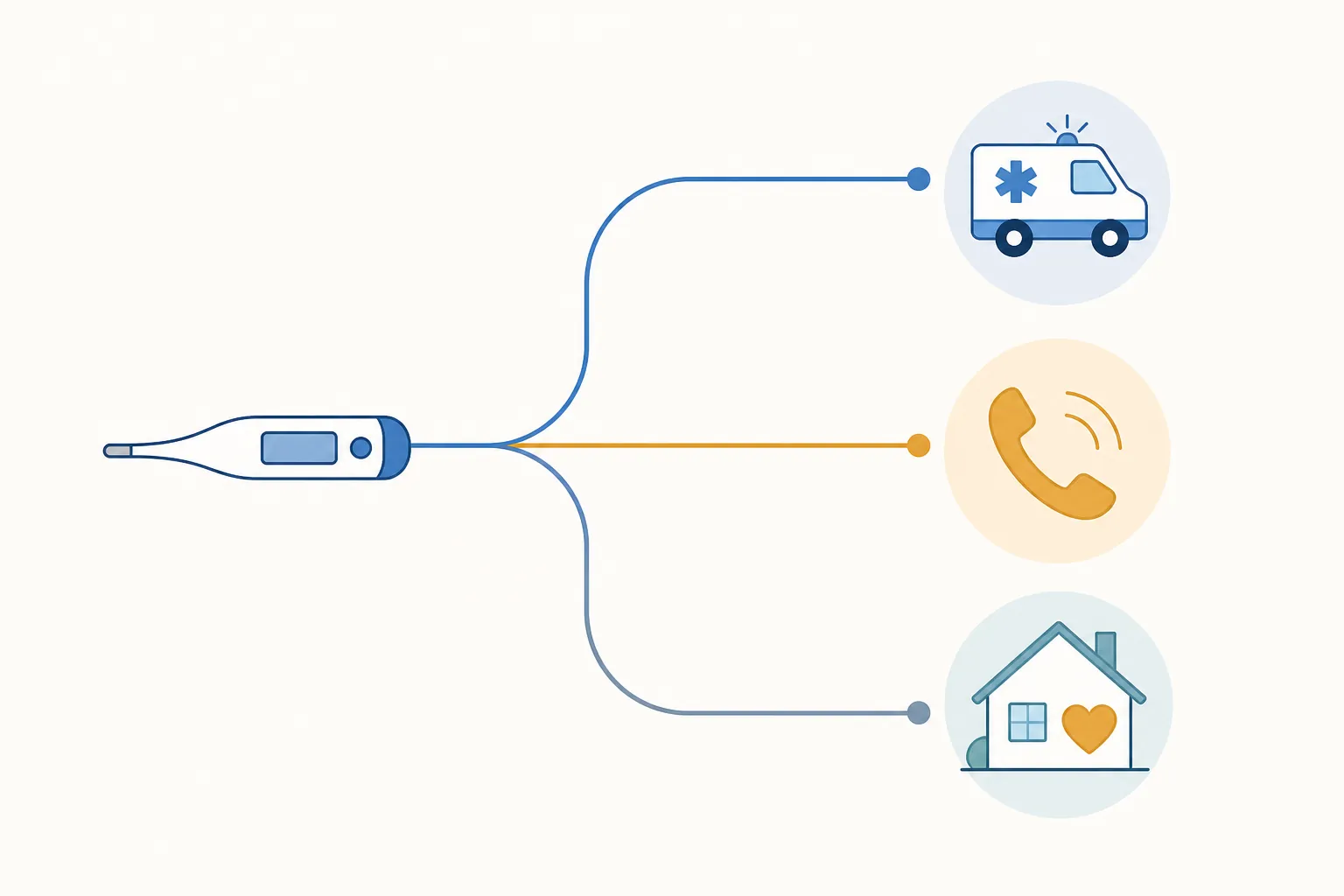
- Take a reliable temperature. For adults 65 and older, Mayo Clinic’s thermometer guidance favors a mouth or ear thermometer rather than a forehead thermometer.[3]
- Compare it with the person’s usual temperature if you know it. A reading that is only “mildly high” for a younger adult may be meaningful if it is more than 2°F above this person’s normal baseline.[1]
- Look for emergency signs before you keep rechecking the thermometer: new or worsening confusion, trouble breathing, seizure, stiff neck, fever with rash, not urinating, severe weakness or unsteadiness, or any fall or collapse during the illness.[4][5]
- If emergency signs are present, call 911 or go to the ER. If there are no emergency signs but the temperature is over 100°F, call the doctor today for guidance.[2]
- Monitor at home only when the person is alert, breathing comfortably, drinking enough to urinate, steady enough not to fall, and you have a clear plan for when to call back.
Why 100.4°F is not enough for older adults
Many adult fever pages use 100.4°F as the clean dividing line. It is tidy, but it is not a safe stand-alone rule for an older person at home. Geriatric sources use lower and more personal thresholds because older adults can run lower baseline temperatures and may not mount a strong fever even with infection.
HealthInAging, from the American Geriatrics Society, defines fever in older adults as any one of these: one oral reading above 100°F, two repeated oral readings above 99°F, or a rise of more than 2°F above the person’s usual temperature.[1] AARP’s infection warning guidance is even more direct for caregivers: call the doctor for a temperature over 100°F in an older adult.[2]
That does not mean every 100.1°F reading is an ambulance situation. It means the reading should not be waved away, especially if the person is unusually sleepy, newly confused, weaker than usual, short of breath, drinking poorly, or urinating less.
| What you see | How to treat it in an older adult |
|---|---|
| Single oral temperature above 100°F | Treat as a doctor-call trigger, even if it looks mild by younger-adult standards.[1][2] |
| Repeated oral readings above 99°F | Take seriously if the person is ill, weaker, confused, or has infection symptoms.[1] |
| More than 2°F above the person’s usual baseline | Treat as fever even if the absolute number is below 100.4°F.[1] |
| 103°F or higher | Seek immediate medical evaluation; Mayo Clinic and Banner Health both identify 103°F or higher in an older adult as requiring prompt evaluation.[6][7] |
| 101°F or higher with heart disease, lung disease, kidney disease, or diabetes | Call a clinician promptly for individualized instructions; Hackensack Meridian lists these chronic conditions as reasons to seek care at this fever level.[8] |
| Fever that does not resolve | Ask for care rather than letting it run on. Hackensack Meridian flags fever beyond 3 days when it is 103°F or higher, and Mass General Brigham advises care for fevers lasting beyond 5 days.[8][9] |
Emergency signs: stop watching the thermometer and act
The most dangerous mistake is to keep saying, “But the fever is not that high,” while the person in front of you is clearly getting worse. CDC flu emergency warning signs include trouble breathing, seizures, not urinating, severe weakness or unsteadiness, and confusion that does not improve.[4] A 2001 American Family Physician review on infections in older adults reported that delirium occurs in about half of older adults with infections; that review is older, but the warning remains clinically important enough that new confusion should never be treated as ordinary tiredness.[5]

Call 911 or go to the ER now if an older adult with fever or suspected infection has any of the following:
- New confusion, new agitation, unusual sleepiness, or a behavior change that is clearly not normal for them.
- Trouble breathing, blue lips, chest pain, or struggling to speak in full sentences.
- A seizure.
- A stiff neck, severe headache, or fever with a rash.
- Not urinating, or urinating far less than usual.
- Severe weakness, inability to stand safely, ongoing dizziness, or new unsteadiness.
- Any fall, collapse, or near-fall during the illness. If the person has fallen, use the same act-now mindset you would use for any sudden change in mobility; the fall prevention FAQ can help you think through the fall-risk side after urgent medical needs are addressed.
If you are debating whether the confusion is “bad enough,” do not debate alone. Call the doctor’s after-hours line, urgent care, or emergency services and describe exactly what changed.
When to call the doctor today
A same-day doctor call is appropriate when an older adult has a temperature over 100°F, even if they are not sick enough for an ambulance.[2] The call is not a nuisance. It gives the clinician a chance to decide whether the person needs testing, medication changes, urgent care, an ER evaluation, or closer home monitoring.
Call promptly if the person has fever plus a major chronic condition such as heart disease, lung disease, kidney disease, or diabetes. Hackensack Meridian specifically flags 101°F or higher with those conditions as a reason to seek care.[8]
Also call if the fever persists. Sources do not use one identical time limit: Hackensack Meridian advises care for fever of 103°F or higher lasting beyond 3 days, while Mass General Brigham advises evaluation for fevers lasting beyond 5 days.[8][9] For an older adult, especially one who is frail or medically complex, it is reasonable to call earlier rather than wait for the outer limit.
How to monitor at home without missing deterioration
Home monitoring belongs only in the safer branch: no emergency signs, no severe weakness or unsafe walking, no breathing trouble, no new confusion, and the person is able to drink and urinate. If that changes, the plan changes.
- Use the same type of thermometer each time when possible, preferably mouth or ear for an adult 65 or older.[3]
- Write down the temperature, time, and method: “101.2°F by mouth at 6:40 p.m.” is much more useful than “feverish.”
- Track fluid intake and urination. AARP’s caregiver guidance recommends watching temperature, fluids, urination, and mental status, and it quotes Dr. Morgan Katz advising rechecks about every 2 hours while the person is ill.[2]
- Watch how they move. Fever, poor intake, dizziness, and weakness can make a bathroom trip unsafe. If they are wobbly, do not let them walk alone “just this once.”
- Keep the path to the bathroom clear, turn on lights, and consider using the same practical safety habits covered in the senior heat safety checklist for dehydration, dizziness, and fall-risk prevention.
Avoid the trap of monitoring only the fever curve. A lower number after fluids or fever-reducing medicine does not prove the illness is safe if the person is more confused, weaker, short of breath, or urinating less.
What to say when you call
A triage nurse or doctor can help faster when you give a clean report. Before you call, write down what you know. If you do not know an answer, say that plainly.
- Current temperature and how you took it: mouth, ear, or another method.
- Usual baseline temperature, if known.
- When symptoms started and whether the fever is rising, falling, or coming back.
- Main symptoms: cough, pain, burning with urination, vomiting, diarrhea, rash, stiff neck, or anything else new.
- Mental status: whether they are more confused, sleepy, agitated, or “not themselves.”
- Breathing: normal, faster than usual, labored, wheezing, or unable to speak comfortably.
- Fluid intake and urination: what they drank, when they last urinated, and whether urine output is clearly less than usual.
- Weakness, dizziness, unsteadiness, or whether they need more help walking than usual.
- Any fall, collapse, or near-fall during this illness.
- Major conditions such as heart, lung, kidney disease, diabetes, dementia, immune suppression, or recent surgery.
- Medications that may matter, especially immune-suppressing medicines, blood thinners, diuretics, or recent antibiotics, if you have the list available.
This article is general triage guidance, not a diagnosis or a substitute for medical care. If you are unsure whether an older adult’s fever is safe to watch at home, contact a clinician, urgent care, or emergency services. In older adults, the emergency is defined by the whole pattern, not the temperature number alone.
References
- Flu (Influenza): Symptoms — HealthInAging.org
- Signs and Symptoms of Infection in Older Adults — AARP
- Thermometers: Understand the options — Mayo Clinic
- Flu: What To Do If You Get Sick — Centers for Disease Control and Prevention
- Common Infections in Older Adults — American Family Physician, January 15, 2001
- Fever — Mayo Clinic
- Fevers at Every Age — Banner Health
- When to Seek Care for a Fever — Hackensack Meridian Health, September 17, 2020
- When to Go to Urgent Care for Fever — Mass General Brigham
Related reading
Noticed something outdated or inaccurate on this page? Flag a correction. We review every report against CDC, NIA, and AARP HomeFit guidance before updating a page.
Part of the Fall Prevention section.