
STEADI: Intervene
Car Breakdown Emergency Checklist for Older Drivers
Standard roadside emergency kits assume a driver who can kneel, lift a spare tire, or walk for help — conditions that don't hold for many older drivers. This checklist maps what to keep in the glove box, passenger area, and trunk, covering medications, spare glasses, medical information, mobility aids, and heat/cold gear, plus pre-trip vehicle checks and a six-month refresh cadence.
A standard roadside kit is useful. It is also written, too often, for a driver who can kneel on asphalt, lift a tire, rummage through a trunk, read tiny labels in dim light, and walk for help if the phone fails. A car breakdown emergency checklist for elderly drivers has to start in a different place: what can the person reach, understand, and use while staying safely in or near the driver’s seat?
That matters because the danger in a breakdown is not only the flat tire or dead battery. For an older adult, the next hour can bring heat exposure, chilling, dizziness, missed medication, confusion over who to call, or a fall while trying to do something the kit quietly assumes they can do. The CDC reported that in 2022, about 9,100 older adults were killed and more than 270,000 were treated in emergency departments for motor vehicle crash injuries; the agency describes that as an average of 25 older adults killed and more than 740 injured each day that year.[1] Those figures are not a reason to take the keys away from responsible older drivers. They are a reason to stop stocking the car as if age, vision, hearing, balance, and temperature tolerance do not matter.
This is general preparedness information, not medical, legal, or driving-fitness advice. Medication storage, driving restrictions, and emergency plans should be checked with the older driver’s clinician, pharmacist, insurer, and local rules when needed.
Build the kit by where the driver can actually use it
AAA, the American Red Cross, the National Safety Council, and Ready.gov all point drivers toward the usual car-emergency basics: water, food, first aid, flashlight, jumper cables, warning devices, blankets, and tools.[2][3][4][5] Those belong in the car. They are the floor.
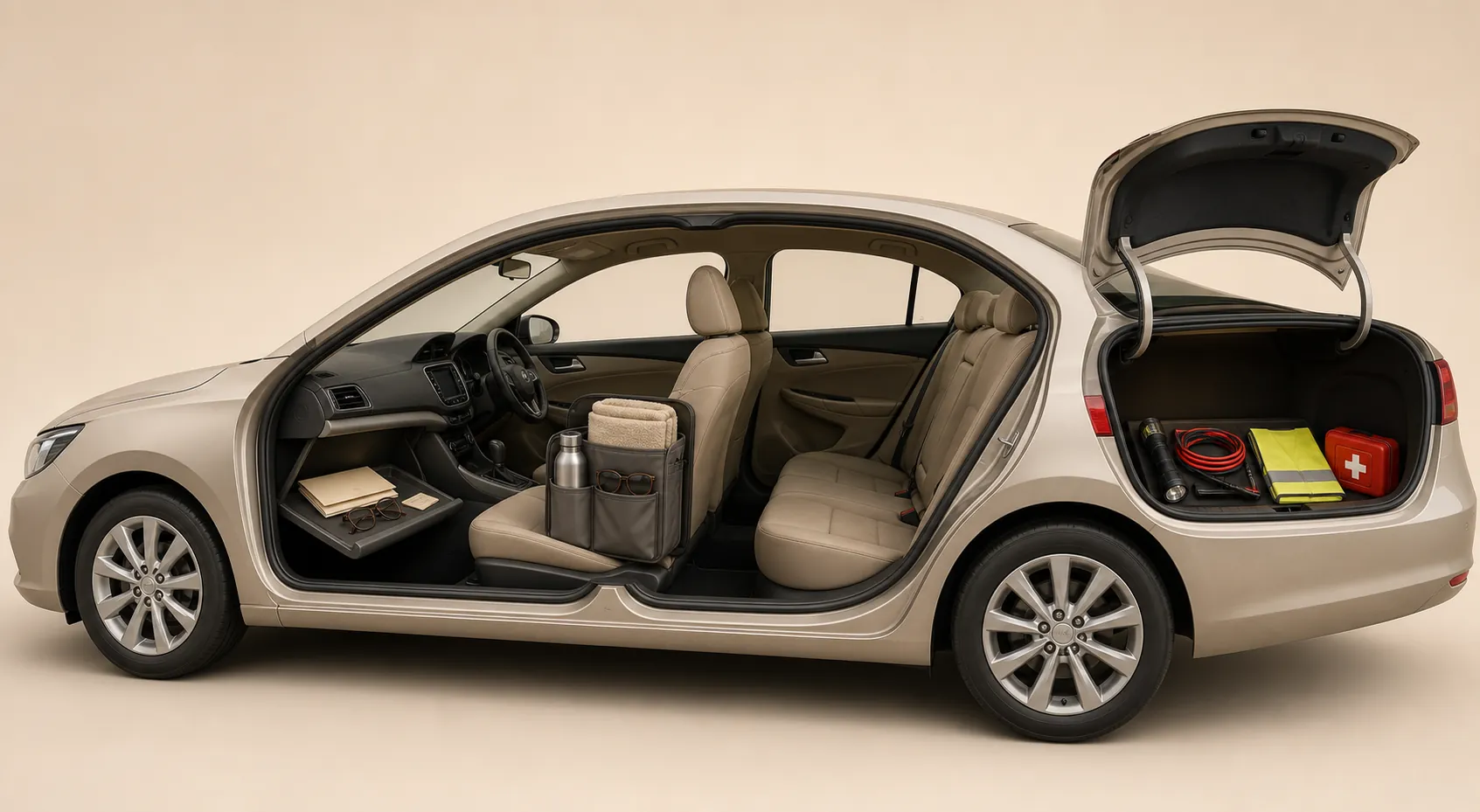
For an older driver, the missing layer is placement. A flashlight in the trunk does not help much if getting to the trunk means stepping onto a sloped shoulder at night. A medication pouch is not helpful if it has been baking all summer. A cane under suitcases may as well be at home. Start with three zones.
| Zone | What belongs there | Why it matters |
|---|---|---|
| Glove box | Identity, emergency contacts, medical card, insurance, doctor and pharmacy details, written instructions | A rescuer, police officer, tow driver, or family member can find essential information quickly. |
| Passenger area | Reachable water, snacks, phone charger, spare glasses, hearing-aid batteries, medication plan, mobility support, light blanket or wrap | These are the items the older driver may need before anyone arrives, without leaving the seat. |
| Trunk | Standard roadside kit: flashlight, jumper cables, reflective warning items, first-aid supplies, tools, weather gear | These help helpers, tow drivers, family members, or able drivers handle the vehicle problem safely. |
Glove box: the information someone else will need
The glove box should not be treated as a junk drawer. In a breakdown, it is the place another person is most likely to check first. Keep the paperwork simple, current, and easy to read.
- Emergency contacts: at least two names, phone numbers, and relationships. Include one person nearby if possible and one person who can make decisions or coordinate help.
- Medical information card: major conditions, allergies, current medications, implanted devices if relevant, preferred hospital if there is one, doctor names, pharmacy, and insurance information. A one-page format is easier for emergency responders and relatives than a stack of old visit summaries. If your family already keeps a medical packet, the same one-page idea used in a wandering or emergency information packet can be adapted for the car.
- Copies or photos of key documents: insurance card, registration, roadside-assistance membership, and any instructions the driver uses to request a tow.
- Written step-by-step breakdown instructions: whom to call first, what to say, and where the roadside-assistance card is. Stress can make even familiar phone numbers disappear.
- A note about mobility or communication needs: for example, “uses hearing aids,” “walks with cane,” “cannot stand long in heat,” or “please call daughter before towing vehicle.”
Use large print. Put the pages in a bright folder or zip pouch labeled in ordinary language, such as “Emergency Information.” Do not count on a phone alone. Phones lose battery, lock screens get in the way, and a driver who is shaken may not be able to explain where everything is stored.
Passenger area: the items that protect the driver before help arrives
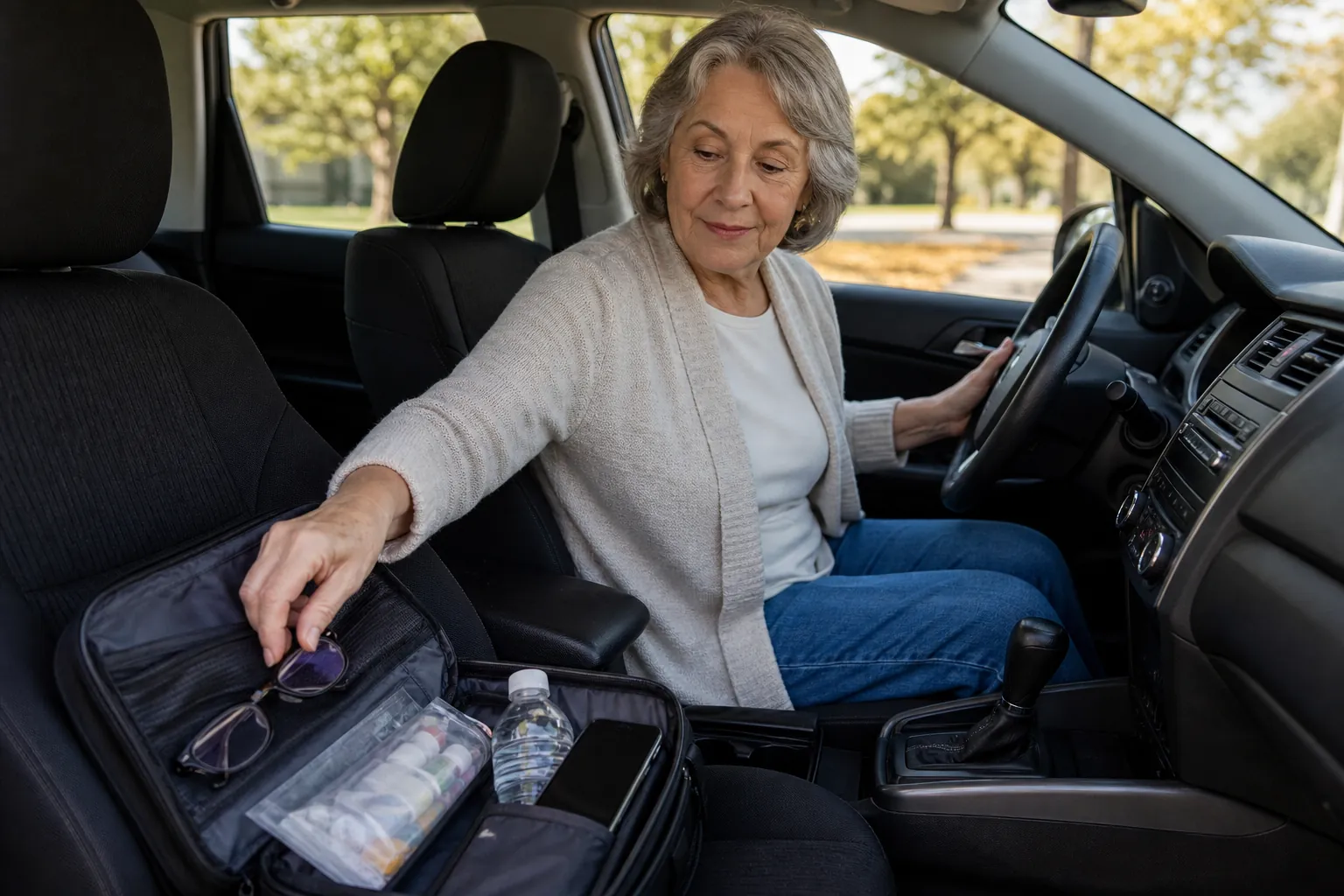
This is the part many car-kit lists shortchange. The passenger area is not for clutter; it is for the things an older driver may need while staying seated, belted if appropriate, doors locked if necessary, and off the roadway. A small organizer, soft-sided bag, or seat-back pouch is usually better than a heavy box.
Water and snacks should be reachable, not buried
The Red Cross recommends water and non-perishable, high-energy foods in a car emergency kit, and its car-kit guidance uses one gallon of water per person per 24 hours as the water planning amount.[3] In a small car, that full amount may not fit comfortably in reach, but at least some water should be accessible from the driver’s seat. The rest can live in the trunk.
Choose snacks the driver can open without scissors or strong hands. Avoid anything that becomes impossible to chew, melts into a mess, or conflicts with the person’s medical diet. If diabetes, kidney disease, swallowing problems, or sodium limits are involved, this is worth a clinician or dietitian check rather than a guess.
Glasses, hearing aids, and phone power are not extras
A spare pair of glasses in the passenger-area kit can turn a frightening wait into a manageable one. If the driver uses reading glasses for the phone, dashboard controls, medication labels, or insurance cards, those glasses belong within reach. If hearing aids use replaceable batteries, keep spare batteries in the same reachable pouch. If they recharge, include the correct charging cable and a charged power bank.
The phone plan should be just as plain: a car charger that fits the driver’s current phone, a written list of important numbers, and instructions for using roadside assistance. If voice assistants, emergency SOS features, or location sharing are part of the plan, practice them on an ordinary afternoon. A feature no one has practiced is not much of a plan.
Medication needs a plan, not a bottle forgotten in the heat
It is tempting to say, “Keep extra medication in the car.” For some older drivers, that could be the wrong instruction. Baylor College of Medicine warns against leaving medications in an unattended vehicle because heat can degrade potency; its examples include open insulin losing strength, aspirin breaking down into acids that can irritate the stomach, and some hypothyroid medications needing to stay at or below 86°F.[6]
The safer approach is a medication plan. For a short local drive, that may mean carrying time-sensitive medication with the person in a purse, waist pack, or small insulated pouch rather than storing it permanently in the vehicle. For a longer trip, it may mean packing medication in a temperature-appropriate travel bag and bringing it inside at stops. The pharmacist is the right person to ask which medicines can tolerate car temperatures and which cannot.
Do not forget the information side of medication. The glove-box medical card should list medication names, doses, allergies, and the prescribing doctors. If the driver becomes ill, confused, or unable to explain, that paper can matter as much as the pills.
Heat and cold supplies belong in a year-round kit
Older adults are at higher risk from heat, and the CDC identifies adults aged 65 and older as a higher-risk group for heat-related health problems.[7] A breakdown on a warm day can become dangerous faster than a standard checklist admits. Keep water reachable, include a small cooling towel or fan if the driver can use it, and make the family plan clear: when in doubt, call for help early rather than waiting to “see if it passes.” More detailed heat planning belongs in a separate heatwave safety checklist for seniors living alone, but the car kit should at least acknowledge heat as an immediate breakdown risk.
Cold matters too, even outside snow country. A light blanket, warm hat, gloves, and an easy-on layer can keep a stranded driver from stepping out and pacing just to stay warm. The point is not to build a full winter survival trunk for every climate. The point is to keep the person in the safest position while help is on the way.
Mobility support has to be accessible
If the driver uses a cane, walker, folding seat, brace, reacher, or transfer aid, the breakdown plan must say where it rides. A cane wedged under grocery bags in the trunk is not available when the driver has to step out onto gravel. A walker that requires lifting across the back seat may be unusable after a long, stressful wait.
For some cars, the answer is a cane clip, a compact folding cane in the passenger area, or a rule that the main mobility aid never gets covered by luggage. For families already working on safer movement and confidence, this overlaps with the larger goal of helping an aging parent maintain mobility independence. In the car, the standard is simple: the driver should be able to get the mobility item without climbing, twisting, or unloading the trunk.
Trunk: the standard roadside kit still belongs there
The trunk is the right place for bulkier supplies. These items may be used by a family member, police officer, tow driver, roadside-assistance technician, or a driver who is physically able to use them safely. They should still be present, even if the older driver is not expected to change a tire or jump-start a battery alone.
- Flashlight with extra batteries, or a rechargeable flashlight that is checked regularly
- Jumper cables or a jump starter, if someone in the household knows how to use them safely
- Reflective triangles, flares if legal and appropriate, or other warning markers
- Reflective vest, especially if anyone may need to stand near the vehicle
- First-aid kit
- Basic tools, work gloves, and duct tape
- Blanket, rain poncho, warm layer, or other weather gear suitable for the region
- Additional water and non-perishable snacks
These are the familiar items because they are repeatedly recommended in mainstream car-kit guidance.[2][3][4][5] The older-driver adjustment is not to throw them out. It is to stop pretending that the trunk is where the most urgent personal safety items belong.
One more trunk rule is worth making explicit: do not make the driver lift a heavy emergency bin to reach the spare tire, walker, or blanket. Use smaller bags. Keep labels large. Put the most likely items on top. If the trunk has a deep well, test whether the driver can reach into it without losing balance.
Before longer trips, reduce the chance of needing the kit
The best emergency kit is still the one that waits unused. Before a longer drive, the older driver or family member should do a few vehicle-readiness checks. This does not have to become a full mechanic’s course. It does need to catch the obvious problems that turn into roadside waits.
- Check tires when they are cold. NHTSA advises checking tire pressure at least monthly and before long trips, using the pressure listed by the vehicle manufacturer, not the number on the tire sidewall.[8]
- Look at tread depth. NHTSA states that tires are unsafe and should be replaced when tread is worn down to 2/32 of an inch.[8]
- Keep the gas tank close to full, especially before a longer drive or bad-weather period. NHTSA includes keeping the gas tank close to full in its vehicle-preparedness guidance.[8]
- Before a longer trip, consider a mechanic check. Ready.gov lists brakes, battery, ignition system, lights, exhaust, heating and cooling system, wipers, fluids, oil, and thermostat among the items to have checked.[5]
- Confirm that roadside assistance is active and that the driver knows which number to call.
- Share the route and expected arrival time with someone, especially for rural drives, medical appointments in extreme weather, or trips through unfamiliar areas.
Families in hurricane, earthquake, or severe-storm areas may already be doing larger emergency planning. The car kit should match that plan, not sit apart from it. If the household has a severe-storm preparedness checklist for seniors, hurricane safety checklist, or earthquake checklist, use the same emergency contacts, medication information, and mobility notes so no one is working from three different versions.
Refresh the kit every six months
The Red Cross and National Safety Council both advise checking or refreshing emergency car kits about every six months.[3][4] That cadence is not busywork. Six months is long enough for batteries to drain, snacks to expire, water bottles to sit through heat, phone cords to become obsolete, and contact information to change.
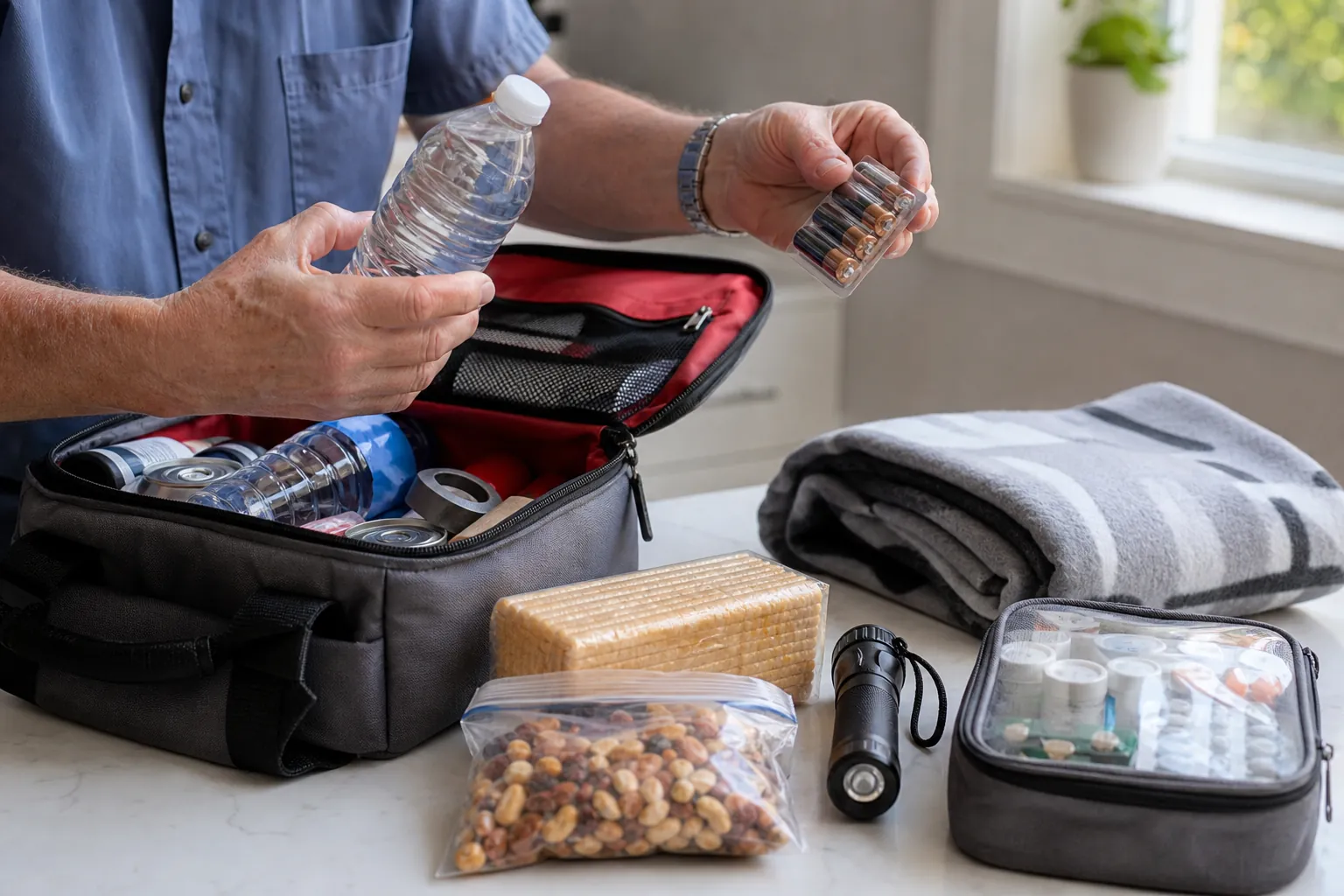
Twice a year, bring the kit inside and check it on a table. Do not do the whole review hunched over a trunk. Replace expired food. Rotate water. Test flashlights and power banks. Update the medical card. Confirm that spare glasses still match the current prescription. Check hearing-aid batteries. Review the medication plan with the pharmacist if prescriptions changed or if the car will be exposed to hotter or colder conditions.
Then put everything back by zone: information in the glove box, immediate personal needs in reach, roadside equipment in the trunk. Before calling it finished, have the older driver sit in the driver’s seat and actually reach for the water, phone charger, glasses, hearing-aid batteries, written instructions, and mobility aid. If an item cannot be reached or used from that position, it is not packed correctly.
A standard car kit is necessary. For an older driver, it is not the finished plan. Stock the car by zone, verify reach from the seat, and refresh it twice a year.
References
- About Older Adult Drivers, Centers for Disease Control and Prevention
- What To Have In Your Car Emergency Kit, AAA
- Emergency Car Kit: 10 Essential Items, American Red Cross
- Emergency Car Kit, National Safety Council
- Car Safety, Ready.gov
- How heat affects your medications, Baylor College of Medicine
- Heat and Older Adults (Aged 65+), Centers for Disease Control and Prevention
- Winter Driving Tips, National Highway Traffic Safety Administration
Related reading
Noticed something outdated or inaccurate on this page? Flag a correction. We review every report against CDC, NIA, and AARP HomeFit guidance before updating a page.
Part of the Fall Prevention section.