
STEADI: Assess
Eye Drops Recalled? A Senior Safety Checklist for Caregivers
Worried a parent used recalled eye drops? Infections are uncommon, so the right response is monitored calm, not panic. Use this caregiver checklist to know what to check in both eyes, which seniors need earlier escalation, and when a symptom means a clinician call versus an ER visit.

If a parent has used an eye-drop product that was recalled, the bottle should be out of use or set aside while you verify the product and arrange a safe replacement. Recent recall notices have not automatically meant that a user has an infection: no infections had been reported for the March 2026 K.C. Pharmaceuticals recall as of early April, and no infections were reported in connection with the July 2026 Clear Eyes recall. [2][5] The practical response is monitored calm: look at both eyes, write down changes, and use clear thresholds for calling a clinician or seeking emergency care.
For the recall-response basics, follow the label-match and medication-recall workflow in How to Check Product and Medication Recalls for Older Adults. Keep the bottle or packaging, record the lot or NDC information, stop using the affected product, and report a suspected problem through FDA MedWatch when appropriate. Do not stop a prescription eye drop on your own; contact the prescriber for instructions.
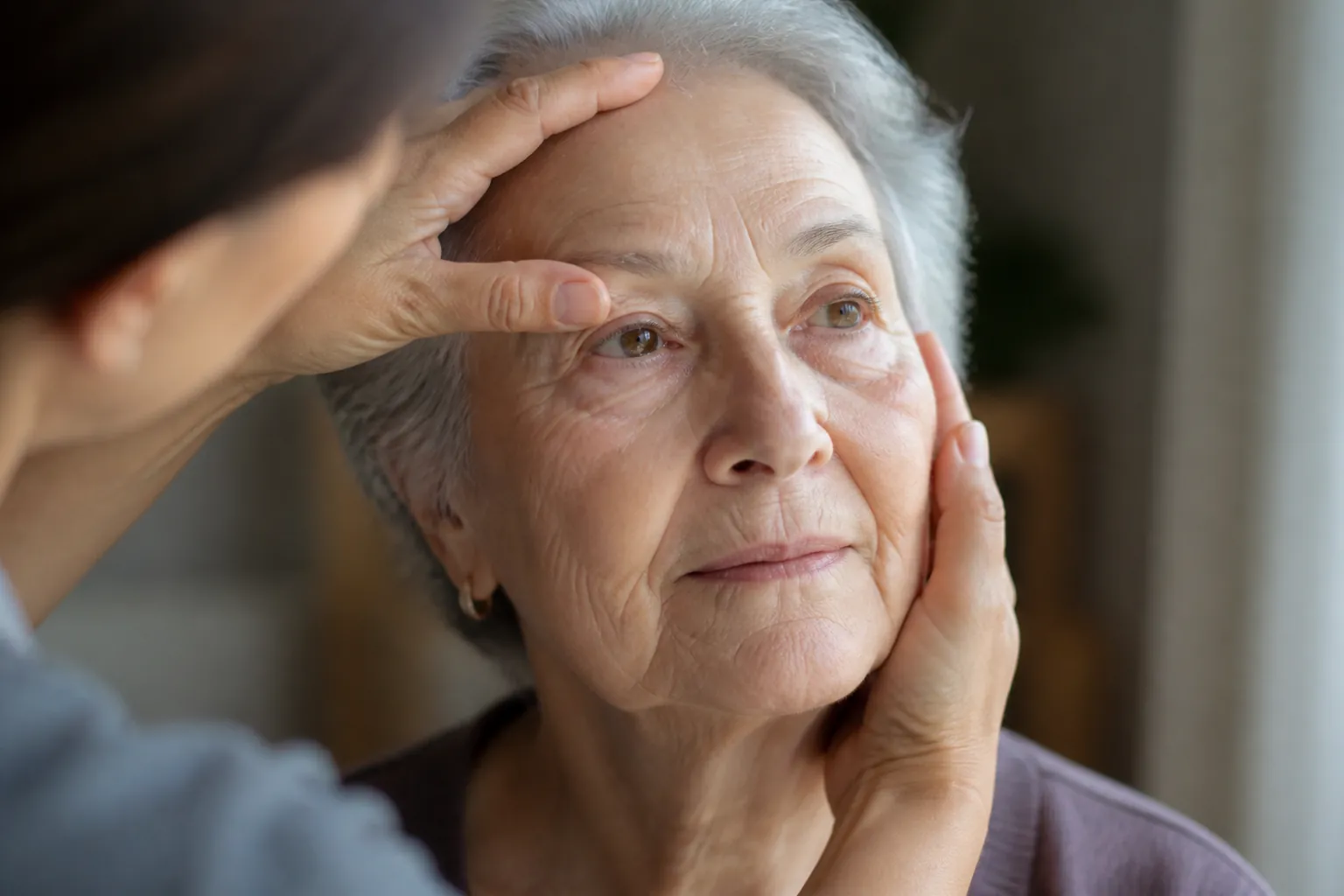
Start With a Two-Eye Check
Choose a well-lit place, preferably near a window, and have your parent sit down. Ask them to look forward while you compare one eye with the other. Direct observation supplements what your parent tells you; it does not replace listening, especially if they describe discomfort that is not obvious from across the room.
- Redness: compare the whites of the eyes with each other and with the way they normally look. Pay attention to redness that is new, clearly worse, or spreading rather than assuming that every irritated-looking eye is caused by the recalled drops.
- Discharge: look for unusual fluid at the inner or outer corners, on the lashes, or on a tissue after the eye is gently dabbed. Thick or new discharge matters even when the eye is not dramatically red.
- Eyelids: check for swelling and for eyelids that are stuck together, particularly after sleep. Do not force the lids apart; note what you can see and call for advice if this is new.
- Pain, itchiness, or irritation: ask separately whether the eye hurts, itches, burns, feels gritty, or simply feels different. A parent who says “it is nothing” may answer more clearly when the question names the sensations.
- Light sensitivity: ask whether ordinary room light or daylight feels unusually uncomfortable. Watch for squinting, turning away, or keeping one eye closed.
- Vision: ask whether either eye is suddenly blurrier, dimmer, distorted, or different from the previous check. Test one eye at a time only if your parent can do so comfortably and safely; do not delay care to perform a formal vision test.
The symptom list used here combines consumer guidance from the FDA with infection warning signs described by UConn Health: redness, eyelids stuck together, unusual discharge, vision changes, eyelid swelling, and eye pain, itchiness, or irritation. [2][3] It is a monitoring aid, not a way to diagnose an infection at home.
Use a Simple Watch Routine
Check at breakfast, later in the day, and again the next day while the situation remains uncertain. Use the same light and roughly the same questions so that a small change is easier to recognize. Record the date and time, which eye looked different, what your parent reported, and whether redness, discharge, swelling, pain, irritation, light sensitivity, or vision changed.
If both eyes look as usual and your parent reports no new symptoms, continue the planned checks for the next several days and keep the product details available. If a symptom is present but difficult to judge, call the clinician or pharmacist rather than repeatedly examining the eye or trying another unapproved product.
Know Which Threshold You Have Reached
| What you notice | What to do |
|---|---|
| Both eyes look usual, with no new discharge, swelling, pain, irritation, light sensitivity, or vision change | Continue observing and documenting during the next several days. Keep the bottle and recall information. |
| Worsening redness, unusual discharge, eyelids stuck together, eyelid swelling, eye pain, itchiness or irritation, or light sensitivity | Call the parent’s clinician or eye-care professional the same day for instructions. Do not wait for the next routine appointment. |
| Sudden vision change or severe eye pain | Seek emergency care now. Do not drive if vision is impaired; arrange safe transportation or emergency assistance. |
The RSVP warning signs from UT Southwestern are redness, sudden vision changes, and pain. The source notes that a severe bacterial infection can damage the cornea within 24 to 48 hours, which is why sudden vision changes or severe pain should not be managed through home observation. [1] The FDA also advises stopping use and seeking medical care for discharge, pain, or vision changes. [3]
Escalate Earlier for Higher-Risk Seniors
A senior who is immunocompromised, wears contact lenses, or already has corneal damage should not be treated as a lowest-risk user. UT Southwestern identifies these groups as needing particular attention during eye-drop contamination concerns. [1] For them, a new symptom deserves an earlier call, and uncertainty about pain or vision is a reason to contact the clinician promptly rather than waiting for the next check.
Contact lenses should remain out of the eye until a clinician gives different instructions. Do not share drops, touch the bottle tip to the eye or skin, or add leftover products to the routine while you are trying to work out what caused a change.
Prescription Drops Need a Prescriber’s Plan
The July 2026 recall included 2.5 million bottles of prescription prednisoLONE because of a foreign substance concern. A recalled prescription product needs prompt clarification from the prescribing clinician or pharmacist, but the medication should not simply be stopped without that direction. Write down the product name, strength, lot or expiration information, last dose, and any symptoms so the clinician can make a replacement or stopping decision.
Keep the recalled bottle and the older adult’s complete medication list together. FDA older-adult medication guidance recommends including over-the-counter products on the list, and the bottle details may be needed for reporting or follow-up. [6] Include other eye products, contact-lens solutions, and prescription drops rather than assuming they are unrelated.
Why the Recall Still Deserves Attention
The absence of reported infections in a recent recall is reassuring but limited: it describes reports available at that time, not a guarantee that every user is unaffected. The seriousness of bacterial contamination was made clear by the aggregate figures available in April 2026 for the 2023 outbreak: 81 people in 18 states were affected, with 14 cases of vision loss, four deaths, and four eye removals. [2] Those figures are context for taking warning signs seriously, not a reason to assume that every recalled bottle caused the same outcome.
Recall identifiers and affected products can change. Check the FDA drug alert and enforcement information for the current product, lot, NDC, and expiration details before discarding the packaging.
Last verified: August 25, 2026. This checklist is decision support, not medical advice or a diagnosis. Contact a clinician for individualized guidance, and seek emergency care for sudden vision changes or severe eye pain. Clinical review: CareWise clinical review team.
References
- What patients need to know about the 2023 eye drop recall — UT Southwestern Medical Center
- Massive Eye Drop Recall Reflects Ongoing Issues with Manufacturing and FDA Inspections — UConn Today, April 2026
- What You Should Know about Eye Drops — U.S. Food and Drug Administration
- FDA Warns Consumers Not to Purchase or Use Certain Eye Drops from Several Major Brands Due to Risk of Eye Infection — U.S. Food and Drug Administration
- Eye drops sold nationwide recalled over possible contamination, FDA reports — NBC News, July 2026
- 5 Medication Safety Tips for Older Adults — U.S. Food and Drug Administration
Related reading
Noticed something outdated or inaccurate on this page? Flag a correction. We review every report against CDC, NIA, and AARP HomeFit guidance before updating a page.
Part of the Fall Prevention section.