
STEADI: Intervene
Air Quality Alert? A Safety Checklist for Seniors with COPD
An air quality alert changes the whole day for a senior with COPD. This safety checklist covers the act-now steps — checking the AQI, protecting medication and oxygen plans, and knowing when to call the doctor versus 911 — plus the pre-season setup that keeps those days manageable.
The alert fired. Start with the next hour.
The phone says the air is unhealthy, your parent has COPD, and now the day has to shrink fast. Not dramatically. Practically. The walk can wait. The porch chair can wait. The question is whether your parent is breathing comfortably, where the cleanest room is, whether the rescue inhaler is within reach, and whether the oxygen setup still works if the power blinks.
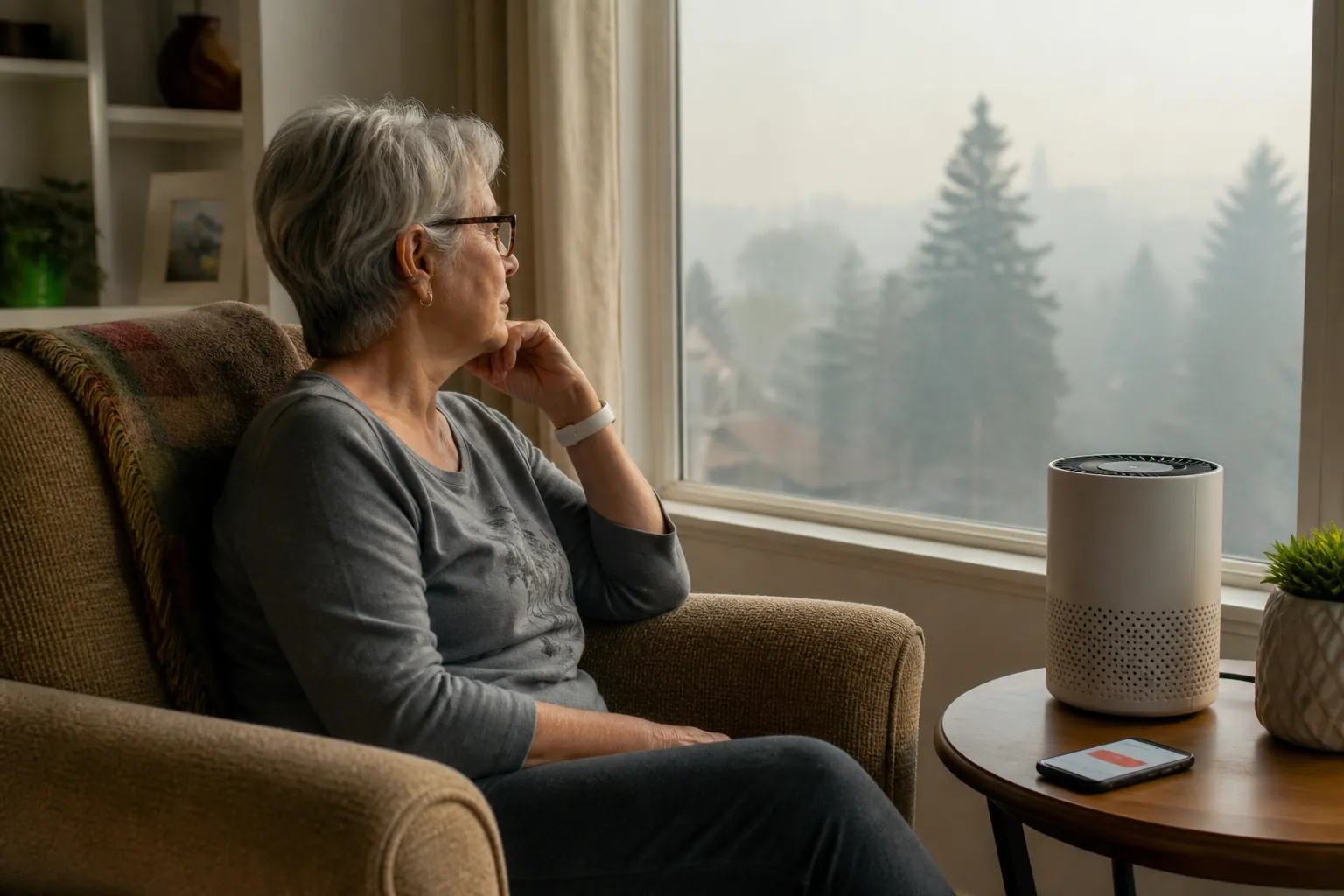
Use this air quality alert safety checklist for seniors with COPD in order. The first job is not to diagnose the pollutant. It is to confirm the AQI, reduce exposure, protect the COPD plan, and decide whether symptoms belong in the “call the provider” lane or the “call 911” lane.
- Check the current AQI through AirNow, the AirNow app, or EnviroFlash.
- Treat Orange AQI — 101 to 150, “Unhealthy for Sensitive Groups” — as the point where a senior with COPD should limit prolonged outdoor activity.
- Bring the day indoors and choose one room to keep cleaner than the rest of the house.
- Close windows and doors, run filtration if available, and avoid anything indoors that adds smoke, particles, strong fumes, or ozone.
- Keep maintenance COPD medications on schedule and put rescue medication where the person can reach it without searching.
- If oxygen is prescribed, follow the written oxygen instructions exactly; do not change the flow rate unless the healthcare provider has told you to.
- Watch symptoms during the alert and for the next 24 to 48 hours; call the provider for worsening symptoms and call 911 for emergency breathing symptoms or anything the action plan labels an emergency.
1. Confirm the AQI, not just the weather headline
A vague “air quality alert” is not enough to run the day. Check the AQI from a source built for that job: AirNow, the AirNow mobile app, or EnviroFlash alerts are the practical channels to use when the notification arrives.[1][2]
For this checklist, the anchor is Orange: AQI 101 to 150. EPA’s AQI basics label Orange as “Unhealthy for Sensitive Groups,” and AirNow includes older adults and people with lung disease among the groups at higher risk from air pollution.[3][4] The American Lung Association’s AQI guidance advises people in sensitive groups to limit prolonged outdoor activity at this level.[5]
You do not need to relearn every AQI color while your parent is waiting by the door. If you want the full color-by-color map, use the site’s AQI guide for older adults with breathing problems. On an alert day for COPD, Orange is enough to change plans.
2. Move the day into one cleaner room
“Stay inside” is too loose. Inside where? The bedroom with a purifier? The living room with the leaky front door? The kitchen where someone is frying lunch? Pick the room that can be kept closed, comfortable, and easiest to walk through without cords, clutter, or rugs becoming trip hazards.
CDC wildfire guidance advises people with chronic conditions to plan with their healthcare provider before wildfire season, stay indoors when advised, and reduce smoke exposure inside.[6] CDC safety guidance also includes choosing a room, using high-efficiency filtration when possible, upgrading HVAC filtration to MERV-13 or the highest rating the system can handle, and using recirculate settings rather than pulling smoky outdoor air inside.[7]
If the home already has a portable HEPA purifier, run it in that chosen room. The American Thoracic Society also warns against ozone-generating devices sometimes marketed as “super oxygenators”; those are not a safe shortcut for a person with COPD.[8] For the bigger setup — purifier size, MERV-13 details, sealing leaks, and clean-room layout — use the site’s wildfire smoke clean-room guide. The alert-day version is simpler: close, filter, keep the room cool enough, and stop adding indoor irritants.
3. Put the COPD medications where the day actually happens
COPD medication routines should not get casual because everyone is distracted by the air alert. Maintenance inhalers and other prescribed daily medications stay on their usual schedule unless the healthcare provider has given different instructions. Rescue medication should be reachable from the cleaner room, not sitting in a purse in the car or in a bathroom drawer down the hall.
This is also the moment to check the ordinary failure points: Is the inhaler nearly empty? Does the spacer need washing? Is the nebulizer equipment, if prescribed, clean and usable? Is the written COPD action plan where the caregiver can find it without calling three siblings? None of that requires the caregiver to become a clinician. It requires the plan to be visible before breathing gets worse.
4. If your parent uses oxygen, protect the instructions and the power
Oxygen deserves its own pause. If oxygen has been prescribed, follow the prescribed oxygen flow instructions. Do not raise or lower the flow because the AQI is bad unless the healthcare provider has specifically instructed when and how to do that. The American Thoracic Society’s wildfire guidance tells patients not to self-adjust oxygen flow during wildfire smoke events.[8]
Then look at the equipment like the power might fail, because wildfire, heat, storms, and grid strain do not politely avoid each other. If your parent uses an oxygen concentrator, the alert-day question is simple: What is the backup if electricity goes out? The full backup plan belongs in a calmer conversation; use the site’s power outage plan for elderly parents to work through batteries, tanks, charging, contacts, and transport.
5. Decide early who gets called for symptoms
The COPD action plan should spell this out, but alert days are when missing instructions become obvious. Call the healthcare provider or follow the action plan’s non-emergency instructions for symptoms that are worse than usual but not an emergency: more coughing, more wheezing, more shortness of breath with normal activities, more mucus, or needing rescue medication more often than the plan allows.
Call 911 for severe trouble breathing, breathing symptoms that the written action plan labels an emergency, chest pain, fainting, new confusion, bluish lips or face, or symptoms that do not improve the way the action plan says they should. If you are unsure which lane your parent is in, do not stand in the hallway debating it while their breathing worsens.
Why COPD makes an air alert a different kind of day
For a healthy adult, an Orange AQI day may mean moving the jog indoors. For a senior with COPD, it can mean the difference between an ordinary day and a flare that eats the week. One 2026 Journal of the COPD Foundation study reported that environmental triggers may account for up to 30% of COPD exacerbations and found a 2.7% increase in COPD exacerbations for each 10 µg/m³ rise in particulate matter exposure.[9] That is one study, not a rule that predicts your parent’s exact risk, but it is enough to take exposure reduction seriously.
Also, not every alert is wildfire smoke. Summer ozone can drive air-quality warnings too, and the response still starts with the AQI and activity limits rather than guessing from the sky color.[3][5] Smoke-heavy days add the clean-room and filtration urgency. Hot days add another problem: the safest room for breathing may not be the safest room for heat. If heat and smoke guidance collide, use the site’s heat and wildfire smoke safety checklist instead of trying to tough it out in a closed room that is getting too warm.
There is a fall-prevention piece here, even though the alert is about lungs. Bad-air days keep older adults indoors, interrupt walking routines, and may leave someone sitting longer than usual. After several days, legs can feel weaker, balance can be a little off, and dizziness from illness, heat, poor sleep, or medications can make the first “normal” outing riskier than expected. The answer is not hallway laps during bad breathing. It is a cleaner room, safe indoor movement if tolerated, and a slower restart when the air improves.
The before-season checklist that makes alert days calmer
The alert-day checklist works best when the boring pieces were handled weeks earlier. This is the difference between “Dad, where is your inhaler?” and “Dad, move to the bedroom; the purifier is on; your rescue inhaler is on the table.”

- Ask the healthcare provider for a written COPD action plan that names the person’s usual medications, rescue medication instructions, oxygen instructions if prescribed, and when to call the office versus 911.
- Keep a 7- to 10-day supply of prescription medicines on hand before wildfire season or other expected poor-air periods, as CDC recommends for people with chronic conditions.
- Choose the clean room before the first alert, and put the purifier, extension-cord-safe setup, chair, water, phone charger, and medication access there.
- Have N95 masks available for brief necessary trips outside, evacuation, or travel through smoky air.
- Stock no-cook or low-cook groceries so nobody has to add indoor particles from frying, broiling, or heavy cooking on a bad-air day.
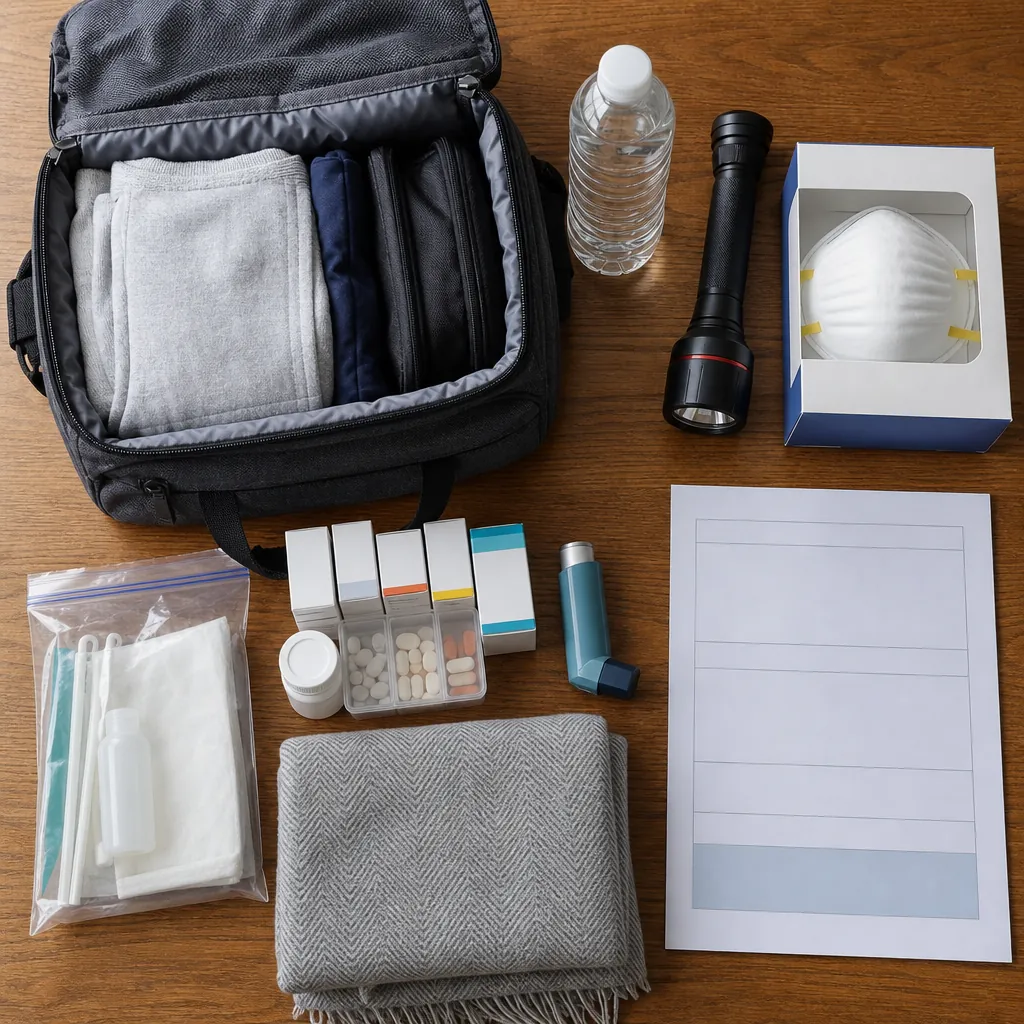
- Pack a go-bag with medication lists, inhalers, oxygen information if relevant, chargers, copies of key documents, and enough basics to leave without hunting through drawers.
- If oxygen equipment depends on electricity, make the backup power and evacuation plan before smoke, heat, or storms are already in the forecast.
CDC specifically advises people with chronic conditions to talk with a healthcare provider before wildfire season and to keep a 7- to 10-day supply of prescription medicines.[6] CDC safety guidance also supports the clean-room mechanics: choose a room, improve filtration where possible, and use recirculation settings to avoid drawing outdoor smoke inside.[7]
Do not let the go-bag become a fantasy survival kit while the actual inhaler is expired. Start with the COPD pieces: medication list, current prescriptions, rescue inhaler, spacer if used, oxygen supplier information if relevant, healthcare provider phone numbers, and the written action plan. Then add the usual evacuation pieces using the site’s wildfire evacuation preparedness checklist for seniors and broader severe-weather preparedness checklist for older adults.
After the visible smoke or alert passes
A clearer sky does not always mean the COPD risk is finished. Keep watching breathing symptoms for 24 to 48 hours after the exposure window, especially if your parent was outside, the home got smoky, the power went out, or rescue medication use increased.[6]
Do not restart the whole routine at once just because the alert disappeared from the phone. Begin with short, familiar activity inside or close to home, and pay attention to breathlessness, dizziness, leg weakness, and fatigue. If symptoms are worse than the COPD action plan allows, call the provider before pushing activity.
For long smoke events, the question becomes how many days indoors are reasonable and how to keep the person moving safely while exposure stays low. That longer judgment belongs in the site’s guide on how long seniors should stay indoors during wildfire smoke. If the hazard is dust rather than smoke or ozone, use the sibling dust storm safety checklist for seniors with breathing problems instead of stretching a wildfire plan to fit every particle in the air.
Safety note
This article is educational and is not medical advice. Medication changes, rescue-medication limits, oxygen-flow instructions, and the person’s individualized COPD action plan belong with the healthcare provider who knows that patient. Follow the written plan you were given; if the symptoms look severe or unsafe, call 911.
Clinical review: This COPD and home-safety guidance is reviewed by the site’s geriatric RN or occupational therapist; the reviewer’s name and credentials should be displayed with the article.
References
- AirNow Mobile App. AirNow. https://www.airnow.gov/airnow-mobile-app
- EnviroFlash. EnviroFlash. https://www.enviroflash.info/
- AQI Basics. AirNow. https://www.airnow.gov/aqi/aqi-basics
- Older Adults. AirNow. https://www.airnow.gov/air-quality-and-health/older-adults
- Air Quality Index. American Lung Association. https://www.lung.org/clean-air/outdoors/air-quality-index
- Wildfire Smoke and People with Chronic Conditions. CDC. https://www.cdc.gov/wildfires/risk-factors/wildfire-smoke-and-people-with-chronic-conditions.html
- Safety Guidelines: Wildfires and Wildfire Smoke. CDC. https://www.cdc.gov/wildfires/safety/how-to-safely-stay-safe-during-a-wildfire.html
- Wildfires Disaster Guidance: Tips for Staying Healthy During Wildfires. American Thoracic Society. https://site.thoracic.org/advocacy-patients/patient-resources/wildfires-disaster-guidance-tips-for-staying-healthy-during-wildfires
- Understanding COPD Patients' Perspectives on Utilizing Strategies to Limit Their Exposure to Wildfire Smoke. Journal of the COPD Foundation. 2026. https://journal.copdfoundation.org/jcopdf/id/1591/
Related reading
Noticed something outdated or inaccurate on this page? Flag a correction. We review every report against CDC, NIA, and AARP HomeFit guidance before updating a page.
Part of the Fall Prevention section.