Alzheimer's Wandering at Night: A Crisis Response Guide for Caregivers
15 minutesReviewed: 2026-07-05
Alzheimer's Wandering at Night: A Crisis Response Guide for Caregivers
When a person with Alzheimer's is missing at night, every minute counts. This guide provides a clear, timed protocol for the first 15 minutes of searching, when to call 911, and the essential follow-up steps to prevent future wandering episodes.
By Editorial Team
new caregiver
experienced caregiver
long-distance caregiving
spousal caregiver
working caregiver
daily routines
medication management
personal hygiene
care coordination
first steps
ADLs
IADLs
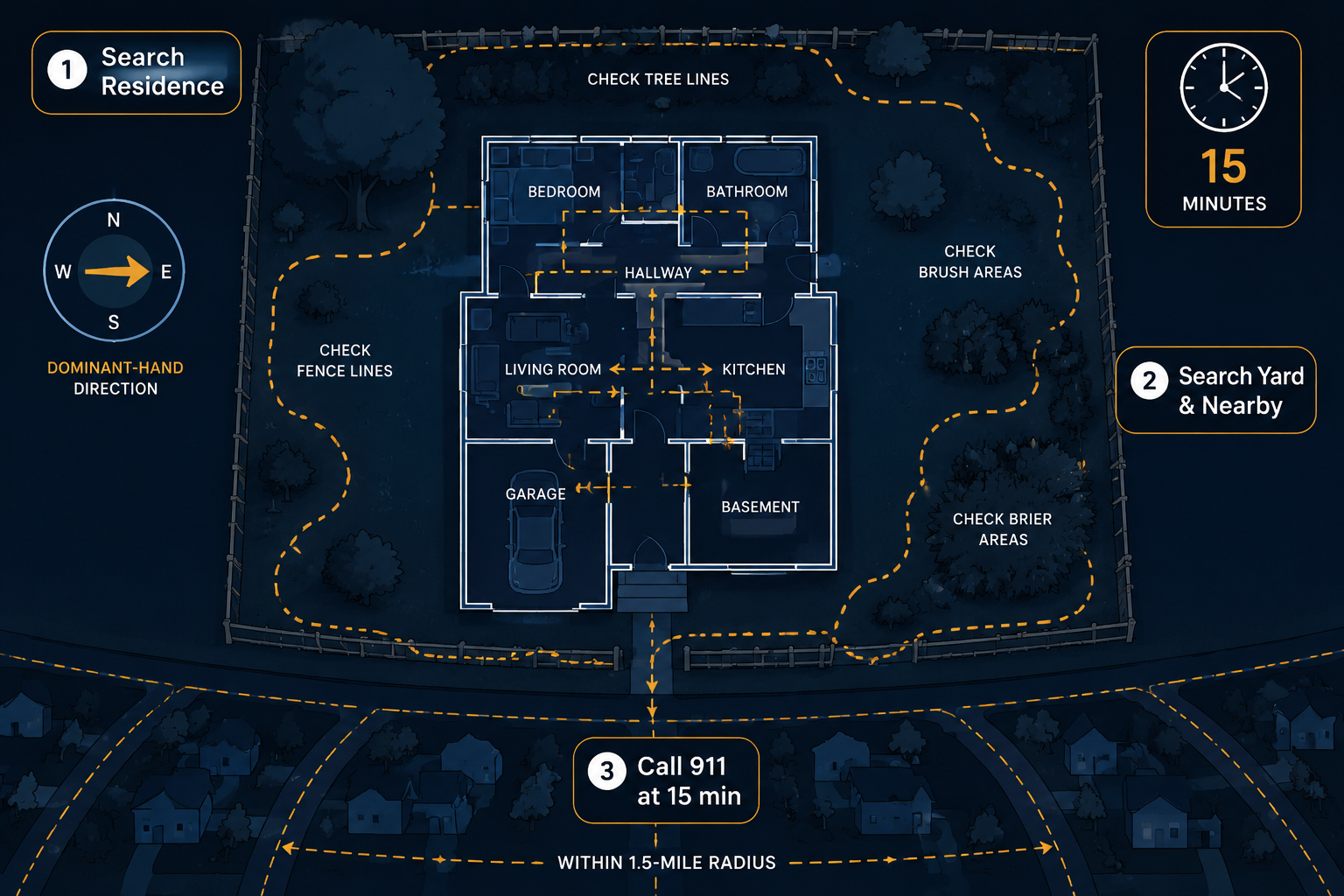
If the bed is empty and the person with Alzheimer’s is not answering, start two things at once: search the home in a fixed order, and put a clock on the search. If you do not find them within 15 minutes, call 911. Do not spend the next hour trying to keep this private.
The Alzheimer’s Association advises calling 911 if a person with dementia is not found within 15 minutes, and notes that many people who wander are found within 1.5 miles of where they started.[1] That does not mean you casually cover 1.5 miles alone in the dark. It means the first private search has a limit, and the search area you describe to emergency responders should be practical, nearby, and specific.
The first 15 minutes: search close, search low, search hidden
Say the time out loud or start a timer on your phone. Panic stretches time. A timer keeps you from doing the same hallway twice while the driveway, garage, or side yard goes unchecked.
Time
Action
What to check
0-5 minutes
Search the residence
Bedroom, bathroom, closets, behind doors, under or beside furniture, basement, laundry room, attached garage
Fence lines, tree lines, brush, ditches, dark corners, the direction they usually turn
15 minutes
Stop the private search if not found
Call 911 and say Alzheimer’s or dementia clearly
Minutes 0 to 5: clear the house before you run outside
Check the bedroom first, including the floor beside the bed. Look behind the door. Look in the bathroom, including the tub or shower. Check closets, laundry baskets, the space beside a recliner, the far side of the sofa, the basement stairs, the mudroom, and the attached garage.
Call their name, but do not rely on an answer. A person may be frightened, sleepy, stuck, trying to be quiet, or unable to understand that you are looking for them. Turn on lights as you move. Open doors fully. If another adult is home, one person searches while the other stays by the phone and checks whether a door alarm, camera, or motion alert shows which exit opened.
Minutes 5 to 10: move to the threshold places
Go to the doors they can open: front, back, side, garage, patio, basement walkout. Look at the ground if there is rain, snow, mud, or dew. Check the porch, steps, ramp, car, driveway, trash bins, shed, detached garage, and any place where a person could sit down out of sight.
Do not search only the obvious walking route. People who wander at night may not follow sidewalks. The Alzheimer’s Association tells caregivers to check brush, brier, tree lines, and fence lines.[1] Those are uncomfortable places to look in the dark, which is exactly why families miss them.
Minutes 10 to 15: use likely direction, not wishful thinking
If you know which door opened, start there. If you do not, think about patterns: the mailbox, the old workplace route, a former home, the church, the corner store, the neighbor’s porch, the bus stop, the place they keep saying they need to go. The Alzheimer’s Association also notes that people often travel in the direction of their dominant hand, so a right-handed person may tend to turn right.[1] Use that as a clue, not a rule.
Take a flashlight and your phone. If you are alone, do not leave the house unlocked with no phone access and no way for the person to re-enter. If there is another adult nearby, call them now and give a job: “Check the fence line behind the house,” “Stand by the front door,” or “Drive slowly to the corner and back.” Vague help wastes minutes.
At 15 minutes, stop expanding the private search. The next correct action is not one more lap around the block. The next correct action is 911.
What to say when you call 911
Use plain words. Do not say only, “My husband went for a walk,” or “My mom is confused.” Say: “My father has Alzheimer’s disease and is missing from home.” Or: “My wife has dementia and wandered from the house at night.” Dispatchers need the dementia information immediately because it changes the urgency and the search approach.
“The missing person has Alzheimer’s disease,” or “The missing person has dementia.”
“They were last seen at home at approximately [time].”
“They may not answer to their name or may refuse help.”
“They may try to go to [former address, workplace, store, church, school, or family member’s home].”
“Please tell me whether a Silver Alert or similar missing vulnerable adult alert is available here.”
Have a recent photo ready to send if the dispatcher or responding officer asks for it. Give height, approximate weight, hair color, glasses, mobility aids, medical ID jewelry, shoes, coat, and the exact clothing you last saw. Clothing matters more than a polished description. At night, a dark coat, slippers, hospital socks, or no coat at all changes where responders look and how urgent exposure risk becomes.
Tell them about water, traffic, woods, railroad tracks, drainage ditches, construction sites, steep driveways, or unlocked outbuildings nearby. If the person has a favorite destination or repeated phrase — “I need to go home,” “I have to get to work,” “The children are waiting” — say that too. It may point responders toward an old route, not the reality of the current night.
The reason to call early is not that you failed. It is that time changes the risk. The Alzheimer’s Association has estimated that about half of people with dementia who are not found within 24 hours may suffer serious injury or death, although the underlying study details are not always clear in secondary citations.[1] Treat that number as an urgent warning, not as a prediction for any one family.
While responders are on the way
Stay reachable. Keep your phone volume on. If you have another adult present, one person remains at the home base while the other follows dispatcher instructions. The person who returns home on their own may come to the same door they left through. Someone needs to be there.
Text a recent photo to one trusted neighbor or family member only if it does not interfere with the 911 call.
Ask neighbors to check porches, unlocked cars, garages, sheds, and fence lines, not just the sidewalk.
Do not send several people driving fast in different directions without telling responders.
Write down the last known time, last known location, clothing, and any confirmed sightings.
When police, fire, EMS, or search personnel arrive, hand over the facts without apologizing your way through them. “He has dementia. He left through the side door. He is wearing gray sweatpants and a blue jacket. He used to walk to the gas station on Maple. He is right-handed. I searched the house, garage, yard, and fence line for 15 minutes.” That is a useful report.
Identification systems help after the emergency call, not instead of it
Medical identification is one of the better layers to have in place before a night like this. It is not a leash, a fence, or a promise. It is a way for a first responder, hospital, transit worker, store clerk, or neighbor to connect the person to help when the person cannot explain who they are.
A 2024 retrospective study of MedicAlert Foundation’s Safe Return-related records found that 90.6% of enrolled individuals who wandered were returned home safely. In those cases, 47.7% were found by first responders and 46.1% by Good Samaritans. The same study reported that 16.4% had repeated missing incidents.[2] Those numbers do not mean enrollment prevents every episode. They do show why identification, a 24-hour response line, and trained handoff can matter when the person is already out of sight.
If the person is enrolled, tell 911 and give the ID number if you have it. If they are not enrolled, make enrollment part of the next-day plan. Bracelets, shoe tags, wallet cards, and clothing labels are all easier to arrange before the next door opens at 2:00 AM.
After they are found: do the boring medical checks
Once the person is back, the room often fills with relief, irritation, crying, and too many explanations. Set those aside long enough to check the body in front of you. A person who wandered at night may be dehydrated, chilled, overheated, bruised, cut, frightened, or exhausted. They may have fallen and forgotten it.
Look at hands, knees, elbows, feet, and head for cuts, swelling, or bruising.
Check whether shoes are missing, wet, damaged, or on the wrong feet.
Offer fluids if they are awake and can swallow safely.
Call their doctor, urgent care, or EMS again if there is a fall, head injury, chest pain, breathing trouble, severe confusion beyond baseline, exposure to cold or heat, or any doubt about safety.
Then write a short incident note before sleep wipes the details away: date, time discovered missing, likely exit, weather, clothing, where found, who found them, what they seemed to be trying to do, and what helped. This is not paperwork for paperwork’s sake. It is the start of the safety plan.
The next morning is for layers, not promises
Wandering is common in Alzheimer’s disease; the Alzheimer’s Association says 6 in 10 people living with dementia will wander at least once, though estimates vary across studies and settings.[1] The useful response is not to argue about whether it will happen again. Build layers so one missed sound does not become the only safety system.
Start with the exit that actually failed. If the side door opened, that door gets the first fix. If the person rose from bed silently, start at the bed and hallway. BrightFocus Foundation and dementia-care safety guidance commonly recommend practical measures such as door alarms, camouflaged exits, locks placed outside the usual line of sight, and environmental changes that reduce unsupervised exiting risk.[3][4]
Install door alarms or chimes on exterior doors, including garage and basement exits.
Consider a pressure-sensitive bed mat or floor mat if the person gets up silently.
Move deadbolts high or low, where local fire-safety rules allow, rather than at eye level.
Use night lights from bedroom to bathroom so toileting does not turn into searching.
Camouflage or visually soften exits when appropriate, while keeping emergency egress possible.
Update the recent photo on every caregiver’s phone.
Notify trusted neighbors that the person has dementia and may need gentle redirection or a 911 call.
For a deeper device-by-device review, use a room-by-room wandering safety audit. That is where it makes sense to compare alarms, pressure mats, GPS options, ID systems, cameras, and the false-alert burden each one brings.
If there were warning signs before the episode — late-afternoon pacing, packing, repeated requests to go home, checking doors, or agitation after dark — keep those patterns with the incident note. A sundowning response card can help caregivers respond earlier in the evening, before the door becomes the focus.
Bring the doctor into the pattern, not just the crisis
A night-wandering episode is worth reporting to the clinician who manages the person’s dementia care. Ask specifically about sleep, pain, urinary symptoms, constipation, anxiety, medication timing, alcohol use, and anything that changed in the last week. The reason for the question is practical: if the person is waking repeatedly, searching for a bathroom, or becoming activated at night, the door alarm is only catching the last step.
Mayo Clinic notes that cholinesterase inhibitors such as donepezil and rivastigmine may cause sleep problems, and that taking certain medications too late in the day can worsen insomnia. Mayo also discusses approaches such as melatonin and bright light therapy for sleep-wake disturbance in Alzheimer’s care, with medical guidance.[5] Do not change dementia medication timing on your own after a frightening night. Make the call and ask the question directly.
For families trying to reduce nighttime wakefulness without adding sedating medication as the first move, an overnight dementia care guide can help separate sleep routines, environmental cues, supervision, and sundowning management.
When one episode changes the care plan
The first incident can be treated as a warning. Repeated night wandering has to be treated as a change in care needs. That is not an accusation against the spouse who sleeps hard after years of caregiving. It is not proof that an adult child should have noticed sooner. It means the household has reached a point where memory, judgment, sleep, and door access no longer match the amount of supervision available.
If the person has left more than once, defeated alarms, removed ID, walked toward traffic or water, fallen outside, or required police search, put the question on the table: can this home be made safe enough at night with the people and equipment available? The answer may be yes with paid overnight help, a different bedroom arrangement, better alarms, and neighbor response. It may be no.
If you want the broader reasons wandering happens — old routines, unmet needs, disorientation, stress, pain, sleep disruption — read a fuller guide to understanding wandering in dementia. During the actual night search, reasons can wait. The order is simpler: search systematically for 15 minutes, call 911 if not found, say Alzheimer’s or dementia clearly, then turn the episode into a written safety plan that does not depend on one exhausted person hearing every sound at 2:00 AM.


Comments
Join the discussion with an anonymous comment.