
Dementia-Friendly Home Modifications: A Stage-by-Stage Guide to Adapting Your Home for Alzheimer's and Memory Loss
This guide helps adult children understand how to modify a parent's home for dementia safety across early, middle, and late stages. It explains why dementia modifications are fundamentally different from general aging-in-place remodeling, with room-by-room guidance on contrast, wayfinding, wandering prevention, and when to prioritize familiarity over new features.
Why Dementia Home Modifications Are Different from Standard Aging-in-Place Remodeling
If you have spent any time researching how to make a home safer for an older adult, you have likely encountered the standard advice: install grab bars, improve lighting, remove throw rugs, and widen doorways. These are sound recommendations for general aging in place, but they were not designed for a brain that is changing. When a parent has Alzheimer's disease or another form of dementia, the home environment must be adapted to a fundamentally different set of challenges — declining judgment, impaired spatial perception, and new behaviors like wandering and agitation.
The core difference is this: standard aging-in-place modifications aim to accommodate physical limitations while keeping the home looking as normal as possible. Dementia-friendly modifications must actively guide behavior, reduce confusion, and prevent harm from actions the person may not remember taking. A grab bar in a matching tile color helps someone with weak knees. A grab bar in a bright contrasting color helps someone whose brain no longer processes depth cues accurately. The goal shifts from "blending in" to "standing out" — but only for the things that matter.
This guide focuses specifically on the physical home environment across the three stages of dementia. It does not cover general behavior management, medication, or the decision to transition out of home care — those topics are addressed in our companion guides on Dementia Care at Home and When Home Is No Longer Safe. Here, the focus is on the walls, floors, doors, and fixtures — and how to adapt them as the disease progresses.
How Dementia Changes Safety Needs at Home
To understand why dementia modifications differ, it helps to recognize the four specific ways the disease alters a person's relationship with their home.
- Declining judgment. A person may try to use appliances they no longer understand — turning on a stove burner and walking away, or placing metal in a microwave. They may also fail to recognize hazards like a hot surface or a slippery floor.
- Impaired spatial perception. Dementia affects the brain's ability to process depth, contrast, and edges. A dark rug on a dark floor may appear as a hole. A step without a contrasting edge may look like a flat surface. This is why falls in dementia are often caused by misperception, not just weakness.
- Balance and coordination changes. Even in early stages, dementia can affect the motor cortex. Combined with impaired perception, this makes tasks like stepping into a bathtub or navigating a cluttered hallway significantly more dangerous.
- New behaviors. Wandering, agitation, repetitive movements, and attempts to leave the house are common as the disease progresses. These behaviors are not deliberate — they are neurological responses to confusion, discomfort, or unmet needs. The home must be adapted to prevent harm from these behaviors without making the person feel trapped.
For a deeper look at how these behavioral changes manifest day to day, see our Dementia Care at Home guide, which covers communication strategies and daily routines alongside safety.
Stage-by-Stage Modification Guide
The modifications your parent needs will change as the disease progresses. What works in early-stage dementia may become confusing in middle stage, and what is essential in late stage may have been unnecessary a year earlier. The following framework builds on itself: each stage assumes the previous modifications are already in place.
Early Stage: Orientation and Clarity
In early-stage dementia, the person is still largely independent but may experience moments of confusion, forget appointments, or misplace items. The goal at this stage is to reduce cognitive load and create clear visual cues that support wayfinding.
- Label rooms with brightly colored signs. The NIA recommends using large, brightly colored signs with both words and pictures — a picture of a toilet on the bathroom door, a bed on the bedroom door. Place them at eye level.
- Declutter aggressively. Excess furniture, stacks of magazines, and decorative objects create visual noise that is harder for a dementia-affected brain to filter. Remove anything that is not essential for daily life.
- Add contrast on step edges. Use brightly colored tape or paint on the edge of each step, both indoors and outdoors. The NIA advises that this contrast helps the brain register a change in elevation.
- Paint walls a lighter color than floors. This creates a clear visual boundary between vertical and horizontal surfaces, helping the brain orient itself. Avoid busy wallpaper patterns, which can be perceived as moving or threatening.
- Improve lighting throughout. Motion-sensor night-lights in hallways and bathrooms reduce the risk of falls during nighttime trips. Ensure all rooms have even, glare-free lighting.
Middle Stage: Safety and Wandering Prevention
As dementia progresses to the middle stage, judgment declines further, and new behaviors like wandering and agitation emerge. This is when the most significant structural modifications become necessary.
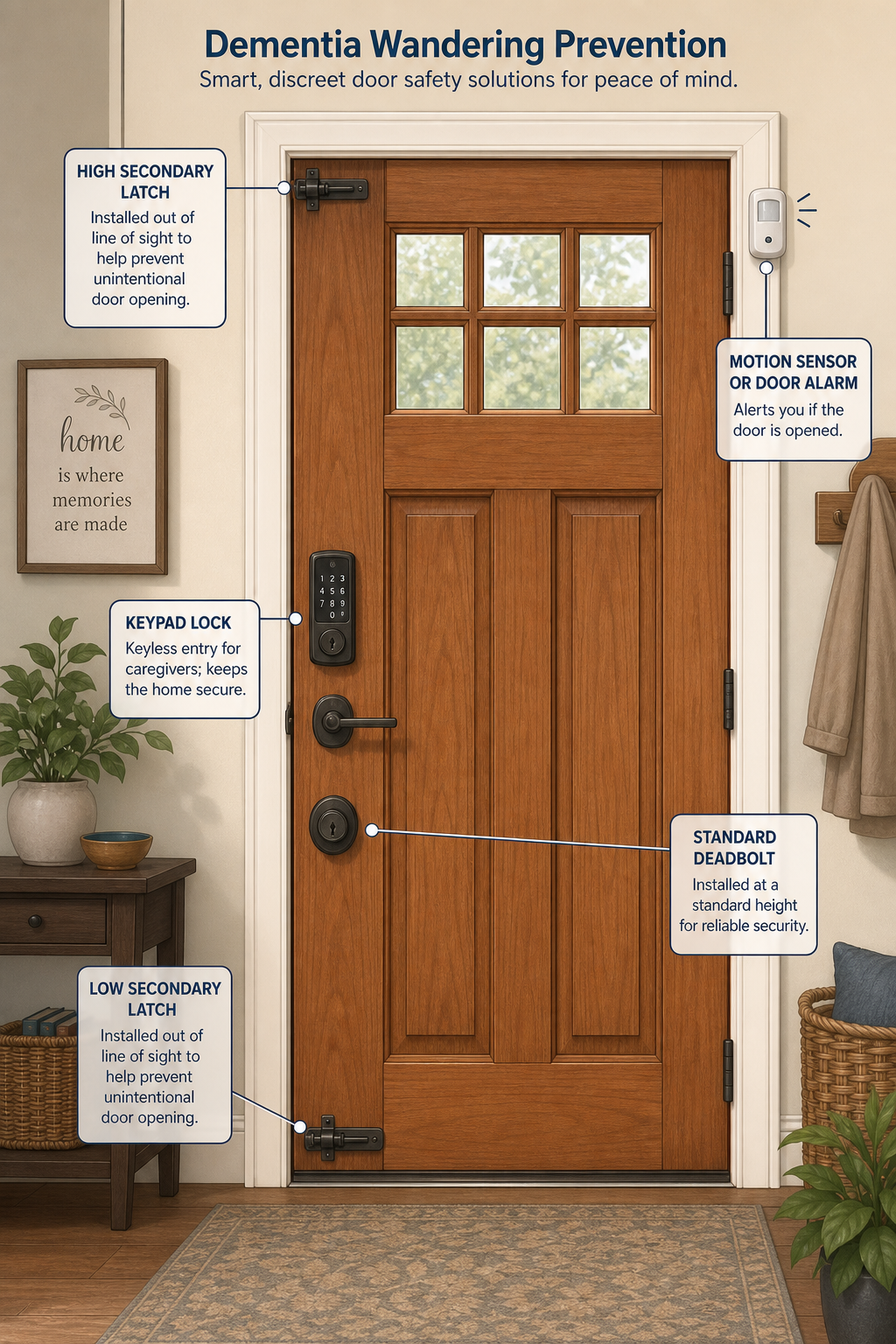
- Install locks out of sight. The Alzheimer's Association recommends placing a latch or deadbolt either above or below eye level on exterior doors. A lock at standard height is too obvious and may trigger an attempt to open it. A lock at the very top or bottom of the door is less likely to be noticed.
- Add stove shut-off devices and knob covers. Automatic shut-off devices detect when a stove has been left on and turn it off automatically. Stove knob covers prevent the person from turning on burners. The Alzheimer's Association also recommends removing knobs entirely when the stove is not in use.
- Install grab bars in contrasting colors. Standard grab bars that match the wall color are invisible to a brain that has lost depth perception. The NIA advises installing grab bars in a color that contrasts sharply with the wall — bright white against a dark wall, or yellow against a light wall.
- Secure exits with door alarms and motion sensors. Door alarms alert you when an exterior door is opened. Motion sensors in hallways and near exits can detect unusual movement patterns, especially at night. These are not replacements for locks — they are additional layers of awareness.
- Remove interior door locks. A person with dementia may lock themselves in a bathroom or bedroom and not remember how to unlock the door. The Alzheimer's Association recommends removing or disabling interior locks, or replacing them with simple slide bolts that can be opened from the outside in an emergency.
Late Stage: Full Accessibility and Monitoring
In late-stage dementia, the person is likely bedbound or chairbound and requires full assistance with all activities of daily living. The home must be adapted for caregiving tasks and safety monitoring.
- Install bed rails or a hospital bed. Bed rails prevent falls during sleep and provide something to hold onto during transfers. A hospital bed with adjustable height also makes caregiving tasks easier on the back.
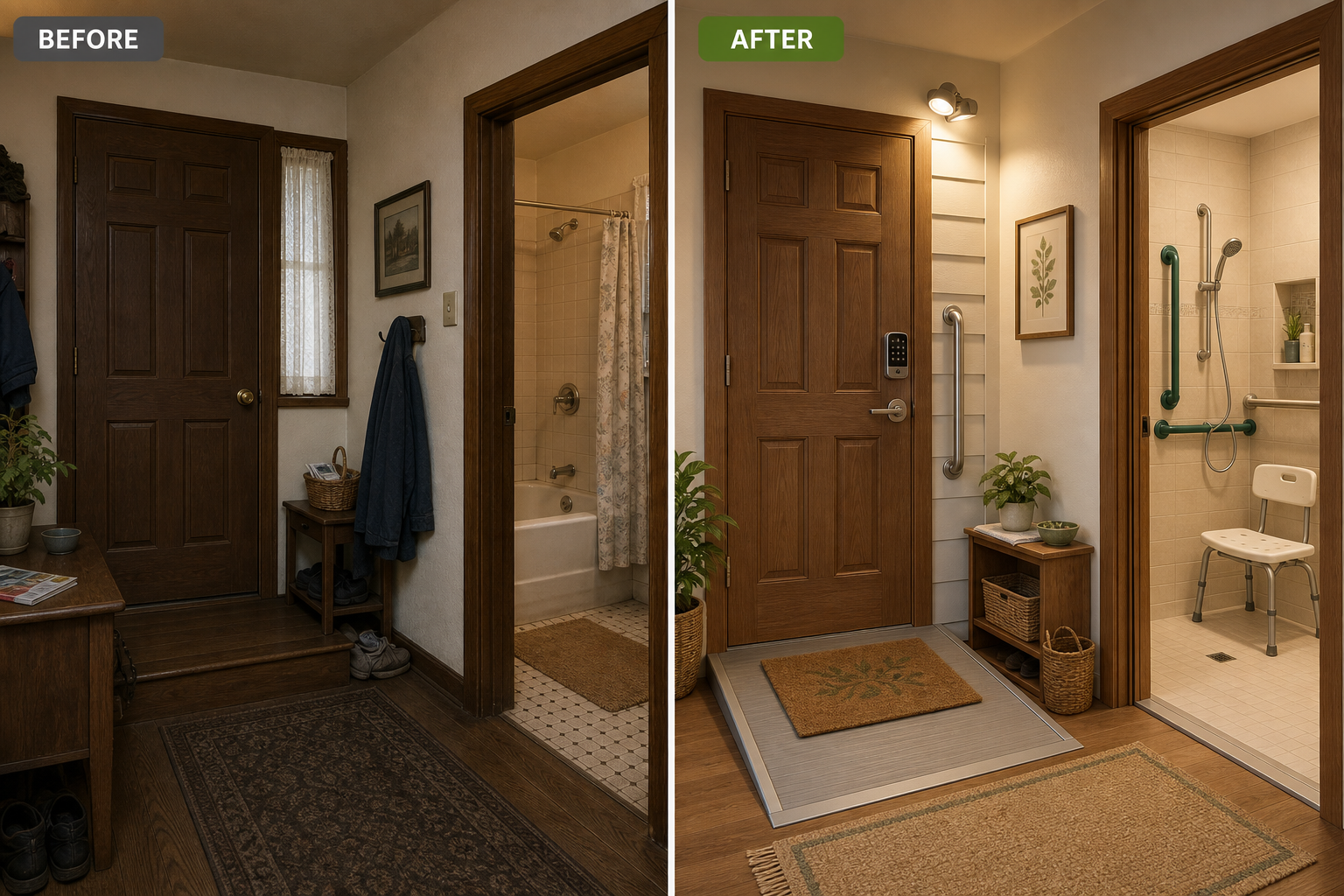
- Convert to a full walk-in shower. A curbless or low-threshold walk-in shower with a shower chair and handheld showerhead is essential when the person can no longer step over a tub wall. This is a structural change that may require a contractor.
- Use monitoring technology. Bed exit alarms, motion sensors, and video monitors (with consent and privacy considerations) can alert caregivers when the person needs assistance or has left the bed.
- Ensure caregiver access. Widen doorways if needed to accommodate a wheelchair or walker. Consider a first-floor bedroom and bathroom if the person can no longer safely use stairs.
| Stage | Primary Goal | Key Modifications |
|---|---|---|
| Early | Orientation and clarity | Room labels, decluttering, contrast on steps, lighter walls, improved lighting |
| Middle | Safety and wandering prevention | Locks out of sight, stove shut-offs, contrasting grab bars, door alarms, remove interior locks |
| Late | Full accessibility and monitoring | Bed rails, walk-in shower, monitoring technology, widened doorways, first-floor living |
Bathroom Safety: The Highest-Risk Room for Dementia
The bathroom is the most dangerous room in any home for an older adult, but dementia adds specific risks. The person may not remember that the water is hot, may struggle to distinguish the toilet from the floor, or may become agitated by the reflection in a mirror. The NYT Wirecutter, citing interviews with seven occupational therapists, notes that the bathroom is uniquely hazardous because "you're naked and wet" — a combination that increases both fall risk and injury severity.
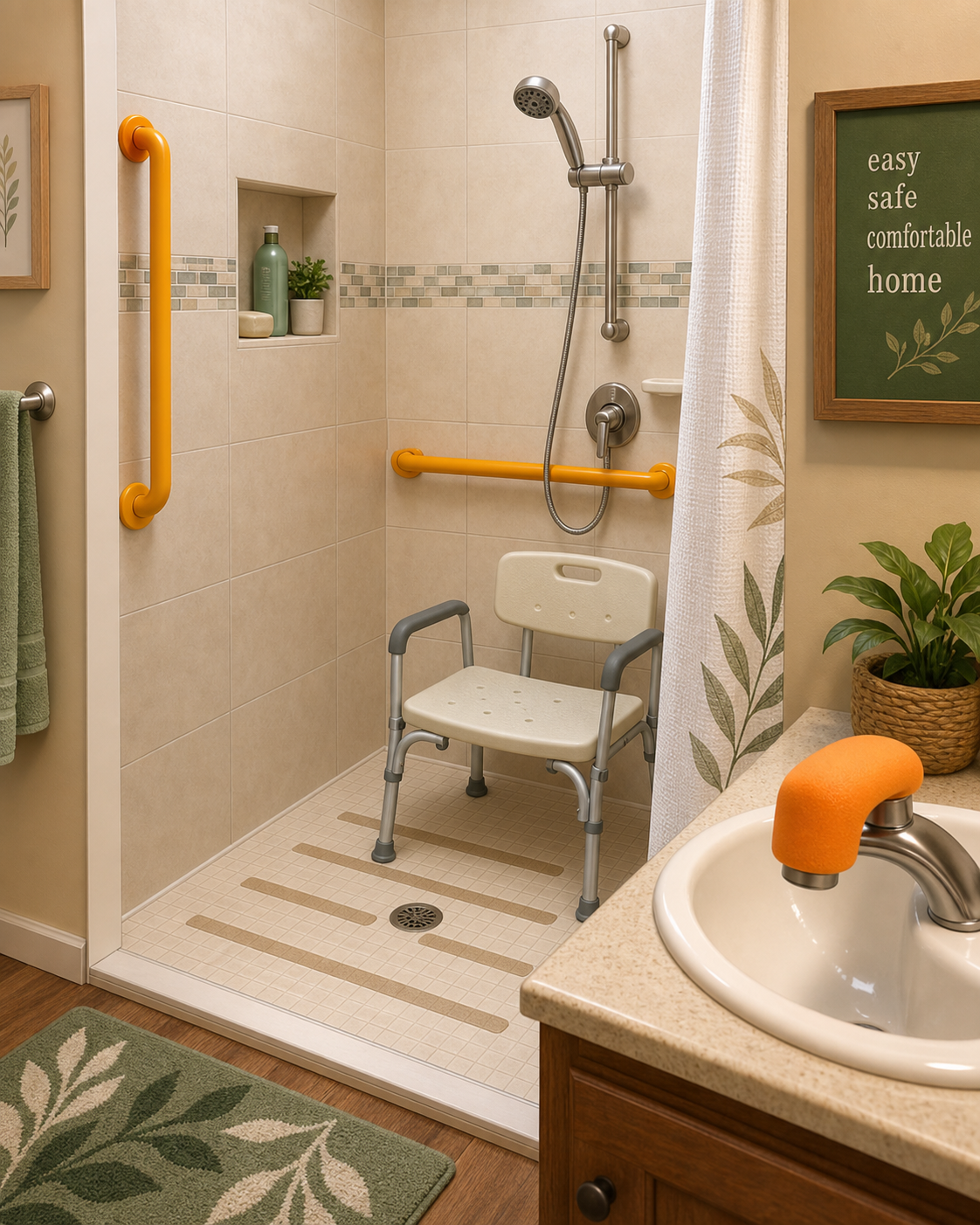
- Grab bars in contrasting colors. Install grab bars in the shower, next to the toilet, and near the sink. They must be in a color that contrasts with the wall — not matching. One study found that people who had a grab bar in their shower were 75% more likely to keep their balance (Forbes Health, citing research).
- Nonskid adhesive strips. Place nonskid strips or a textured mat in the tub and shower floor. The NIA recommends adhesive strips over loose mats, which can themselves become tripping hazards.
- Foam faucet cover. A foam rubber cover on the sink faucet prevents injury if the person falls against it. This is a low-cost modification (under $15) that can prevent serious head or facial injuries.
- Walk-in shower with shower chair. A curbless walk-in shower with a built-in or portable shower chair allows the person to bathe safely while seated. A handheld showerhead on a sliding bar gives the caregiver control over water direction. According to ElderLife Financial, walk-in showers range from $1,500 to $3,500+ not including installation.
- Set water heater to 120°F. The NIA explicitly advises setting the water heater to 120°F to prevent scalding. A person with dementia may not feel that the water is too hot or may not remember to adjust the temperature.
- Label hot and cold faucets. Use red and blue labels or colored tape on faucet handles. The NIA recommends labeling hot-water faucets red and cold-water faucets blue.
- Consider removing or covering mirrors. Some people with dementia do not recognize their own reflection and may become frightened or agitated by the "stranger" in the mirror. If this occurs, remove the mirror or cover it with a cloth.
Kitchen Safety: Preventing Burns, Falls, and Confusion
The kitchen presents a unique set of dangers for a person with dementia. Appliances that were once familiar become sources of confusion and hazard. The NIA and the Alzheimer's Association both emphasize that kitchen modifications should focus on preventing access to dangerous items and reducing the cognitive load of meal preparation.
- Install an automatic shut-off stove. These devices detect when a burner has been left on for an extended period without activity and turn it off automatically. The Alzheimer's Association recommends this as a primary safety measure.
- Use stove knob covers or remove knobs. Stove knob covers prevent the person from turning on burners. If the stove is not in use, removing the knobs entirely is an even simpler solution.
- Secure cleaning products and sharp objects. Store all cleaning supplies, knives, and other dangerous items in locked cabinets. A person with dementia may mistake a cleaning product for a beverage or attempt to use a knife without understanding the risk.
- Remove artificial fruits and vegetables. The NIA specifically warns that artificial fruits and vegetables may seem edible to a person with dementia. Remove them from countertops and decorative bowls.
- Use contrasting-colored dishes and cutting boards. A white plate on a white tablecloth may be invisible to a person with impaired depth perception. Using dishes and placemats in contrasting colors makes it easier for the person to see their food and utensils.
- Ensure good task lighting. Under-cabinet lighting and a well-lit countertop reduce shadows and make it easier to see what is on the work surface.
Wandering Prevention: Securing Exits Without Creating a Prison
Wandering is one of the most challenging behaviors for dementia caregivers. It is not a deliberate act of leaving — it is a neurological response to confusion, discomfort, or an unmet need. The goal of wandering prevention is to keep the person safe without making them feel trapped or confined.
- Install deadbolts or latches above or below eye level. The Alzheimer's Association recommends placing a latch or deadbolt at the very top or bottom of the door — out of the person's typical line of sight. This reduces the likelihood that they will attempt to open it.
- Use keypad locks. Keypad locks on exterior doors require a code to open. A person with dementia is unlikely to remember the code, but caregivers can enter it easily. Make sure the lock has a manual override in case of power failure.
- Add door alarms and motion sensors. A simple door alarm that chimes when the door is opened alerts you to an exit attempt. Motion sensors placed near exits can detect unusual movement patterns, especially at night.
- Remove interior door locks. As noted earlier, interior locks can trap the person in a room. Remove them or replace them with locks that can be opened from the outside.
- Secure the yard with fencing. If the person enjoys being outdoors, a fenced yard allows them to spend time outside safely. Ensure the fence is high enough that they cannot climb over it, and that gates have locks that are out of sight.
What the Evidence Says About Dementia Home Modifications
The evidence base for dementia-specific home modifications is smaller than for general aging-in-place modifications, but the studies that do exist are compelling. A 2025 systematic review of 20 studies on home modifications for older adults, published in PMC, found that 13 (65%) confirmed effectiveness in fall prevention, functional independence, and cost savings. However, only 2 of those 20 studies focused specifically on older adults with cognitive decline — a gap the review authors identify as a major research need.
The two key studies on cognitive decline are:
- Yeni et al. (2022): This study found that in homes where nurse-led modifications were made for people with dementia, zero falls occurred (p=0.000). Falls reduced significantly after 3 months (p=0.002). This is a striking result, though the sample size was small.
- Jeon et al. (2020) — I-HARP program: This program combined occupational therapy with a $1,000 modification budget. Participants showed improved functional independence and quality of life. The program's success suggests that even a modest budget, when guided by professional assessment, can make a meaningful difference.
The systematic review also noted that for cognitive decline, home modifications that maintain familiar environments while enhancing safety are essential, and that gradual adjustments rather than abrupt changes support memory retention and spatial awareness. Bathroom modifications were identified as particularly effective for fall prevention in this population.
Getting Started: Professional Assessments and Funding Options
Before you buy a single grab bar or call a contractor, start with a professional assessment. An occupational therapist (OT) can evaluate your parent's specific needs, recommend modifications, and help you prioritize. The OT assessment may be covered by health insurance, including Medicare Part B if it is deemed medically necessary.
Once you have an assessment, you can decide which modifications to tackle yourself and which require a contractor. For structural changes like walk-in showers, widened doorways, or stair lifts, consider working with a CAPS-certified contractor — a Certified Aging-in-Place Specialist who has training in accessible design. Our guide CAPS vs. General Contractor vs. OT explains the differences and how to choose.
Funding for dementia-friendly home modifications is available through several programs, though eligibility varies:
- VA grants: Veterans with qualifying service-connected disabilities may be eligible for SAH grants (up to $126,526 in FY2026) or SHA grants (up to $25,350 in FY2026) for home modifications. The HISA program also covers medically necessary modifications.
- Medicaid HCBS waivers: Many states offer Home and Community-Based Services waivers that may cover home modifications. Coverage varies dramatically by state, so check with your local Medicaid office.
- USDA Section 504 loans and grants: Very-low-income homeowners aged 62 and older in rural areas may qualify for loans up to $40,000 and grants up to $10,000 for home repairs and modifications.
- Nonprofit programs: Organizations like Habitat for Humanity and Rebuilding Together offer aging-in-place modification programs in some areas.
The most important takeaway: start with an OT assessment, not with a contractor. A professional who understands dementia can help you make the right choices for your parent's specific stage and needs — and can help you avoid expensive modifications that may actually increase confusion rather than reduce it.
Related reading
Noticed something outdated or inaccurate on this page? Flag a correction. We review every report against CDC, NIA, and AARP HomeFit guidance before updating a page.
Part of the Fall Prevention section.