
Caregiver decision guide
Dementia Monitoring Systems: What Works for Wandering, Nighttime Agitation, and Daily Routine Changes
This guide helps family caregivers of a parent or spouse with early-to-moderate dementia choose monitoring technology that addresses dementia-specific challenges like wandering, nocturnal agitation, and medication adherence — explaining why passive sensors and GPS trackers often work better than traditional wearables.
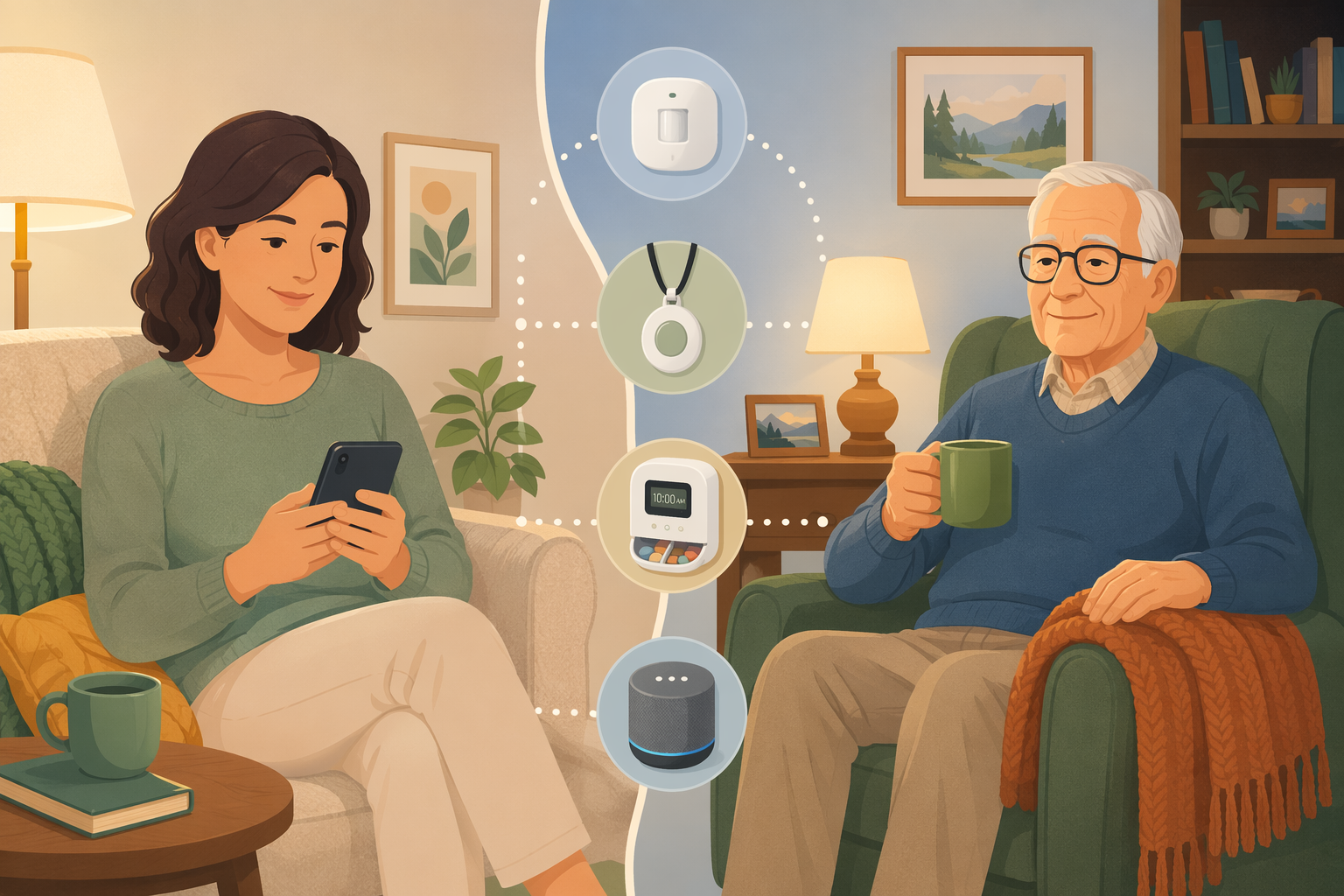
Why Dementia Changes the Monitoring Equation
If you have been researching monitoring technology for an older parent or spouse, you have likely encountered the standard advice: choose a medical alert system with fall detection, make sure the device is waterproof, and keep it charged. That advice works well for a generally healthy older adult who remembers to put on a pendant each morning. It falls apart when the person has dementia.
Dementia changes the monitoring equation in three fundamental ways. First, the primary safety risk shifts from falls to wandering. The Alzheimer's Association estimates that 6 in 10 people with dementia will wander at some point, a statistic cited by the National Council on Aging. A fall alert button does nothing if the person has already left the house and cannot find their way back. Second, the person may not cooperate with the technology. They might remove a pendant because it feels unfamiliar, forget to charge a device, or become confused by a smartphone interface. Third, the monitoring needs will change as the disease progresses. A system that works in early-stage dementia may be inadequate six months later.
This means the technology selection logic for dementia caregiving is fundamentally different from general senior monitoring. Wandering detection and GPS tracking take priority over fall alerts. Passive sensor systems — which require no action from the person — often outperform wearables. And the system must be chosen with future cognitive decline in mind, not just the current situation.
Wandering Prevention: GPS Trackers, Geofencing, and Door Sensors
Wandering is the most urgent safety concern for dementia caregivers. A person with dementia may leave the house at any hour — to go to work, visit a deceased parent, or simply because they feel disoriented. Once outside, they can become lost, disoriented, and at risk of injury or exposure. Monitoring technology for wandering works best as a layered system, not a single device.
GPS Trackers with Geofencing
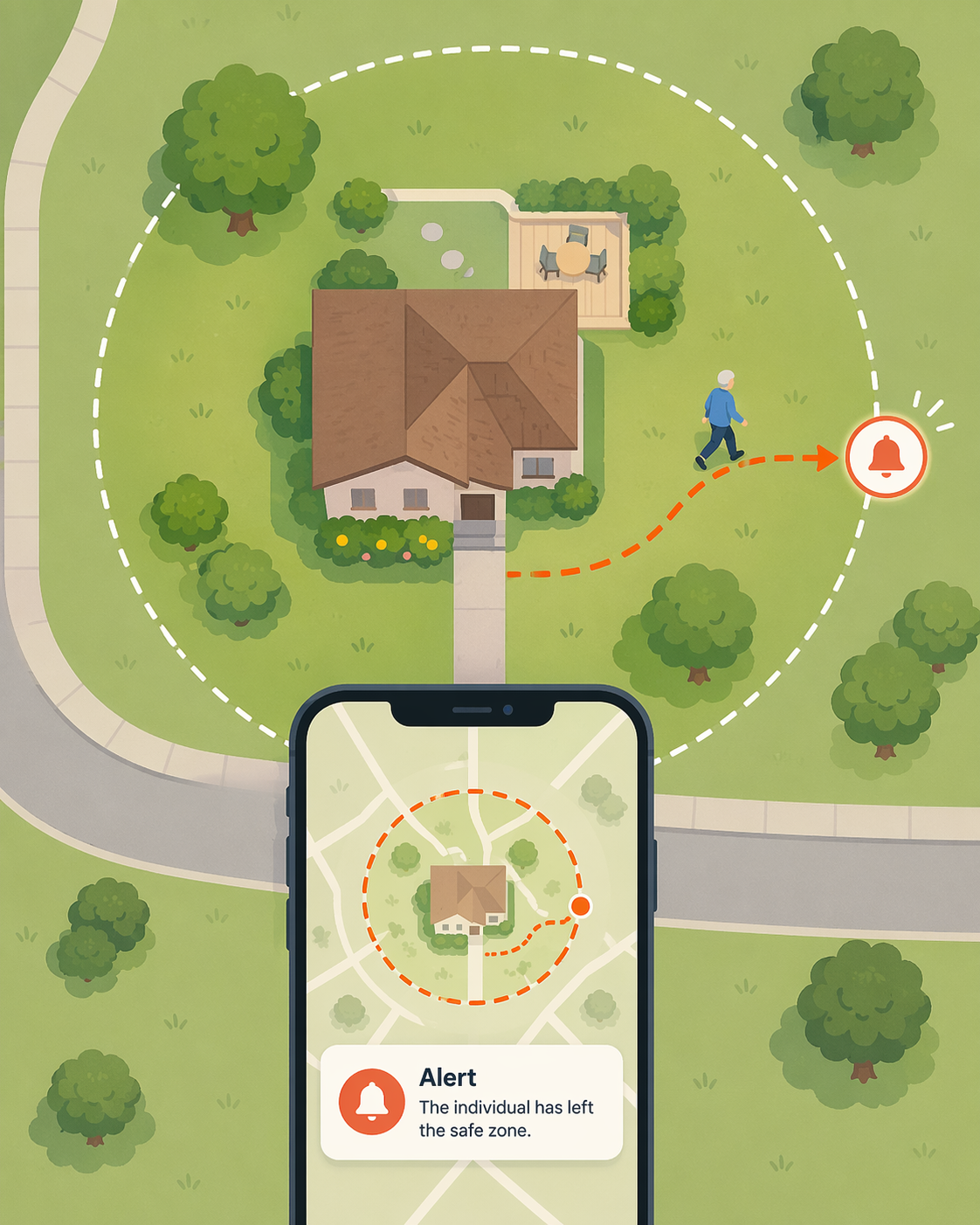
GPS-enabled devices allow you to define a safe zone — typically your home and yard — and receive an alert the moment the person leaves that boundary. This is called geofencing. For dementia caregivers, geofencing is the single most valuable feature in a monitoring system because it provides early notification before the person has traveled far.
When evaluating GPS trackers for a person with dementia, the key evaluation dimensions are different than for general use. Battery life becomes critical because the person may not remember to charge the device. The form factor matters because a pendant or watch is less likely to be removed than a device that must be clipped to a belt. And the alert system must reach multiple caregivers, not just one.
| Feature | Why It Matters for Dementia | What to Look For |
|---|---|---|
| Battery life | The person may forget to charge the device daily | Devices with 5–10 day battery life or swappable batteries |
| Geofencing alerts | Provides early notification before the person travels far | Customizable safe zones, instant alerts to multiple caregivers |
| Form factor | A wearable that can be removed or lost is useless | Watch-style or pendant that stays on; consider clothing-integrated options |
| Cellular connectivity | Wi-Fi may not be available outside the home | Cellular-enabled device that works without home internet |
| Two-way communication | Allows caregiver to speak to the person if they wander | Speaker and microphone that are simple to activate |
The UnaliWear Kanega Watch is an example of a device designed with these considerations in mind. It uses a patented quick-swap battery system so the watch never needs to be removed for charging — you simply swap the battery pack. This is a meaningful advantage for dementia caregivers because it eliminates the daily struggle of reminding someone to charge their device. The watch also includes fall detection and two-way communication, though for dementia caregiving the GPS and geofencing features are the primary value.
Door and Window Sensors as a First Layer
Before a GPS tracker becomes necessary, door and window sensors can serve as an early warning system. These simple magnetic sensors attach to doors and windows and send an alert to your phone when they are opened. For a person in early-stage dementia who is still oriented most of the time but occasionally wanders, door sensors provide a non-intrusive way to know when they have left the house.
Door sensors are inexpensive, easy to install, and require no action from the person with dementia. They can be paired with a smart lock that alerts you when the door is unlocked from the inside, or with a simple chime that sounds when the door opens — giving you an audible cue even if you are in another room.
For a detailed room-by-room approach to implementing door sensors, bed sensors, and locks as part of a wandering prevention plan, see our Wandering in Dementia: A Room-by-Room Home Safety Audit and Monitoring Technology Guide.
Nighttime Monitoring: Detecting Nocturnal Wandering and Falls
Nighttime agitation and wandering are among the most challenging dementia behaviors for family caregivers. A person with dementia may wake at 2 a.m. convinced it is morning, get dressed, and attempt to leave the house. Or they may get up to use the bathroom and, in their confusion, lose their balance or forget where they are. The fall risk during these nighttime episodes is substantial.
Traditional wearable medical alert systems are poorly suited to this scenario because many people remove their pendant or watch before bed. A device left on the nightstand cannot detect a fall in the bathroom. This is where passive monitoring — sensors that do not require the person to wear or interact with anything — becomes the more reliable solution.
Bed Sensors and Motion Sensors
A bed sensor is a pressure-sensitive pad placed under the mattress or sheet. When the person gets out of bed, the sensor triggers an alert to a caregiver's phone or to a base station in the house. This gives you immediate awareness that your loved one is up and moving, allowing you to check on them before they attempt to leave the bedroom or fall.
Motion sensors placed in hallways and near the bathroom door can extend this awareness. If the bed sensor triggers but the motion sensor in the hallway does not activate within a few minutes, it may indicate that the person has fallen between the bed and the door. Some passive monitoring platforms, such as the Caregiver Smart Solutions Core Kit (approximately $899 plus $59/month), use a network of motion sensors to learn the person's typical daily patterns and send alerts when those patterns deviate — for example, if the person normally gets up once at night but suddenly starts getting up four times, or if they get up and do not return to bed within a normal timeframe.
For a deeper understanding of sundowning behavior and how to build a comprehensive nighttime safety plan, read our guide When Your Parent Wanders at Night: Understanding Sundowning and Building a Nighttime Safety Plan.
Daily Routine Tracking: Medication Adherence and Missed Meals
In early-to-moderate dementia, the most common daily challenges are forgetting medications and skipping meals. These may seem less urgent than wandering, but they have serious consequences: missed doses of blood pressure or diabetes medication can lead to hospitalization, and poor nutrition accelerates cognitive and physical decline.
Automated Medication Dispensers
Automated medication dispensers are one of the most effective monitoring tools for dementia caregiving because they address both the cognitive and the logistical challenge. The device holds multiple medications, dispenses the correct dose at the scheduled time, and alerts a caregiver if a dose is missed. The person does not need to remember which pill to take or whether they already took it.
The Hero Smart Pill Dispenser is one example of this category. It costs $29.99 per month with an annual commitment (plus a $99.99 setup fee) and can hold up to 90 days' worth of up to 10 different medications. When a dose is missed, the device sends an alert to designated caregivers. This is particularly valuable for long-distance caregivers who cannot be present to supervise medication-taking.
| Challenge | Monitoring Solution | How It Works |
|---|---|---|
| Forgotten medications | Automated medication dispenser | Device dispenses correct dose at scheduled time; alerts caregiver if missed |
| Skipped meals | Appliance sensor or motion sensor | Detects when stove or refrigerator is not used during typical meal times |
| Unusual inactivity | Motion sensor network | Flags when a normally active person stays in bed all day or does not visit the kitchen |
| Repetitive behaviors | Pattern-learning sensor system | Learns daily routines and alerts when behavior deviates from the norm |
Appliance and Motion Sensors for Meal Detection
For detecting missed meals, appliance sensors and motion sensors can be more effective than asking the person whether they have eaten. A sensor on the refrigerator door or stove can detect whether the appliances are being used during typical meal times. If the refrigerator has not been opened by noon, the system can send an alert to a caregiver.
More sophisticated passive monitoring platforms, such as the CarePredict @Home Kit ($499 plus $69.99/month), use a wearable Tempo device with swappable batteries that tracks eating, bathing, walking, and sleep patterns. The system learns what is normal for the individual and alerts caregivers when patterns change — for example, if the person stops eating breakfast or starts bathing less frequently. According to vendor marketing materials cited by SeniorSite, clinical studies have shown the system can reduce hospitalizations by 40% and falls by 69%, though these claims should be verified against independent published research.
Systems Designed for Dementia: Companion-Style Monitoring and Care Circles
A growing category of monitoring systems is designed specifically for dementia care, moving beyond simple alerts to provide companionship, social interaction, and shared awareness among multiple family members.
Companion-Style Smart Speakers
Companion-style devices like Sentai (available in the UK at £24.50–£29.50/month) function as smart speakers designed for older adults. They can play music, set reminders, make calls, and provide conversation. For a person with dementia, a voice-activated companion can reduce feelings of isolation and provide a familiar, non-threatening presence. These devices also include monitoring features: they can detect unusual silence (which may indicate a fall or medical event) and alert designated caregivers.
The key advantage of companion-style devices for dementia care is that they do not require the person to learn a new interface. Voice commands are intuitive, and the device is always available. For a person who finds buttons and screens confusing, a voice-activated companion can be far more accessible than a smartphone or tablet.
Care Circle Notification Systems
Dementia caregiving is rarely a one-person job. Care circle systems allow multiple family members, neighbors, and professional caregivers to receive alerts and share information about the person's status. When a door sensor triggers or a medication dose is missed, the alert goes to everyone in the circle — not just the primary caregiver.
This shared awareness reduces the burden on any single caregiver and ensures that someone is always available to respond. For long-distance caregivers, care circle notifications provide peace of mind that someone local is being alerted when needed. For a deeper look at why passive, sensor-based systems are often the better choice for dementia care, see our article Beyond the Panic Button: Why Passive, Sensor-Based Monitoring Is Replacing Wearables for Elderly Safety.
- Companion-style smart speakers provide social interaction and voice-activated monitoring without requiring the person to learn a new interface.
- Care circle notification systems distribute alerts to multiple family members, reducing the burden on the primary caregiver.
- Passive sensor platforms learn daily patterns and alert when behavior deviates from the norm, without requiring any action from the person.
- Systems with swappable batteries (like the UnaliWear Kanega Watch and CarePredict Tempo) eliminate the need for the person to remember to charge the device.
What Doesn't Work: Devices and Approaches to Avoid
Not all monitoring technology is suitable for dementia care. Some approaches that work well for cognitively healthy older adults become ineffective or even counterproductive when the user has memory loss or confusion. Here are the most common pitfalls to avoid.
- Complex smartphone apps as primary interfaces. If the person with dementia needs to open an app, navigate a menu, or remember a password to use the system, it will not work. Choose devices with one-button operation or voice activation.
- Devices requiring daily charging. A pendant or watch that must be charged every night will be forgotten, lost, or left uncharged. Look for devices with swappable batteries or battery life measured in days or weeks, not hours.
- Cameras in private spaces. Bedroom and bathroom cameras raise serious privacy and dignity concerns, especially for a person who may not understand why they are being watched. They can also create legal complications if the person is unable to consent. If cameras are used at all, they should be limited to common areas and accompanied by a clear conversation about consent.
- Wearables that can be easily removed. A person with dementia may remove a pendant because it feels uncomfortable, unfamiliar, or because they do not remember what it is. If the device can be taken off, it will be. Consider clothing-integrated trackers or devices that are designed to be worn continuously.
- Systems that only alert one person. Dementia caregiving requires a support network. Choose a system that can send alerts to multiple caregivers, including long-distance family members.
How to Talk to Your Parent or Spouse About Monitoring
Introducing monitoring technology to a person with dementia is one of the most delicate conversations a caregiver will have. The person may not recognize that they have memory problems, may feel that monitoring is an invasion of privacy, or may become suspicious of your motives. How you frame the conversation can determine whether the technology is accepted or rejected.
- Frame it as a benefit to you, not a restriction on them. Instead of saying "This will help us keep track of you," try "This will help me stop worrying when I'm at work. I'll know you're safe, and I won't have to call you every hour."
- Involve them in the choice. If possible, show them two or three options and let them choose the one they prefer. A person who feels they have a say in the decision is more likely to accept it.
- Start with the least intrusive option. Begin with a simple door sensor or motion sensor that requires no action from them. If they accept that, you can add more features later.
- Use familiar language. Avoid terms like "monitoring," "tracking," or "surveillance." Instead, talk about "staying connected," "peace of mind," or "a little help so I don't have to call so often."
- Be prepared for refusal. If the person refuses, do not force the issue. You may need to try again later, or you may need to use passive sensors that they do not need to interact with. For a deeper understanding of why people with dementia resist technology and how to address those barriers, see our guide Beyond 'They Just Don't Want to Learn': The 6 Real Barriers to Senior Tech Adoption and How to Overcome Each One.
Planning for Progression: Choosing a System That Adapts
Dementia is a progressive disease. The monitoring system that works today may be inadequate in six to twelve months. When choosing a system, think ahead about how your loved one's needs will change and whether the system can grow with them.
- Choose a platform that allows you to add sensors over time. A system that starts with a single door sensor should be able to expand to include motion sensors, bed sensors, and appliance sensors as needs evolve.
- Look for systems that support multiple caregivers. As the disease progresses, you may need to bring in home health aides or involve additional family members. The system should allow you to add new caregivers to the alert circle without replacing the hardware.
- Consider whether the system works with declining cognitive ability. A voice-activated companion may work well in early-stage dementia but become confusing in middle-stage dementia. A passive sensor system that requires no interaction at all will remain effective longer.
- Plan for the transition to higher levels of care. If your loved one eventually moves to an assisted living facility or memory care unit, some monitoring devices (like GPS trackers) may still be useful, while others (like door sensors) may become redundant. Choose systems that are portable and can be repurposed.
For a comprehensive overview of dementia home care strategies beyond monitoring technology, see our guide Dementia Care at Home: A Practical Guide to Managing Behaviors, Safety, and Daily Life.
Questions to bring to a clinician or OT
This is not medical, legal, or a family's final decision — only a framework. Bring these questions to a clinician, occupational therapist, or your local Area Agency on Aging.
Find Local HelpRelated reading
Noticed something outdated or inaccurate on this page? Flag a correction. We review every report against CDC, NIA, and AARP HomeFit guidance before updating a page.