
STEADI: Intervene
Heat Stroke or Heat Exhaustion? What to Do for Older Adults
Heat stroke in older adults can occur with damp skin and a gradual onset, so the classic hot, dry skin check is unreliable in this population. Here is how to judge the warning signs, decide between calling 911 and cooling at home, and keep watching after the heat wave ends.
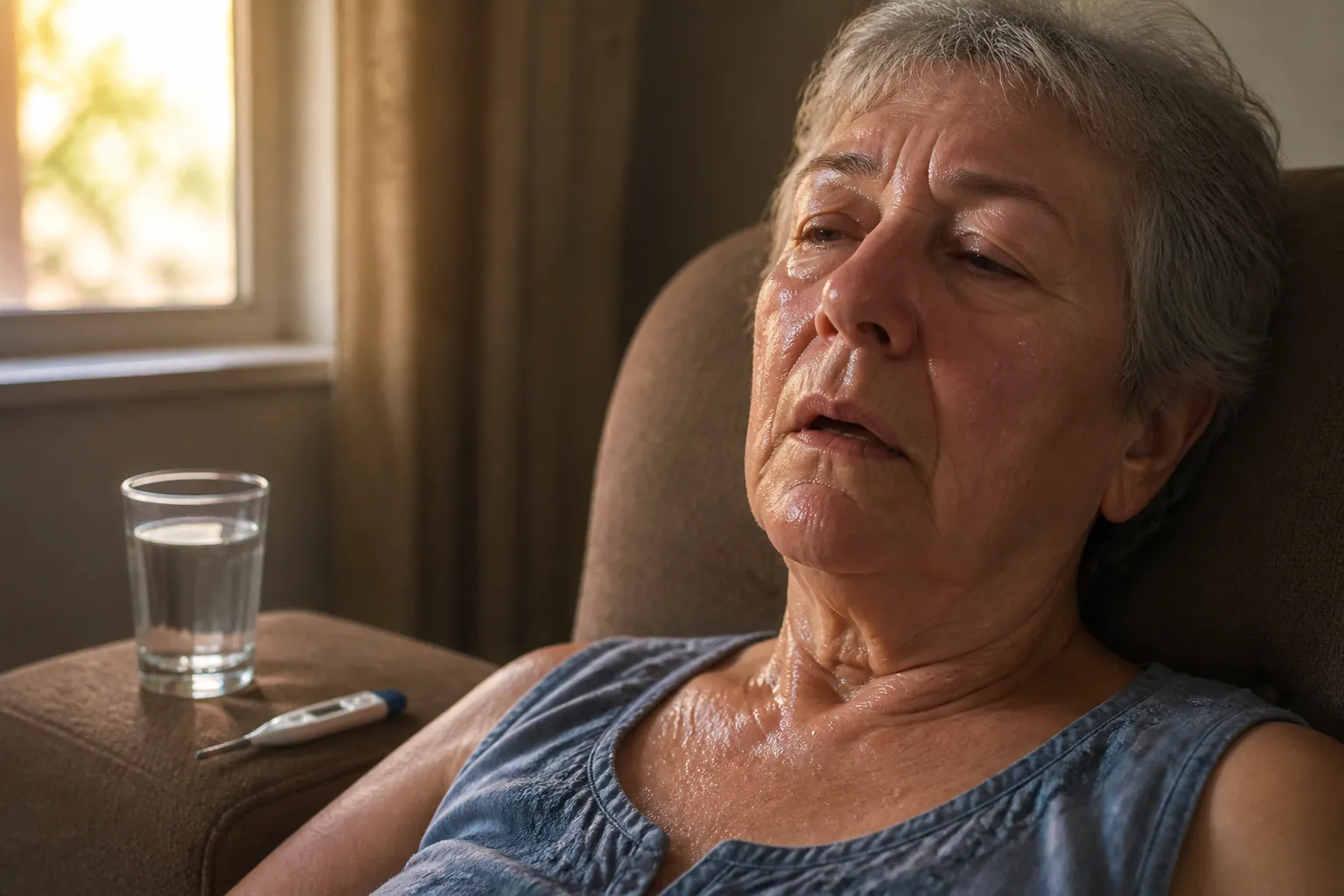
If an older adult is confused, vomiting, fainting, unusually weak, too drowsy to drink, or has a temperature near 104 F, treat it as a possible heat emergency now. Do not wait for “hot, dry skin.” In older adults, heat stroke can come on gradually, sweating can continue, thirst can be muted, and damp skin can still belong to a person in real danger.
For planning before the next advisory, use the Heat Wave Safety Checklist for Seniors During El Niño. This article is for the moment when the person is already acting wrong, looking sick, or not recovering with simple cooling.
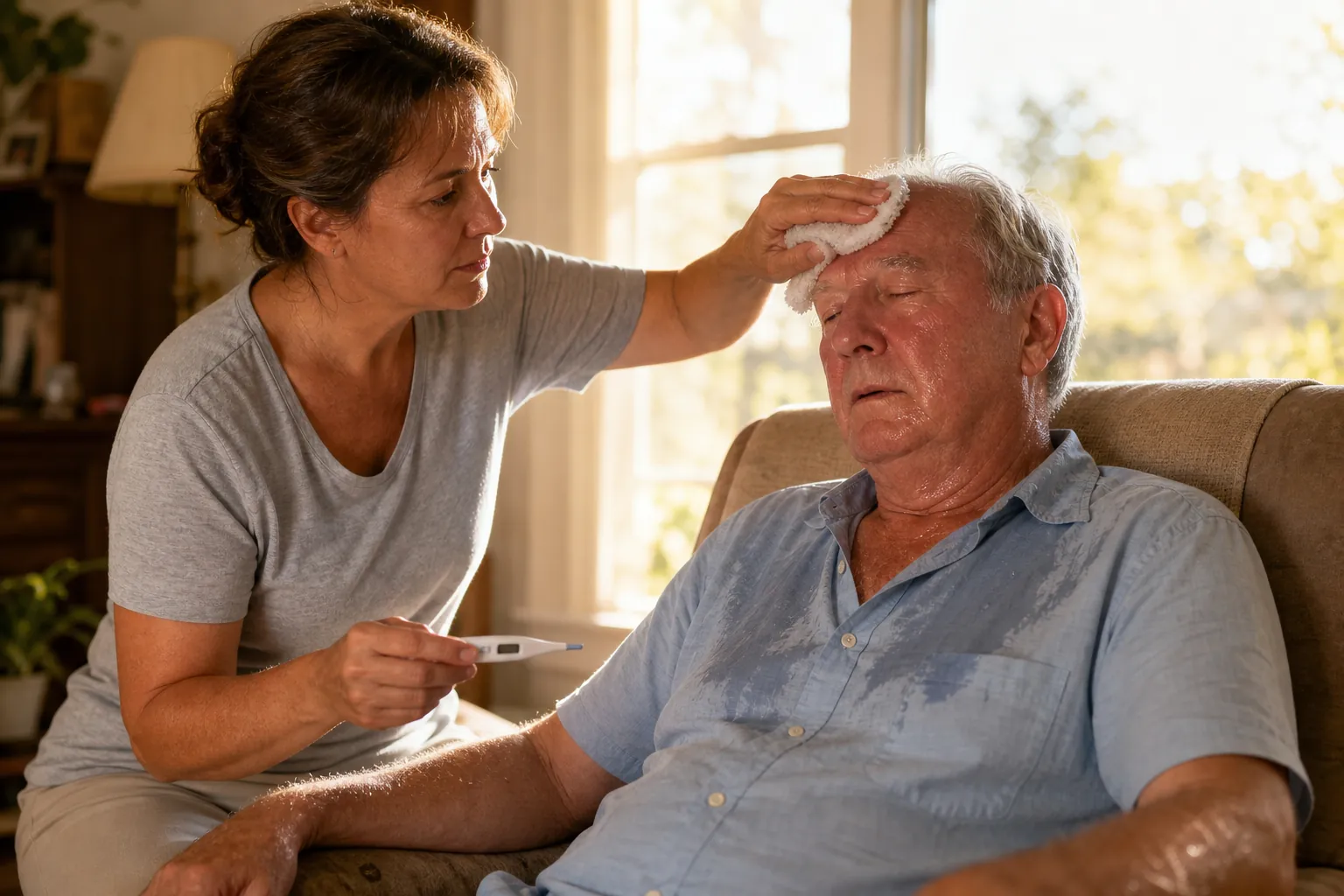
This is emergency-adjacent health information, not a diagnosis or a substitute for local emergency care. If you are unsure whether the older person is safe, call emergency services or a local medical advice line. When heat stroke is possible, delay is the wrong risk.
First decision: are there heat-stroke signs?
Mayo Clinic defines heatstroke as a core body temperature of 104 F, or 40 C, or higher, and notes that classic nonexertional heatstroke occurs most often in older adults.[1] That temperature is a danger marker, not a permission slip to relax when the number is lower. Home thermometers can be imperfect, readings can lag behind the person’s condition, and older adults may show trouble through behavior before a caregiver gets a clean measurement.
The American Red Cross lists heat-stroke signs that include a temperature of 104 F or higher, hot red dry or damp skin, a fast strong pulse, confusion, and passing out. Its instruction is simple: call 911 first, then start cooling the person while help is on the way. It also warns not to give fluids to a drowsy or less-alert person.[2]
| What you see right now | What to do |
|---|---|
| Confusion, strange behavior, hard to wake, passing out, or seizure-like activity | Call 911. Start cooling while help is coming. Do not give fluids if they are drowsy or not fully alert. |
| Temperature near 104 F or higher | Call 911. Begin active cooling immediately. |
| Vomiting, repeated retching, or cannot keep fluids down | Call 911 or seek urgent medical help. Keep cooling and watch breathing and alertness. |
| Alert, talking normally, able to sit up and drink, no fainting, no worsening symptoms | Move to a cooler place, cool the skin, offer fluids, and keep watching closely. Escalate if symptoms do not improve or any danger sign appears. |
The 5 checks to make with one hand on the phone
Do these in order. Do not spend ten minutes hunting for the perfect symptom list while the person is getting sleepier.
1. Check alertness and behavior
Ask a plain question: “What day is it?” “Where are you?” “Can you tell me what happened?” You are not testing intelligence; you are checking whether the brain is functioning normally under heat stress.
Call 911 if the person is newly confused, unusually agitated, hard to keep awake, unable to answer simple questions, or has passed out. A person who is “just wiped out” may still be able to speak normally, sit up, and follow instructions. A person who is drifting, mumbling, not making sense, or repeatedly trying to lie back down despite being overheated is in a different category.
2. Check whether they can drink safely
If they are fully alert, sitting upright, and able to swallow, you can offer small sips of cool fluid while you cool them. If they are drowsy, confused, slumped over, repeatedly coughing with sips, or not clearly awake, do not push fluids. The Red Cross specifically warns against giving fluids to a drowsy person during suspected heat stroke.[2]
This matters because caregivers often focus on dehydration and try to “get some water into them.” That is reasonable for a fully alert person with milder symptoms. It is not safe when alertness is impaired.
3. Check for vomiting, fainting, or rapid worsening
Vomiting changes the situation. So does fainting. So does a caregiver’s honest sense that the person looked tired ten minutes ago and now looks much worse. If they cannot keep fluids down, have fainted, are getting weaker, or are too unsteady to stand, escalate rather than trying to manage it as ordinary overheating at home.
Heat-related weakness and dizziness also raise fall risk. If you are cooling the person at home, do not have them walk alone to the bathroom, shower, porch, or bedroom. Heat illness can turn a short walk into a fall, especially if blood pressure is low or the person is dehydrated.
4. Check temperature if you can — but do not let the thermometer overrule the person
A reading near 104 F is an emergency marker. Call 911 and cool immediately.[1][2] If the reading is lower but the person is confused, fainting, vomiting, or too drowsy to drink, treat the symptoms as more important than the number.
If you have only a forehead, ear, or oral thermometer and the result does not match what you are seeing, do not argue with the device. A clean low number is reassuring only when the person is also alert, improving, able to drink, and not showing danger signs.
5. Decide: emergency branch or home-cooling branch
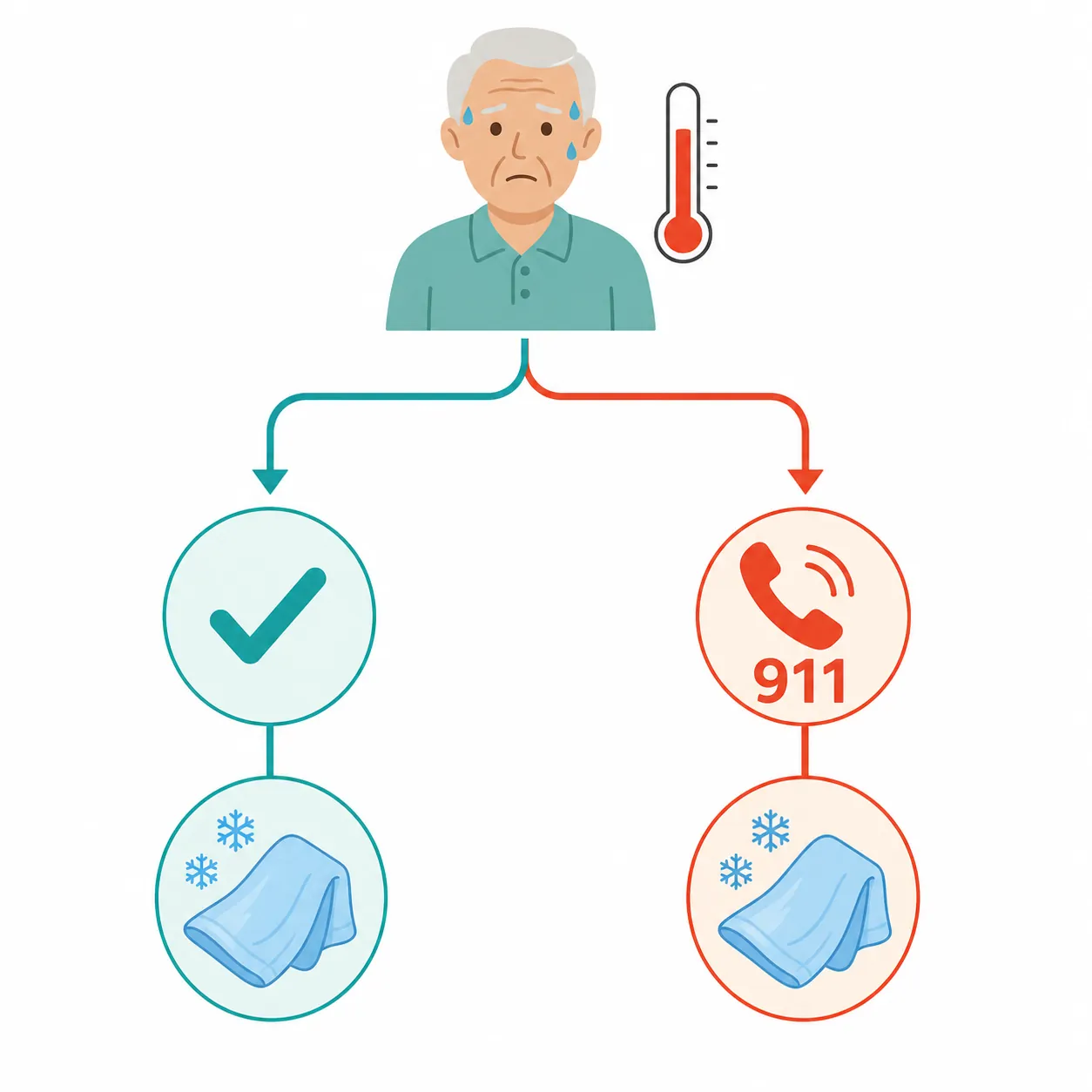
Use the emergency branch if there is confusion, passing out, a temperature near 104 F or higher, inability to drink safely, repeated vomiting, or rapid worsening. Call 911 first. Then cool the person while waiting.
Use the home-cooling branch only when the person is awake, making sense, able to drink, not vomiting, not fainting, and improving after cooling. That branch still requires watching. If the person stops improving or any emergency sign appears, switch branches.
If you call 911, cool while you wait
Calling 911 is not the last action. It is the first action in the emergency branch. The Red Cross advises cooling the person while help is on the way.[2]
- Move them out of the heat if you can do it safely: indoors, into shade, or near air conditioning.
- Loosen or remove excess clothing.
- Apply cool wet cloths or towels to the skin, especially the neck, armpits, and groin.
- Fan them if it helps cooling and does not delay other steps.
- If they are less alert, drowsy, or not swallowing normally, do not give fluids.
- Stay with them. Watch breathing, alertness, and whether they pass out.
If you are alone, put the phone on speaker. Tell the dispatcher the person’s age, temperature if you have it, whether they are confused or drowsy, whether they have vomited or fainted, and what cooling you have started. If you do not have a medication list, say so. Do not leave a confused or faint older adult alone to search for paperwork.
If you cool at home, make the standard for improvement strict
Home cooling is for the older adult who is alert, drinking safely, and getting better. Move them to a cooler area, loosen clothing, use cool cloths, offer small sips of fluid, and keep them seated or lying down until steadiness returns.
Improvement should be visible: clearer thinking, less distress, steadier posture, easier conversation, and no new vomiting or fainting. If the person remains unusually weak, seems “off,” refuses fluids because they are too sleepy or confused, or worsens after an initial improvement, stop treating it as a mild problem.
- Do not send them to shower alone.
- Do not let them walk unassisted if they are dizzy or weak.
- Do not assume sweating means they are safe.
- Do not assume a lack of thirst means they are hydrated.
- Do not wait for skin to become dry before calling for help.
Why older adults may not look like the textbook case
The “hot, dry skin” shortcut is especially risky with older adults because it leaves out too much. The American Red Cross includes hot red dry or damp skin among heat-stroke signs.[2]
AGS Health in Aging notes that heat stroke in older adults can develop gradually over days of heat exposure, and it recommends that older adults begin precautions when temperatures rise above 80 F.[3] That 80 F point is not an emergency line. It is a cue to become watchful earlier, before the person is confused or too weak to recover easily.
The CDC explains part of the reason: adults 65 and older do not adjust as well as younger people to sudden temperature changes, are more likely to have chronic medical conditions that change normal heat responses, and are more likely to take medicines that affect temperature control.[4] Climate Central also reports that older adults are less able to sense heat, sweat effectively, and feel thirst, and that more than 80% of heat-related deaths are among people over 60.[5]
Put those facts into a living room and the danger becomes obvious. An older man may still be sweating. An older woman may deny thirst. A person may have spent two hot days “just tired” before the confusion becomes clear. The caregiver who waits for the dramatic version of heat stroke may lose the safer window to act.
Heat exhaustion versus heat stroke: the practical difference
For a caregiver, the useful dividing line is not a perfect label. It is whether the person can still protect their airway, drink safely, think clearly, and improve with cooling.
| More consistent with heat exhaustion if… | Treat as possible heat stroke if… |
|---|---|
| They are awake, oriented, and able to answer normally. | They are confused, agitated, hard to wake, or not making sense. |
| They can sit up and drink small sips safely. | They are drowsy, choking or coughing with sips, or unable to drink safely. |
| They feel weak or overheated but improve with cooling. | They pass out, worsen, or fail to improve. |
| No repeated vomiting. | Repeated vomiting or inability to keep fluids down. |
| Temperature is not near 104 F and symptoms are improving. | Temperature is near 104 F or higher, or symptoms are serious even with a lower reading. |
The left column still deserves attention. Heat exhaustion can worsen, and an older adult who is dizzy, weak, or dehydrated can fall. The right column is the emergency branch.
After the immediate danger passes, keep watching
The room may cool before the person is fully safe. After a heat illness scare, keep checking hydration, alertness, breathing, weakness, dizziness, falls, and any worsening of chronic symptoms. Pay close attention if the person has heart, lung, kidney, neurological, or mobility problems, or if medication changes, poor appetite, or poor sleep followed the heat event.
This aftercare step is not a Red Cross rule that says to monitor for a fixed number of days. It is a safety judgment supported by population-level evidence. A Harvard Chan School summary of a Lancet Planetary Health study of 73.7 million Medicare beneficiaries from 2000 to 2018 reported roughly 9 extra deaths per heat wave per 10,000 older adults per year, about 17,600 extra deaths annually nationwide, with elevated cardiovascular, respiratory, and neurological deaths persisting across the year after heat waves.[6]
That kind of study does not tell you that one parent will have a problem on one specific day. It does say not to treat the end of the visible heat wave as the end of concern. If the older adult remains weaker than usual, is newly short of breath, more confused, less steady, less able to drink, or has a fall after the heat breaks, do not file it away as ordinary aging.
Heat stroke in older adults is an emergency even when the skin is damp, the onset is slow, or thirst is absent. Act on alertness, ability to drink, vomiting, fainting, and a temperature near 104 F. Call 911 first when heat stroke is possible, cool while help is coming, and keep watching after the weather looks better.
References
- Heatstroke - Symptoms and causes, Mayo Clinic.
- Extreme Heat Safety, American Red Cross.
- Hot Weather Safety Tips for Older Adults, Health in Aging.
- Heat and Older Adults (Aged 65+), Centers for Disease Control and Prevention.
- Seniors at Risk: Heat and Climate Change, Climate Central.
- Heat waves and annual death rates in older adults in the United States, Harvard T.H. Chan School of Public Health.
Related reading
Noticed something outdated or inaccurate on this page? Flag a correction. We review every report against CDC, NIA, and AARP HomeFit guidance before updating a page.
Part of the Fall Prevention section.