
STEADI: Intervene
How to Protect Older Adults From Heat Wave Dangers
Heat danger in older adults is often invisible — blunted thirst, reduced sweating, and heat-sensitive medications can hide it until it's severe. This caregiver action plan provides the CDC's twice-daily check-in protocol, a cooled-home checklist, a medication review, and the specific warning signs that call for 911.
Start with the check-in, not the reminder
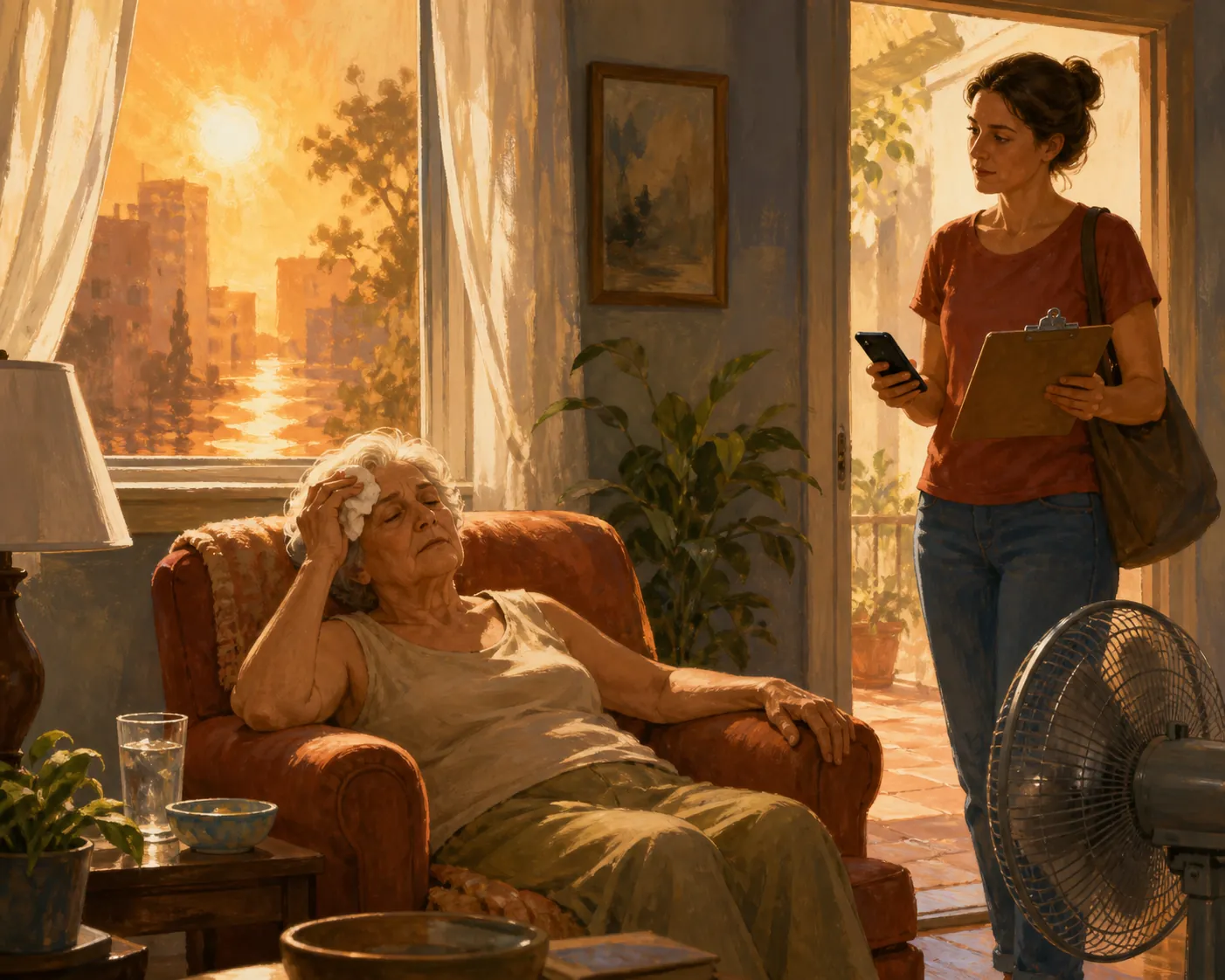
The safest way to protect an older adult from heat-wave danger is not a cheerful “drink more water” text. For an older adult living at home, heat protection has to become a scheduled task that someone else can verify. The CDC’s caregiver instruction is plain: visit at-risk older adults at least twice a day and ask whether they are drinking enough water, whether they have access to air conditioning, whether they know how to keep cool, and whether they show signs of heat stress.[1]
If you live nearby, that can mean two brief in-person checks. If you are coordinating from another town, it can mean one family member, neighbor, building manager, or paid caregiver takes the morning check while you take the evening call. The point is not to make the older adult feel supervised. It is to keep heat danger from depending on whether they happen to feel thirsty, uncomfortable, or worried enough to ask for help.
Use the same questions every time:
- What have you had to drink since breakfast, lunch, or dinner?
- Is the air conditioning on, and what room are you sitting in right now?
- Are the blinds or curtains closed on the sunny side of the home?
- Do you feel dizzy, weak, nauseated, unusually tired, confused, or headachy?
- Has anything changed since the last check: appetite, walking steadiness, speech, alertness, sweating, or bathroom trips?
A yes-or-no call is too easy to pass. “Are you okay?” often gets “I’m fine.” A useful check asks for observable details: the room, the air conditioner, the drink, the medication plan, the way the person sounds.
Why older adults can be in trouble before they say they are
Heat is not a minor comfort issue for adults 65 and older. In a CDC MMWR analysis of U.S. heat-related deaths from 2004 through 2018, 10,527 heat-related deaths were identified; 39% occurred among people aged 65 and older, and that age group had the highest death rate, 0.7 per 100,000.[2] CDC public guidance also describes extreme heat as causing more than 700 deaths in the United States each year.[3]
Those numbers matter because they explain why the household protocol has to be more serious than ordinary summer advice. The older adult may not adjust as well to sudden temperature changes, may have chronic medical conditions that affect heat tolerance, and may take medicines that change sweating, thirst, blood pressure, or alertness.[1]
That is also why heat safety belongs in a fall-prevention plan. A hot apartment, mild dehydration, or a medication-related blood pressure drop can show up as dizziness, weakness, confusion, or an unsteady walk before anyone uses the words “heat illness.” If the household is already thinking about emergency water access, the same concerns overlap with the fall risks described in why a water crisis is a fall emergency for older adults.
Before the heat wave: make a cooled-home plan someone can verify
“Stay cool” is not a plan until the caregiver knows where the cool air is coming from, what happens if it stops, and who can physically get the older adult to a safer place. The CDC’s heat guidance emphasizes staying in air-conditioned buildings and says not to rely on a fan as the main cooling source during extreme heat.[1][3]

Before the advisory starts, confirm the basics in a way that does not depend on memory:
| What to confirm | What the caregiver needs to know |
|---|---|
| Air conditioning | Which unit works, which room gets cool, who can adjust the thermostat, and whether the older adult is actually using it. |
| Cool room | The safest room for the hottest part of the day, preferably away from direct sun, with seating, phone, water, medications, glasses, walker, and bathroom access. |
| Window coverings | Blinds or curtains closed on sun-facing windows before the room overheats. |
| Back-up destination | A cooling center, library, relative’s home, senior center, lobby, or other air-conditioned place the older adult can realistically reach. |
| Transportation | Who drives, who calls the ride, whether stairs or long walks are involved, and what time the person should leave before the hottest hours. |
| Power outage plan | Who is notified if the AC fails, what battery lights or phones are available, and when the older adult should leave the home instead of waiting. |
Fan advice needs care because the sources do not say it in exactly the same way. The CDC says fans can make body temperature rise when indoor temperatures are above 90°F, and that a fan should not be used as the main cooling device during extreme heat.[3] The American Red Cross says electric fans may provide comfort, but when temperatures are in the high 90s, fans may not prevent heat-related illness.[4] In a caregiver plan, that means a fan can be treated as comfort, not as proof that the home is safe.
No-AC and power-outage situations deserve a lower threshold for action. If the home is getting hotter and there is no reliable air conditioning, the next step is not another reminder to drink water. It is moving the older adult to a cooled location. Households that already keep storm supplies or outage contacts can adapt the same thinking from this power-outage fall-prevention checklist. If the heat advisory overlaps with smoke, wildfire risk, or a heat dome, the cooling destination also has to be breathable and reachable; that overlap is covered in wildfire safety for older adults during a heat dome.
For homes that repeatedly become unsafe in summer, cooling belongs on the same priority list as lighting, bathroom access, stair safety, and emergency exits. Larger changes can be planned through a room-by-room home modification priority guide or a broader plan for prioritizing aging-in-place modifications. During an active advisory, though, the priority is simpler: get the person into a cool room or to a cool place.
During the heat wave: run the twice-daily check the same way
A heat-wave check-in should be boring on purpose. Same times, same questions, same escalation rule. That repetition helps a second caregiver notice change: yesterday Dad answered quickly and was sitting in the cool room; today he sounds slow, says he is “just tired,” and is sitting near a sunny window.
What to ask by phone or video
- “Where are you sitting right now?” Listen for whether they are in the planned cool room.
- “Is the air conditioner running?” If possible, ask them to show or read the thermostat, AC display, or room thermometer.
- “What did you drink with your last meal?” This is more useful than “Are you drinking enough?”
- “Have you felt dizzy, weak, cramped, nauseated, headachy, unusually sleepy, or confused?”
- “Have you taken today’s medicines as prescribed?” Do not use the heat wave as a reason to improvise medication changes.
- “Can you stand and walk normally?” If standing is unsafe, do not ask them to prove it over the phone; send help.
What an in-person checker should look for
- A hot room, closed-off AC, sunny windows, or the older adult sitting somewhere other than the planned cool area.
- New confusion, irritability, slowed answers, unusual quietness, or trouble following a normal conversation.
- Unsteady walking, weakness when rising, dizziness, or a near fall.
- Heavy sweating, no sweating when the room is hot, flushed skin, clammy skin, nausea, vomiting, headache, or muscle cramps.
- Untouched drinks, little food, missed medications, or signs that the person has not moved from one chair for hours.
The dignity piece matters. A check-in does not have to sound like an inspection. It can sound like, “The advisory is rough today, and I’m checking the same things for everyone. Let’s make sure the cool room is working.” The responsibility still stays with the caregiver network, not with the older adult’s ability to self-diagnose heat stress.
Medication and fluid questions should be settled before the hottest day
Medication review is part of heat preparation, especially for an older adult with heart disease, kidney disease, high blood pressure, diabetes, dementia, or a history of dizziness or falls. CDC clinician guidance notes that some medicines can increase heat risk by contributing to volume depletion, electrolyte imbalance, hypotension, reduced cardiac output, sedation, impaired sweating, or reduced thirst; examples include diuretics, anticholinergic medicines, some psychotropics, and certain over-the-counter medicines.[5]
The caregiver’s job is not to stop medications. It is to ask the prescribing clinician or pharmacist what to watch for during hot weather, whether any monitoring should change, and what symptoms should trigger a call. CDC medication guidance is explicit that patients should not abruptly stop taking prescribed medicines without talking to a clinician.[5]
Hydration advice also needs a boundary. Some public heat-safety sources give general amounts, but an older adult who has been told to restrict fluids, has heart or kidney disease, or takes diuretics needs clinician-specific instructions. The safer caregiver question is: “How much fluid is right for this person during a heat advisory, and when should we call you?” CDC heat guidance tells people on low-fluid diets or water pills to ask their doctor how much they should drink during hot weather.[3]
Warning signs: move from monitoring to action
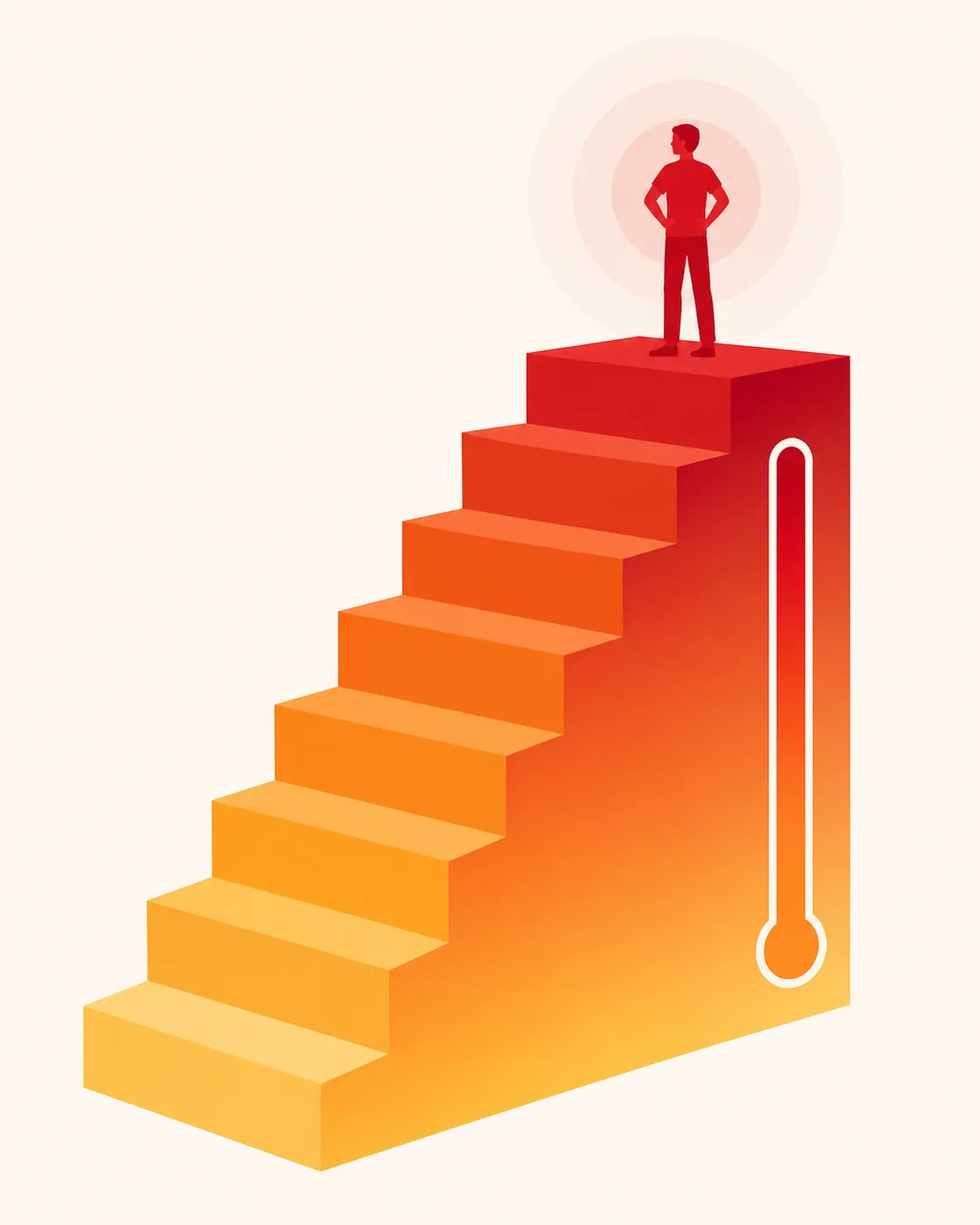
Heat illness is a ladder. The lower steps still matter because they can become the upper steps, especially when the person is older, alone, and sitting in a home that is not cooling down.
| Possible stage | What you may notice | What to do |
|---|---|---|
| Heat cramps | Painful muscle cramps or spasms, often after sweating or exertion. | Move to a cool place, rest, and follow the person’s clinician-approved fluid plan. Keep checking for worsening symptoms. |
| Heat exhaustion | Heavy sweating, weakness, dizziness, headache, nausea or vomiting, cool or clammy skin, fast pulse, or faintness. | Move to air conditioning or shade, loosen clothing, cool the body, and get medical advice promptly if symptoms are severe, the person has high-risk conditions, or symptoms do not improve. |
| Heat stroke | Core body temperature of 104°F or higher with altered mental state or behavior such as confusion, agitation, slurred speech, seizures, or loss of consciousness. Skin may be hot and dry, but sweating patterns can vary. | Call 911 immediately. Begin cooling while waiting for emergency medical services. |
Mayo Clinic describes heat stroke as a medical emergency marked by a core body temperature of 104°F or higher and altered mental state or behavior, including confusion, agitation, slurred speech, seizures, or coma.[6] Cleveland Clinic similarly distinguishes heat exhaustion from heat stroke by the escalation to brain dysfunction and emergency danger.[7]
Most families will not have a safe way to measure core temperature at home. Do not wait for a number if the person is hot, has been exposed to extreme heat, and shows new confusion, slurred speech, seizure, collapse, or loss of consciousness. Treat that as an emergency.
If heat stroke is possible, call 911 first
Once heat stroke is possible, the caregiver’s sequence should be simple: call 911, move the person to a cooler place if you can do so safely, and start cooling measures while waiting for emergency medical services. The Red Cross recommends cooling by applying wet cloths, misting or spraying with water, fanning, and placing ice or cold packs on the neck, armpits, and groin if available.[4]
Remove excess clothing if it can be done without delay or loss of privacy. Keep the person lying down if they are weak, faint, or confused. Stay on the line with emergency dispatch if instructed.
Do not give fluids to someone who may have heat stroke or who is unconscious; the Red Cross gives that warning because swallowing may be unsafe in that condition.[4] Fluids belong in the prevention and early-symptom plan for people who can safely drink, not in the middle of a heat-stroke emergency.
The protection plan
An older adult should not have to detect and report heat danger alone. The practical standard is a twice-daily check-in, a deliberately cooled environment, a medication and fluid plan reviewed before the heat wave, and a clear 911 threshold for altered mental status, collapse, seizure, loss of consciousness, or suspected heat stroke.
Medical note: This article is for education and home-safety planning only and is not medical advice. For diagnosis, treatment, medication changes, fluid restrictions, or heat-related symptoms in a specific person, contact that person’s clinician or emergency services.
References
- Heat and Older Adults (Aged 65+), Centers for Disease Control and Prevention
- Heat-Related Deaths — United States, 2004–2018, Centers for Disease Control and Prevention
- Protect Yourself From the Dangers of Extreme Heat, Centers for Disease Control and Prevention
- Extreme Heat Safety, American Red Cross
- Heat and Medications – Guidance for Clinicians, Centers for Disease Control and Prevention
- Heatstroke - Symptoms and causes, Mayo Clinic
- Heat Exhaustion vs. Heat Stroke, Cleveland Clinic
Related reading
Noticed something outdated or inaccurate on this page? Flag a correction. We review every report against CDC, NIA, and AARP HomeFit guidance before updating a page.
Part of the Fall Prevention section.