
STEADI: Screen
Call 911 First for These Heat Stroke Symptoms in Seniors
Heat stroke in older adults often shows up as confusion or weakness before a classic high fever. Learn which symptoms in an elderly parent are immediate 911 triggers and the exact cooling steps to follow while you wait for help.
It is a hot afternoon, and an older parent is suddenly weak, dazed, not answering normally, slurring words, agitated, delirious, having a seizure, or unconscious. When these heat stroke symptoms appear in an elderly person, the first step is not to offer water, search for fever medicine, or wait for a perfect thermometer reading. Call 911 now, then start cooling while help is on the way. Changes in thinking or behavior are a major heat stroke warning sign and an emergency trigger. [1][2]
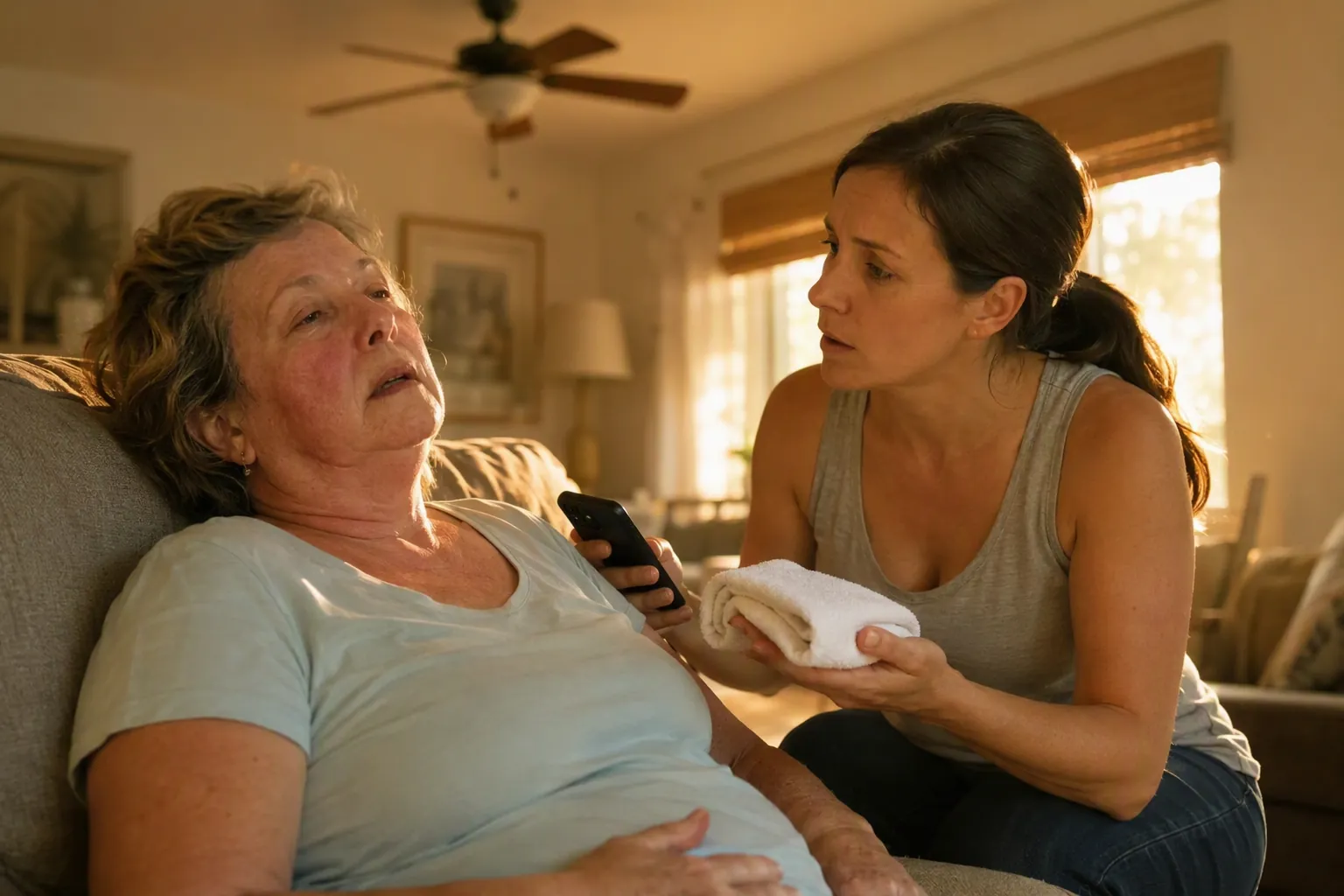
If you are alone, put the phone on speaker. If the person can be moved safely, move them to cooler air while you talk. If they cannot stand or they are too confused to follow directions, do not wrestle them across the house. Get the 911 call started, open the way for responders, and cool them where they are as much as you safely can.
The first five minutes: call, move, cool, keep cooling
Heat stroke is not a problem to “watch for a while” once mental status changes. Body temperature can climb to 106°F or higher within 10 to 15 minutes after heat stroke begins, and delay can be fatal. [3]
- Call 911 immediately for confusion, agitation, slurred speech, delirium, seizure, collapse, or unconsciousness in the heat. Do this before trying drinks, fever reducers, or a wait-and-see plan. [1][2]
- Move the person out of the heat if you can do it safely: into air conditioning, into shade, or into the coolest available room. [1][3][4]
- Remove excess clothing, blankets, heavy socks, hats, or anything trapping heat. [1][3][4]
- Cool the skin right away with cold wet towels, cold water, or wrapped ice packs. Focus on the head, neck, armpits, and groin. A cool bath or shower can help if it can be done safely and without delaying emergency care. [1][3][4]
- Keep cooling until EMS takes over. Re-wet towels, replace warmed ice packs, and keep the person in the coolest reachable place.
This is emergency first aid while professionals are coming. Heat stroke can damage the brain, heart, kidneys, and muscles; EMS and the emergency department are not optional once the warning signs are present. [1]
Why confusion matters more than the number on the thermometer
A dangerously high temperature matters, but it is a bad gatekeeper for a frightened family member. You may not have a thermometer. The person may not cooperate with taking a temperature. The reading may be delayed, and the change in behavior may already be obvious.
Medical sources describe heat stroke as a high body temperature with changes in the central nervous system, including confusion, agitation, slurred speech, delirium, seizures, or coma. Mayo Clinic and Cleveland Clinic use 104°F as the major heat stroke temperature level, while the National Weather Service describes heat stroke with body temperature at or above 103°F. Treat 103°F to 104°F as a danger range, not as a number you must prove before calling. [1][2][5]
Skin clues can help, but they can also mislead. Classic, nonexertional heat stroke, the type more often seen in adults over 65 during hot weather, may come with hot, dry skin. But sweating does not make heat stroke safe to ignore, especially if the person is confused or not acting like themselves. [1][2]
Call 911 now if an older adult in the heat has any of these
- New confusion, strange answers, or inability to hold a normal conversation
- Agitation, combativeness, or sudden personality change
- Slurred speech, delirium, fainting, collapse, seizure, or unconsciousness
- Very hot skin, especially with a temperature around 103°F to 104°F or higher
- Severe weakness with heat exposure plus any change in thinking or behavior
Weakness alone can have many causes. Weakness plus confusion on a hot day is different. That is the moment to stop debating whether the person is “just tired.”
What to tell the 911 dispatcher
Keep it plain. The dispatcher does not need a polished medical story. They need the facts that change the urgency and help responders find you.
- The exact address, apartment number, gate code, or easiest entrance
- The person’s age
- The mental-status change: confused, slurring words, agitated, delirious, seizure, unconscious, or not making sense
- The heat exposure: hot room, no air conditioning, outdoor heat, or recent time in a hot car or sun
- Temperature if you already know it, without delaying the call to get it
- What cooling you have started: moved to air conditioning or shade, removed clothing, cold towels, ice packs, cool water, or cool bath
If the person worsens while you are on the phone, say so immediately. “She was answering me two minutes ago and now she is not” is useful information.
Cooling steps that are worth doing right away

The first cooling decision is location. Air conditioning is best if it is nearby. If the person is outside, shade is better than sun. If the bedroom is hotter than the hallway or the first floor is cooler than the second, choose the cooler place only if moving them is safe. Do not drag a confused or faint person into a bathtub alone if that creates a second emergency.
Once they are in the coolest safe place, strip away heat traps: sweater, robe, shoes, socks, hat, extra bedding. Then cool the skin. Cold wet towels are often the fastest household tool. Place them at the head and neck and over the armpits and groin, where large blood vessels are close to the skin. Wrapped ice packs can be used in the same places. Cold water on the skin also helps. These are standard first-aid cooling measures while emergency help is coming. [1][3][4]
A cool bath or shower may be useful, but only when it can be done safely. A fully alert person who can sit and follow directions is different from a delirious parent who may slide under the water, fight the move, or collapse. If the bath is not safe, keep cooling with towels, water, and wrapped ice packs where the person is.
Cooling is not a one-time towel. Towels warm up. Ice packs soften. Skin dries. Keep going until EMS arrives and takes over.
The well-meant things to skip
Caregivers reach for familiar tools because they are trying to help. In heat stroke, some familiar tools are the wrong ones.
Do not give fluids by mouth
Water sounds sensible on a hot day. But if someone is confused, drowsy, seizing, or not fully able to swallow, fluids can go into the airway. Cleveland Clinic warns not to give anything to drink to a person with heat stroke because of aspiration risk. [2]
If EMS or a clinician later decides fluids are needed, they can give them in a safer, controlled way. Your job before they arrive is cooling and airway safety, not forcing drinks.
Do not use acetaminophen or other fever reducers as the fix
Heat stroke is not the same as a fever from infection. Fever reducers do not correct the heat emergency, and Cleveland Clinic notes that acetaminophen can worsen complications related to heat stroke. NOAA also tells people not to give fever-reducing medicine for suspected heat stroke. [2][6]
If you already gave a dose before realizing how serious this was, tell the dispatcher and EMS. Do not give more.
Do not let a fan be the whole plan in very high heat
A fan may feel helpful, especially with damp towels, but it should not be the only cooling plan when the room is extremely hot. NOAA warns that electric fans may provide comfort but will not prevent heat-related illness when the heat index is in the high 90s. The American Red Cross emphasizes getting to air conditioning or a cooler location during extreme heat. [6][7]
If air conditioning is not available at home, tell the dispatcher. If a neighbor, lobby, car with working AC, cooling center, or nearby public building is safely reachable, the dispatcher can help you think through what makes sense while responders are coming.
Why older adults can be in danger before anyone feels certain
Adults 65 and older are at higher risk during heat because their bodies may not adjust to sudden temperature changes as well, and chronic medical conditions or some medicines can make heat harder to handle. [8]
That risk shows up in public health data, too. USAFacts, citing CDC data, reported 1,600 heat-related deaths in the United States in 2021 and 1,714 provisional deaths in 2022. WHO reports that heat-related mortality among people older than 65 rose by about 85% when comparing 2000–2004 with 2017–2021. [9][10]
Those numbers are not there to make every warm day terrifying. They are a reminder that the dangerous moment may look ordinary at first: a parent sitting in a hot room, too weak to get up, answering strangely, or suddenly angry and disoriented.
After EMS arrives
Tell responders exactly what you saw and what you did: confusion, slurred speech, seizure, collapse, temperature if known, how long the person was in the heat if you know, and which cooling steps you started. Mention medical conditions, medications, and whether any fever reducer or fluids were given.
From there, clinicians take over cooling, monitoring, and treatment because heat stroke can injure organs and needs emergency medical care. Recovery is not something to judge by whether the person “seems better” after a few towels. The emergency still needs evaluation. [1][2]
Make the rule visible before the next hot day
If an older adult lives alone or spends time in a home without reliable air conditioning, write the emergency rule where people will see it: confusion, agitation, slurred speech, delirium, seizure, or unconsciousness in the heat means call 911 first.
For planning before the next dangerous forecast, use a practical heat-day plan such as the Heat and Wildfire Smoke Safety Checklist for Seniors and the Go/No-Go Outdoor Safety Tips for Seniors in Bad Weather. If thinking or behavior changes in the heat, call 911 first and cool continuously while waiting.
References
- Heat stroke - Symptoms and causes — Mayo Clinic
- Heatstroke — Cleveland Clinic
- Heat-related Illnesses — CDC NIOSH
- Heat exhaustion and heatstroke — NHS
- Heat Illness — National Weather Service
- Heat exhaustion or heat stroke? Know the signs of heat illness — NOAA
- Extreme Heat Safety — American Red Cross
- Heat and Older Adults Aged 65+ — CDC
- How many people die from extreme heat in the US? — USAFacts
- Climate change and health — World Health Organization
Related reading
Noticed something outdated or inaccurate on this page? Flag a correction. We review every report against CDC, NIA, and AARP HomeFit guidance before updating a page.
Part of the Fall Prevention section.