
STEADI: Intervene
Go/No-Go Outdoor Safety Tips for Seniors in Bad Weather
Per-condition go/no-go rules that help older adults judge whether an outing is wise on ice, snow, rain, heat, or storm days — concrete thresholds that replace generic warnings, with safer-walking technique when the trip is worth it. Family caregivers get a defensible framework for advising a parent on a hazardous-weather day.
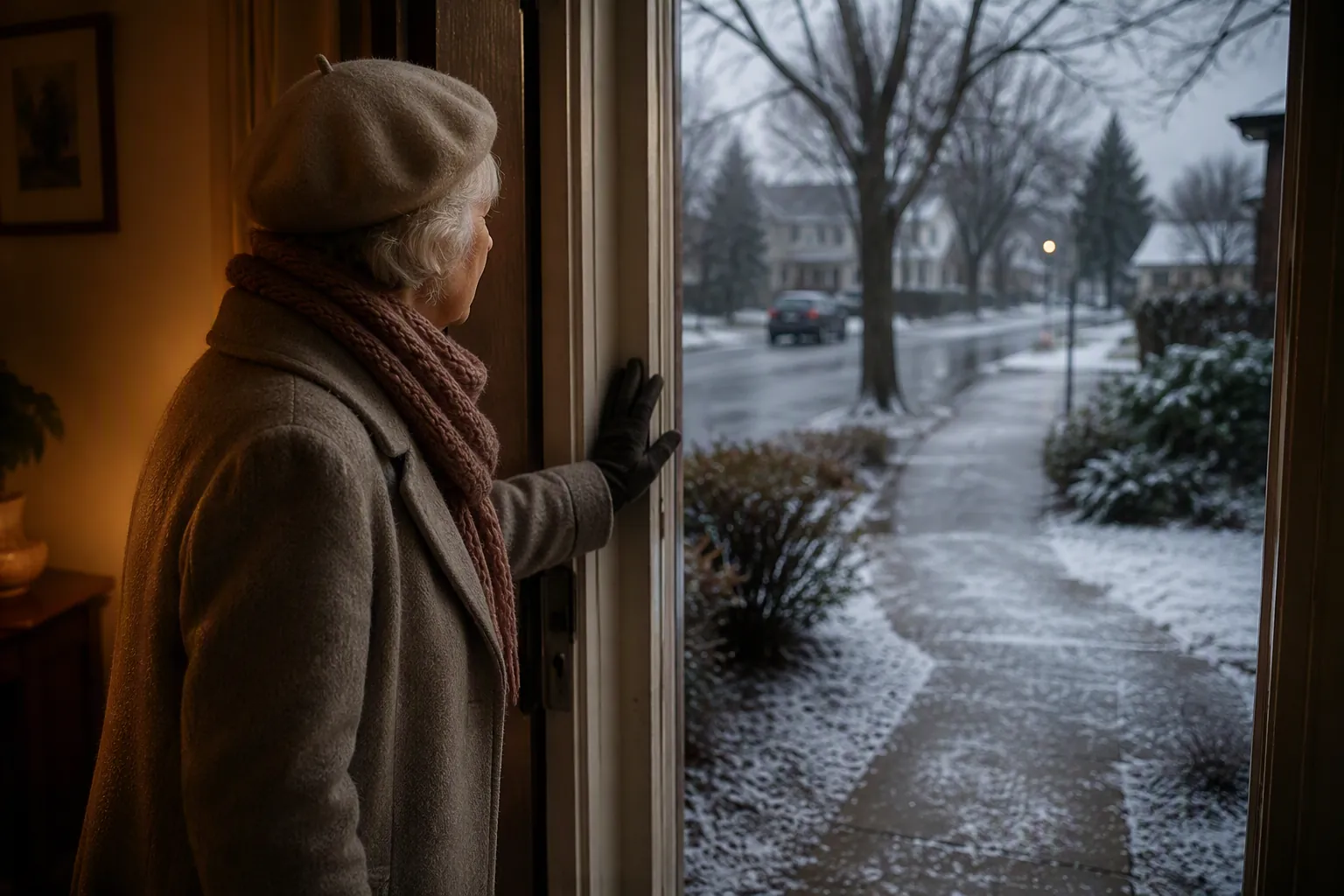
The hard part is not knowing that bad weather can be risky. The hard part is deciding what to do at 8:20 a.m., coat already on, when the sidewalk is shiny, the pharmacy opens at 9, and someone in the family is saying, “Please don’t go out today.”
Bad-weather safety advice for older adults should not sound like a permanent ban on errands, walking groups, gardening, bus rides, or mailbox trips. The better question is narrower: is this specific outing, under today’s condition, worth the risk — and if it is, what has to change before stepping outside?
This guide is educational, not medical advice. A clinician, pharmacist, physical therapist, or local emergency service may give stricter instructions for a particular person, especially after a recent fall, fainting spell, surgery, medication change, or heat illness.
The 60-second go/no-go check
Before separating snow from heat from storms, run the same short check every time. It keeps the decision from becoming a family argument about “being careful” and turns it into a small safety inspection.
| Question | Go | Cautious-go | No-go |
|---|---|---|---|
| How necessary is the outing? | Routine walk, flexible errand, social visit that can move indoors. | Needed errand, but time and route can change. | Non-urgent outing during a known hazard; use delivery, phone call, ride, or indoor substitute. |
| What is the weather hazard right now? | Clear surface, mild temperature, good visibility. | Wet pavement, light snow, heat, cold, or wind that can be managed with changes. | Freezing-rain watch, more than 1 inch of snow on walking surfaces, thunderstorm/high-wind danger, extreme heat symptoms, visible ice on the route. |
| How is the person today? | Steady, alert, usual medications, no new dizziness or weakness. | Tired, using a cane/walker, vision limited, medication may affect heat/cold tolerance, or balance feels “off.” | Recent fall, fainting, confusion, chest pain, severe shortness of breath, heat-stroke signs, or inability to use the mobility aid safely. |
| What is the safer alternative? | Go as planned. | Change time, route, footwear, support, transportation, or destination. | Replace the outing with indoor strength/balance movement, a ride, delivery, or a caregiver check-in. |
The reason to be this deliberate is simple: falls are common and costly for older adults. CDC reports that about 1 in 4 older adults falls each year — more than 14 million people — and identifies falls as the leading cause of injury for adults 65 and older in the United States.[1] Outdoor weather decisions belong inside fall prevention, not off to the side as “seasonal tips.” For more on routine route hazards even in good weather, see neighborhood safety tips for older adults.
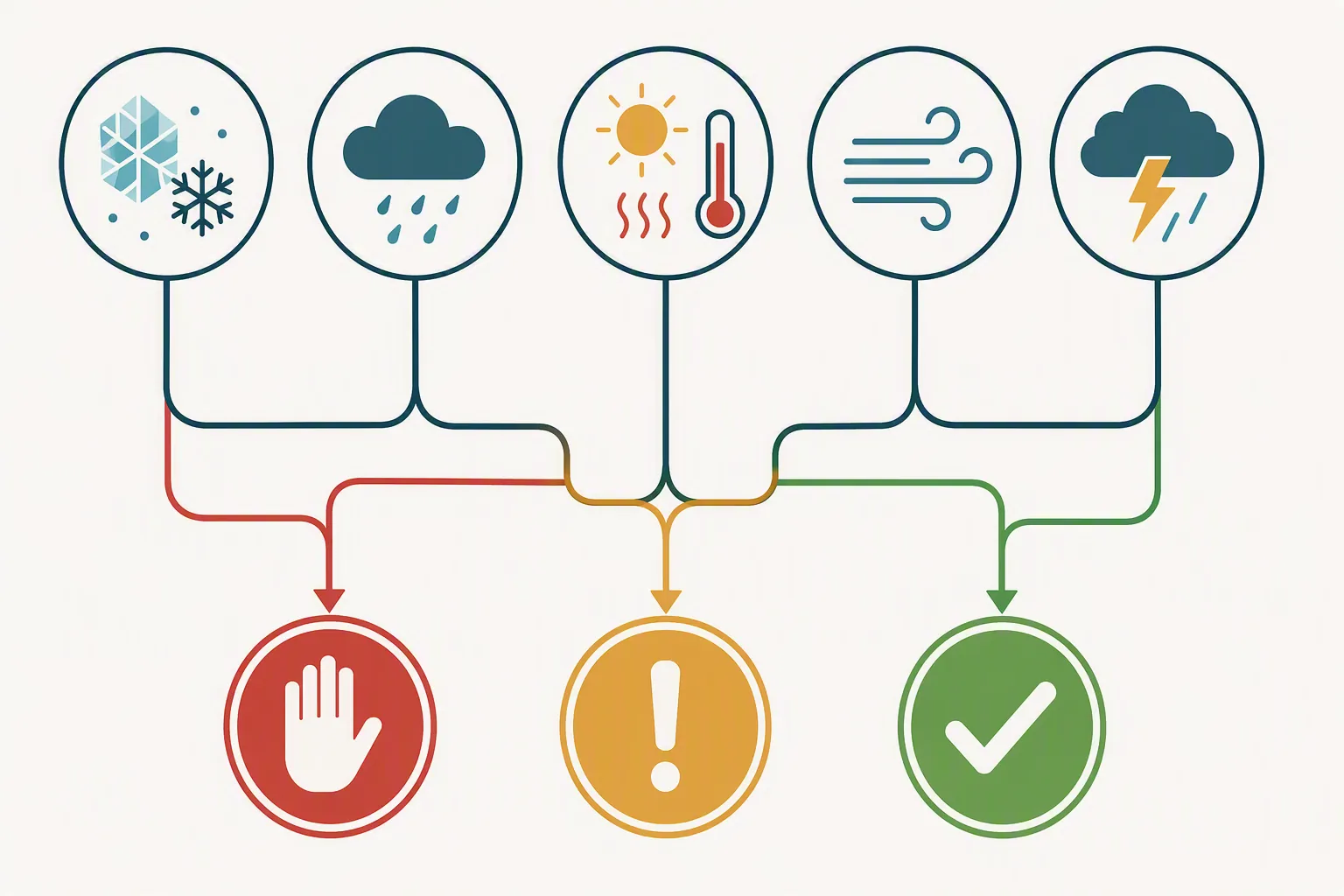
Ice and snow: let the surface make the decision
Ice is not just “winter weather.” It is a surface hazard that removes the tiny corrections the body normally makes with each step. A peer-reviewed Calgary emergency department study of ice- and snow-related slip-and-fall visits found that more than half occurred from January through March across 11 years, and same-day ice was the strongest single weather predictor in that setting.[2] That is Canadian emergency department data, not a U.S. national burden estimate, but it gives a useful practical lesson: when ice is present today, treat it as a decision trigger, not as scenery.
No-go triggers for snow and ice
- Freezing-rain watch or freezing rain already falling. Do not walk for routine errands; reschedule, request delivery, or get a ride door-to-door.
- More than 1 inch of snow on walking surfaces. Ohio Department of Aging’s seasonal fall-prevention guidance uses this as an avoid-walking threshold.[3]
- Visible ice, refrozen slush, black-ice conditions, or a route that has not been salted, sanded, shoveled, or inspected.
- The outing requires carrying bags, a purse in one hand, trash, laundry, or a package. Hands need to be free for balance.
- A cane tip is worn smooth, a walker has unstable tips, shoes have poor tread, or the person cannot place the mobility aid flat and steady on the surface.
- The person has had a recent fall, feels lightheaded, is unusually weak, or is rushing to make an appointment.
The “rushing” part deserves respect. Many winter falls start before the front step: someone sees the bus coming, worries about being late, or tries to carry one more thing. If the trip matters, change the transportation or timing rather than asking an older adult to hurry across a bad surface.
Cautious-go checks when the route is mostly clear
A winter walk is more defensible when the route has been checked, the destination is flexible, and the person can turn back without embarrassment. If the sidewalk is shoveled but damp, assume the curb cuts, driveway aprons, and shaded patches may be worse than the main stretch.
- Replace worn cane tips before ice season and after obvious wear; HealthinAging’s winter safety guidance specifically calls out cane-tip replacement for winter safety.[4]
- Consider removable ice grippers for icy conditions, but do not wear them indoors on smooth floors unless the product is meant for that use; NCOA’s winter fall-prevention guidance discusses ice-gripper use and winterizing mobility equipment.[5]
- Keep both hands free. Use a backpack, crossbody bag, delivery cart only if the surface is safe, or ask someone else to carry items.
- Tell someone the route and expected return time, carry a charged phone, and carry a small amount of traction grit when appropriate; Ohio Department of Aging includes route-sharing, phone-carrying, hands-free walking, and traction material among seasonal fall-prevention practices.[3]
- Use the safest entrance, not necessarily the closest one. A longer route on cleared pavement beats a short route across packed snow.
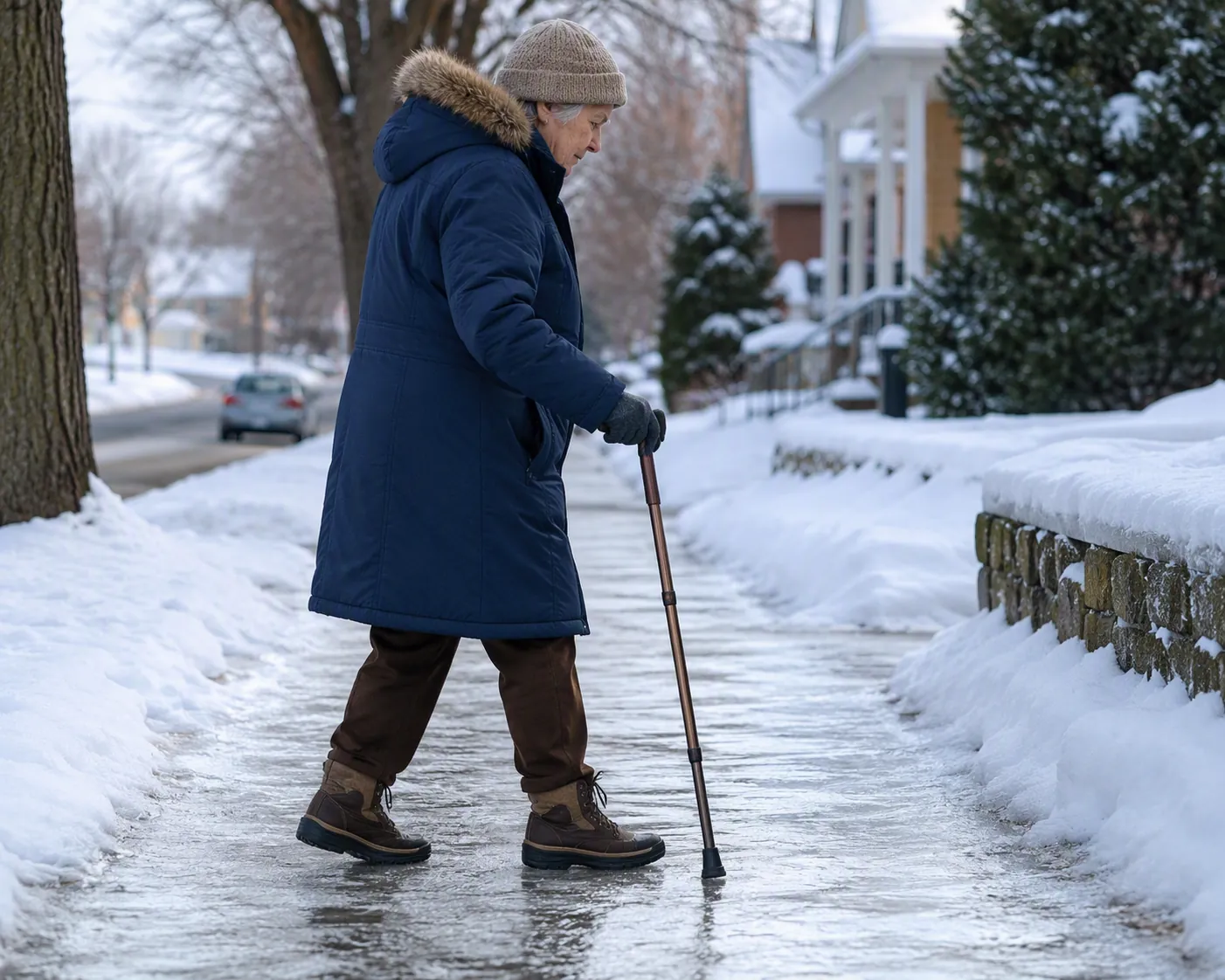
How to walk if an icy patch cannot be avoided
The “penguin walk” is not cute advice; it changes the mechanics of the step. PreventFalls.ca’s winter walking guidance recommends short steps, feet pointed slightly outward, knees loose, and arms free for balance.[6] The goal is to keep the body’s weight over the feet instead of taking a long heel-first stride that can shoot forward on ice.
- Stop before the questionable patch. Do not decide mid-stride.
- Point feet slightly outward and take very short, flat-footed steps.
- Keep the knees soft and the body slightly forward, with weight over the feet.
- Keep hands out of pockets and bags off the hands.
- If using a cane, place it carefully and vertically; do not reach far ahead with it.
A useful caregiver sentence is: “I’m not saying don’t go out all winter. I’m saying today has ice, and ice changes the decision. Let’s get the prescription another way and do the walk inside.” That lands better than “You’ll fall,” because it names the hazard and offers a substitute.
Rain and mud: watch the transition points
Rainy days look less dramatic than icy ones, but the fall often happens at the seam: porch to step, curb to crosswalk, parking lot to store entrance, wet shoe to tile floor. Ohio Department of Aging specifically flags wet shoes as a seasonal fall hazard.[3]
No-go triggers for rain or mud
- Standing water hides curb edges, potholes, uneven pavement, or storm-drain gaps.
- Mud, wet leaves, algae, or loose gravel sits on a slope, ramp, driveway, or garden path.
- Rain is heavy enough to reduce visibility or force the person to look down constantly.
- The outing requires an umbrella plus a cane or walker. A hand-held umbrella can steal the hand needed for balance.
- Shoes are smooth-soled, loose, backless, or already wet inside.
Cautious-go on a wet day means shrinking the route and improving the hand situation. Use a hooded rain jacket instead of an umbrella when balance is a concern. Step onto curbs squarely rather than at an angle. Pause just inside the destination to wipe shoe soles before crossing tile, polished concrete, or store mats that may bunch underfoot.
Gardeners need their own rule: if the ground is soft enough that a foot sinks or twists, postpone the outdoor task. A weed can wait. A turned ankle may take over the week.
Heat: check the forecast tools before symptoms start
Heat is harder to judge from the doorway than snow. The sidewalk may look dry and safe while the body is already working harder to cool itself. In a CDC MMWR analysis of U.S. heat-related deaths from 2004 through 2018, adults 65 and older accounted for about 40% of decedents with known age — 4,019 of 10,470 — and had the highest heat-related death rate, 0.7 per 100,000.[7] Those figures describe that 2004–2018 period, not a current-year rate, but they are enough to justify checking heat before planning outdoor activity.
CDC’s heat guidance for adults 65 and older recommends checking both HeatRisk and air quality before outdoor activity, drinking before feeling thirsty unless a clinician has restricted fluids, and not relying on a fan as the main cooling method during high heat.[8] That turns “It’s hot, be careful” into a practical first step: look up the day’s heat risk and air quality before choosing the walk time.
No-go triggers for heat
- HeatRisk or local heat alerts show dangerous conditions for older adults, especially during the afternoon.
- Air quality is poor, wildfire smoke is present, or the person has breathing or heart symptoms.
- There is no reliable cool place to rest at the destination or on the route.
- The person has vomiting, confusion, fainting, unusual weakness, a severe headache, or hot skin.
- Body temperature reaches 103°F or higher, or heat stroke is suspected. Treat that as an emergency and call 911; Harvard Health and California Department of Aging both distinguish heat stroke from milder heat illness as an emergency condition.[9][10]
Medication review matters in heat planning. Harvard Health and California Department of Aging both note that medications such as diuretics, beta-blockers, calcium-channel blockers, some antipsychotics or antidepressants, and antihistamines can affect hydration, sweating, circulation, or heat regulation.[9][10] The answer is not to stop medicine on a hot day. The answer is to ask the prescriber or pharmacist ahead of the season what heat rules should apply.
For a deeper look at how heat can lead to dizziness, weakness, poor judgment, and falls, use the extreme heat fall-risk chain. If a heat dome is forecast and an older parent lives alone, the 72-hour heat-dome plan is the better tool than a one-time reminder.
Cautious-go rules for hot days
- Move the outing to the coolest practical time of day.
- Shorten the route and identify indoor cooling stops before leaving.
- Carry water, but follow clinician instructions if fluids are restricted.
- Do not use “I’m not thirsty” as proof of safety; CDC advises drinking before thirst in older adults unless medically restricted.[8]
- Pair HeatRisk with AQI when smoke or pollution is part of the day. The heat and wildfire smoke safety checklist can help families combine those two decisions.
- Set a return time before leaving. Heat decisions get worse when fatigue arrives.
Caregivers can keep the tone practical: “Let’s check HeatRisk and air quality first, then decide whether this is a morning walk, a ride, or an indoor exercise day.” That is very different from “You can’t handle the heat.”
Cold and wind: the risk is exposure plus delay
Cold-weather decisions are not only about the thermometer. Wind, damp clothing, a delayed bus, a locked entrance, or a longer-than-expected walk across a parking lot can turn a manageable errand into an exposure problem. Older adults who move slowly, use mobility aids, or have circulation problems may have fewer easy ways to “just hurry inside.”
No-go triggers for cold and wind
- High wind makes standing, opening doors, using a walker, or crossing an exposed parking lot unstable.
- The person must wait outside for transportation without a guaranteed shelter.
- Clothing or shoes are wet, or the route includes puddles, slush, or snowbanks.
- The person is confused, unusually sleepy, very weak, or not able to describe how cold they feel.
- The outing depends on carrying heavy items while bracing against wind.
Cautious-go on a cold, windy day means planning the waiting points. A door-to-door ride may be safer than a bus trip with an exposed stop. If public transportation is still the best option, use the same route-and-return rule, carry a charged phone, and build in time so no one has to rush over icy curb cuts. For routine transit safety beyond weather, see bus safety tips for older adults.
Storms, lightning, and power outages: do not bargain with the warning
Storm days tempt people to “beat it” by leaving quickly. That is usually the wrong instinct for older adults, because storm hazards change faster than walking speed: wind gusts, falling branches, slick steps, street flooding, low visibility, and power loss can appear between leaving home and trying to return.
- No-go: thunder or lightning nearby, tornado warning, severe storm warning, high-wind warning, flash flooding, downed branches or wires, or an outage that affects elevators, lighting, medical equipment, phones, or garage doors.
- Cautious-go: the warning has passed, daylight is good, the route has been checked, and the errand cannot reasonably wait.
- After the storm: treat cleanup as a separate fall risk. Wet leaves, extension cords, debris, ladders, and unfamiliar footing cause trouble even after the sky clears.
Families who live in tornado or severe-storm regions should set the shelter plan before the season, not during the siren. Start with a tornado safety plan for seniors, and pair it with a power-outage safety checklist if elevators, refrigeration, oxygen equipment, or home lighting are part of the risk.
Once the weather clears, do not treat the yard or sidewalk as automatically safe. Use post-storm cleanup fall-safety guidance or storm-damage safety steps for seniors before picking up branches, moving wet objects, or walking around damaged areas.
If the trip cannot wait
Some outings are not optional. Medical appointments, essential prescriptions, food, pet care, and urgent family needs may still have to happen. The decision then shifts from “Should I go?” to “What part of this trip can be made safer or removed?”
- Change the method first. Ask for delivery, curbside pickup, a pharmacy transfer, a telehealth appointment, or a ride that gets as close to the door as possible.
- Change the time. Ice, heat, storms, and traffic all vary by hour. A later cleared sidewalk or earlier cool walk may be safer than the original plan.
- Change the route. Pick the path with railings, lighting, shoveled surfaces, benches, open businesses, and fewer crossings.
- Tell someone the exact route and return time, and call when home. This is not permission-seeking; it is a rescue plan if something goes wrong.
- Carry a charged phone, identification, key information, and any urgent medication needed during the outing.
- Keep hands free. If the errand creates bags, arrange help with carrying before leaving.
- Give yourself permission to turn back. A route that looked acceptable from the doorway may fail at the first corner.
The most important hidden rule is to remove speed from the errand. Bad weather plus hurry is a poor bargain.
No-go days need a replacement plan
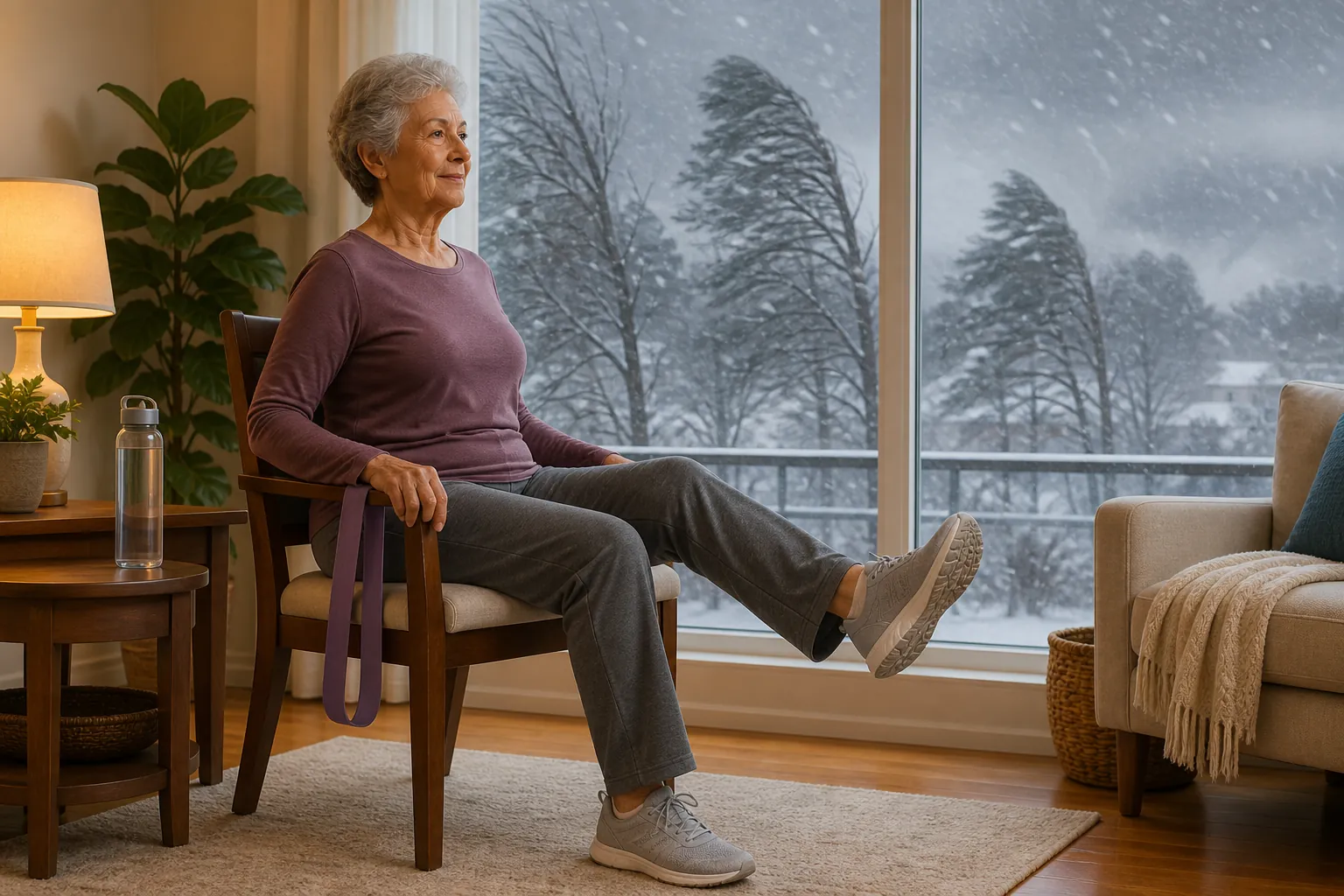
Canceling the outdoor trip should not mean canceling movement. PreventFalls.ca makes the point directly in its winter walking guidance: staying inside because of fear can contribute to deconditioning, which can increase later fall risk; indoor exercise is the safer alternative when outdoor walking is not safe.[6]
That replacement can be modest: seated marching, sit-to-stands from a sturdy chair, heel raises at the kitchen counter, a hallway walk, gentle resistance-band work, or a balance routine approved by a clinician or physical therapist. The useful standard is not whether it feels like a “real walk.” It is whether the no-go day still protects leg strength, confidence, and tomorrow’s mobility.
For structured indoor options, use posture exercises for senior balance or senior workout videos for strength and balance. If a fall has already happened, do not treat the next bad-weather decision as the only issue. Use the post-fall crisis path on the site and consider a STEADI-style fall-risk screening conversation with a healthcare professional.
A no-go day is not a loss of independence. It is a choice to spend the risk budget carefully: skip the ice, heat, wind, or storm today, keep moving indoors, and protect the ability to go out on the next safer day.
References
- Older Adult Fall Prevention: Data and Statistics, Centers for Disease Control and Prevention. Last verified Aug. 4, 2026.
- A Slip and Fall Index for Winter Sidewalk Safety, PMC. Last verified Aug. 4, 2026.
- Falls Prevention in Every Season, Ohio Department of Aging. Last verified Aug. 4, 2026.
- Tip Sheet: Winter Safety for Older Adults, HealthinAging.org. Last verified Aug. 4, 2026.
- Winterize to Prevent Falls, National Council on Aging. Last verified Aug. 4, 2026.
- Walk Safely All Year, PreventFalls.ca. Last verified Aug. 4, 2026.
- Heat-Related Deaths — United States, 2004–2018, Centers for Disease Control and Prevention, June 19, 2020. Last verified Aug. 4, 2026.
- Heat and Older Adults (Aged 65+), Centers for Disease Control and Prevention. Last verified Aug. 4, 2026.
- Extreme heat endangers older adults: What to know and do, Harvard Health Publishing, July 16, 2025. Last verified Aug. 4, 2026.
- Extreme Heat Safety for Older Adults, California Department of Aging. Last verified Aug. 4, 2026.
Related reading
Noticed something outdated or inaccurate on this page? Flag a correction. We review every report against CDC, NIA, and AARP HomeFit guidance before updating a page.
Part of the Fall Prevention section.