
STEADI: Intervene
In Extreme Heat, Seniors Living Alone Can't Trust Thirst
Many older adults living alone can't rely on thirst or body-heat signals to warn them during extreme heat. This guide replaces guesswork with concrete cues—indoor temperature thresholds, fan limits, timed hydration, urine-color checks, and twice-daily check-ins—that stay in place for up to three days after the heat breaks.
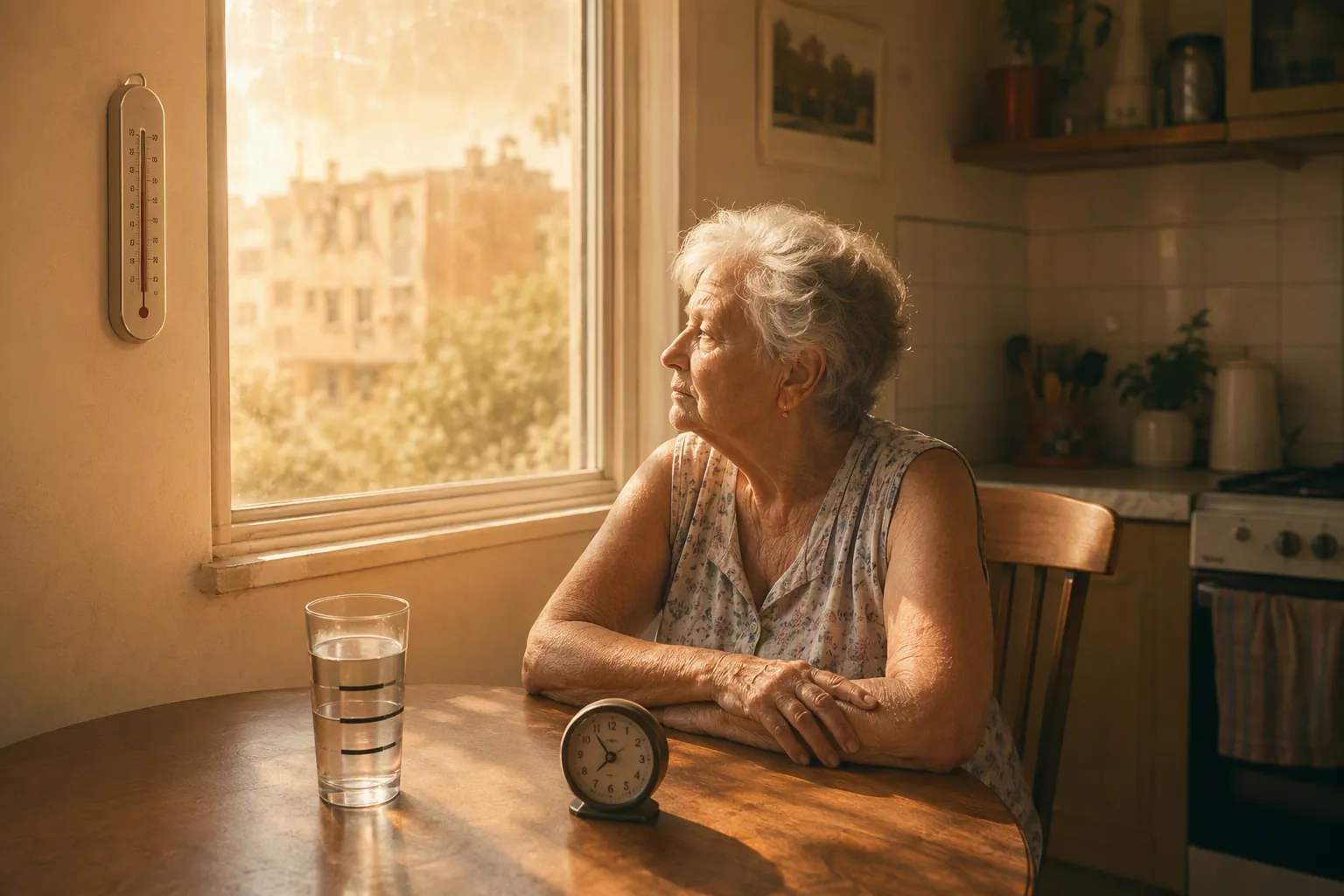
Extreme heat safety tips for seniors living alone have to start with an uncomfortable fact: thirst is a weak alarm. So is the feeling of being “too hot.” Aging can make it harder for the body to adjust to heat, and older adults are more likely to have chronic conditions or medicines that complicate heat exposure.[1] A person can sit at a kitchen table, feel basically fine, and still be in a room that is already asking too much of the body.
That is why the safest plan is not “drink when thirsty” or “rest if you feel overheated.” The plan has to leave behind visible cues: a thermometer number, a bottle marked for the day, a urine-color check, a phone alarm, and a person who calls at the same times every day.
This guide is educational home-safety information, not medical advice. Anyone with heart disease, kidney disease, a fluid restriction, diuretics, or recent medication changes should ask a clinician what their personal heat and fluid plan should be before using any general hydration target.
Set up the routine before the next hot day
If an older adult lives alone, the routine should be simple enough to run when they are tired, distracted, or reluctant to make a fuss. Put the cues where the person already spends time: kitchen table, bathroom mirror, refrigerator door, favorite chair.
| Cue | What to do |
|---|---|
| Wall thermometer | Start the heat routine when the home reaches 80°F; do not wait for the person to feel hot. The American Geriatrics Society advises older adults to keep the home cooler than 80°F when possible.[2] |
| Fan rule | Use a fan only as a short-term comfort tool when indoor heat is still low enough. CDC warns that when indoor temperatures are above about 90°F, fan use can increase body temperature.[3] |
| Marked bottle or glass | If fluids are not medically restricted, use clock-based drinking instead of thirst. WHO advises at least 2–3 liters of water per day during hot weather, and the Red Cross gives a similar rough target of about 3/4 gallon per day.[4][5] |
| Bathroom cue | Check urine color during the day. Pale or light-colored urine is a better sign than waiting to feel thirsty; dark urine is a reason to review fluids and cooling, and to call for guidance if it continues.[5] |
| Twice-daily call | Schedule a morning and evening check-in. The caller should ask about water intake, whether cooling is actually being used, and whether there are signs of heat stress.[1] |
| 72-hour calendar mark | Keep the routine going for about three days after the worst heat appears to break. NYC Health Department modeling notes that heat-related deaths can occur up to three days after hot weather.[6] |
The thermometer gets to overrule how the room feels
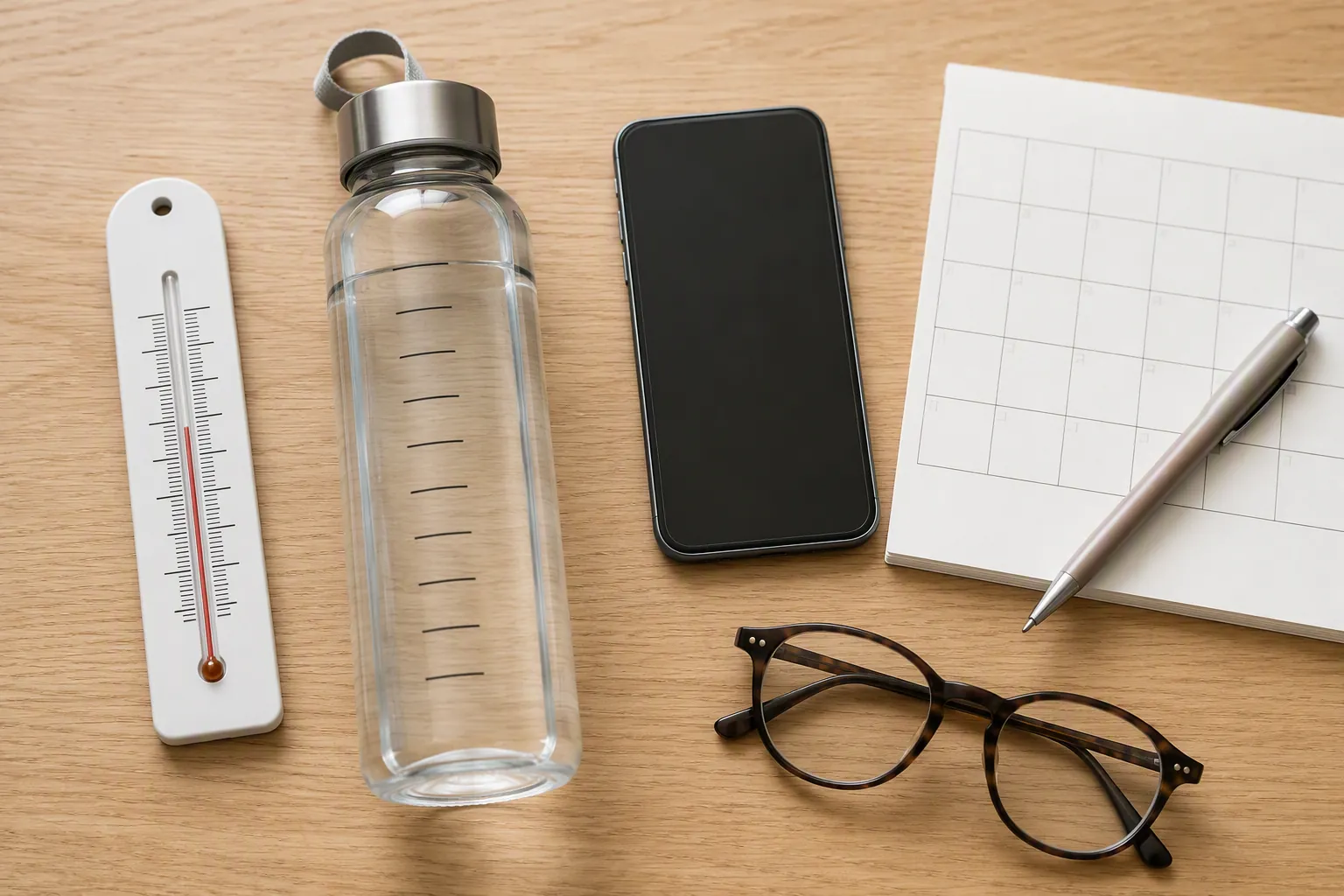
A wall thermometer is not decoration in a heat wave. It is the decision-maker. Put one in the main living area and one in the bedroom if those rooms heat differently. Do not hide it behind curtains, in direct sun, or next to an appliance that gives off heat.
At 80°F indoors, start acting: close sun-facing curtains, turn on air conditioning if available, move to the coolest room, begin timed fluids if medically allowed, and begin the check-in schedule. The 80°F number matters because the American Geriatrics Society tells older adults to keep the home cooler than 80°F when possible during hot weather.[2]
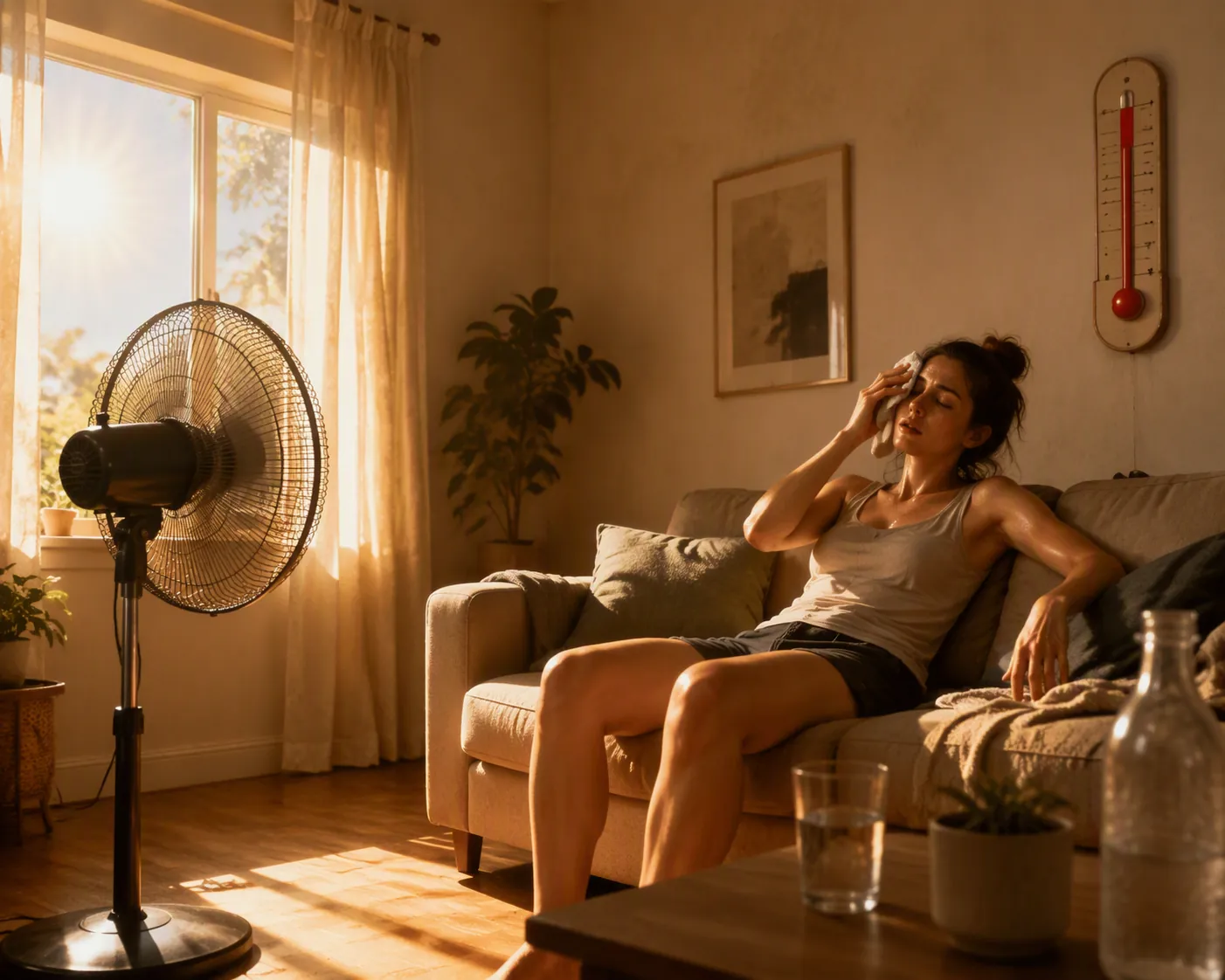
The fan rule needs more care than most heat advice gives it. CDC says fans may provide comfort, but when indoor temperatures are above about 90°F, they can increase body temperature.[3] WHO frames fan use differently, saying fans should be used when temperatures are below 40°C, or 104°F.[4] Those two thresholds do not say the same thing.
For a senior living alone in the United States, the safer practical rule is to treat 90°F indoors as the point where fan-only planning has failed. A fan may move hot air around the room and make the person feel that something is being done, while the body is still gaining heat. If the thermometer is approaching or above that level, the next action is not a stronger fan. It is air conditioning, a cooler room, a cooling center, a library, a mall, a neighbor’s air-conditioned home, or a call for help.
This is also where caregivers need to be careful by phone. “Do you have the fan on?” is not enough. Ask, “What number is on the thermometer right now?” If the answer is high, the plan has to move from comfort to cooling.
Hydration should run by the clock, with medical limits respected
Thirst is allowed to be information, but it should not be the trigger. In hot weather, the trigger is the clock. A simple version is to place a marked bottle or pitcher on the counter in the morning and divide the day into visible portions: morning, midday, afternoon, evening.
General heat guidance gives similar daily fluid amounts, but those numbers are not safe for everyone. WHO advises at least 2–3 liters of water per day during hot weather, while the Red Cross advises drinking plenty of fluids and gives a rough amount of about 3/4 gallon per day.[4][5] For an older adult with heart failure, kidney disease, a fluid restriction, diuretics, or a clinician’s instruction to limit fluids, those general targets must be checked with a clinician.
A workable home setup does not need to be fancy:
- Write the day’s safe fluid amount on tape and place it on the bottle or pitcher.
- Set phone alarms for small drinks at regular times instead of asking the person to drink a large amount at once.
- Keep water within reach of the main chair, bed, and bathroom path.
- Use the same cup each time so the person does not have to estimate.
- Add a bathroom reminder: “Check urine color.”
Urine color is a plain cue that many people can use without calculating ounces. The Red Cross advises that pale or clear urine generally indicates adequate fluids, while dark urine can be a sign to drink more water.[5] If urine stays dark, the person feels weak, becomes confused, stops urinating normally, or cannot keep fluids down, it is time to call for medical guidance rather than simply pushing more water.
Alcohol should not be part of the cooling plan. It can worsen dehydration and judgment. Very sugary drinks are not a substitute for a daily fluid plan either. The point is not to make hydration complicated; it is to remove the need for the person to notice thirst before acting.
A senior living alone needs a cooling place, not just cooling tips
The hardest part of extreme heat safety is not telling someone to “stay cool.” It is deciding where they will go when the apartment is not cool enough. That decision has to be made before the thermometer is already in the danger range.
NYC’s 2026 Heat Mortality Report is city-specific, so it should not be stretched into a national estimate. But it is still a useful warning for home planning: the report estimates about 500 heat deaths per year in New York City, found that 48% of heat-stress deaths occurred at home, and reported that among at-home decedents with air-conditioning information, none were using air conditioning.[6] The lesson is blunt. A plan that stops at “use a fan” or “you have AC somewhere” does not prove the person is actually cooled.
Before the next heat advisory, write down two cooling destinations. One should be the best option. The second should be the backup if the first is closed, unreachable, too crowded, or the person feels too weak to travel alone.
- A cooling center listed by the state, city, county, or emergency management office.
- A public library, senior center, community center, indoor mall, or other air-conditioned public place that is known to be open during the hottest part of the day.
- A neighbor’s, relative’s, or friend’s air-conditioned home, with permission arranged in advance.
- A clinic, faith community, or local aging-services program that can help coordinate transportation or welfare checks.
For state-by-state cooling-center starting points, the National Center for Healthy Housing maintains a cooling-center resource list.[7] Some local governments also publish heat-help pages with practical supports; Multnomah County, Oregon, for example, directs residents to cooling spaces, transportation help, and local heat resources.[8] In many communities, calling 2-1-1 is the fastest way to ask about cooling centers, rides, shelter, utility assistance, or local heat-response programs.
If the barrier is cost, ask about utility assistance before the bill becomes the reason the AC stays off. The American Geriatrics Society points older adults to the federal Low Income Home Energy Assistance Program help line at 1-866-674-6327 for help with air-conditioning or utility costs.[2] For a longer look at energy and weatherization support, see CareWise Guide’s discussion of utility-assistance planning for aging in place.
Transportation needs the same advance work. A cooling center that requires a long walk in full sun may be the wrong choice for a person who already feels weak. Put the route, ride number, paratransit option, neighbor contact, or taxi plan on paper. If the person uses a walker, oxygen, incontinence supplies, hearing aids, or refrigerated medicine, the cooling-place bag should be packed before the heat arrives.
Twice-daily check-ins should ask for proof, not reassurance
A good heat check-in is not a social call with one anxious question at the end. It is a short, predictable safety routine. CDC’s older-adult heat guidance tells caregivers to check on older adults at least twice a day and ask about water intake, access to air conditioning, and signs of heat stress.[1]
The best times are usually morning and late afternoon or evening. Morning catches the plan before the home heats up. Late afternoon catches the part of the day when rooms, walls, and sidewalks may still be holding heat even if the person says the weather report looks better.
| Ask this | Why it works better than “Are you okay?” |
|---|---|
| What number is on the thermometer right now? | It replaces a feeling with a room condition. |
| Is the AC on, or are you in an air-conditioned place? | It checks whether cooling is actually happening. |
| How much of the marked bottle is gone? | It turns hydration into something visible. |
| What color was your urine the last time you went? | It gives a practical dehydration cue without waiting for thirst. |
| When is your next planned cool-place visit if the room keeps heating up? | It prevents the person from improvising after they are already tired. |
| Any confusion, faintness, vomiting, chest pain, severe weakness, or trouble waking up? | It identifies the safety boundary where ordinary check-ins are no longer enough. |
If the older adult tends to minimize symptoms, ask for actions instead of opinions. “Read me the thermometer.” “Put the phone near the water bottle and tell me where the fill line is.” “Are you sitting in the room with AC, or is it off because you are saving money?” These questions can feel a little nosy. During extreme heat, they are kinder than asking a person to judge their own danger.
For older adults who live fully alone, add a missed-call rule. If they do not answer the morning or evening check-in, the caller should know exactly who tries next: neighbor, building manager, nearby relative, local aging-services contact, or emergency services if there is a serious concern. Do not invent this chain during the heat event.
Keep medication questions brief, but do not ignore them
Heat planning should include a medication review, but this page is not the place for a drug-by-drug table. The practical rule is simpler: do not stop prescriptions abruptly, do not change diuretics or blood-pressure medicine on your own, and ask the clinician or pharmacist whether hot weather changes the person’s fluid plan, dizziness risk, or storage instructions.
If the main concern is how heat, dehydration, medicines, dizziness, blood-pressure changes, and falls connect, use CareWise Guide’s separate fall-focused guide: Keep Seniors Safe in a Heat Wave by Preventing Falls. This article stays with the home routine because the first failure is often the warning system: the person does not feel thirsty or hot enough to act.
Know the point where the routine stops and emergency help starts
A home routine is for prevention and early correction. It is not a way to monitor a person through a medical emergency. Call 911 if the person is confused, faints, cannot be awakened normally, has a seizure, has hot skin with worsening symptoms, has chest pain, has severe trouble breathing, or is getting worse despite cooling steps. The Red Cross treats heat stroke as a life-threatening emergency and advises calling 911, moving the person to a cooler place, and using rapid cooling while waiting for help.[5]
Do not ask a senior who may be heat-ill to drive themselves to a cooling center or urgent care. If the person sounds confused, unusually sleepy, or too weak to stand safely, the plan has already moved beyond ordinary heat advice.
Heat can also collide with other hazards. If wildfire smoke is present and the advice to seal the house conflicts with the need to cool it, use CareWise Guide’s heat and wildfire smoke safety checklist. If the question is whether an outing should happen at all on a dangerous weather day, see outdoor safety tips for seniors in bad weather.
The heat plan has to outlast the heat alert
The end of a heat advisory is not a good reason to pull down the cues. Rooms can stay hot, sleep can remain poor, dehydration can lag behind, and the person may be more tired on the day after the worst heat than during it.
NYC Health Department modeling notes that heat-related deaths can occur up to three days after hot weather.[6] That is the reason for the 72-hour calendar mark. Keep the thermometer checks, timed fluids, urine-color cue, cooling-place plan, and twice-daily calls in place for about three days after the weather appears to improve.
For someone living alone, this is the point of the whole setup: safety should not depend on noticing thirst, admitting weakness, or deciding that the room feels too hot. The clock, thermometer, marked bottle, bathroom cue, cooling destination, and check-in schedule can keep working even when the body’s own alarms are quiet.
References
- Heat and Older Adults (Aged 65+) — Centers for Disease Control and Prevention.
- Tip Sheet: Hot Weather Safety Tips for Older Adults — Health in Aging/American Geriatrics Society.
- About Heat and Your Health — Centers for Disease Control and Prevention.
- Heat and health — World Health Organization, July 2026.
- Extreme Heat Safety — American Red Cross.
- 2026 Heat Mortality Report — NYC Health Department.
- Cooling Centers by State — National Center for Healthy Housing.
- Help for When It's Hot — Multnomah County.
Related reading
Noticed something outdated or inaccurate on this page? Flag a correction. We review every report against CDC, NIA, and AARP HomeFit guidance before updating a page.
Part of the Fall Prevention section.