
STEADI: Intervene
How to Help Elderly Parents Evacuate During a Wildfire
Generic emergency checklists aren't built for an older adult's real limits. This guide gives caregivers a four-step wildfire evacuation system — needs profile, plan, go bag, practice — built on Ready.gov, CAL FIRE, Red Cross, and AARP guidance, so leaving early is realistic even with mobility, medication, or sensory limits.
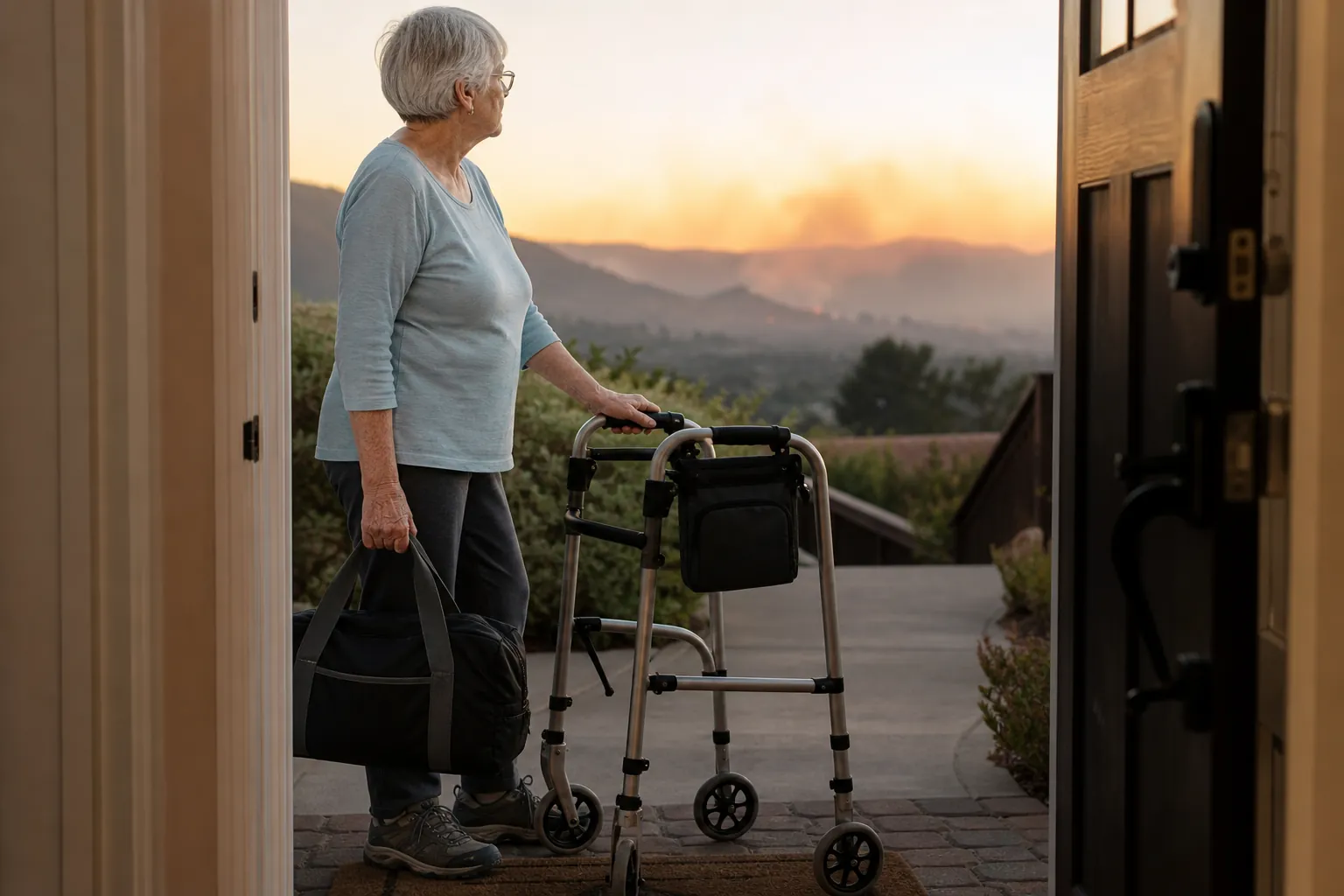
A generic wildfire checklist says, “Grab your go bag.” For an older parent, that sentence may hide half the evacuation: glasses on the nightstand, hearing aids on the bathroom counter, prescriptions in three places, a walker that will not fit in every car, a phone set to silent, oxygen equipment with a supplier no one has called, and a neighbor who is willing to help but does not know the garage code.
That is the real problem behind how to help elderly parents evacuate during a wildfire. The plan cannot be built for a fast, well-rested adult with good vision, good hearing, spare cash, a full tank of gas, and the ability to improvise under smoke and stress. It has to be built for the parent who actually lives in the house.
The stakes are not theoretical. The U.S. Fire Administration reports that from 2014 through 2023, adults 65 and older had 2.5 times the general population’s relative risk of dying in a fire, with a rate of 33.0 deaths per million; for adults 85 and older, the relative risk rose to 3.4 times the general population’s risk [1]. AARP’s 2023 survey found that only 29% of U.S. adults 50 and older had a comprehensive emergency plan, while 36% lacked extra prescription medication and 57% lacked a portable phone charger [2]. After the 2018 Camp Fire, the Los Angeles Times reported that 53 of 69 positively identified bodies at that point were people 65 or older, one example of how sharply wildfire evacuation can punish age, isolation, and delay [3].
This article is for calm-season planning, not for the hour when an evacuation order is already on the phone. It is educational planning support, not medical, legal, financial, or emergency-response advice. If your parent uses oxygen, a CPAP, powered mobility equipment, refrigerated medication, or other prescribed equipment, confirm the evacuation and backup-power details with their clinician, equipment supplier, utility, and local emergency management office.
Start with the parent, not the checklist
Most official wildfire advice is sound. The problem is that families often read it as if every household member can do the same tasks at the same speed. “Use two routes” is good advice. It is not enough if one route has a steep driveway your parent cannot walk down without a handrail. “Bring medications” is good advice. It is not enough if the medication list is in an online portal and the phone dies. “Call a contact” is good advice. It is not enough if your parent cannot hear the alert, cannot read the small print, or cannot remember which number to call when frightened.
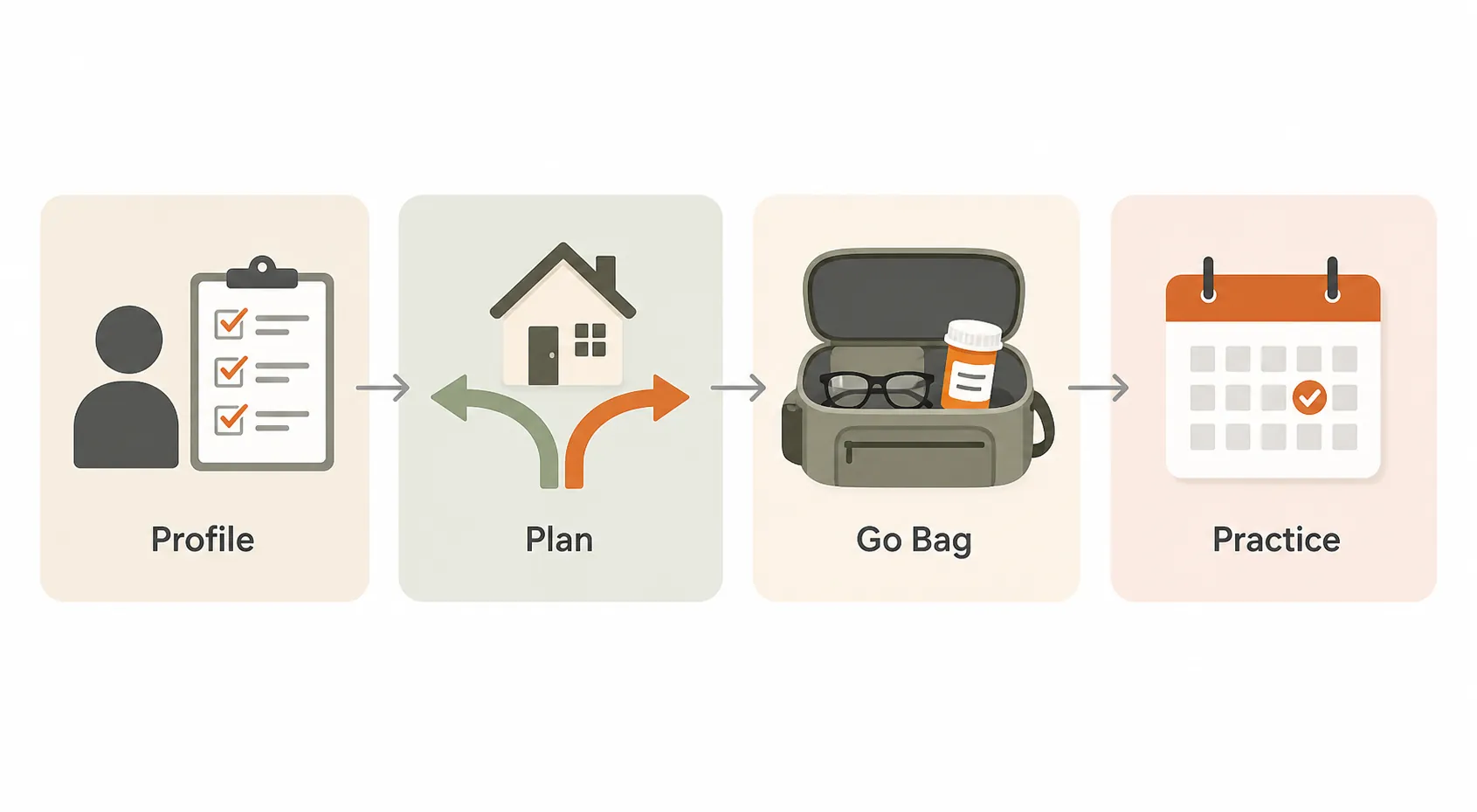
The safer approach is a four-part system: build the parent’s evacuation profile, turn that profile into a leave-early plan, pack a go bag fitted to the parent’s limits, and practice the whole thing often enough that the weak spots show up before the smoke does.
| Part of the system | What it answers |
|---|---|
| Evacuation profile | What does this parent need in order to leave safely? |
| Leave-early plan | Who alerts them, who helps, where do they go, and which routes are realistic? |
| Older-adult go bag | What must be packed because this parent cannot simply replace it on the road? |
| Practice and refresh | Can the parent, neighbor, or caregiver actually use the plan without guessing? |
Build an evacuation profile before you build the evacuation plan
Ready.gov’s older-adult preparedness guidance starts in the right place: older adults should plan around how assistive devices, medicines, batteries, chargers, and other daily supports will travel during an emergency [4]. For a caregiver, that means making a plain-language profile of the parent’s limits. Not a medical biography. Not a binder no one will open. A working sheet that tells a neighbor, sibling, or first responder what must happen for this specific person to leave.
Do this in the house, not over the phone if you can avoid it. Walk from the bedroom to the bathroom, to the medication shelf, to the front door, to the garage. The trip will show you things your parent may not mention because they have worked around them for years.
Mobility and assistive devices
Write down how your parent moves on a good day and on a bad day. Can they walk from the bedroom to the car without sitting? Can they manage porch steps in the dark? Do they use a cane inside but a rollator outside? Does the walker fold, and will it fit in the neighbor’s back seat? If there is a wheelchair, who can lift it, and into which vehicle?
This is also where wildfire preparedness overlaps with fall prevention. Power outages, smoke, heat, unfamiliar lodging, and rushed movement all make ordinary mobility problems more dangerous. If your parent already has balance issues, review the home’s severe-weather risks too; our guide to severe weather fall risks for seniors is a useful companion for power outages and emergency movement around the home.
Medications and medical equipment
List every daily medication, dose, prescribing clinician, pharmacy, and refill schedule. Then add the things families forget because they are not pills: inhalers, eye drops, insulin supplies, syringes, wound-care items, hearing-aid batteries, CPAP parts, oxygen tubing, denture supplies, compression garments, incontinence products, and any device charger.
For oxygen, CPAP, dialysis-related needs, refrigerated medication, or powered mobility equipment, the profile should say who must be called before evacuation season, not during the evacuation. Write down the supplier, after-hours number, backup-power instructions, and whether the destination can support the equipment. A hotel room that cannot handle the equipment is not a safe destination just because it has a bed.
Hearing, vision, and alerts
Wildfire alerts do not help much if the phone is silenced, the text is too small, the parent does not wear hearing aids while napping, or the television is the only source they trust. Record what your parent can reliably hear and see at night, without glasses, without hearing aids, and under stress. If they use a captioned phone, amplified ringer, smartwatch, bed shaker, or weather radio, write down where it is and how it charges.
Cognition and decision-making
If your parent has memory loss, confusion under stress, or trouble sequencing tasks, the profile needs to be blunt. Can they follow a written instruction sheet? Can they unlock the door for a neighbor? Do they understand evacuation levels in their county? Are they likely to say “I’ll wait and see” even when leaving is safer? A plan that depends on calm judgment at 2 a.m. is not a plan; it is a hope with a phone number attached.
Transportation
Write down the real transportation options, not the polite ones. Does your parent still drive at night? Can they drive in smoke? Is the car usually fueled? Who has keys? Which neighbor has a vehicle that can take the parent and the walker? Is there a paratransit service, and does it operate during evacuations? If a family member lives two hours away, that person may be part of the plan, but they cannot be the only first move.
| Profile item | What to record |
|---|---|
| Mobility | Walking distance, stairs, transfer help, cane/walker/wheelchair details, vehicle fit |
| Medications | Medication list, pharmacy, prescribers, refill timing, allergies, copies of prescriptions |
| Medical equipment | Oxygen, CPAP, powered chair, refrigeration, backup power, supplier and after-hours numbers |
| Hearing and vision | Glasses, hearing aids, batteries, alert devices, phone settings, large-print instructions |
| Cognition | Memory concerns, decision support, who can authorize help, simple written instructions |
| Transportation | Driver status, keys, fuel, two realistic vehicles, neighbor or local backup |
Turn the profile into a leave-early plan
Once the profile is written, the evacuation plan becomes less generic. You are no longer planning for “a senior.” You are planning for a person who needs eight minutes to get shoes on, cannot hear a phone in the bedroom, needs a walker loaded first, and should not spend the night somewhere without electricity for medical equipment.
The plan should live in at least three places: with your parent, with you, and with the local helper who may reach the house first. Tape a short version inside a cabinet door or near the exit if your parent will tolerate it. Put the fuller version in the go bag and share a copy with the neighbor or nearby relative who agreed to help.
Use at least two alert methods
Sign your parent up for local emergency alerts, then add a second method that does not depend on the same weak point. That might mean county text alerts plus a weather radio, phone alerts plus a neighbor knock, or a caregiver monitoring the county alert feed plus a local buddy system. Ready.gov emphasizes planning for how older adults will receive emergency information and communicate during disasters [4].
Then test it. If the alert arrives silently on a phone that spends most of the day in another room, fix that now. If your parent dismisses unknown numbers, label the county alert number if possible and write down which alerts mean “prepare,” “leave soon,” and “leave now.”
Map two routes that work with the parent’s body
CAL FIRE’s evacuation guidance tells residents to know several routes in case roads are blocked [5]. For an older parent, “two routes” has to mean two routes they can actually use. Drive them. Look for steep driveways, gates, gravel shoulders, confusing intersections, cell dead zones, and places where your parent might need to transfer from walker to car in smoke or wind.
Keep a paper map in the car and in the go bag. CAL FIRE includes a map marked with at least two evacuation routes in its emergency supply kit guidance [7]. Phones are useful until the battery dies, the network overloads, or the person holding the phone cannot read it clearly.
Choose a medically realistic destination
“Go to your sister’s” may be fine for a healthy adult. It may be unsafe for a parent who cannot climb the sister’s stairs, needs a walk-in shower, uses oxygen, or becomes confused in a crowded house. Pick a primary destination and a backup destination. For each one, write down the address, phone number, route, pet policy, accessibility issues, power needs, and where medications or equipment can be stored.
The American Red Cross advises older adults to build a support network and make sure helpers know their needs and emergency plan [6]. That network should include the destination, not just the ride. The person receiving your parent needs to know what equipment is coming, which medications matter first, and whether your parent needs help with bathing, toileting, stairs, meals, or nighttime orientation.
Set up a neighbor buddy system
A neighbor buddy does not have to become a full caregiver. They need a specific, agreed job: knock on the door if alerts escalate, help load the walker, confirm the parent has the go bag, drive if that is agreed in advance, or call the out-of-town contact if the parent has left. Give that person written permission details where appropriate, emergency contacts, the location of the go bag, and the limits of what they are being asked to do.
Do not leave this as a vague “we look out for each other” arrangement. People are kinder when they know the assignment.
Use CAL FIRE’s pre-evacuation habits before the warning
During fire weather, small habits matter. CAL FIRE recommends keeping shoes and a flashlight near the bed for night evacuations, parking the car facing out, and keeping the gas tank at least half full [5]. These are not dramatic steps, which is why they work. They remove decisions and delays when the parent is tired, scared, or moving slowly.
| Plan decision | Older-adult version |
|---|---|
| Alerts | Two methods, with volume, hearing, vision, and phone settings tested |
| Routes | Two routes driven in advance, with paper maps and mobility barriers noted |
| Contact | One out-of-town contact who knows the plan and can relay updates |
| Destination | Accessible, medically realistic, and able to support equipment and medications |
| Local helper | Named neighbor or nearby person with a narrow, written job |
| Fire-weather habits | Shoes and flashlight near bed, car facing out, gas tank at least half full |
Pack a go bag fitted to an older adult
Start with the official emergency kit, then add the parent-specific layers. CAL FIRE’s emergency supply kit includes basics such as a three-day supply of nonperishable food, three gallons of water per person, prescriptions, extra eyeglasses, copies of important documents, and a map marked with at least two evacuation routes [7]. That is the floor.
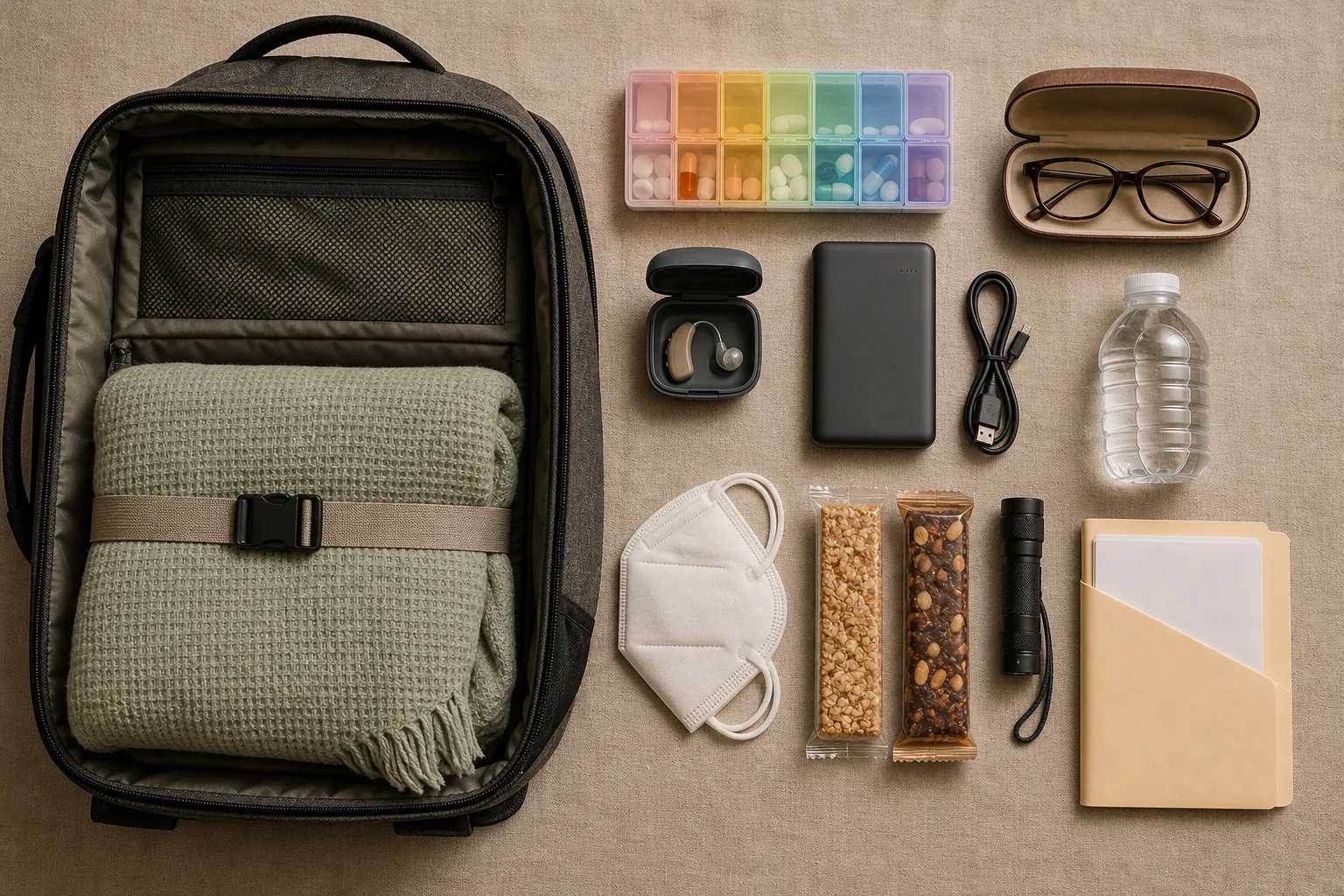
For an older parent, the bag also needs to cover the items that become hard to replace quickly: medication supply, hearing-aid batteries, glasses, mobility accessories, incontinence supplies, masks for smoke particulates, chargers, cash, and medical equipment pieces that do not come standard in a shelter or hotel room. The Red Cross advises older adults to plan for medications, assistive devices, extra batteries, and backup power for medical devices [6]. AARP’s emergency go-bag guidance also highlights items such as N95 masks, portable medical equipment, cash in small bills, incontinence supplies, accessible storage, and regular review every 3 to 6 months [8].
Medication and health documents
- Current medication list with dose, schedule, prescribing clinician, pharmacy, and allergies
- Copies of prescriptions, insurance cards, Medicare or Medicaid cards, ID, advance directive or key medical documents if applicable
- Extra prescription medication as allowed by the prescriber, insurer, and pharmacy; the Red Cross recommends older adults work toward a 30-day supply for emergencies [6]
- Over-the-counter items the parent actually uses, such as pain reliever, antacids, constipation treatment, or glucose tablets if recommended by their clinician
Vision, hearing, and communication
- Extra eyeglasses or readers
- Hearing-aid case, batteries, charger, cleaning tool, and written instructions if a helper may need them
- Large-print emergency contact sheet
- Portable phone charger, charging cords, and wall plug
- Small notebook and pen for someone who hears poorly, becomes confused, or needs instructions repeated in writing
Mobility and personal care
- Cane tips, walker glide caps, wheelchair cushion, transfer belt, or other small parts the parent depends on
- A written note saying which mobility device must leave with the parent
- Incontinence supplies, wipes, disposable bags, gloves, and skin-protection products
- Sturdy shoes and socks if they are not already kept by the bed during fire weather
- A lightweight blanket, change of clothing, and simple hygiene items
Smoke, power, and money
- N95 masks, if the parent can safely use them and understands how to wear them
- Flashlight or headlamp with extra batteries
- Backup battery for phone and small devices
- Cash in small bills, because card systems and ATMs may not be available
- Copies of key phone numbers on paper, not only in the phone
Make the bag physically usable. A heavy duffel in a hall closet is not a go bag for someone with arthritis, poor balance, or a walker. Use a small rolling bag, a backpack a helper can carry, or two lighter bags labeled by priority. Put the most important items where a neighbor can find them without rummaging.
Practice the plan before anyone has to trust it
A plan that has never been practiced usually contains a surprise. The garage door opener does not work during a power outage. The walker blocks the front door when the bag is next to it. The neighbor’s car trunk is too small. The paper map is in the wrong vehicle. The phone charger fits the old phone.
Do a short drill at least every six months, and also when medication, mobility, equipment, phone, caregiver, neighbor, or destination details change. AARP recommends reviewing go-bag contents every 3 to 6 months [8]. Keep the drill ordinary: start in the bedroom, put on shoes, collect hearing aids and glasses, pick up the go bag, get to the car, load the mobility device, and confirm the route and destination.
| Every 3 to 6 months, check | What can fail quietly |
|---|---|
| Medications | Expired supply, changed dose, missing refill, old medication list |
| Batteries and chargers | Dead power bank, wrong cord, hearing-aid battery shortage |
| Mobility equipment | Walker no longer fits the car, worn cane tip, missing wheelchair cushion |
| Contacts | Neighbor moved, phone number changed, out-of-town contact unavailable |
| Routes and destination | Road work, closed bridge, inaccessible lodging, changed pet or equipment rules |
| Documents | Old insurance card, outdated clinician list, missing ID copy |
If your parent resists, keep the first practice small. You do not need to stage a full evacuation to learn something useful. Time how long it takes to get from bed to car. Try loading the walker. Confirm the alert volume. Put the paper contact sheet where it belongs. One fixed weak spot is better than one perfect conversation that never happens.
The leave-early rule
For an older adult with mobility, medication, sensory, cognition, or transportation limits, “leave when ordered” may already be too late as a planning principle. That does not mean ignoring authorities. It means using official evacuation levels with the parent’s limits in mind.
Oregon’s three-level evacuation system says that at Level 1, “Be Ready,” people who cannot move quickly, including older adults, should consider leaving early; at Level 2, “Be Set,” voluntary evacuation is recommended for people who need extra time [9]. The U.S. Fire Administration’s wildfire evacuation outreach tells residents with physical challenges to leave early [10]. CAL FIRE’s evacuation guidance is just as plain: do not wait for an evacuation order if you feel at risk [5].
There is no safe universal promise that your parent will have a certain number of minutes once an order arrives. The calm-season job is to make early departure realistic, documented, packed, and practiced before fire weather turns a predictable barrier into the reason someone cannot leave.
References
- Older Adult Fire Death Risk (2014-2023), U.S. Fire Administration.
- AARP Survey Reveals Opportunities for Older Adults to Increase Disaster Preparedness and Stay Actively Informed During an Emergency, AARP, August 30, 2023.
- The Camp fire killed 86 people. Three months later, many of the victims remain unidentified, Los Angeles Times, February 9, 2019.
- Older Adults, Ready.gov.
- Go! Evacuation Guide, CAL FIRE Ready for Wildfire.
- Older Adults, American Red Cross.
- Emergency Supply Kit, CAL FIRE Ready for Wildfire.
- Emergency Go Bag, AARP.
- Prepare for wildfire season by having an evacuation plan, Oregon Department of Emergency Management.
- Wildfire Evacuation, U.S. Fire Administration.
Related reading
Noticed something outdated or inaccurate on this page? Flag a correction. We review every report against CDC, NIA, and AARP HomeFit guidance before updating a page.
Part of the Fall Prevention section.