
STEADI: Intervene
Check air quality for elderly parents during wildfire smoke
Outdoor AQI alone can't show what your elderly parent is breathing indoors during wildfire smoke. Use a three-layer check — outdoor air, indoor air, and your parent's symptoms — with clear thresholds, actions for each result, and the symptoms that warrant medical help.
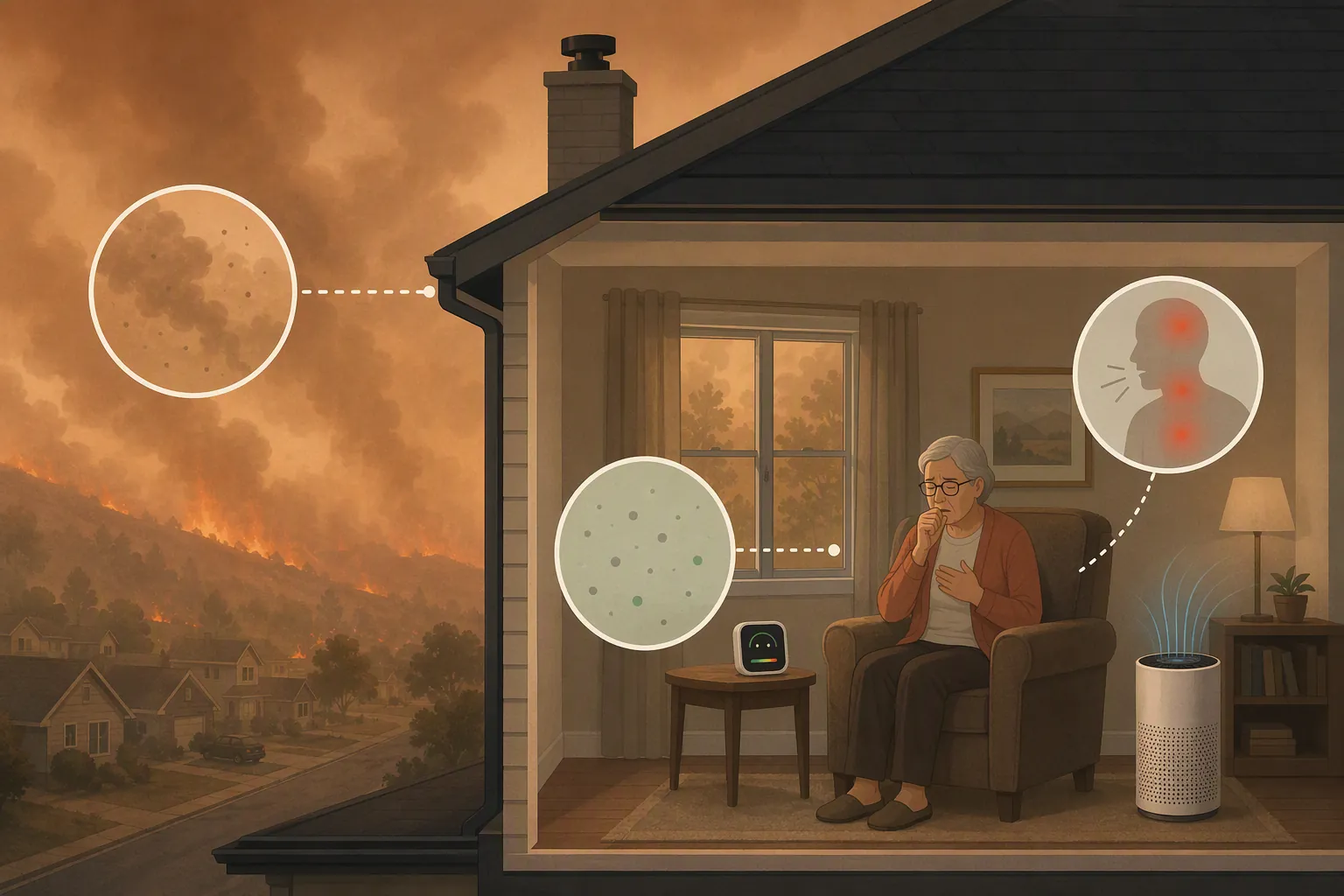
Your phone can say the outdoor AQI is orange while your parent is sitting in a closed bedroom saying, “I’m fine.” That still does not answer the caregiving question: what are they breathing in that room, and do you need to change something now?
Use a three-layer check: outdoor air, indoor air, then your parent’s symptoms. Do it in that order if you can, but do not wait for all three layers to agree. If one layer crosses its limit, act on that layer.
The first outdoor trigger comes earlier for an older adult than it does for a healthy adult. AirNow defines orange AQI, 101–150, as “unhealthy for sensitive groups,” and AirNow’s older-adult guidance identifies older adults as one of those sensitive groups.[1][2]
| Layer | What to check | Threshold that changes your next step | Caregiver action |
|---|---|---|---|
| 1. Outdoor air | AirNow Fire and Smoke Map or local AQI report | AQI orange, 101–150, is already unhealthy for sensitive groups; treat that as a practical trigger for a parent age 65+. | Start reducing exposure: keep them indoors, close smoke entry points, and move to the indoor-air check. |
| 2. Indoor air | PM2.5 monitor if available; otherwise smell, visible haze, and whether symptoms are changing indoors | Indoor PM2.5 rising, smoke smell or haze indoors, or no improvement after closing the room. | Create or improve a clean room and remove indoor particle sources. |
| 3. Parent’s body | Breathing, cough, wheeze, chest tightness, fatigue, confusion, chest symptoms, or new weakness | New, worsening, or persistent symptoms override a reassuring number. | Call the clinician, urgent care, emergency services, or prepare to leave if indoor control is not enough. |
Layer 1: Start outside, but do not stop there
Open AirNow’s Fire and Smoke Map or a trusted local AQI report. If the AQI is green or yellow, that is useful, but it still does not prove the bedroom air is clean. If the AQI is orange or worse, assume your older parent needs exposure reduced now, especially if they have COPD, asthma, heart disease, or a recent respiratory infection.
For a parent with COPD or asthma, do not treat orange as a “maybe later” category. It is the point where you should check medications, confirm the action plan, and keep outdoor trips brief. If you are also managing oxygen, rescue inhalers, or mask decisions, see how to keep seniors with COPD safe during air quality warnings while you work through the indoor steps.
If your parent must go outside for an appointment, medication pickup, or evacuation preparation, use the outdoor AQI to decide how urgent and short that trip should be. But if they are staying inside, the next useful question is not “what is the AQI outside?” It is “is smoke getting into the room where they are breathing?”
Layer 2: Check the air in the room where your parent actually sits or sleeps
If you have a PM2.5 monitor, bring the decision into the room. PM2.5 is the fine-particle pollution that matters during wildfire smoke. The current PM2.5 AQI breakpoints define “good” as 0.0–9.0 µg/m³, “moderate” as 9.1–35.4 µg/m³, and “unhealthy for sensitive groups” as 35.5–55.4 µg/m³.[3]
Those numbers are not a reason to stare at the device and argue over a decimal. A consumer monitor is a caregiving tool, not a regulatory instrument. In a 2020 Berkeley Lab study of four low-cost PM2.5 monitors during the Camp Fire, the monitors overreported readings by 1.6–2.4 times compared with regulatory instruments, but they still tracked trends well enough to show whether indoor air was getting better or worse.[4]
That trend is what you need. If the number falls after you close the room and run the air cleaner, the clean room is probably helping. If it keeps climbing, the smoke is still entering, the cleaner is too small, the filter is not doing enough, or something inside the home is adding particles.
Put the monitor where the answer matters
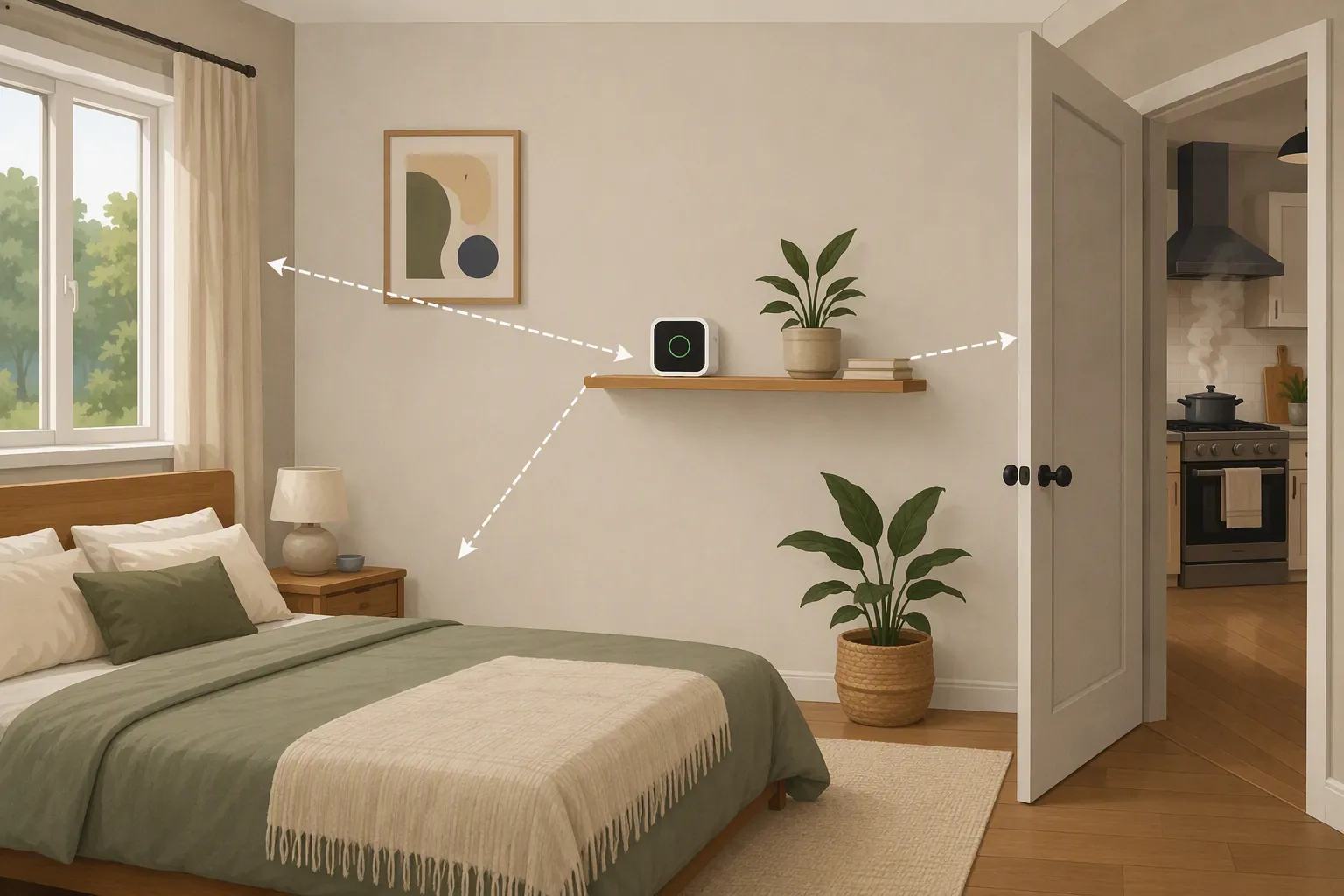
A monitor sitting by a leaky window tells you about the window. A monitor sitting next to a stove tells you about the stove. For this check, place it near breathing-zone height — about 3–6 feet from the floor — and away from windows, doors, vents, cooking areas, candles, tobacco smoke, and the direct blast of an air cleaner.[5]
For a parent in a recliner, bedside chair, or bed, the best spot is usually a stable shelf or table near where their head actually is, not across the house in a hallway. Leave it there long enough to see direction. A single reading can jump around; a worsening trend after you have tried to seal the room deserves attention.
What to do with the indoor reading
- If the room is in the “good” range and your parent has no symptoms, keep the room set up and recheck when outdoor smoke changes, doors open, the HVAC cycles, or your parent moves rooms.
- If the reading is moderate but rising, tighten the room: close windows and doors, run the air cleaner continuously, and stop indoor particle sources.
- If the reading reaches the “unhealthy for sensitive groups” range or keeps rising after cleanup steps, treat the room as not controlled yet. Improve filtration, move to a better room, or consider whether the home can safely protect them.
- If the number looks acceptable but your parent is coughing, wheezing, unusually tired, confused, or short of breath, move to the symptom layer. Their body outranks the device.
If you want a more room-by-room setup for a parent with breathing problems, use this indoor air safety guide for seniors after you have handled the immediate smoke check.
No monitor or no internet: use visibility, smell, haze, and symptoms
No monitor does not mean no evidence. Start with what you can safely observe. Do not send an older parent outside to “see how smoky it is.” Look from a window, doorway, or another safe spot.
Oregon DEQ’s 5-3-1 visibility method gives a useful fallback when AQI information is unavailable: visibility well over 5 miles is generally good; under 5 miles is unhealthy for adults over 65 and people with heart or lung disease; under 3 miles is unhealthy for everyone; and under 1 mile means avoid all outdoor activity.[6]
| What you can tell without a monitor | What it means for an older parent | What to do next |
|---|---|---|
| You smell smoke indoors | Smoke is entering the home or room, even if it looks clear. | Close entry points, run filtration, and move the parent into the cleanest closable room. |
| You see haze indoors | The room is already failing as a protected space. | Set up or improve the clean room immediately. |
| Outdoor visibility is under 5 miles | For adults over 65 or people with heart/lung disease, treat conditions as unhealthy. | Avoid outdoor activity and tighten indoor protection. |
| Your parent’s cough, breathing, fatigue, or confusion worsens | Symptoms are now the most important reading. | Follow the medical escalation steps rather than waiting for better measurements. |
The nose is not a calibrated sensor, but a smoke smell in the bedroom is not something to debate away. It is enough to act, especially for a parent with COPD, asthma, heart disease, or frailty.
When any layer crosses its limit, build the cleanest room you can
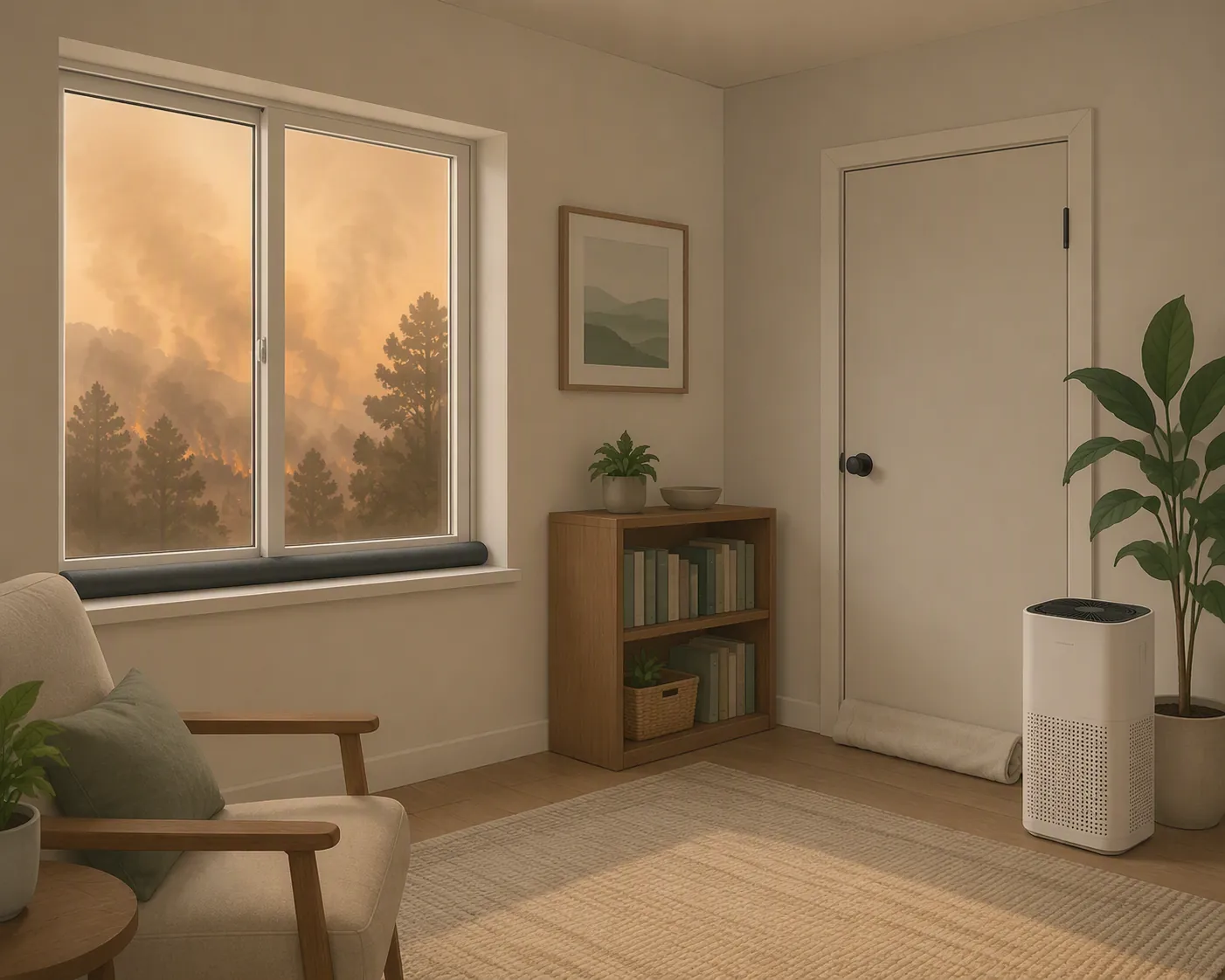
Pick one room first. The best clean room is not always the prettiest bedroom; it is the room you can close off, filter, and keep comfortable. CDC and EPA guidance both emphasize using a closable room, a portable air cleaner or effective HVAC filtration, and avoiding indoor particle sources during wildfire smoke.[7][8]
Choose the room
- Use a room with a door that closes.
- Prefer fewer exterior walls, fewer leaky windows, and less foot traffic.
- Keep the parent’s usual needs nearby: phone, charger, water, medications, glasses, walker or cane, and bathroom route.
- Do not choose a room that becomes dangerously hot once closed.
That last point matters. A sealed room that traps heat can become its own emergency. If wildfire smoke arrives during extreme heat, use this heat-dome wildfire safety guide for older adults to balance smoke reduction with overheating risk.
Run filtration continuously
Use a portable air cleaner sized for the room. AHAM’s wildfire-smoke guidance uses the two-thirds CADR rule: the tobacco-smoke CADR should be at least two-thirds of the room’s area in square feet.[9] If the room is large and the cleaner is small, the number on the box may look comforting while the room still does not clear fast enough.
If the home has central HVAC and the system can handle it, use a MERV-13 or higher filter and set the system to recirculate rather than pulling smoky outdoor air inside.[7][8] Do not force a high-MERV filter into a system that cannot tolerate it; a struggling HVAC system is not a clean-room plan.
If power is flickering or the parent depends on powered medical equipment, an air cleaner plan needs a backup. Work from a power outage plan for elderly parents before the smoke event turns into a power event.
Stop making particles indoors
During the smoke period, pause the things that add particles inside: frying, broiling, burning candles, using a fireplace, smoking, and vacuuming unless the vacuum has appropriate filtration. CDC includes avoiding frying, vacuuming, and candles among the steps for staying safer indoors during wildfire smoke.[7]
This is where many homes lose ground. Someone closes the windows, turns on the cleaner, then cooks a smoky dinner in the next room. If your parent’s indoor PM2.5 rises after that, the monitor is not being dramatic; it is telling you the room is receiving particles from inside the house.
Check the medical basics while the room is clearing
For parents with asthma, COPD, heart disease, diabetes, or other chronic conditions, check the medication supply and the condition-specific action plan while filtration is running. CDC advises people with chronic conditions to keep a 7–10 day supply of medicine, follow asthma or COPD action plans, and consider evacuating if breathing trouble does not improve.[10]
This is not a full emergency kit project in the middle of a smoke hour. It is the short version: rescue inhaler where they can reach it, oxygen or device needs understood, clinician instructions available, and enough medication that a road closure or pharmacy closure does not create a second problem.
Layer 3: Symptoms override the AQI and the monitor
An older adult may underreport symptoms because they do not want to be moved, do not want to worry anyone, or think smoke is just “a little smell.” Watch what is changing. Are they coughing more? Breathing faster? Pausing between words? More tired than usual? Unsteady when standing? More confused?
CDC says to watch for coughing, trouble breathing, wheezing, and chest tightness during wildfire smoke exposure, and to get medical help for new or worsening symptoms.[7] AARP’s wildfire-smoke guidance also flags difficulty breathing, chest pain or pressure, unusual fatigue, irregular or rapid palpitations, and stroke-like symptoms as warning signs that need urgent attention.[11]
| What you notice | Do this |
|---|---|
| Mild smoke smell indoors, no symptoms, outdoor AQI orange or worse | Set up the clean room and keep checking indoor conditions. |
| Cough, wheeze, chest tightness, or trouble breathing starts or worsens | Follow the parent’s action plan and contact medical help. |
| Breathing trouble does not improve after moving to cleaner air and following the action plan | Seek urgent medical guidance and consider evacuation if the home cannot protect them. |
| Chest pain or pressure, stroke-like symptoms, severe breathing distress, or rapid/irregular palpitations | Call emergency services. |
| Unusual fatigue, dizziness, weakness, or confusion | Treat it as a safety change, not just a mood change; get medical advice, and reduce fall hazards while you decide the next step. |
Smoke-related fatigue, dizziness, weakness, or confusion can also make a parent less steady. That does not turn this into a fall article, but it does change how you move them: lights on, walker within reach, no rushing to the bathroom, and someone nearby if they stand after sitting in a closed room for hours.
When the house is not controlling the smoke
Sometimes the answer is not another towel under the door. If outdoor smoke is severe, indoor haze or PM2.5 stays high, the room overheats, the power fails, or symptoms keep worsening, the home may not be the safest place for that parent during this part of the event.
That is when you stop trying to prove the number is bad enough and start planning the move: a cleaner-air location, a medical facility, a relative’s home outside the smoke, or an official shelter if available. If evacuation orders or wildfire zones are involved, use evacuation guidance for seniors rather than waiting until your parent is harder to move.
Repeat the same sequence as conditions change: outdoor AQI, indoor air, symptoms. If the outdoor layer crosses its limit, reduce exposure. If the indoor layer crosses its limit, improve or leave the room. If the symptom layer crosses its limit, get medical help. The parent’s body gets the final vote.
References
- AQI Basics — AirNow.
- Older Adults — AirNow.
- Particle Pollution and the Air Quality Index — U.S. Environmental Protection Agency, February 2024.
- Low-cost home air quality monitors prove useful for wildfire smoke — Berkeley Lab, August 18, 2020.
- Air Quality Sensors for Smoke Factsheet — U.S. Environmental Protection Agency, 2026.
- Using Visibility to Estimate Health Effects — Oregon Department of Environmental Quality.
- How to safely stay safe during a wildfire — Centers for Disease Control and Prevention.
- Create a Clean Room to Protect Indoor Air Quality During a Wildfire — U.S. Environmental Protection Agency.
- Using an Air Cleaner to Manage Wildfire Smoke — AHAM Verifide.
- Wildfire Smoke and People with Chronic Conditions — Centers for Disease Control and Prevention.
- How to Protect Yourself From Wildfire Smoke — AARP.
Related reading
Noticed something outdated or inaccurate on this page? Flag a correction. We review every report against CDC, NIA, and AARP HomeFit guidance before updating a page.
Part of the Fall Prevention section.