
Why Holiday Loneliness Raises Fall Risk (and What to Do)
Holiday loneliness in older adults isn't just an emotional concern — research shows it significantly raises fall risk. This guide explains the connection and offers practical strategies to address both isolation and safety during the holiday season.
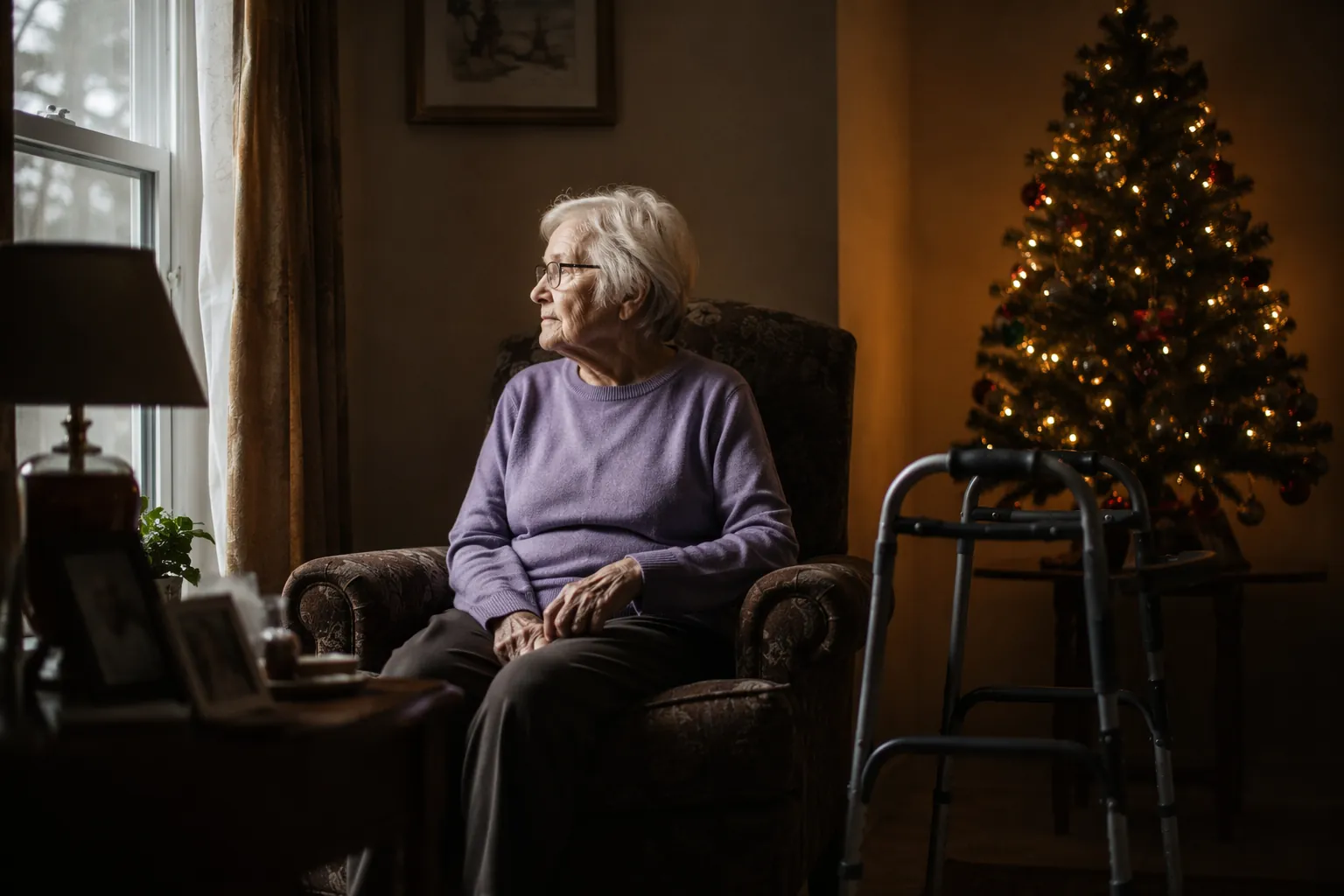
A holiday call can sound perfectly normal until you start listening for what is missing. Your mother says she is fine, but she has stopped going to church dinners. Your father laughs about skipping the neighbor’s open house, but the walker is across the room when he answers the video call. The worry starts as loneliness. Then it becomes physical: less walking, less help, more chores done alone, and fewer people around to notice when something changes.
That is why helping elderly parents cope with loneliness during holidays is not only an emotional question. For an older parent living alone, holiday loneliness can belong in the fall-prevention plan.
AARP has reported that 28% of adults age 50 and older feel more lonely during the holiday season.[1] That would be reason enough to pay attention. But two large peer-reviewed studies make the concern harder to leave in the “sad but separate” category. In one analysis of 22,153 person-observations from the Health and Retirement Study, perceived social isolation was associated with a 33% higher risk of falling.[2] In another study of 2,337 older adults, each one-point increase on the UCLA 3-item Loneliness Scale predicted 11% higher odds of falling within five years.[3]
Those studies do not prove that loneliness directly causes falls. They are observational, and people who feel isolated may also be dealing with health problems, grief, mobility limits, or depression that contribute to the risk. Still, the findings are longitudinal, based on national cohorts, and consistent enough to change how a caregiver should look at holiday withdrawal. A parent who is pulling back socially may also be losing pieces of the routine that keep them steady.
The Holiday Clues That Should Change the Visit
Holiday loneliness often shows up indirectly. The refrigerator has less real food than last year. The porch light has been out for weeks. Mail is stacked near the door because bending and carrying are harder. A parent who once complained about too many invitations now says, a little too quickly, that staying home is easier.
There may be good reasons. A spouse or close friend may be gone. Hearing loss can make a noisy dinner feel humiliating instead of festive; Baylor College of Medicine has warned that untreated hearing loss can contribute to holiday isolation because group conversations become exhausting.[4] Flu and COVID concerns may make crowded rooms feel risky. Shorter, colder days can shrink the safe window for errands or walks. Holiday advertising keeps insisting everyone belongs at a full table, which can make a quiet apartment feel even quieter.
The point is not to scold an older parent into attending parties. The point is to notice when isolation starts changing movement, judgment, and help-seeking. A cheerful phone call does not show whether the cane is by the chair, whether the hallway is clear, or whether your parent has stopped taking the trash out until the bag is too heavy.
How Loneliness Can Turn Into Fall Risk
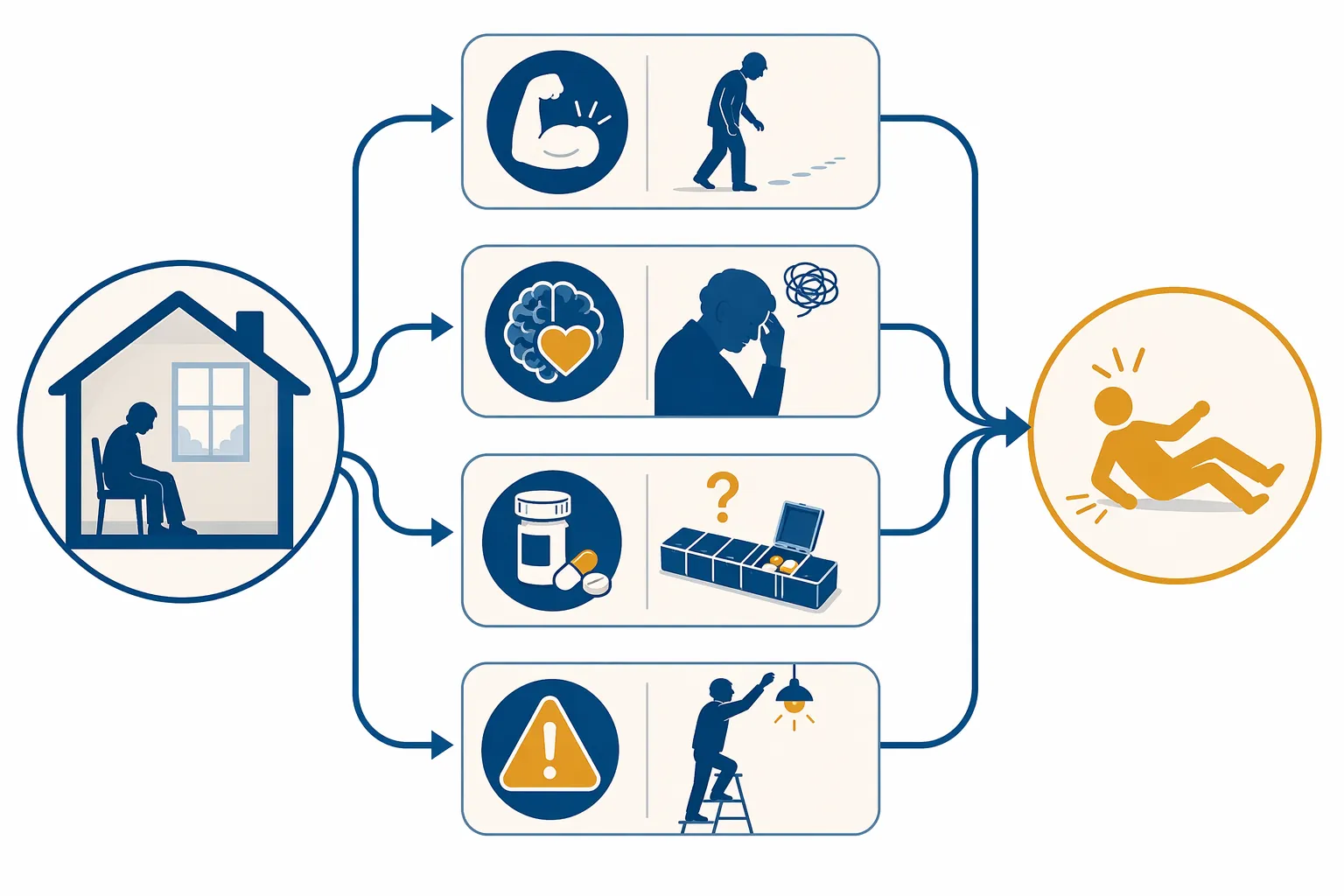
Loneliness does not have to push someone down the stairs to matter. It can remove the ordinary supports that keep a person moving safely through the house.
Less Activity Means Less Strength
Social plans are often movement plans in disguise. A lunch date means getting dressed, walking to the car, navigating a curb, standing in line, and carrying a plate. A choir rehearsal means repeated trips out of a chair. A weekly card group may be the only reason someone leaves the apartment after dark.
When those plans disappear, the loss is not only companionship. The legs get fewer chances to practice. Balance gets less challenged. A parent may begin saving steps: leaving dishes on the counter, sleeping in the recliner, or skipping the mailbox because the walkway looks icy. Reduced physical activity is one plausible pathway linking isolation to falls, and it is the one caregivers can often see first.
Mood Changes Can Make the House Harder to Manage
Quach and colleagues found that depressive symptoms helped explain part of the relationship between social isolation and falls. In their analysis, each additional depressive symptom was associated with a 13% increase in fall risk.[2] That does not mean every lonely parent is depressed, or that depression is the only pathway. It does mean mood deserves practical attention, not polite avoidance.
Depression can slow reaction time, reduce appetite, disturb sleep, and make ordinary hazards feel less worth fixing. A parent who is grieving may not replace a burned-out bulb. Someone who is ashamed of needing help may stop mentioning dizziness. Cognitive strain matters too: the more a person has to manage alone, the easier it is to forget a dose, misjudge a step, or hurry through a task that used to be automatic.
Medication Problems Are Easier to Miss When No One Is Around
Medication mistakes rarely announce themselves as medication mistakes. They show up as lightheadedness, confusion, sleepiness, or an unsteady trip to the bathroom. During the holidays, routines get disrupted: refills are delayed, pharmacies change hours, meals happen at odd times, and visitors may assume someone else has checked the pill organizer.
An isolated parent has fewer chances for another adult to notice that the same bottle is still full, that a new medicine causes dizziness, or that “I forgot breakfast” has become a pattern. This is one reason a social check-in needs more structure than “How are you?” It should create enough contact for small safety problems to surface before they become a fall.
Risky Tasks Get Done Alone
The holiday season adds jobs that do not look dangerous until the wrong person is doing them without help: carrying bins from the garage, climbing for decorations, moving dining chairs, salting steps, taking heavy trash bags out in the dark, or standing too long in the kitchen because guests are coming.
A parent who feels forgotten may push through those tasks to prove they are still capable. A parent who feels like a burden may avoid asking for help. The fall risk is not only the task itself; it is the private decision to do it alone.
Why This Belongs Beside the Usual Fall-Prevention Checklist
The CDC’s STEADI materials focus on proven fall-risk areas such as fall history, gait and balance, medication review, vision, home hazards, and clinical follow-up.[5] Social isolation screening is not presented as an official STEADI step. It should not be described that way.
But caregivers do not have to wait for a checklist to name every risk they can see. The research on isolation and falls supports adding a simple question to holiday planning: has loneliness changed this parent’s movement, routine, medication management, or willingness to ask for help?
The broader stakes are not small. The U.S. Surgeon General’s 2023 advisory described the mortality impact of social disconnection as similar to smoking up to 15 cigarettes a day.[6] That comparison can sound dramatic, but in a caregiver’s house it becomes very ordinary: fewer visitors, fewer walks, fewer noticed hazards, fewer chances for someone to say, “Wait, why is your ankle swollen?”
A Holiday Plan That Reduces Loneliness and Fall Risk at the Same Time
The useful plan is not “call more.” Calling more can help, but only if it changes a routine, reveals a safety issue, or connects the parent to real activity. The best holiday supports do two jobs at once: they reduce isolation and protect mobility.
| Caregiver action | What it helps you notice or preserve |
|---|---|
| Schedule a structured video call | Lighting, clutter, footwear, mobility aids, facial expression, movement getting up from a chair |
| Choose social activities that involve safe movement | Leg strength, balance practice, confidence leaving home, recurring contact |
| Give a holiday role that fits current mobility | Participation without unsafe lifting, climbing, or prolonged standing |
| Build a post-holiday routine before January | Continuity after visitors leave and decorations come down |
Make Video Calls Visual, Not Just Friendly
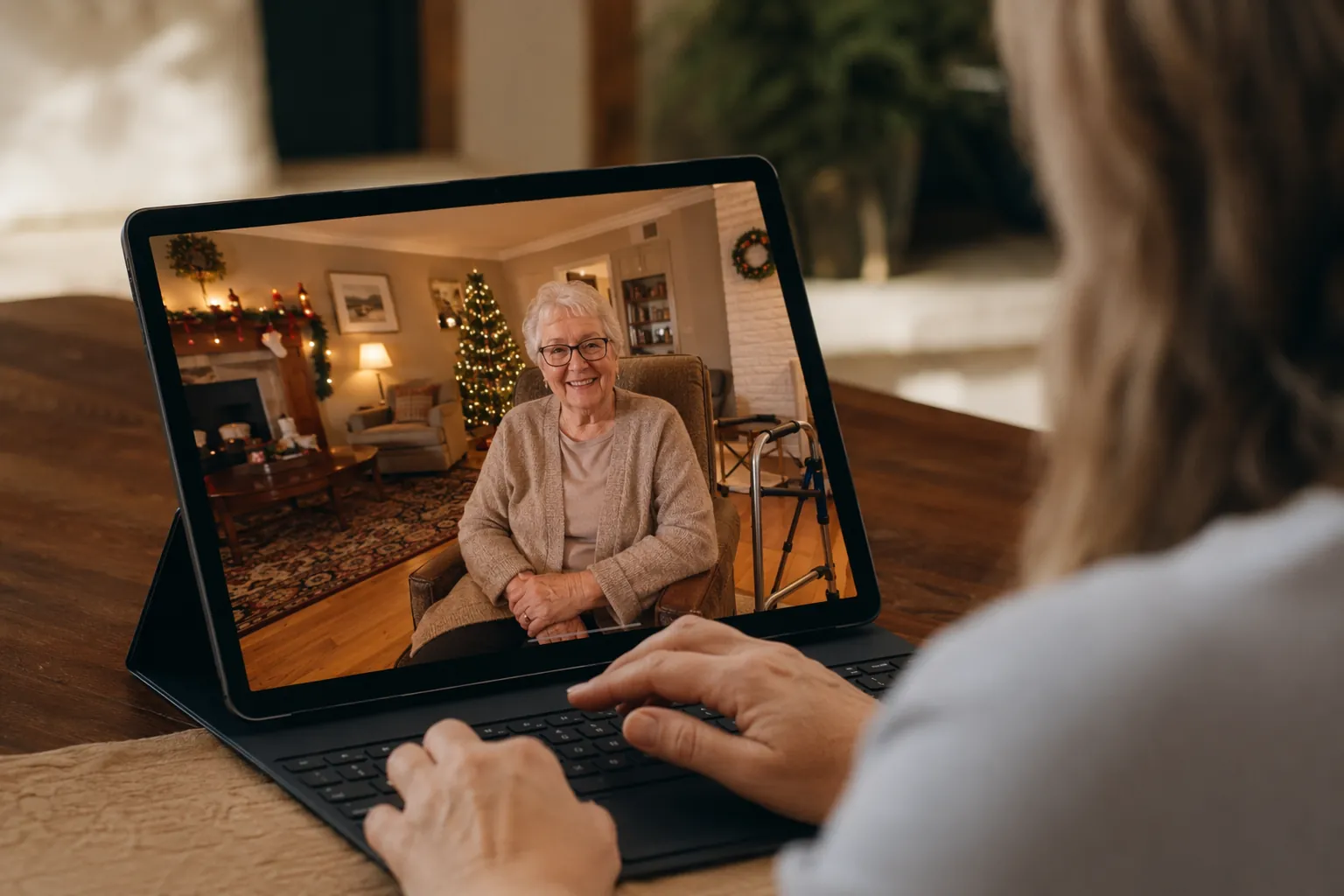
A video call can be a safety visit when an in-person visit is not possible. Ask your parent to sit where they normally sit, not in the one tidy corner prepared for the call. Notice whether the room is dim, whether the throw rug has curled, whether the cane is across the room, and whether they use the armrests or furniture to stand.
Keep the tone matter-of-fact. “Can you show me where you keep the walker at night?” will get you farther than “You really shouldn’t leave that there.” If your parent resists, frame it as convenience: the goal is to make the easiest choice the safest one.
- Ask to see the path from the chair to the bathroom.
- Check whether the porch, hallway, and kitchen lighting are bright enough.
- Look for cords, pet bowls, gift bags, or holiday boxes in walking paths.
- Confirm that glasses, hearing aids, phone, water, and mobility aids are within reach.
- Ask whether any medication has changed since the last visit.
During an in-person visit, use a home hazard checklist rather than relying on memory. The CDC STEADI fall prevention checklist for home is a practical place to start because it keeps the visit focused on specific hazards instead of vague worry.
Choose Company That Keeps the Body Moving
A long holiday lunch may be emotionally nice and physically passive. For fall prevention, look for social contact that includes safe, repeated movement: a walking club, tai chi class, senior center exercise group, or intergenerational volunteer shift. NCOA has emphasized both social connection and evidence-based fall-prevention programming as ways older adults can maintain health and independence.[7]
The right activity depends on the parent, not on what sounds wholesome from a distance. A person with hearing loss may do better in a small walking group than a noisy banquet. Someone grieving may tolerate a recurring volunteer task better than a party where everyone asks how they are doing. Someone afraid of falling may need transportation, a first visit together, or a class designed for balance rather than general fitness.
Social engagement also builds confidence. If your parent has become cautious after a stumble, pair this plan with mobility basics such as strength, balance, and meaningful daily activity. The same idea sits behind broader healthy-aging guidance like Five Foundations for Staying Fabulous in Your 90s: connection matters more when it helps someone keep participating in ordinary life.
Give Holiday Jobs That Fit the Body They Have Now
Participation is not the same as performance. An older parent may still want a role, especially if they used to host everyone. The safer approach is to match the task to current mobility rather than either taking over completely or pretending nothing has changed.
- Wrapping gifts at a table instead of sitting on the floor.
- Mixing or decorating cookies from a seated position.
- Folding napkins, writing cards, or sorting photos.
- Setting part of the table with someone else carrying heavy dishes.
- Choosing music, recipes, or family stories while another person handles ladders, bins, and outdoor tasks.
If your parent is staying with you, plan the house around both dignity and safety before they arrive. A safe bedroom path, reachable bathroom, good lighting, stable seating, and realistic activities matter more than a perfect table. For a fuller hosting plan, use How to Host an Elderly Guest: Safety Prep and Activities.
Do Not Let the Plan End on New Year’s Day
The week after the holiday can be the dangerous part. Visitors leave, decorations come down, weather worsens, and the parent who rallied for company may be more tired than they admit. Before the visit ends, set one recurring routine that continues without holiday energy: a weekly walking group, book club, balance class, volunteer shift, neighbor coffee, or family video call with a predictable day and time.
Seasonal safety planning works best when it connects the event to everyday fall prevention. The same pattern applies during storms, extreme cold, or other disruptions; Help an Older Adult Stay Safe and Steady During Severe Weather is useful because it treats weather as a mobility and support problem, not just a forecast.
When Loneliness Needs More Than Family Support
Some sadness around the holidays is expected, especially after loss. What deserves faster action is a change that persists or interferes with safety: staying in bed most of the day, losing interest in food, stopping hygiene, missing medications, expressing hopelessness, giving away possessions unexpectedly, drinking more, seeming confused, or refusing contact that used to be welcome.
If you are worried about depression, involve the parent’s primary care clinician or a mental health professional. The Friendship Line at 1-800-971-0016 offers support for older adults and adults with disabilities, and Mental Health America provides online screening tools at MHAScreening.org.[8]
If the holiday visit reveals bruising, new pain, confusion, a sudden change in walking, soiled clothing, broken furniture, or an explanation that does not fit what you see, shift out of prevention mode. Those may be signs of a recent unreported fall. Use Your Parent Just Fell: A Caregiver’s Guide to the First 72 Hours and seek medical guidance when pain, head injury, confusion, weakness, or new mobility trouble is present.
This is the practical line: social contact is not a decorative holiday extra for an older parent living alone. When it preserves movement, routine, medication support, and help with hazards, it becomes fall prevention.
References
- Holiday Loneliness Survey, AARP, 2023.
- The Association Between Social Isolation and Falls in Older Adults, Journal of Applied Gerontology, 2020.
- Social Isolation, Loneliness, and Falls in Older Adults: A Longitudinal Study, Journal of the American Geriatrics Society, 2021.
- Hearing loss can lead to holiday isolation, Baylor College of Medicine.
- STEADI - Older Adult Fall Prevention, Centers for Disease Control and Prevention.
- Our Epidemic of Loneliness and Isolation, U.S. Surgeon General, 2023.
- Falls Prevention for Older Adults, National Council on Aging.
- The Friendship Line: A Lifeline for Older Adults, National Council on Aging and Mental Health America.
Related reading
Noticed something outdated or inaccurate on this page? Flag a correction. We review every report against CDC, NIA, and AARP HomeFit guidance before updating a page.
Part of the Fall Prevention section.