
How to Talk to an Aging Parent About Fall Risk and Home Assistance: A Guide for Family Caregivers
Many older adults resist discussing fall risk, making it difficult for family caregivers to introduce home safety changes. This guide provides a structured communication approach based on the CDC STEADI Stages of Change Model, with conversation scripts and practical strategies to help your loved one accept the support they need.
The Hidden Problem: Why Falls Go Undiscussed
Every year, more than one in four older adults experiences a fall. That statistic alone is sobering. But what may surprise you more is this: less than half of those who fall ever tell their doctor. Even fewer bring it up with family members. The silence around falls is not a minor oversight — it is a major barrier to prevention.
The stakes are high. According to the CDC, a single fall doubles the risk of falling again. Among older adults who do fall, roughly 37% sustain an injury that requires medical treatment or restricts their activity for at least a day. Falls are also the leading cause of traumatic brain injuries in older adults. These are not rare events — they are common, consequential, and largely preventable.
This communication gap creates a dangerous cycle. A parent who does not disclose a fall cannot receive a clinical fall risk assessment. Without that assessment, modifiable risk factors — weak leg muscles, medication side effects, vision problems, home hazards — go unaddressed. The next fall may be more serious, and the parent's confidence erodes further, making them even less likely to speak up next time.
As a family caregiver, you are in a unique position to break this cycle. But doing so requires understanding why your parent is staying silent in the first place.
Why Your Parent Resists Talking About Fall Risk
If you have tried to bring up fall prevention with your parent and been met with deflection, irritation, or flat refusal, you are not alone. The resistance is rarely about the specific suggestion — a grab bar, a medical alert system, a home care aide. It is about what that suggestion represents.
Research published in the Disability and Health Journal (Hanson et al., 2009) found that older adults often view falls as a stigmatizing topic. A fall is not seen as a neutral health event — it is interpreted as a sign of decline, frailty, and loss of control. For many older adults, admitting fall risk feels like admitting that they can no longer manage their own lives.
This psychological resistance typically stems from three overlapping sources:
- Fear of losing independence. Accepting help — whether a grab bar or a home care aide — feels like surrendering autonomy. Your parent may worry that one concession will lead to a cascade of lost freedoms.
- Denial of declining abilities. The human brain is wired to maintain a stable self-image. Acknowledging that balance is worsening or that the bathroom floor has become dangerous requires accepting a new, less capable version of oneself. That is psychologically painful.
- The stigma of falling. Falls are associated with aging, weakness, and vulnerability. Your parent may feel ashamed, as though a fall would be a personal failure rather than a predictable outcome of cumulative risk factors.
Understanding these drivers is essential because it changes the goal of the conversation. You are not trying to convince your parent that they are at risk. You are trying to help them see that accepting support is a way to protect the independence they value, not a threat to it.
A Better Approach: The Stages of Change Model
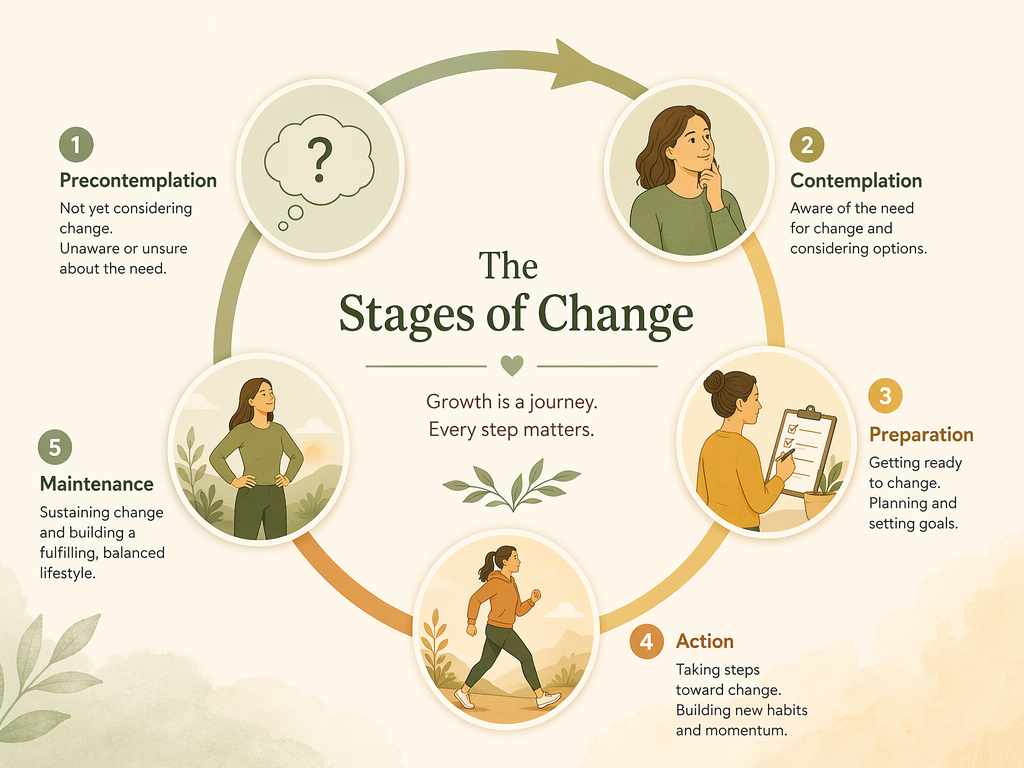
The CDC STEADI (Stopping Elderly Accidents, Deaths & Injuries) toolkit — the same clinical framework that guides healthcare providers in fall risk assessment — offers a communication strategy that is far more effective than simply presenting facts and expecting action. The toolkit incorporates Prochaska's Stages of Change Model, a well-established psychological framework originally developed to understand how people change health behaviors.
The model identifies five stages:
- Precontemplation: The person does not see a problem and has no intention of changing.
- Contemplation: They are aware of the risk and are weighing the pros and cons, but are not yet ready to act.
- Preparation: They intend to take action soon and may be gathering information or making small plans.
- Action: They have made specific, observable changes.
- Maintenance: They are working to sustain the change and prevent relapse.
The critical insight from this model is that pushing for action when someone is in precontemplation or early contemplation does not work. It triggers resistance, not cooperation. The goal is not to jump from precontemplation to action in one conversation. The goal is to help your parent move one stage forward.
Related reading
Noticed something outdated or inaccurate on this page? Flag a correction. We review every report against CDC, NIA, and AARP HomeFit guidance before updating a page.
Part of the Fall Prevention section.