
STEADI: intervene
How to Build a Hurricane Season Plan for Elderly Parents
Most hurricane checklists miss what older adults actually depend on: medications, assistive devices, and decisions made before the storm. This plan details the waterproof documents folder, 30-day medication buffer, 72-hour kit, and written stay-or-go trigger that keep an aging parent safe through landfall and the risky weeks after.
A hurricane season preparation plan for elderly parents should start before the forecast gets personal. Once a named storm is close enough to argue about, the hard parts are already late: refilling prescriptions, finding the power of attorney, checking whether the scooter battery will last, deciding who will drive, and getting an older parent to agree to one clear plan.
The cleanest way to build the plan is Ready.gov’s older-adult framework: assess needs, create a plan, and engage a support network. That sounds simple because it is supposed to be simple. The work is in making each step specific to your parent’s medications, mobility, memory, home, pets, and tolerance for disruption—not to a generic household that can improvise in the dark. Ready.gov calls this “Take Control in 1, 2, 3” and provides worksheets for older adults and caregivers to use together. [1]

The plan below is built around the items that tend to fail first for an aging parent: documents that cannot be found, medication lists nobody can recite, assistive devices that need power or spare parts, and a stay-or-go decision that gets reopened every time the forecast shifts.
Start with the parent-specific version of “1, 2, 3”
| Ready.gov step | What it means for an aging parent | The caregiver’s deliverable |
|---|---|---|
| Assess needs | List medications, devices, mobility limits, cognitive or communication needs, pets or service animals, and what would become unsafe if power or water were out. | One written needs inventory. |
| Create a plan | Build the documents folder, medication buffer, 72-hour go-kit, two-week stay-home kit, power plan, and stay-or-go trigger. | One printed plan stored in the folder and shared. |
| Engage a support network | Assign who calls, who drives, who checks supplies, who handles prescriptions, and who is the backup if the first person cannot reach the house. | One contact sheet with names, roles, and backup roles. |
Do this with your parent, not around them. The Conversation’s hurricane planning guidance for aging parents is blunt on that point: the parent’s autonomy matters, and the plan works better when the older adult helps shape it instead of being handed instructions during a stressful week. It also recommends the practical pieces that too many emergency lists leave vague: a waterproof folder, hard-copy phone numbers, at least 72 hours of self-sufficiency, emergency medications, batteries and chargers for assistive devices, and shelter planning that accounts for mobility, cognition, and pets. [2]
The American Red Cross adds two numbers worth building around: keep at least 30 days of medications and plan either to stay home for at least two weeks or to evacuate. It also tells older adults to plan for backup power for medical devices and refrigerated medications, keep extra assistive items such as a cane or eyeglasses, and register for local special-needs assistance if evacuation help may be needed. [3]
Build the waterproof folder first
The folder is not paperwork housekeeping. It is what lets another adult act when your parent is tired, displaced, overheated, or unreachable by phone. Make it waterproof, zipped, and easy to carry. If your parent evacuates, it goes in the car. If they shelter at home, it stays in the same visible place every time.
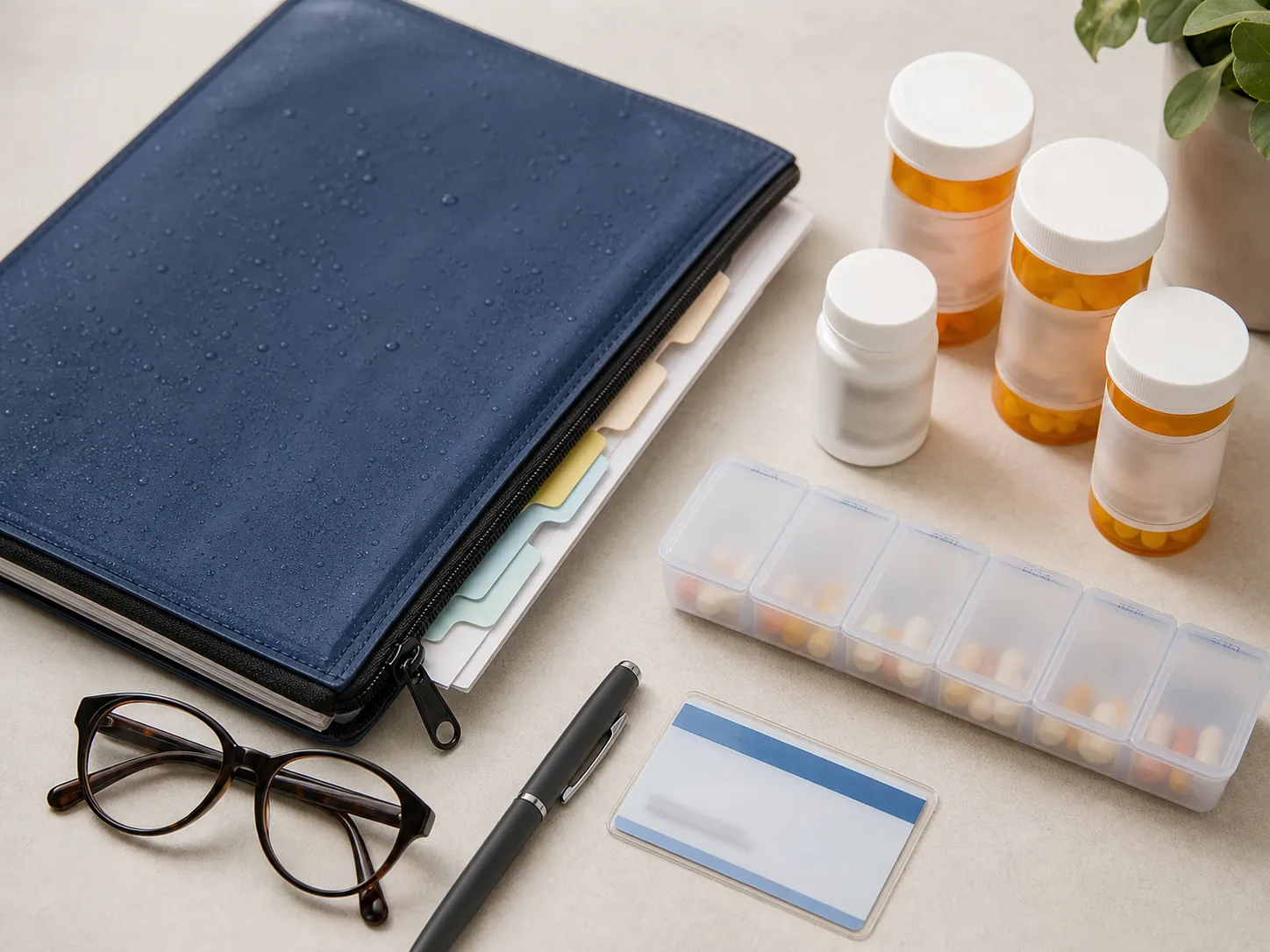
At minimum, include hard copies of wills, deeds, powers of attorney, insurance records, and phone numbers. The Conversation specifically points out that many older adults rely on preprogrammed phones; once the phone is dead, lost, or replaced, the numbers are gone unless they are printed. It also recommends sharing copies of important documents with trusted family members. [2]
- Medication list: drug name, dose, schedule, prescriber, pharmacy, and what each medication is for.
- Medical basics: diagnoses, allergies, recent surgeries, implanted devices, preferred hospital, primary care clinician, specialists, and health plan information.
- Decision documents: health care proxy, power of attorney, advance directive, and any legal documents your family may need to access care, housing, insurance, or finances.
- Household documents: insurance policies, deed or lease, vehicle information, utility account numbers, and photos of the home before storm season.
- Contact sheet: family, neighbors, pharmacy, doctors, home health agency, durable medical equipment supplier, oxygen supplier if applicable, local emergency management, and the planned evacuation destination.
- Device list: walker, cane, wheelchair, scooter, CPAP, hearing aids, glasses, dentures, chargers, batteries, and any model numbers or supplier contacts.
Do not leave this as a cloud folder only. A cloud copy is useful, but hurricane conditions punish assumptions: phones die, passwords are forgotten, cell service drops, and the person holding the login may not be the person standing at the pharmacy counter.
Set the 30-day medication and equipment buffer
The Red Cross recommendation to keep at least 30 days of medications is the right baseline for an older parent because the problem is not only landfall day. Pharmacies may close, roads may be blocked, mail-order deliveries may stop, and a caregiver may not be able to reach the house when the refill is due. [3]
Ask the prescribing clinician or pharmacist what can be refilled early before hurricane season, what cannot, and what the emergency process is for each medication. Controlled substances, refrigerated drugs, inhalers, insulin supplies, eye drops, and specialty medications deserve a separate line in the plan. If the answer is “call us when there is a storm,” write down who “us” is, which number to use, and what information the pharmacy will need.
The equipment buffer matters just as much. The Red Cross calls out extra assistive items such as a cane and eyeglasses; The Conversation adds batteries and chargers for assistive devices and mobility equipment such as scooters and wheelchairs. [2][3]
- Keep spare glasses where they can be packed quickly, not buried in a drawer.
- Add extra hearing-aid batteries or charging equipment.
- Keep a backup cane or walker tips if your parent depends on them.
- Label wheelchair, scooter, oxygen, CPAP, or other medical equipment with your parent’s name and contact information.
- Write down the medical equipment supplier and after-hours number.
- If a medication must stay cold, decide before the season how it will be transported or protected during an outage.
This is also where vague family optimism causes trouble. “Mom knows her meds” is not a plan. A scoping review on natural-disaster and medication preparedness among older adults found that a common failure is evacuation without prescriptions and inability to recall medication names and dosages. The same review summarizes prior U.S. survey evidence that six in ten older adults did not feel prepared for emergencies. [6]
Separate the 72-hour kit from the two-week stay-home kit
One emergency bin cannot do every job. A parent who evacuates needs a kit that can move fast. A parent who stays home needs enough supplies to wait out service interruptions. Mixing those two plans usually means the go-bag becomes too heavy and the home kit becomes too thin.
| Kit | Purpose | What to build around |
|---|---|---|
| 72-hour go-kit | Leave quickly and function away from home. | Medications, document folder, water, ready-to-eat food, clothing, chargers, device supplies, hygiene items, flashlight, cash, phone numbers, pet or service-animal supplies. |
| Two-week stay-home kit | Remain home when evacuation is not required or is less safe. | Water, shelf-stable food, medication buffer, lighting, batteries, cooling plan, sanitation supplies, backup power plan, device charging, and check-in schedule. |
For the portable 72-hour kit, use items your parent can actually lift, open, eat, read, and use. The Conversation recommends planning for at least 72 hours of self-sufficiency, including bottled water and food that does not require refrigeration or cooking. [2] For the longer stay-home plan, use the Red Cross older-adult guidance to plan for staying home for at least two weeks. [3]
For water, plan on one gallon per person per day. That means a parent living alone needs at least three gallons for a 72-hour minimum and fourteen gallons for a two-week stay-home baseline. Add more if there is a pet, medical need, high heat, or a second person staying with them.
Do not pack only food that technically has calories. Pack food your parent will eat without cooking, with packaging they can open, and with enough protein to keep them steady. If they have diabetes, swallowing problems, kidney disease, dental issues, or a medically restricted diet, the emergency food shelf has to reflect that before the stores are crowded.
The small items that prevent large problems
- A manual can opener if any food requires one.
- A flashlight your parent can grip, plus extra batteries.
- A battery-powered or hand-crank radio if your parent can use it.
- A printed map with the evacuation route and destination marked.
- Cash in small bills.
- Incontinence supplies, wipes, trash bags, gloves, and toilet paper.
- A change of clothing that is easy to put on, including shoes safe for wet ground.
- Pet food, leash, carrier, vaccination records, and service-animal supplies if applicable.
If your parent uses a walker or has balance problems, put the go-kit where they do not have to climb, bend deeply, or cross a cluttered room to reach it. The same rule applies to pre-storm home setup: clear the route from bedroom to bathroom, remove loose cords and throw rugs, and keep lighting within reach. A storm plan that creates a fall hazard is not finished. For a more detailed room-by-room pass, use a home fall-prevention checklist before the season gets busy.
Write the power plan as if the outage lasts longer than expected
Power loss is where older-adult hurricane planning stops being a supply list and becomes a medical safety plan. The Red Cross specifically tells older adults to make backup power plans for medical devices and refrigerated medications. [3]
List every item that depends on electricity: phone, hearing-aid charger, scooter, power wheelchair, adjustable bed, lift chair, oxygen equipment, CPAP, nebulizer, medication refrigerator, home Wi-Fi, medical alert system, and garage door opener. Next to each item, write the backup.
| Device or need | Question to answer before the storm |
|---|---|
| Phone | How many charged battery packs are available, and who calls if the phone goes dead? |
| Scooter or power wheelchair | How long does the battery usually last, where is the charger, and what is the manual-mobility backup? |
| Oxygen or respiratory equipment | Who is the supplier, what is the after-hours number, and what is the outage plan? |
| Refrigerated medication | How will it be kept within required storage conditions during evacuation or outage? |
| Medical alert system | Does it work during a power or internet outage, and what is the backup check-in method? |
| Elevator or stair access | Can the parent leave safely if power is out, and who physically helps? |
If any answer is “we’ll figure it out,” that item belongs on the pre-season task list, not the storm-day task list. Call the device supplier, clinician, utility, pharmacy, apartment manager, or local emergency management office now. If your parent needs evacuation assistance, the Red Cross recommends signing up for local registries or services before an emergency. [3]
Heat belongs in the power plan too. After a hurricane, an older adult may be indoors without air conditioning, elevators, refrigeration, or reliable phone service. If your family already has a heat-wave check-in routine, adapt it for storm outages; if not, build one using a post-storm heat safety check-in plan.
Make the stay-or-go decision before the forecast gets noisy
The stay-or-go decision should not be remade from scratch every advisory cycle. The National Weather Service says to know the home’s evacuation zone and understand whether it is vulnerable to storm surge, flooding, or wind before a hurricane threatens. It also says the best time to prepare is before hurricane season begins on June 1. [4]
By late August 2026, that pre-season window is already behind us. NOAA described the 2026 Atlantic hurricane season outlook as below normal, but a below-normal outlook is not a permission slip to skip the plan. One storm in the wrong place is enough to expose every missing refill, dead battery, and undecided driver. [5]

Write a branch point into the plan. Do not write “we’ll decide depending on the storm.” Write the conditions that automatically mean your parent leaves, and the conditions that mean they stay with a defined support plan.
Use automatic evacuation triggers
- A mandatory evacuation order is issued for the parent’s zone.
- The home is in a storm-surge or flood-prone area and local officials advise evacuation.
- The parent depends on powered medical equipment and backup power is not reliable enough.
- The parent cannot safely manage stairs, heat, toileting, medications, or meals without help, and help may not be able to reach them after landfall.
- The building relies on an elevator and the parent cannot evacuate by stairs if power fails.
- A caregiver must travel a long distance and cannot arrive safely once conditions deteriorate.
The evacuation destination must be named. “A shelter” is not enough. The Conversation recommends identifying shelters that can support older adults’ mobility and cognitive needs and making a pet plan. [2] If your parent has dementia, uses a wheelchair, needs oxygen, or has a service animal, call the local emergency management office before hurricane season peaks and ask what registration, transportation, or shelter information is required.
If the plan is to drive to a relative, write that address, route, backup route, departure trigger, and driver. If the plan is a public shelter, write the shelter type, transportation plan, what the shelter can and cannot provide, and what must be carried in. If your parent is likely to resist leaving, hold that conversation before a storm exists. The middle of an evacuation order is a bad time to negotiate identity, independence, fear, pets, and pride.
For parents with mobility limits, rehearse the physical movement: from bedroom to door, from door to car, from car to destination. Do not assume the route is safe because it is familiar. Wet thresholds, garage steps, loose mats, crowded hallways, and heavy bags change the risk. If you need a severe-weather movement protocol, adapt the same practical thinking used in this tornado safety plan for elderly parents.
Assign people, not intentions
A support network is only useful if each person knows the job. Ready.gov’s older-adult framework includes engaging a support network for a reason: during a disaster, one caregiver may lose cell service, get blocked by roads, become ill, or be caring for children in another county. [1]
| Task | Primary person | Backup person | When it happens |
|---|---|---|---|
| Confirm medications and refills | Name | Name | At the start of hurricane season and when a storm enters the forecast |
| Check document folder | Name | Name | Before June 1, then after any insurance, legal, or medication change |
| Charge devices and battery packs | Name | Name | When a storm watch is possible |
| Decide stay or go using written trigger | Name | Name | When local officials issue zone guidance or conditions meet the written trigger |
| Drive or arrange transportation | Name | Name | Before conditions deteriorate |
| Check after landfall | Name | Name | At scheduled times until power, water, food, medication access, and cooling are stable |
Give each person the printed contact sheet and a copy of the stay-or-go trigger. If a sibling lives far away, give them a job that can be done from far away: calling the pharmacy, tracking local alerts, booking a hotel, contacting the equipment supplier, or calling the neighbor if the primary caregiver cannot get through. Distance is not useless unless the plan gives the distant person no defined work.
Do one rehearsal that feels almost too ordinary: open the folder, call one number from the paper list, find the go-kit, check the flashlight, plug in the battery pack, locate the cane or walker, and talk through the evacuation trigger. The point is not to perform a drill. The point is to discover the missing charger, expired medication, wrong phone number, or bag your parent cannot lift while there is still time to fix it.
Plan for the weeks after, not just landfall
The day of landfall gets the attention. The weeks after often create the caregiver workload. The National Council on Aging organizes disaster guidance for older adults around before, during, and after—not just the emergency event itself—which is the right frame for a parent who may need help with medications, transportation, food, cooling, repairs, and paperwork after the storm passes. [7]
The danger to older adults is not theoretical. A Conversation article republished by PreventionWeb reported that about 60% of Hurricane Katrina deaths were people age 65 or older. [8] Separate research summaries have found longer-tail mortality signals after hurricanes as well: Medicare beneficiaries age 65 and older in areas flooded by Sandy had a 9% higher all-cause mortality risk up to five years after landfall, and older Medicare beneficiaries exposed to heavy Harvey rainfall had about a 3% elevated one-year mortality risk. [9][10]
Those figures should not be stretched into a prediction for any one family. What they do show is why the plan cannot stop when the wind stops. Power loss, heat, disrupted care, closed pharmacies, displacement, stress, and broken routines are not dramatic details; they are the ordinary pathways that make an aging parent less safe after the cameras leave.
The post-storm check should be concrete
- Is the parent physically safe right now, and can they reach the bathroom without a fall hazard?
- Is the home too hot, and is there a cooling destination if power is out?
- How many days of each medication are left?
- Are refrigerated medications still safe according to their storage instructions?
- Can the parent charge or use every required medical or mobility device?
- Is there drinkable water, food they can eat, and a safe way to prepare or open it?
- Are phone service, medical alert devices, and caregiver check-ins working?
- Does the parent need help documenting damage, contacting insurance, or avoiding unsafe cleanup?
If your parent falls, becomes confused, misses essential medications, cannot cool the home, cannot use a medical device, or cannot be reached as planned, treat that as a change in condition, not an inconvenience. The written hurricane plan should already say who escalates, who drives, and where the parent goes.
This article is planning information, not medical, legal, financial, or emergency-response advice. Medication buffers, refrigerated-drug handling, oxygen plans, evacuation transportation, legal documents, and insurance decisions should be confirmed with the appropriate clinician, pharmacist, local emergency management office, attorney, insurer, or benefits plan before a storm is approaching.
A useful hurricane plan for an elderly parent is not a prettier checklist. It is a written, shared, rehearsed system that keeps prescriptions, documents, mobility, power, communication, and the stay-or-go decision intact when the forecast gets loud and the household has less room to think.
References
- Older Adults | Ready.gov (Take Control in 1, 2, 3) — Ready.gov
- 5 tips for hurricane disaster planning with aging parents, starting now, before the storms — The Conversation
- Older Adults Emergency Preparedness — American Red Cross
- What to Do Before the Tropical Storm or Hurricane — National Weather Service
- NOAA predicts below-normal 2026 Atlantic hurricane season — NOAA
- Natural disaster and medication preparedness among elderly: a scoping review — PMC
- What Older Adults Can Do If Disaster Strikes — NCOA
- Disasters can harm older adults long after storms have passed — PreventionWeb
- Living in hurricane affected areas could increase mortality of older people by 9% years after disaster — Frontiers
- Do natural disasters have long-term impacts on mortality in older adults? — EurekAlert
Related reading
Noticed something outdated or inaccurate on this page? Flag a correction. We review every report against CDC, NIA, and AARP HomeFit guidance before updating a page.
Part of the Fall Prevention section.