
STEADI: Intervene
How to Build a Stay-or-Go Hurricane Plan for Older Parents
Deciding whether an older adult should evacuate or shelter in place before a hurricane or typhoon has no automatic answer — "always evacuate" and "always stay" both carry documented risks. Caregivers get an objective stay-or-go framework plus complete checklists for both branches, so the plan is ready no matter which call the evidence supports.
The hardest part of an elderly evacuation plan during a typhoon or hurricane is not packing the bag. It is refusing the false comfort of one permanent rule. “Always evacuate” can put a frail parent into a dangerous trip, a crowded shelter, or a long interruption in care. “Always stay” can leave that same parent in floodwater, heat, darkness, or a house where nobody can reach them.
Older adults are overrepresented in storm deaths, so delay is not a neutral choice. AARP reports that people age 75 and older were about 6% of New Orleans’ population in 2005 but about 50% of deaths in the city after Hurricane Katrina; a separate Katrina analysis cited in a 2025 scoping review found that about 71% of Louisiana Katrina fatalities were age 60 or older, with roughly half age 75 or older.[1][2] In Hurricane Sandy, nearly half of 117 deaths were among people age 60 and older, and in Hurricane Ian, 61 of 87 deaths with known age were among people age 60 and older.[1]
Those numbers are a warning, not a command. Evacuation itself has documented risk in care settings: a four-hurricane study of nursing-home residents found evacuation was an independent mortality risk factor for that long-term-care population.[3] That finding should not be stretched into proof that an older adult living at home is safer staying put. It does mean the family should decide early, before wind, flooding, medication gaps, and tired caregivers make every option worse.
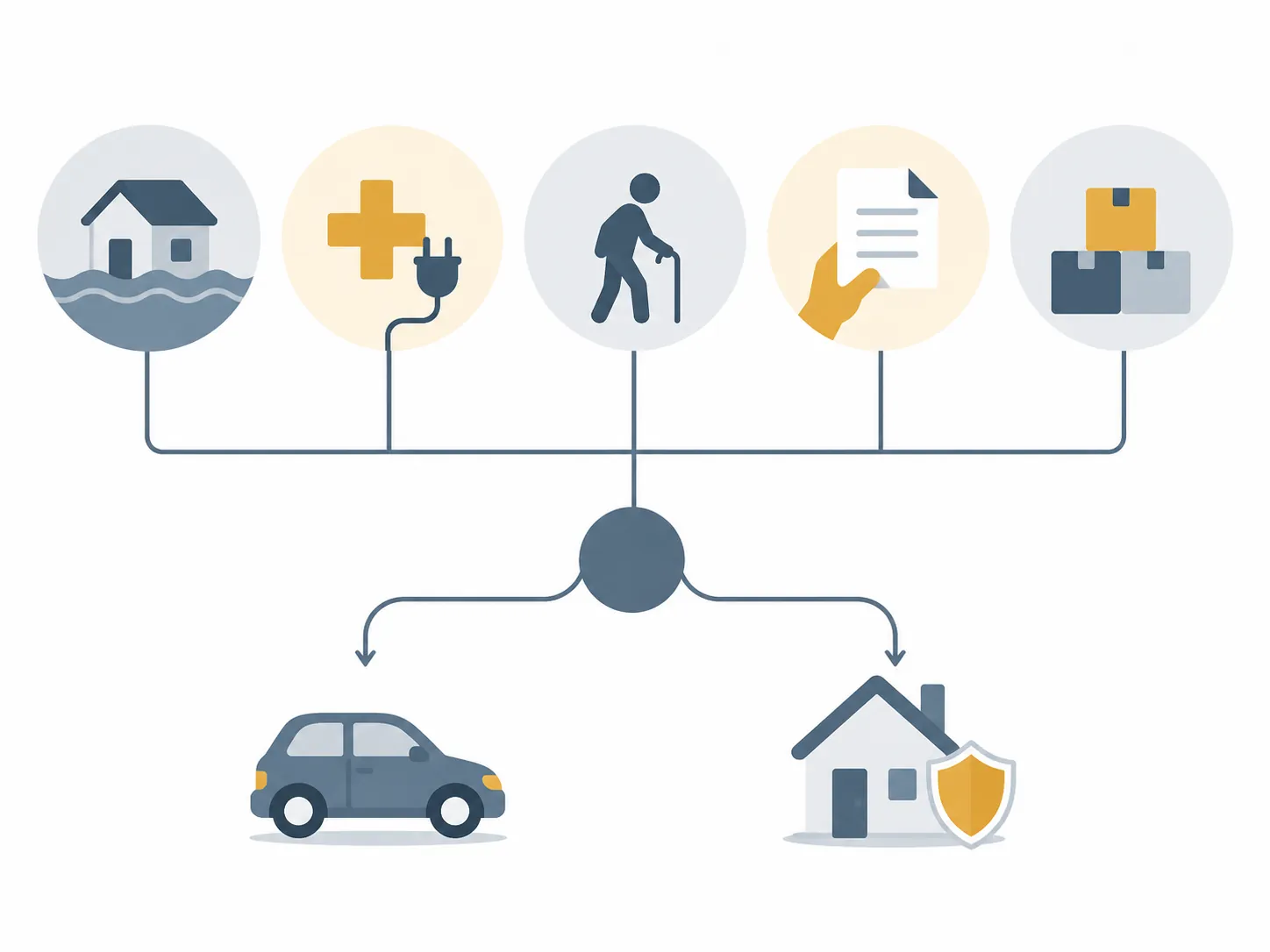
The stay-or-go decision rests on five conditions
A defensible hurricane or typhoon plan for an older parent starts with five concrete checks. They are not equal in weight. An evacuation order overrides preference. Flood exposure can override a good medication setup. A ventilator, oxygen concentrator, dialysis schedule, refrigerated medication, or severe mobility limitation can turn a sturdy home into a poor shelter if the power or helper plan is weak.
- Evacuation order or zone status: Is the home in a mandatory evacuation area, storm-surge zone, flood-prone area, manufactured home, or structure local officials have told residents to leave?
- Home construction and flood exposure: Can the home reasonably withstand the forecast hazard, and can your parent stay on a dry, safe level without needing stairs during the storm?
- Medical and power dependencies: What stops working if electricity fails, pharmacies close, oxygen deliveries pause, or roads are blocked?
- Mobility and available help: Who can move your parent, transfer them, carry equipment, secure the home, drive, and stay reachable after roads close?
- Two-week supply depth: Does the home have enough water, food, medication, batteries, cooling options, hygiene supplies, and caregiver coverage to function without normal services?
Write the answers down before the season starts. A plan that lives in everyone’s head usually has a missing owner: nobody is actually assigned to notice the oxygen backup battery is failing, refill the car tank, move the walker into the vehicle, or call the neighbor who promised to help.
| Condition | Early evacuation is the safer branch when… | Sheltering can remain on the table when… |
|---|---|---|
| Order or zone | Officials issue an evacuation order, the home is in the ordered zone, or the route will likely close before your parent can leave safely. | No order applies, local guidance permits staying, and the family continues monitoring official updates. |
| Flood and structure | The home is exposed to storm surge, likely flooding, unsafe trees or debris, roof failure risk, or manufactured-home wind risk. | The home is outside the expected flood hazard, structurally sound, and has a safe interior area your parent can reach. |
| Medical and power needs | Essential devices, refrigerated medicines, treatments, or clinical care cannot be maintained during a prolonged outage or road closure. | Backup power, medication storage, treatment timing, and clinician instructions are already confirmed. |
| Mobility and help | Your parent needs transfer help, cannot use stairs, is likely to fall in darkness, or would be alone without reachable support. | A named helper can arrive before conditions deteriorate and can remain or check in reliably. |
| Supplies | The home lacks enough water, food, medication, batteries, cooling, hygiene supplies, or caregiver capacity for an extended disruption. | The household has a realistic two-week shelter setup and a way to revise the decision if conditions worsen. |
Start with the parent, not the pantry
A supply list cannot answer whether a parent can survive the plan. First ask what the older adult can actually do under stress, in heat, in darkness, and without the routines that usually keep the day stable.
For power-dependent medical equipment, the gap is often larger than families assume. A University of Michigan researcher quoted by PBS NewsHour noted that only about 25% of older adults who rely on electricity-dependent medical equipment had an alternative power source.[4] That is not a small inconvenience if the device is oxygen, a powered bed, a stair lift, a nebulizer, a ventilator, or refrigerated medication storage.
Chronic conditions also matter because hurricanes and typhoons interrupt the ordinary systems that manage them. CDC’s Preventing Chronic Disease has reported that about 80% of older adults have at least one chronic condition, which can increase disaster vulnerability when medications, appointments, diet, temperature control, or electricity are disrupted.[5]
The mobility questions should be just as specific. Can your parent get from bed to bathroom without lights? Can they rise from a low chair if the lift recliner loses power? Can they step over a threshold into an evacuation vehicle? If the usual caregiver is an older spouse, can that spouse lift, steer, and calm them while also managing shutters, pets, prescriptions, and traffic?
This is where fall prevention becomes storm planning. A parent who is “fine at home” on a normal Tuesday may not be fine when the floor is wet, the hallway is dark, the toilet is harder to reach, and the phone battery is dying. For the home side of this assessment, connect the storm plan to permanent safety work such as lighting, grab bars, threshold fixes, and safe bathroom access; the same priorities show up in aging-in-place modification planning.
Medication planning needs more than one number
Medication advice can look contradictory until the family separates the problem into tiers. The Red Cross recommends a 30-day supply of medications for older adults, along with extra assistive items and registration with local emergency registries when appropriate.[6] AARP’s caregiver emergency guidance recommends a three-day supply in the go bag, plus a waterproof document folder and an emergency drill every six months.[7] Ready.gov and the American Association for Geriatric Psychiatry both support planning for extended disruption, including supplies, backup power, cooling, and medication continuity for older adults.[8][9]
Those are not competing answers to one question. They solve different failures.
| Tier | What it is for | What to keep |
|---|---|---|
| Home reserve | A long pharmacy disruption, delayed deliveries, or a shelter-in-place period. | Aiming toward a 30-day reserve when refill rules, cost, and prescribing instructions allow; include supplies for diabetes care, inhalers, eye drops, wound care, incontinence, hearing aids, and assistive-device parts. |
| Shelter depth | A period when the family may be safe at home but normal services are not restored. | Enough routine medication, water, food, batteries, hygiene supplies, cooling options, and caregiving support to cover an extended outage or road closure. |
| Travel go-bag | The first days after leaving, when pharmacies, records, and routines may not be available. | At least a three-day portable medication supply when feasible, copies of prescriptions, clinician contacts, insurance cards, device settings, allergies, and a current medication list. |
The older adult should know this system, not merely be packed around it. If your parent can make decisions, they should know which medications cannot be skipped, which must stay cold, which symptoms require help, and where the written list is stored. If cognition is impaired, that information still has to travel with them and be visible to whoever takes over.
If the evidence points to evacuation, leave while the plan is still humane
Once an evacuation trigger is met, the job is no longer to keep debating. The job is to move early enough that the older adult is not being transferred in wind, heat, floodwater, darkness, or panic. The evacuation branch should be boring on purpose: named driver, named helper, named destination, named route, named backup.
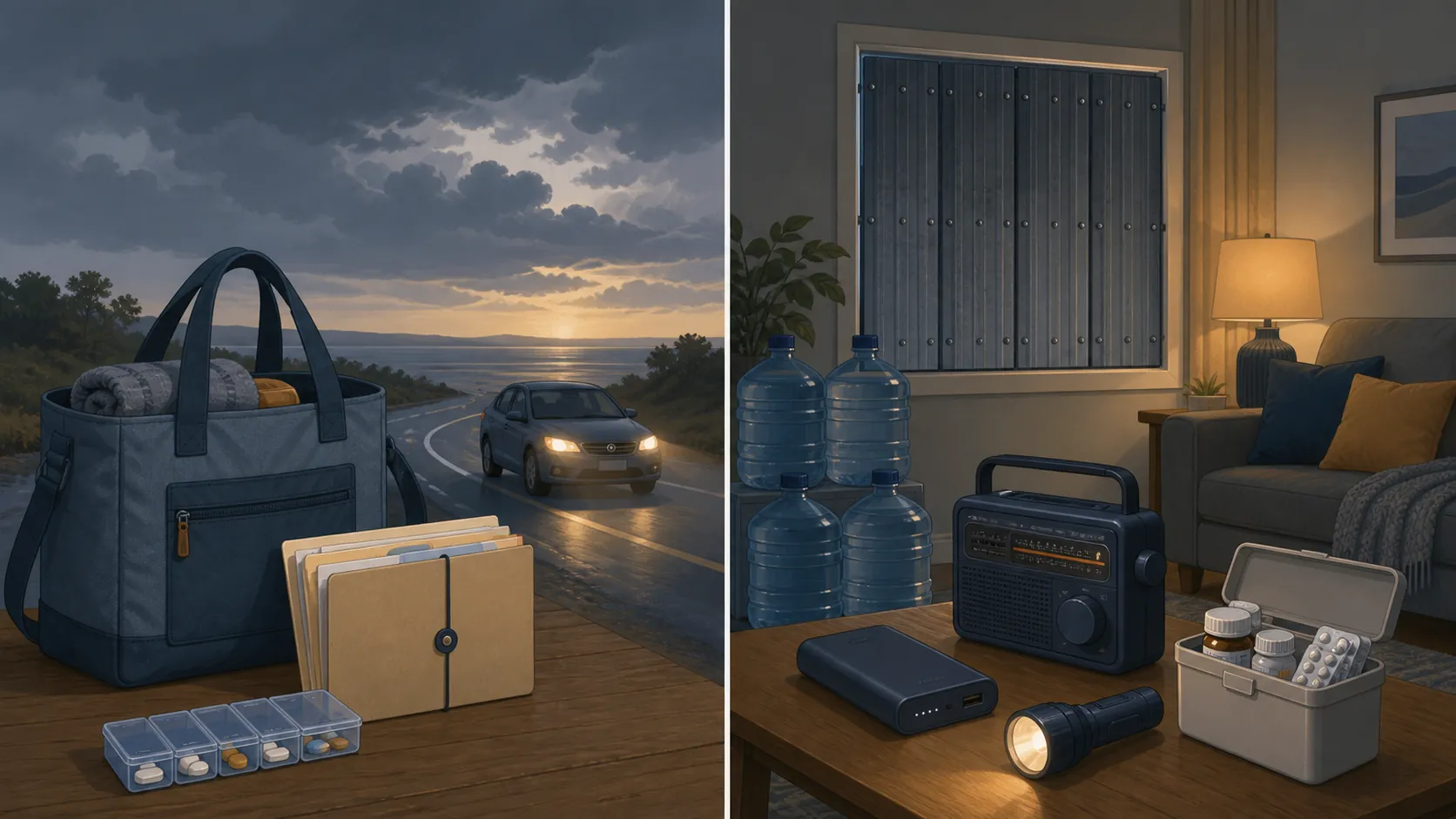
Set the trigger before the forecast becomes frightening
A good trigger is observable. Examples: a mandatory evacuation order for the home’s zone; forecast storm surge affecting the neighborhood; loss of the only available helper; a medical device that cannot be powered beyond a short outage; a destination that will stop accepting arrivals; or a road closure that would leave your parent trapped.
Avoid triggers that depend on courage or mood. “We’ll see how bad it looks” is not a plan for someone who needs a walker, oxygen, insulin, memory support, or help toileting.
Assign the physical work
- Driver: the person who drives the older adult, not the person who is also supposed to secure the house.
- Transfer helper: the person who can safely help with stairs, wheelchair transfer, oxygen tubing, walker loading, or getting into a higher vehicle.
- Medication owner: the person who checks the current medication list against the bag and confirms refrigerated items are packed correctly.
- Document owner: the person who brings IDs, insurance cards, advance directives if used, clinician contacts, prescriptions, equipment settings, and emergency contacts.
- Destination confirmer: the person who calls ahead and confirms the bed, elevator, bathroom access, power, pet rules, oxygen or medical supply delivery, and space for mobility equipment.
If the destination is a relative’s home, inspect it like a temporary care site. A second-floor guest room may be useless. A beautiful bathroom without grab bars may be dangerous. A home that loses power often may not be safer than the parent’s own house unless it has backup power or a better caregiving setup.
Build the travel go-bag around the first 72 hours
The travel bag is not the whole disaster plan. It is the bridge between leaving and reestablishing care. Keep it light enough that the assigned person can actually carry it while also assisting your parent.
- Medication: portable supply, medication list, dosing schedule, prescribing clinicians, pharmacy phone number, and instructions for refrigerated or time-sensitive drugs.
- Documents: photo ID, insurance cards, emergency contacts, copies of key medical information, and legal documents the family already uses for care decisions.
- Mobility and sensory items: walker, cane, wheelchair cushion, hearing-aid batteries, glasses, dentures, chargers, spare device parts, and labels for equipment.
- Comfort and cognition support: familiar clothing, incontinence supplies, simple snacks, written routines, a small comfort item, and clear identification if confusion or wandering is a concern.
- Power and communication: phone charger, battery bank, charging cables, contact sheet on paper, and any device-specific power cord.
Do one practice load before storm season: place the parent, walker, bag, oxygen or other equipment, and caregiver in the vehicle. If it takes two people on a calm day, it will not become a one-person job in rain.
If sheltering is allowed, prove the home can carry the load
Sheltering in place is not passive. It is a staffed, supplied, power-aware plan for staying safe while the outside world is temporarily unreliable. It should be chosen only when the home is not under an evacuation order, the flood and structure assessment supports staying, medical needs can be managed, and help can arrive or remain in place before conditions deteriorate.
Power: decide what must run, not just what would be nice
List every item that depends on electricity and separate it into essential, safety-critical, and comfort. Essential may include oxygen, a ventilator, dialysis-related equipment, a powered bed, refrigerated medication, a CPAP machine if clinically necessary, or a phone used for emergency contact. Safety-critical may include lighting, a lift chair, a stair lift, a medical alert system, or a fan used as part of a heat plan.
For each item, write the backup: battery duration, charging method, generator connection if used, who tests it, and when it is tested. A battery nobody checks is a wish. If your parent has power-dependent care needs, use a focused outage checklist such as what to check first when a parent’s power is out and adapt it before storm season.
Generators require their own rule, written where everyone can see it: never run a generator indoors, in a garage, or near windows or doors. Carbon monoxide risk rises exactly when families are tired, hot, and improvising, so generator placement is not a detail to leave for the night the lights go out. Ready.gov and AAGP both emphasize backup power, generator safety, and carbon-monoxide precautions as part of older-adult disaster planning.[8][9]
Cooling: make heat a medical planning item
After a hurricane or typhoon, heat can become the hazard inside the house. The cooling plan should say which room stays coolest, how air will move if power is limited, where the older adult can go if indoor temperature becomes unsafe, and who makes that call. This is especially important for parents with heart disease, respiratory disease, diabetes, kidney disease, limited sweating, cognitive impairment, or medications that affect fluid balance or heat tolerance.
If the backup cooling site requires a car trip, it belongs in the evacuation branch too. A cooling center that cannot be reached after roads flood is not a shelter-in-place solution.
Medication and water: stock the routine, not just the emergency
The shelter supply should cover the ordinary day: morning pills, evening pills, blood-sugar checks, inhalers, eye drops, wound care, continence supplies, nutrition needs, and safe drinking water. The more complex the routine, the less useful a generic “disaster kit” becomes unless it is matched against the parent’s actual day.
For refrigerated medication, write the storage range, backup cooling method, pharmacy or clinician contact, and discard instructions if temperature control fails. Do not rely on memory for this during a power outage.
Lighting and fall hazards: assume the house will be unfamiliar
A familiar home becomes a different place after a storm. Rugs curl. Water comes under doors. Extension cords cross walkways. The bathroom is darker. The route to the bedroom changes because a window is leaking. The shelter plan should include battery lighting at the bed, bathroom, hallway, kitchen, and main sitting area; clear walking paths; dry towels staged for small leaks; and a rule that the older adult does not walk outside to “just check something.”
Typhoon planning for seniors living alone often fails at this exact point: the supplies exist, but the post-storm walking path is unsafe. If your parent may shelter alone, compare the home against a fall-safe typhoon checklist for seniors living alone, even if your local storms are called hurricanes rather than typhoons.
Communication: do not make one phone the whole system
The communication plan should work if one person loses service, one phone dies, or the older adult cannot manage the device. Put the contact list on paper. Include the local emergency management number, utility outage number, neighbors, nearby relatives, physicians, pharmacy, oxygen or medical supply company, home health agency if used, and the out-of-area person who can relay information.
- Check-in schedule: exact times, who calls whom, and what happens after a missed check-in.
- Battery plan: phone, medical alert device, hearing aids, radio, flashlight, and backup battery bank.
- Neighbor role: who has permission to knock, enter, or call for help if the family cannot reach the parent.
- Information script: short written notes about medications, diagnoses, mobility limits, cognition, allergies, and emergency contacts.
If the older adult uses a medical alert system, confirm whether it depends on home power, cellular service, landline service, or Wi-Fi. Then write down what replaces it when that service fails.
Build both branches before the storm has a name
Families often overbuild the branch they prefer. The parent who hates leaving has a beautiful pantry and no workable destination. The adult child who wants evacuation has a packed tote and no plan for what happens if roads close first. Neither is enough.
Before storm season, the family should be able to answer four questions without opening a browser:
- What exact conditions trigger evacuation?
- What exact conditions permit sheltering in place?
- Who performs each physical task, including transfers, driving, medication packing, power checks, and home safety checks?
- What supply, equipment, caregiver, transportation, or destination gap is still unresolved?
Run one short drill every six months, as AARP recommends for emergency preparation.[7] The drill does not need drama. Check the bag. Charge the battery banks. Confirm the destination. Review the medication list. Practice the transfer into the vehicle. Walk the nighttime path from bed to bathroom with the planned lights. Call the neighbor who is on the list and make sure they still agree to be on it.
For related caregiver planning, power-outage fall prevention after tornadoes and heat-related wildfire planning use the same discipline: identify the hazard, name the person who acts, and remove the unsafe walking path before the crisis. See the sibling guides on post-tornado power outage fall prevention and wildfire safety for older adults during a heat dome if those hazards also affect your family.
The decision can still change. Forecasts shift, helpers get sick, a generator fails its test, a parent develops a new infection, or an evacuation route closes earlier than expected. A stay-or-go plan is useful because it makes those changes visible. When the evidence changes, the branch changes.
References
- Disaster Risks to Older Adults, AARP
- Emergency preparedness and response for older adults during natural disasters: a scoping review, PMC
- Hurricanes put nursing home residents at substantial risk, despite emergency plans, Brown University, September 13, 2018
- Why it can be more difficult to evacuate older adults in a disaster, PBS NewsHour
- Public Health and Aging: Trends in Aging — United States and Worldwide, CDC Preventing Chronic Disease
- Older Adults, American Red Cross
- Preparing for Emergency, AARP
- Older Adults, Ready.gov
- Older Adults and Disaster Preparedness and Response, American Association for Geriatric Psychiatry
Related reading
Noticed something outdated or inaccurate on this page? Flag a correction. We review every report against CDC, NIA, and AARP HomeFit guidance before updating a page.
Part of the Fall Prevention section.