
STEADI: Intervene
How to Build a Wildfire Evacuation Plan for Elderly Parents
An effective elderly wildfire evacuation plan assigns every task to a named helper with a backup, pre-arranges transportation for older adults who don't drive, and packs medical continuity before a fire starts. This guide covers needs assessment, a senior-specific go-bag, pre-driven routes, and the exact actions to take at each Ready/Set/Go level.
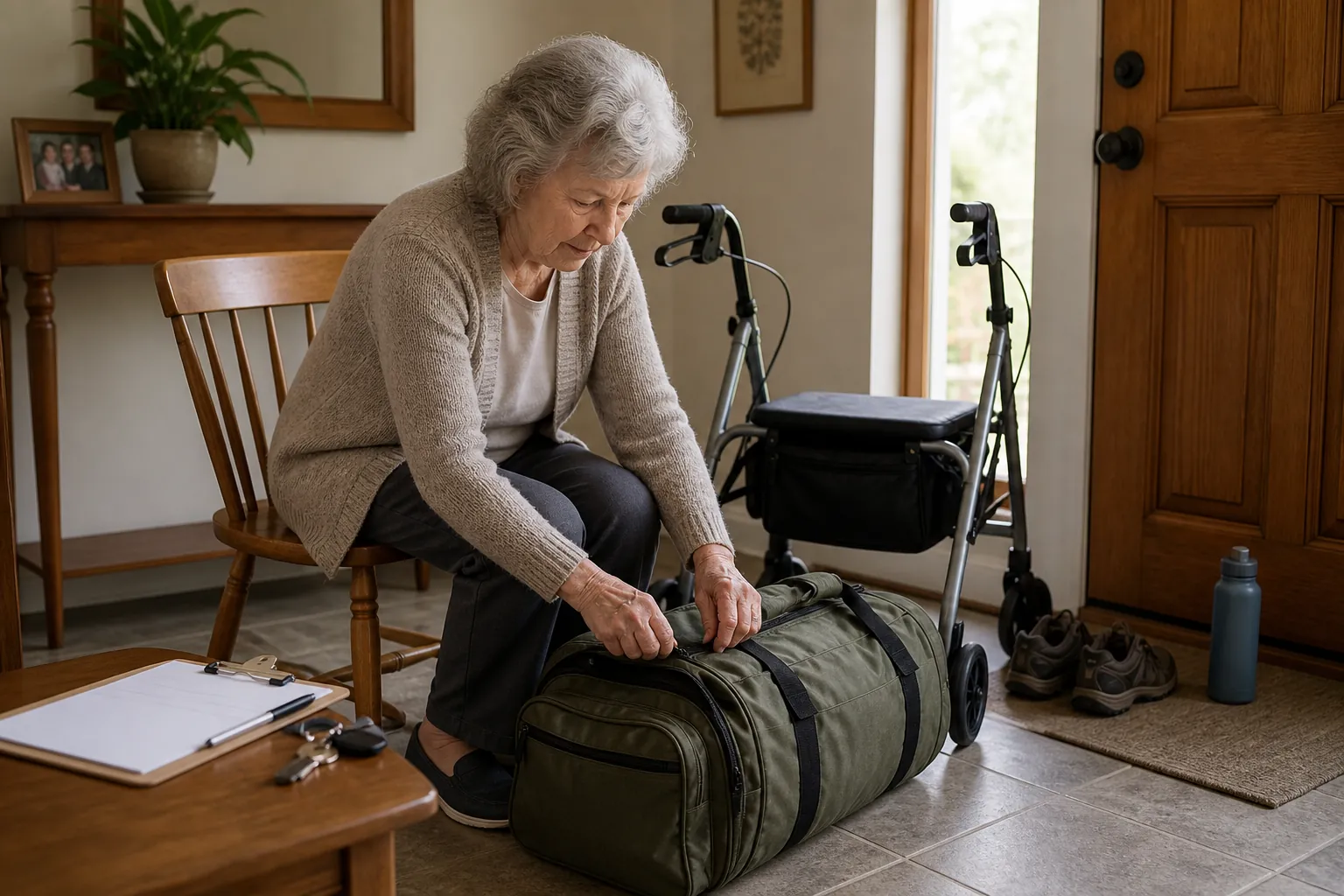
Who leaves with your parent, in whose vehicle, carrying which medical items, at which alert level? If the answer is a group promise such as “we’ll all help,” the evacuation plan is not finished. A workable elderly evacuation plan for wildfire names the driver, names the backup, lists the medical equipment, and states what happens before an evacuation order becomes mandatory.
This matters because adults 65 and older had 2.5 times the fire fatality risk of the total U.S. population in 2020. [1] Older adults may need more time to stand, transfer, find glasses, gather medications, move a walker, or understand a changing instruction. They are also less likely to receive disaster warnings, and many people delay evacuation even after conditions become dangerous. A 2023 scoping review found that older adults face serious evacuation barriers and that social support is associated with fewer wildfire fatalities. [2]
The January 2025 Los Angeles fires made the cost of those barriers visible: reporting on 25 confirmed deaths found that most victims were people 65 and older or people whose disabilities made evacuation nearly impossible. That was an event-specific account, not a universal statistic, but it is a strong reason to make departure an assigned action rather than a last-minute family debate. [3]
Start With a Written Assignment Sheet
Put the plan on paper and keep a copy at the home, in the primary vehicle, and with each assigned helper. The first page should answer the questions a tired person will have while cell service is poor:
- Who is the primary evacuation helper and who is the backup?
- Who drives, and what happens if that driver is working, traveling, injured, or unreachable?
- Where will the older adult go: a named relative's home, hotel, shelter, or another prearranged location?
- Who collects medications, oxygen equipment, CPAP equipment, pets, documents, and mobility devices?
- Which alert or condition triggers departure, and who has authority to make the call?
- Who confirms that the older adult has left, and who checks the house only if authorities say it is safe to do so?
Use names and phone numbers, not roles alone. “Neighbor” is not an assignment. “Daniel Ortiz, primary driver, 555-0100; Priya Shah, backup driver, 555-0112” is an assignment. Ask each person directly whether they accept the responsibility, then record a second person for every task. The general emergency evacuation plan checklist can provide an all-hazards framework; this wildfire version needs the additional detail of smoke, road closures, fast-moving alerts, and early departure.
Assess What Evacuation Actually Requires
Walk through the departure from the older adult's point of view. Do not write “assist as needed.” Observe how long it takes to get from bed or chair to the front door, whether there are steps or narrow passages, and whether the person can enter the planned vehicle safely. The written plan should record the assistance required and the person responsible for providing it.
- Mobility: Can the person walk outside, transfer into a seat, or use stairs? Does fatigue, pain, balance, or smoke exposure change the answer?
- Assistive devices: Which walker, rollator, wheelchair, cane, transfer board, or other device is essential? Can it fit through the exit and into the vehicle without being left behind?
- Breathing and powered equipment: List oxygen cylinders or concentrators, tubing, CPAP or BiPAP equipment, batteries, chargers, and any provider instructions for transport. Identify who disconnects, carries, and reconnects each item.
- Medications: Record generic and brand names, doses, timing, prescribing clinician, pharmacy, allergies, and the plan for refrigeration or controlled medicines. The person collecting medications should be named.
- Cognition and communication: Note dementia, hearing loss, vision loss, speech limitations, language needs, anxiety, or a tendency to wander. Decide who gives instructions and how the older adult is identified if separated.
- Pets and service animals: List carriers, leashes, food, medications, and the person responsible for loading each animal.
- Warnings and contact: Choose more than one way to receive alerts, such as phone notifications, a local alert system, radio, and a neighbor who will knock. The plan should state who confirms the message.
Ready.gov specifically advises planning how assistive devices will travel and keeping copies of Medicare, Medicaid, and insurance cards. [4] For an older adult who relies on powered medical equipment, also include a power-outage contingency: battery capacity, charging locations, and the clinician or supplier to call. The site's guidance on why power outages are dangerous for older adults can help with that part of the assessment.
Build the Support Network Around Tasks
A support network is useful only when its members know what they are expected to do. The Red Cross recommends planning who will help an older adult evacuate and refreshing the plan and supplies every six months. [5] Turn that advice into a small assignment table.
| Task | Primary | Backup | When it happens |
|---|---|---|---|
| Call or visit the older adult | Named helper and phone number | Named helper and phone number | At Level 1 and after every alert update |
| Drive the older adult | Named driver and vehicle | Named driver and vehicle | At the departure trigger |
| Collect medical equipment | Named helper | Named helper | Before departure |
| Collect medications and documents | Named helper | Named helper | Before departure |
| Load mobility devices and pets | Named helper | Named helper | Before departure |
| Confirm arrival | Named caller | Named caller | After reaching the destination |
The primary helper should not be the only person with the medication list or destination address. Give the backup the keys, access code, current health information, and permission to act. Decide how the backup takes over: for example, if the primary driver has not checked in within 10 minutes of a Level 2 alert, the backup calls the older adult and begins the transport plan.
Prepare Medical Continuity Before the Fire
The go-bag is not primarily a collection of snacks and spare clothes. For an older adult, it is a bridge between the home routine and several days away from the usual pharmacy, equipment supplier, clinician, and bathroom setup.
- Medication containers, a current medication list, prescriptions, allergies, and pharmacy contact information
- Required oxygen, CPAP, or other medical equipment, with chargers, batteries, tubing, and adapters
- Spare eyeglasses, hearing-aid supplies, dentures, continence supplies, and basic hygiene items
- Copies of identification, insurance, Medicare or Medicaid cards, emergency contacts, and care instructions
- A phone charger, flashlight, sturdy shoes, clothes that cover the skin, water, food, and pet supplies
- Respiratory protection selected for smoke conditions, not merely a fabric face covering
Medication quantities do not have one universally accepted number. The CDC advises storing a 7-to-10-day supply of prescription medicines in a waterproof, childproof container for evacuation. [6] The Red Cross advises keeping at least 30 days of medications and spare assistive items, while Sonoma County recommends 3 to 7 days of life-saving medications in a personal go-bag. [5][7] Ask the prescribing clinician and pharmacist what is practical and legal for the older adult's medicines, then document the refill plan.
N95 or P100 respirators can reduce exposure to wildfire smoke particles when properly fitted; dust masks, surgical masks, and bandanas do not provide the same smoke protection. [8] Respiratory disease, frailty, and difficulty wearing a respirator may require individualized medical advice. For the broader smoke-response plan, see how to help seniors during wildfire smoke and evacuation and the guide to air-quality safety for elderly adults.
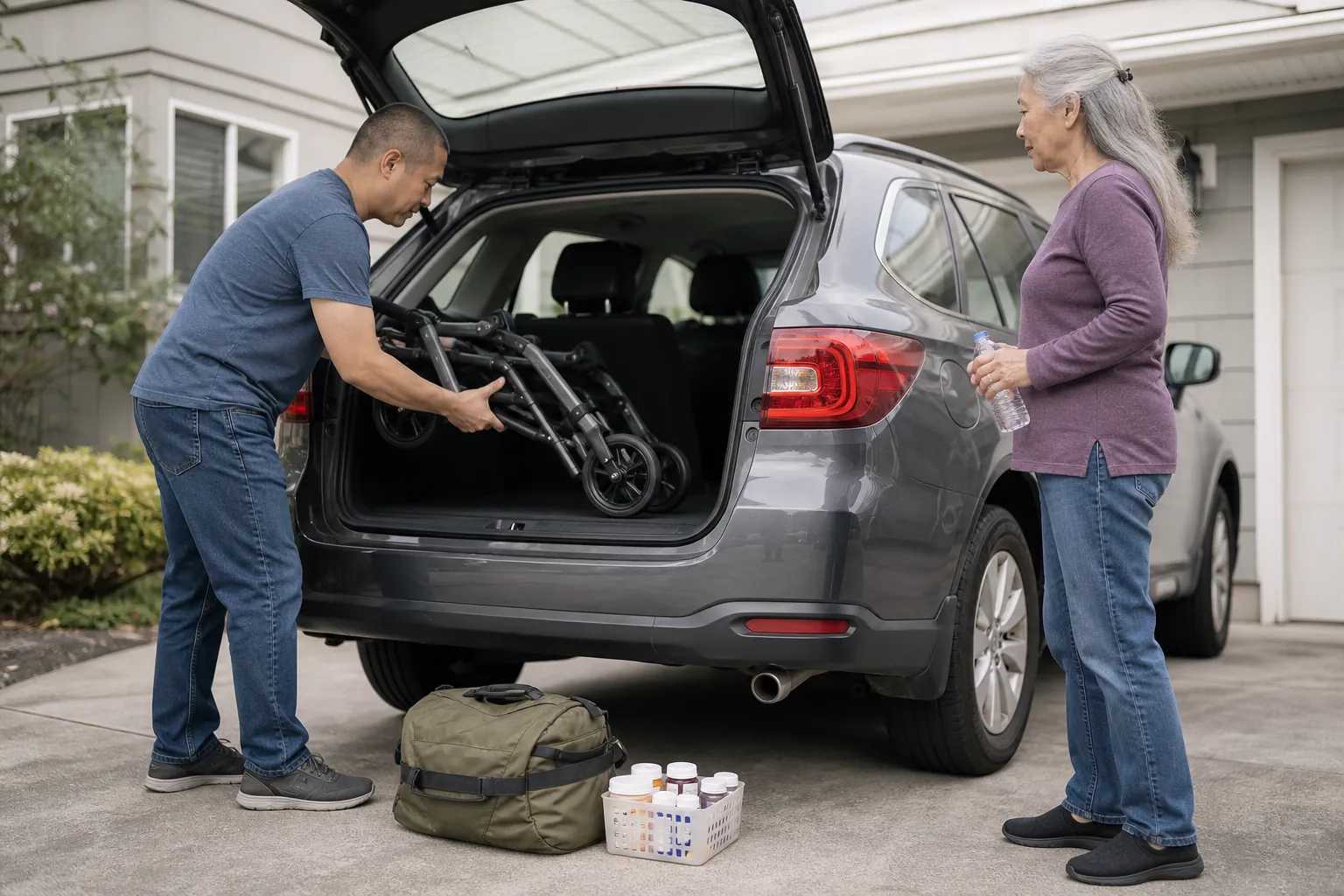
Solve Transportation Before It Is Needed
“Doesn't drive” is not a minor detail. It determines whether the plan can happen at all. The University of Nevada, Reno Extension states that transportation for an older adult who does not drive must be arranged in advance. [8] A ride that exists only in the family group chat is not pre-arranged transportation.
Choose a vehicle that can accommodate the person, caregiver, mobility device, medical equipment, pet, and bags without blocking a safe exit. Measure the folded walker or wheelchair and the vehicle opening. Practice loading it. Put the go-bag where it can be reached quickly, and keep the vehicle at least half full of fuel; CAL FIRE includes that fuel level in its evacuation guidance. [9]
Drive two routes to the destination before fire season. Record the route names, alternate roads, fuel stops, accessible restrooms, and a point where the group will reunite if vehicles separate. Do not assume the familiar route will remain open. The person responsible for checking local road and evacuation information should be named, with a backup who can make the same check.
If family drivers are unavailable, write down the local paratransit, accessible taxi, volunteer transportation, senior service, or emergency transport contacts that serve the address. Call them before an emergency to ask about wildfire evacuation availability, wheelchair capacity, service boundaries, pets, and after-hours requests. A service that cannot confirm these details should not be the only transportation option.
Turn Ready, Set, Go Into Actions
The Western Fire Chiefs Association uses Ready, Set, Go as a working evacuation framework: Level 1 Ready, Level 2 Set, and Level 3 Go. Its Level 1 guidance specifically tells elderly people and residents with limited transportation to consider leaving immediately. [10] Counties may use different labels or define levels differently, so confirm the local terminology with the county emergency management office.
| Level | Action for the older adult's plan |
|---|---|
| Ready | Confirm the alert, call the older adult, notify the primary and backup helpers, check the vehicle and fuel, move the walker and go-bag near the exit, charge devices, and consider leaving immediately rather than waiting. |
| Set | Leave promptly. The primary driver arrives or the backup takes over, medications and medical equipment are loaded, pets are secured, the destination confirms availability, and the family records the departure. |
| Go | Evacuate immediately using the safest confirmed route. Do not spend time gathering nonessential possessions or waiting for every relative to arrive. Tell the contact person where the older adult is going and report arrival. |
For a person who cannot move quickly, Level 1 should be treated as a real departure trigger, not merely a reminder to think about leaving. Smoke, road congestion, a missing helper, a power outage, or a worsening medical condition can make an earlier departure more important even when the official level has not changed. The plan should state who can authorize that earlier departure and what information they use.
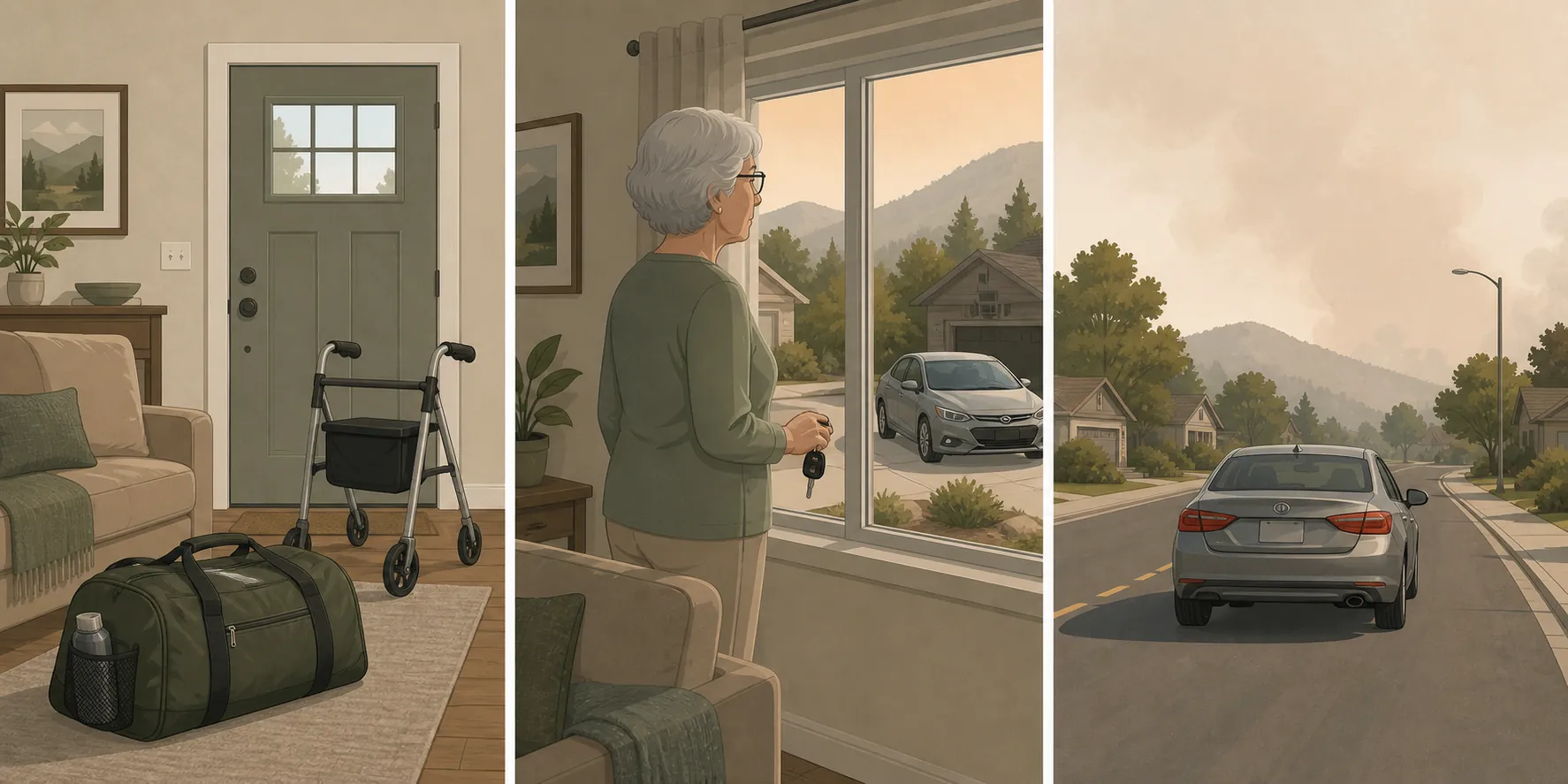
Practice the Parts That Usually Fail
A practice run should expose physical and administrative problems, not create a dramatic rehearsal. Time the trip from the older adult's usual chair or bed to the vehicle. Load the actual mobility device. Check whether the oxygen tubing, CPAP case, medication container, and pet carrier fit. Have the backup helper perform the task instead of the primary once, so the plan does not depend on one person's memory.
Practice receiving an alert and making the call tree without relying on a single phone. Confirm that the destination is accessible and that someone will be present when the older adult arrives. Review dementia-related communication, hearing or vision accommodations, and what happens if the older adult refuses to leave or becomes confused. These situations may require a clinician's or trained caregiver's advice; do not improvise physical restraint or change medication instructions during an emergency.
Review the written plan and supplies every six months, and update them sooner after a medication change, fall, hospitalization, new mobility device, change in cognition, move, vehicle change, or change in helper availability. Replace expired food, batteries, and other perishables according to the local guidance; Sonoma County, for example, advises yearly replacement of perishables in personal go-bags. [7]
A Final Plan Check
Before the next fire season, verify five things: the plan is written, every task has a named primary and backup, transportation has been tested, medical continuity is packed and reviewed, and the local evacuation levels and routes are confirmed. Then practice it with the actual older adult, vehicle, equipment, and helpers. A plan that cannot be followed by a tired caregiver in smoke, traffic, and poor cell service is still a collection of good intentions.
This article provides general preparedness information, not medical or legal advice. Have a geriatric registered nurse, occupational therapist, or Certified Aging-in-Place Specialist (CAPS) review the plan when the older adult uses medical equipment, has significant mobility or cognitive impairment, or needs individualized evacuation support.
References
- Older Adults — U.S. Fire Administration/FEMA
- Wildfire Evacuations Spell Difficulties for Disabled, Elderly Residents — AJMC
- Older Adults and Wildfire Evacuation: A Scoping Review — PMC
- Older Adults — Ready.gov
- Older Adults — American Red Cross
- Wildfire Smoke and People with Chronic Conditions — Centers for Disease Control and Prevention
- Personal Go-Bags — Sonoma County Emergency
- Wildfire Smoke and Older Adults — University of Nevada, Reno Extension
- Go Evacuation Guide — CAL FIRE Ready for Wildfire
- Wildfire Evacuation Levels Explained — Western Fire Chiefs Association
Related reading
Noticed something outdated or inaccurate on this page? Flag a correction. We review every report against CDC, NIA, and AARP HomeFit guidance before updating a page.
Part of the Fall Prevention section.