
STEADI: Intervene
Build a Storm Preparedness Checklist With Your Aging Parent
Storm plans fail when they're imposed on an aging parent. This checklist shows how to build one together — pairing supplies and documents with conversation starters for parents who resist preparing or refuse to evacuate, a redundant check-in network, and dementia-specific evacuation rules.
A storm starts forming, your parent says they are fine, and the fastest thing to do is search for a storm preparedness checklist for elderly parents, fill it in yourself, and text it over.
That may get supplies onto a page. It may not get your parent out the door, onto a backup oxygen plan, into a shelter, or willing to answer the phone when the first check-in comes. Disaster planning with an aging parent has to start earlier than the inventory. Lee Ann Rawlins Williams, writing in The Conversation, puts the correction plainly: “Emergency planning isn’t something done for older adults — it’s something done with them.” Her five-part framework includes documents, medications and equipment, evacuation routes and shelters, a multiperson check-in system, and practice before the storm arrives.[1]
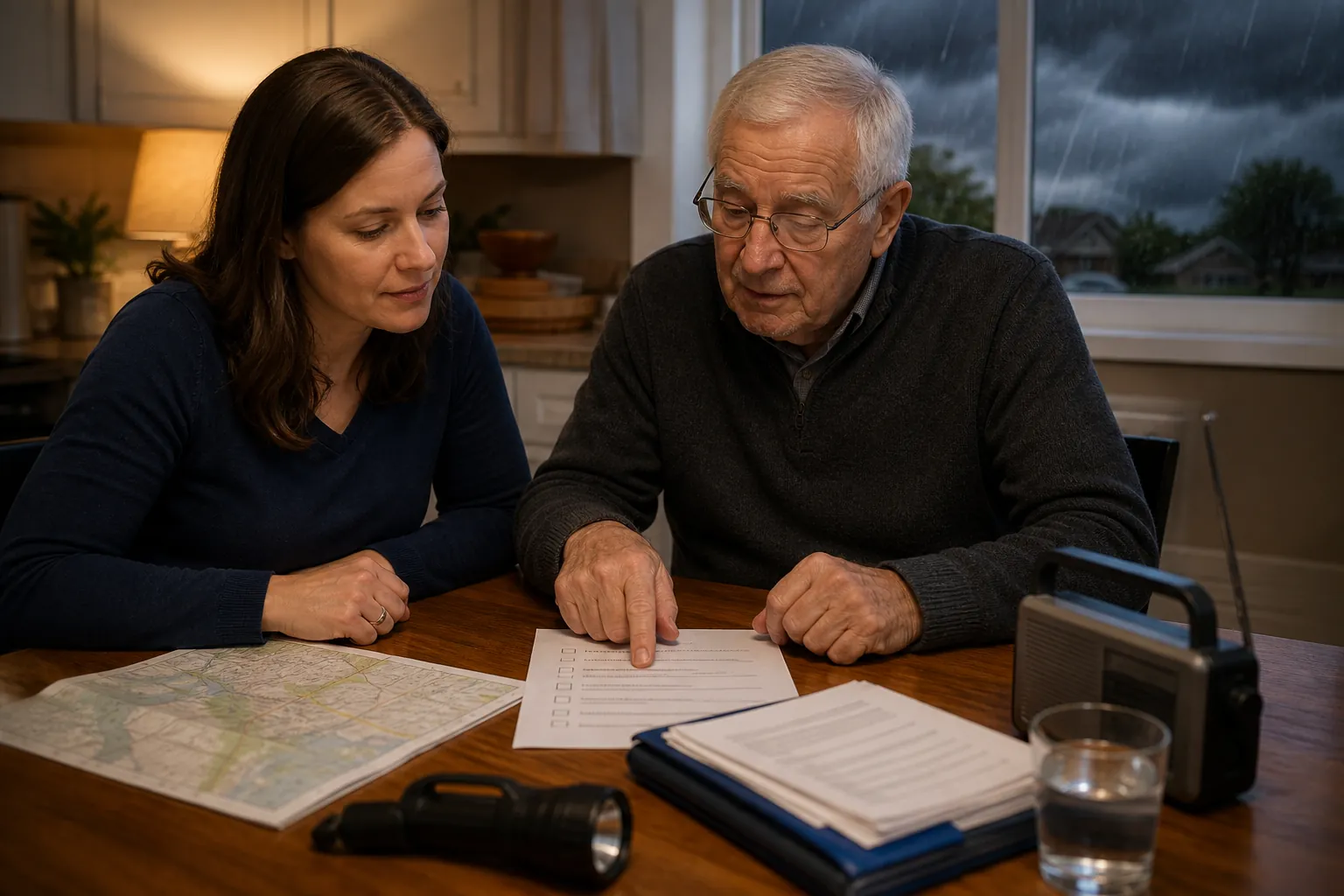
The difference is not politeness. It is usability. A parent who helped choose the driver, pack the document folder, decide what happens to the cat, and name the neighbor with a spare key is more likely to recognize the plan under stress. A parent who only receives instructions may hear a different message: you no longer trust me to run my own life.
Use this in two layers. If a storm may affect your parent within 48 hours, start with the urgent version below. If there is more time, build the fuller checklist together and print it. For detailed kit quantities and packing lists, use this as the conversation layer and pair it with the site’s senior storm supply checklist rather than trying to rebuild every battery, water, and food line here.
This article is general preparedness education, not medical, legal, financial, or emergency-response advice. Medication reserves, equipment backup, evacuation orders, insurance decisions, and legal documents should be confirmed with the clinician, pharmacist, local emergency officials, attorney, or benefits provider involved in your parent’s care.
If the storm is close: the 48-hour version
When there is little time, do not open with a lecture about risk. Open with assignment: “Can we decide who is doing what before the phones get busy?” Then move quickly through the items that fail hardest when they are left vague.
- Agree on the first decision point. What warning, outage, flood risk, medical-equipment problem, road closure, or official order changes the plan from staying put to leaving?
- Name the primary helper and the backup helper. A plan that says “family will check” is not a plan. Put names, phone numbers, and expected check-in times on paper.
- Locate the document folder. Include identification, insurance cards, medical information, emergency contacts, and copies or access instructions for key legal and financial documents.
- Confirm medications and medical equipment. Ask the pharmacist or clinician what supply is realistic and safe for your parent, what cannot be missed, what requires refrigeration, and what changes during an outage.
- Check power-dependent equipment. Oxygen, CPAP, powered mobility devices, refrigerated insulin, lift chairs, and communication devices need more than “we’ll see.” Identify battery, generator, charging, or relocation options.
- Choose the route and shelter options before arguing about evacuation. Include pet-friendly options if a pet is part of the household.
- Put a spare key where the plan says it is. At least one trusted person should know how to get in, where supplies are kept, and how to use lifesaving equipment or administer medicine if that is part of the agreed support role.[3]
- Write the refusal barrier down. If your parent says, “I’m not leaving,” ask what would make leaving unacceptable: cost, pet separation, fear of burglary, mobility, bathroom needs, medications, embarrassment, or not wanting to be a burden.
If your parent is already under an evacuation order, in immediate danger, or dependent on equipment that is failing, follow local emergency instructions. Conversation matters, but it cannot replace urgent response.
The printable checklist should have a task and a prompt
A useful checklist for an aging parent has two jobs. It says what has to exist, and it asks whether your parent will actually use it.
| Checklist item | What to decide together | Question to ask |
|---|---|---|
| Emergency documents folder | Where it is stored, who has copies, and what can be accessed if your parent cannot speak for themselves. | “If I had to help from the ER, what papers or phone numbers would you want me to have?” |
| Medication plan | Which medicines cannot be missed, what supply is realistic, who calls the pharmacy, and what needs refrigeration or special handling. | “Can we ask your pharmacist what they recommend for storm season instead of guessing?” |
| Medical equipment and backup power | Which devices are essential, how long they can run without power, and where your parent goes if backup fails. | “If the power is out overnight, which device worries you first?” |
| Mobility and fall-risk items | Walker, cane, wheelchair, grabber, glasses, hearing aids, sturdy shoes, and a safe path to the exit. | “What would make it hard to get from the bedroom to the car in rain or darkness?” |
| Transportation | Primary driver, backup driver, accessible vehicle needs, and what happens if roads or bridges close. | “If the first driver cannot come, who is the next person you would actually accept help from?” |
| Evacuation route and shelter options | Two routes, where to go, whether the location can handle pets, oxygen, mobility needs, and chronic-care routines. | “Which place would feel least disruptive if you had to leave for a few days?” |
| Pet plan | Carrier, leash, food, medication, vaccination records, pet-friendly shelter or host, and backup caregiver. | “What would you need to know about the pet before you would agree to leave?” |
| Home-security plan | Who locks up, what comes inside, where valuables or documents go, and who checks the property afterward if safe. | “What are you afraid would happen to the house if you left?” |
| Check-in network | Exact times, who calls first, who calls second, who has a key, and when someone escalates to a welfare check. | “If you miss the first call, how long should we wait before asking someone nearby to knock?” |
| Practice | A twice-a-year review, one call-tree test, one document-folder check, and one route review. | “Can we test the plan on a calm day so we are not inventing it during a warning?” |
The supply part still matters. Water, shelf-stable food, flashlights, batteries, a radio, first-aid supplies, chargers, sanitation items, and copies of key records are not optional comforts. But the kit becomes much more useful when every item is attached to a person, a place, and a failure plan. If your parent lives alone, pair this with a before-during-after storm checklist for seniors living alone, especially for spare-key and check-in details.
Refusal is often information, not just defiance
Adult children often hear “I’m not leaving” as denial. Sometimes it is. Sometimes it is also arithmetic.
In a 2020 survey of 2,256 U.S. older adults discussed by Sue Anne Bell, about 1 in 4 respondents, or 24%, said it would be difficult to afford staying somewhere else for a week if necessary. Among respondents who used essential electricity-dependent medical equipment, only about 25% had an alternative power source.[2] Those figures do not prove what any one parent will do in a storm. They do make one thing hard to dismiss: resistance can come from real constraints, not merely from personality.
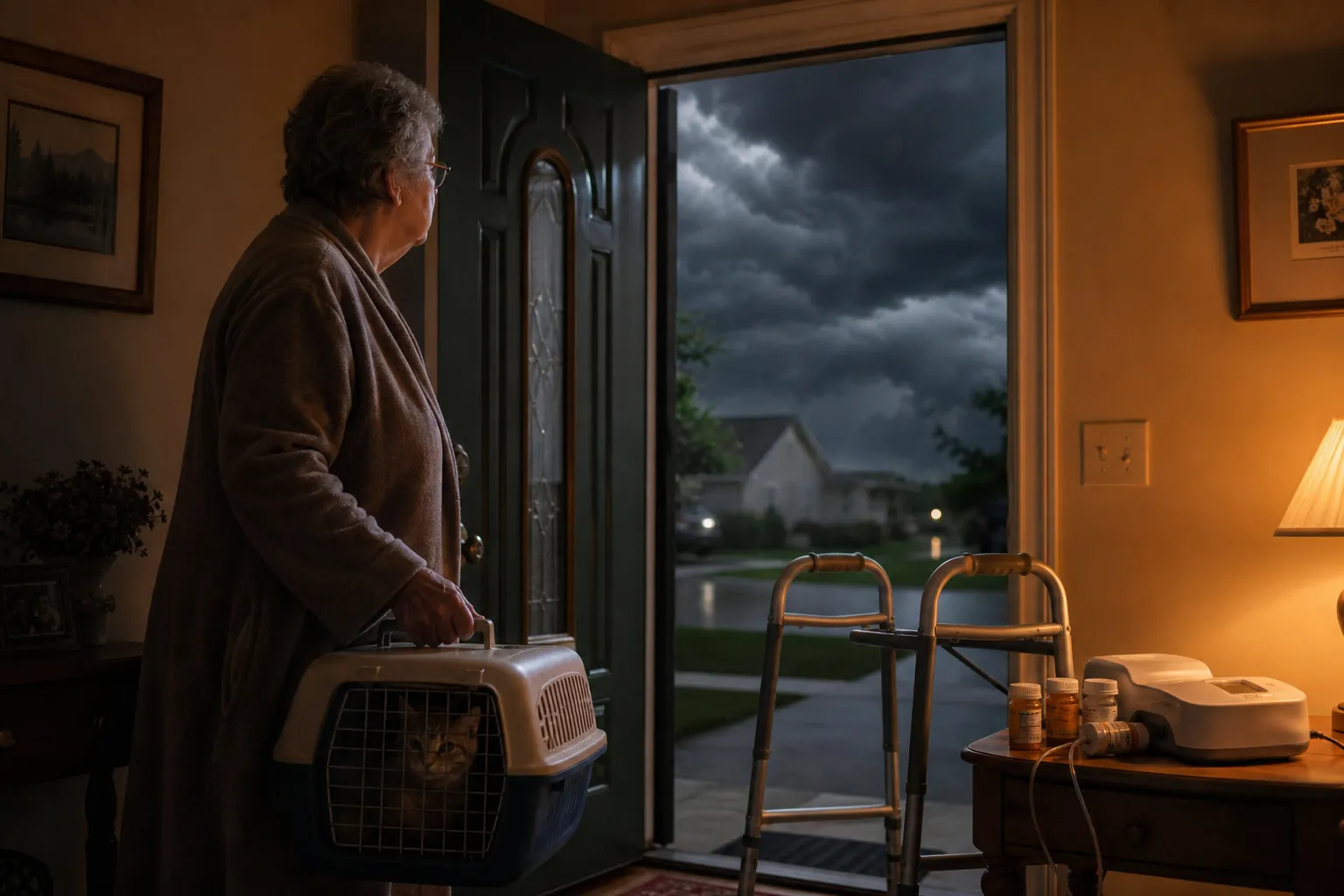
Cost changes the conversation. “You need to go to a hotel” may sound reasonable to a caregiver who has not priced a week away, transportation, meals, pet fees, medication replacement, and lost home-care visits. A better first question is, “If money were the reason not to leave, what part would be hardest?” That opens the door to checking public shelters, relatives, faith communities, accessible transportation programs, benefits access, and local emergency resources before the warning is already active.
Care routines are another quiet barrier. A parent who manages dialysis appointments, wound care, insulin, oxygen, home health aides, memory-care routines, or a carefully timed medication schedule may not experience evacuation as “going somewhere safer.” They may experience it as losing the fragile system that keeps them stable. The checklist should name the routine, not wave at it. Who calls the clinic? Where is the prescription list? Which supplies travel? Which receiving location can handle the need? What is the clinician’s instruction if one dose, treatment, or appointment is disrupted?
Pets deserve the same seriousness. In The Conversation’s discussion of Hurricanes Helene and Milton in 2024, some older adults stayed home because they feared separation from pets or worried their homes would be vandalized.[1] That is case evidence, not a statistic about how often this happens. Still, it is enough to justify a line on the checklist. If the dog, cat, bird, or other animal is not in the plan, the plan may not exist.
Home-security fear also needs an answer more practical than reassurance. Decide who closes blinds, moves outdoor items, locks doors, takes photos for insurance if time allows, and checks the property afterward when officials say it is safe. If your parent’s fear is burglary or vandalism, saying “things can be replaced” may be morally true and conversationally useless. Give the fear a job.
Normalcy bias is harder because it sounds like experience: “This neighborhood never floods,” “The last one missed us,” “I’ve lived through worse.” Do not spend all your time trying to win the storm-history debate. Move to thresholds: “What would make this one different enough that you would leave?” Write down the answer. If the answer is “nothing,” that is not a completed conversation; it is a risk your family needs to plan around with backup contacts, welfare-check rules, and local emergency guidance.
Build redundancy before anyone misses a call
A single adult child cannot be the whole emergency system, especially from another city. Phones fail. Caregivers get blocked by roads. Drivers cancel. Neighbors evacuate. The plan needs assigned roles before everyone is scared.
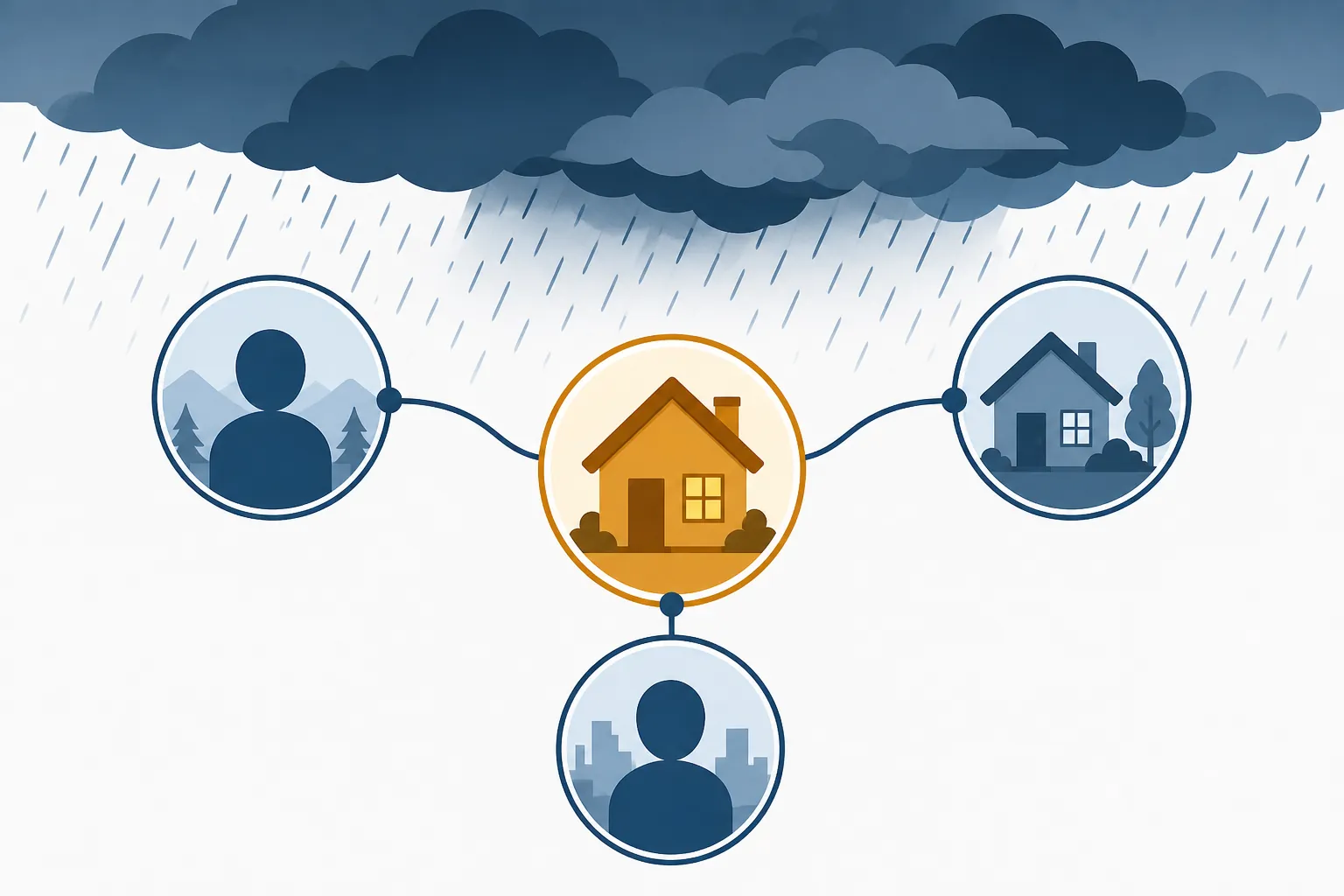
Ready.gov’s older-adult guidance is useful here because it turns concern into concrete delegation. At least one person in the support network should have an extra key, know where emergency supplies are kept, and know how to use lifesaving equipment or administer medicine if that applies. Ready.gov also advises setting up electronic benefit payments and notes that the FEMA app can provide weather alerts for up to five locations, which matters when an adult child is monitoring a parent’s town from somewhere else.[3]
| Role | Best person | What they agree to do |
|---|---|---|
| Parent | Your parent, unless dementia or another condition changes capacity and supervision needs | Keep the printed plan visible, answer scheduled check-ins when able, say early what would make them refuse, and follow official instructions. |
| Primary local contact | Neighbor, nearby relative, building manager, faith-community contact, or friend | Knock if calls fail, use the spare key only under agreed conditions, verify power and safety, and report back. |
| Backup local contact | Someone who does not rely on the same household or vehicle as the primary contact | Step in if the first local helper evacuates, cannot drive, or loses phone service. |
| Long-distance coordinator | Often the adult child | Track alerts, call at agreed times, maintain the contact list, and avoid making the local contact invent the whole plan during the storm. |
| Out-of-area contact | Relative or friend outside the storm zone | Receive status updates if local lines are overloaded and serve as the information hub for scattered family. |
| Medical or equipment contact | Pharmacy, clinician, oxygen supplier, home health agency, durable medical equipment provider, or dialysis clinic as relevant | Confirm medication, device, refrigeration, charging, or treatment instructions before the storm. |
| Pet backup | Friend, relative, boarding option, or pet-friendly destination | Take the animal if your parent must enter a setting that cannot accept it, or help transport the pet with supplies. |
Set escalation rules in plain language. For example: if the 9 a.m. call is missed, the long-distance coordinator tries again after a short interval; if the second call is missed, the local contact knocks; if there is no answer and danger is plausible, the family follows the agreed emergency escalation plan. Keep the wording simple enough that no one has to interpret family politics while emergency lines are busy.
Transportation needs the same backup logic. If your parent uses a walker, wheelchair, oxygen, or cannot transfer safely into any available car, “my brother will pick her up” may be too thin. Name the vehicle, the driver, the backup driver, and the mobility equipment that goes with them. For a deeper transportation template, especially when mobility limits affect vehicle choice, use the site’s evacuation transport planning guide and adapt the driver-and-backup structure to storms.
Evacuation is not one decision; it is a chain of smaller agreements
Whether your parent should evacuate or shelter in place depends on the storm, the home, official orders, medical needs, mobility, transportation, and local hazards. This article is not a substitute for local instructions. If you need help structuring the stay-or-go judgment before a storm, start with the site’s elderly hurricane evacuation plan.
Here, the missing piece is consent and execution. A parent may agree in theory that evacuation is sensible and still refuse when the route, shelter, pet rule, bathroom situation, or sleeping arrangement becomes real. Before the storm, ask your parent to rank the least-bad options: a relative’s home, a hotel, a public shelter, a medical shelter if eligible, or another preidentified location. Then ask what would make each option fail.
- If the barrier is pets, identify pet-friendly shelters, hotels, relatives, boarding options, carriers, food, medications, and vaccination records.
- If the barrier is mobility, identify accessible transportation, transfer help, a wheelchair or walker plan, and where the mobility aid will fit.
- If the barrier is cost, identify no-cost or lower-cost destinations, public options, benefits access, and who can help pay deposits or transportation if appropriate.
- If the barrier is medical routine, call the clinician, pharmacy, supplier, or care agency before the storm to ask what must travel and what can be interrupted safely, if anything.
- If the barrier is home security, assign lock-up, documentation, neighbor notification, and post-storm check roles.
Shelter planning should be specific enough to reduce surprises. Does the shelter allow pets? Can it accommodate oxygen or other equipment? Is there a quieter area? Can your parent manage the bathroom setup? Who stays with them if they cannot navigate the shelter alone? If your parent is likely to refuse a shelter because of privacy, noise, crowds, or fear of losing control, write that down while there is still time to look for alternatives.
Medication planning should be confirmed, not guessed
Medication advice often sounds simpler than it is. Some emergency-preparedness guidance pushes families toward larger reserves; other clinical or system-specific instructions may use shorter minimums. Insurance refill rules, controlled substances, refrigeration, mail-order delays, and condition-specific risks can all change what is possible.
The safest checklist wording is not “pack X days for everyone.” It is: confirm the storm supply with the pharmacist or prescriber, write down what cannot be missed, and decide who is responsible for refills before the storm. Include the prescription list, dosage schedule, allergies, pharmacy phone number, prescriber contact, and storage needs in the document folder.
For equipment, ask a similarly concrete question: “What happens if power is out longer than the battery lasts?” If the answer is relocation, the evacuation threshold should be earlier than it would be for someone without power-dependent medical needs. The survey finding that only about 25% of essential electricity-dependent medical equipment users reported having an alternative power source is not a prediction about your parent, but it is a warning against assuming backup exists until someone has put eyes on it.[2]
When dementia is involved, the plan changes
Dementia is not a small note at the bottom of a storm checklist. It changes supervision, evacuation timing, shelter behavior, identification, and what counts as “safe.” The Alzheimer’s Association advises that a person living with dementia should never be left alone during evacuation.[4]
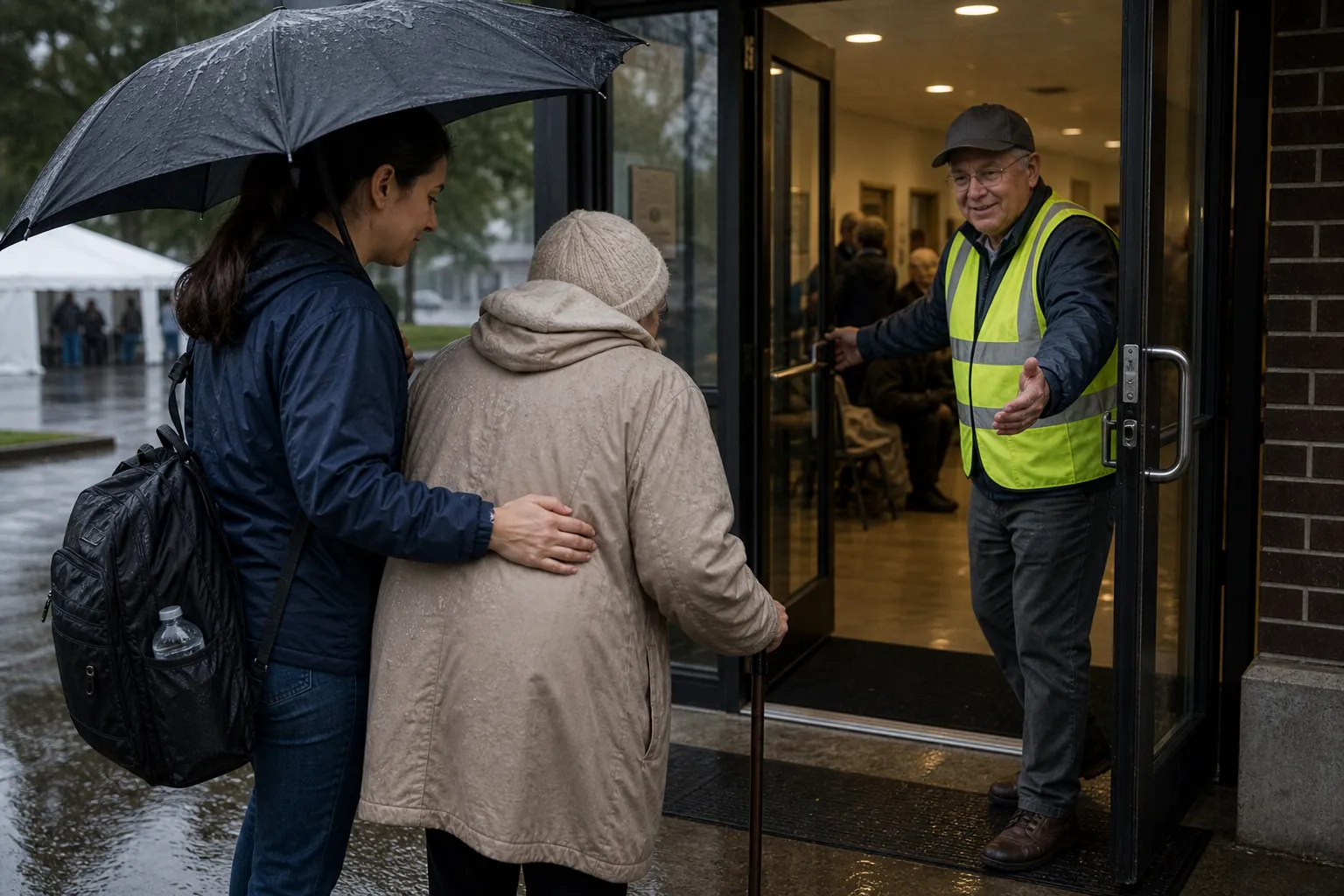
That one rule removes several comforting but unsafe assumptions. It is not enough to send a rideshare, ask a neighbor to drop someone off, or assume shelter staff will know the diagnosis. A caregiver or assigned responsible person needs to remain with the person through the transition unless qualified emergency or care staff have explicitly taken over.
The dementia kit also needs different contents. The Alzheimer’s Association recommends a watertight emergency kit with items including an identification bracelet, a recent photo, Velcro shoes, copies of legal documents, and comfort items.[4] The point is not only survival supplies. It is recognition, redirection, and reducing distress in an unfamiliar place.
- Add identification that stays on the person, not only in the bag.
- Pack a recent photo in case the person wanders or becomes separated.
- Choose practical footwear that is hard to slip out of and safe for wet or crowded conditions.
- Include copies of legal and medical documents that clarify who can make decisions and what care is needed.
- Bring comfort items that help with familiarity: a blanket, familiar clothing, music, small photo album, or other calming object.
- Tell shelter staff about the dementia diagnosis and any wandering, agitation, communication, toileting, medication, or feeding concerns.
- In a shelter, stay away from exits when possible to reduce wandering risk, as the Alzheimer’s Association advises.[4]
The conversation layer may also need to shift. A parent with mild dementia may still participate in familiar choices: which comfort item to pack, which shoes feel secure, which relative’s home feels calmer. But the caregiver must plan for the version of the emergency in which memory, judgment, sleep, noise, and crowding all get worse at once.
Practice the plan while it still feels unnecessary
Practice does not need to be theatrical. It needs to expose friction. Call the backup contact. Open the document folder. Confirm the spare key still works. Ask your parent to point to the flashlight. Check whether the walker fits through the intended exit path. Make sure the pet carrier is not buried in a closet. Walk through the first hour of evacuation: who calls, who drives, what bag leaves, what door gets locked, where everyone goes.
Set a review habit that attaches to something already on the calendar: the start of hurricane season, the switch to daylight saving time, a medication review, a primary-care visit, or a family visit. The point is not to create a perfect binder. It is to catch the changes that quietly break plans: a new medication, a dead battery, a neighbor who moved, a pet that now needs medicine, a parent who no longer drives after dark, a home-health schedule that changed.
Also review the hours around the storm, not only the evacuation. Wet entryways, power outages, rushed trips to the bathroom, misplaced glasses, and dim lighting can turn an otherwise manageable storm into a fall. For that layer, use the site’s guide to severe storm safety for older adults and the tropical-storm aftermath plan for the days after the first danger passes.
By the time the plan is usable, it should be boringly specific: documents located, supplies assigned, medications confirmed, backup power checked, drivers named, contacts tested, pet and home-security worries answered, dementia rules added if relevant, and a review date set. The safest checklist is not the longest one. It is the one your aging parent helped build before the emergency narrowed everyone’s choices.
References
- 5 tips for hurricane disaster planning with aging parents starting now, before the storms, The Conversation
- Why it can be more difficult to evacuate older adults in a disaster, PBS NewsHour / The Conversation
- Older Adults, Ready.gov
- In a Disaster, Alzheimer’s Association
Related reading
Noticed something outdated or inaccurate on this page? Flag a correction. We review every report against CDC, NIA, and AARP HomeFit guidance before updating a page.
Part of the Fall Prevention section.