5 Modifiable Risk Factors That Explain Why Your Parent Keeps Falling
Reviewed: 2026-06-28
5 Modifiable Risk Factors That Explain Why Your Parent Keeps Falling
If your parent is still falling after you've removed rugs and installed grab bars, the cause may lie in medications, muscle weakness, vision loss, or chronic conditions. This guide explains the five modifiable risk factors behind most falls and gives you a checklist to discuss with your parent's doctor.
By Editorial Team
bathroom safety
bedroom safety
stair safety
kitchen safety
entryway access
grab bars
non-slip flooring
balance exercises
medication fall risk
home hazard audit
checklist
STEADI
The rug is gone. The bathroom has grab bars. The hallway is brighter than it has been in years. You moved the cords, cleared the clutter, and had the awkward conversation about shoes in the house.
Then your parent falls again.
That is the moment when fall prevention in older adults stops feeling like a checklist and starts feeling like a problem no one has explained well enough. A safer home matters. It can remove obvious trip points and make recovery from a stumble less dangerous. But home hazards are only one part of the fall-risk picture. Medications, leg strength, balance, vision, hearing, chronic pain, dizziness, neuropathy, and blood pressure changes can all be working in the background at the same time.
Falls are common enough to deserve that broader view. More than 1 in 4 older adults falls each year, less than half tell their doctor, and falling once doubles the chances of falling again, according to the CDC.[1] The CDC also frames most falls as the result of a combination of risk factors, with the chance of falling rising as more risks are present.[2] That is the key shift: your parent may not have “one reason” for falling. They may have several modifiable risks adding up.
The national cost is large, but the urgency is already clear in one household. Healthcare spending for non-fatal older adult falls reached $80 billion in 2020, up from $50 billion in 2015.[3] For a family, the cost often starts smaller and more immediate: an emergency room visit, a shaken parent, a daughter or son replaying the fall in their head, and a doctor visit where everyone says “be careful” but no one names what to check next.
A Safer House Helps, But It Cannot Review a Medication List
The home-safety work was not wasted. Loose rugs, poor lighting, slippery bathrooms, stairs without secure rails, and cluttered walking paths are real fall hazards. If those are still present, they deserve attention. But if you have already handled the obvious hazards and the falls continue, repeating the same room-by-room advice can start to feel like being blamed for not trying hard enough.
A better next step is to walk into the appointment with the question narrowed: “What modifiable risk factors could still be contributing to these falls?” The CDC’s STEADI initiative is built around that kind of clinical approach: screen for fall risk, assess the risk factors that may be driving it, and intervene on the factors that can be changed.[4]
For caregivers, that does not mean diagnosing the cause at home. It means bringing better raw material into the visit: the full medication pile, a timeline of recent falls, specific changes in walking or balance, and a list of conditions that affect feet, joints, vision, hearing, blood pressure, or sensation.
1. Medications That Quietly Change Alertness, Balance, or Blood Pressure
Medication review is often the most useful place to start because the risk is both hidden and actionable. A parent can look steady at breakfast and still be affected by a nighttime sleep aid, a new blood pressure dose, a pain medication, an antihistamine, or the combined effect of several prescriptions that were each reasonable when prescribed separately.
One review on polypharmacy and falls describes evidence that using 4 or more prescription medications was associated with a 75% increase in fall risk, and that polypharmacy raised the odds of recurrent falls by about 1.5 to 2 times.[5] That statistic should not be treated as a universal prediction for every older adult. Medication lists, doses, diagnoses, and frailty differ. But it is more than enough reason to ask for a deliberate medication review instead of assuming the list is fine because each bottle has a valid label.
The review should include prescription drugs, over-the-counter medicines, vitamins, supplements, and anything taken only “once in a while.” Occasional medicines matter because falls often happen during exactly those off-routine windows: after a bad night of sleep, during a respiratory infection, after pain flares, or after a dose change.
Bring the actual containers if you can. A printed list is better than memory, but bottles reveal dose, timing, prescriber, refill patterns, and duplicates. The clinician or pharmacist can look for medications that may cause drowsiness, dizziness, confusion, slowed reaction time, low blood pressure on standing, or unsteady gait. They can also see whether two different products contain overlapping ingredients.
This is not a reason to stop medicines on your own. It is a reason to ask more precisely: “Could any of these increase fall risk?” “Could the timing be changed?” “Are any still necessary?” “Should blood pressure be checked sitting and standing?” “Would a pharmacist-led review help?” Those questions turn medication risk from a vague worry into something the care team can actually work through.
2. Lower-Body Weakness and Balance Changes
Caregivers often say a parent is “getting weaker,” but that phrase can be too general to help in an appointment. Try to describe what changed. Are they pushing off the chair with both arms now? Taking shorter steps? Reaching for furniture? Avoiding curbs? Turning in several small steps instead of pivoting? Stopping before they look up or down? Those details tell a clinician more than a broad report of weakness.
Strength and balance are not side issues. CDC fall-prevention materials cite pooled trial evidence showing that exercise reduced the rate of falls among community-dwelling older adults by 21%.[1] That does not mean every older adult should be handed the same exercise sheet. It means that a fall history should trigger a serious conversation about whether the person needs physical therapy, a balance assessment, a gait evaluation, or referral to an evidence-based strength and balance program.
This is especially important after a fall because people often move less afterward. That caution is understandable. A fall can make the floor, the shower, the front steps, and even the walk to the mailbox feel newly threatening. But less movement can lead to weaker legs and poorer balance, which can make the next fall more likely. The care plan has to respect the fear without letting the fear quietly shrink the person’s world.
At the visit, ask whether your parent should be evaluated for gait, balance, leg strength, and assistive-device fit. A cane that is the wrong height, a walker used inconsistently, or shoes that slide on smooth floors can undo good intentions. The point is not to turn the caregiver into a trainer. It is to get the right professional eyes on the mechanics of walking, rising, turning, and recovering from a stumble.
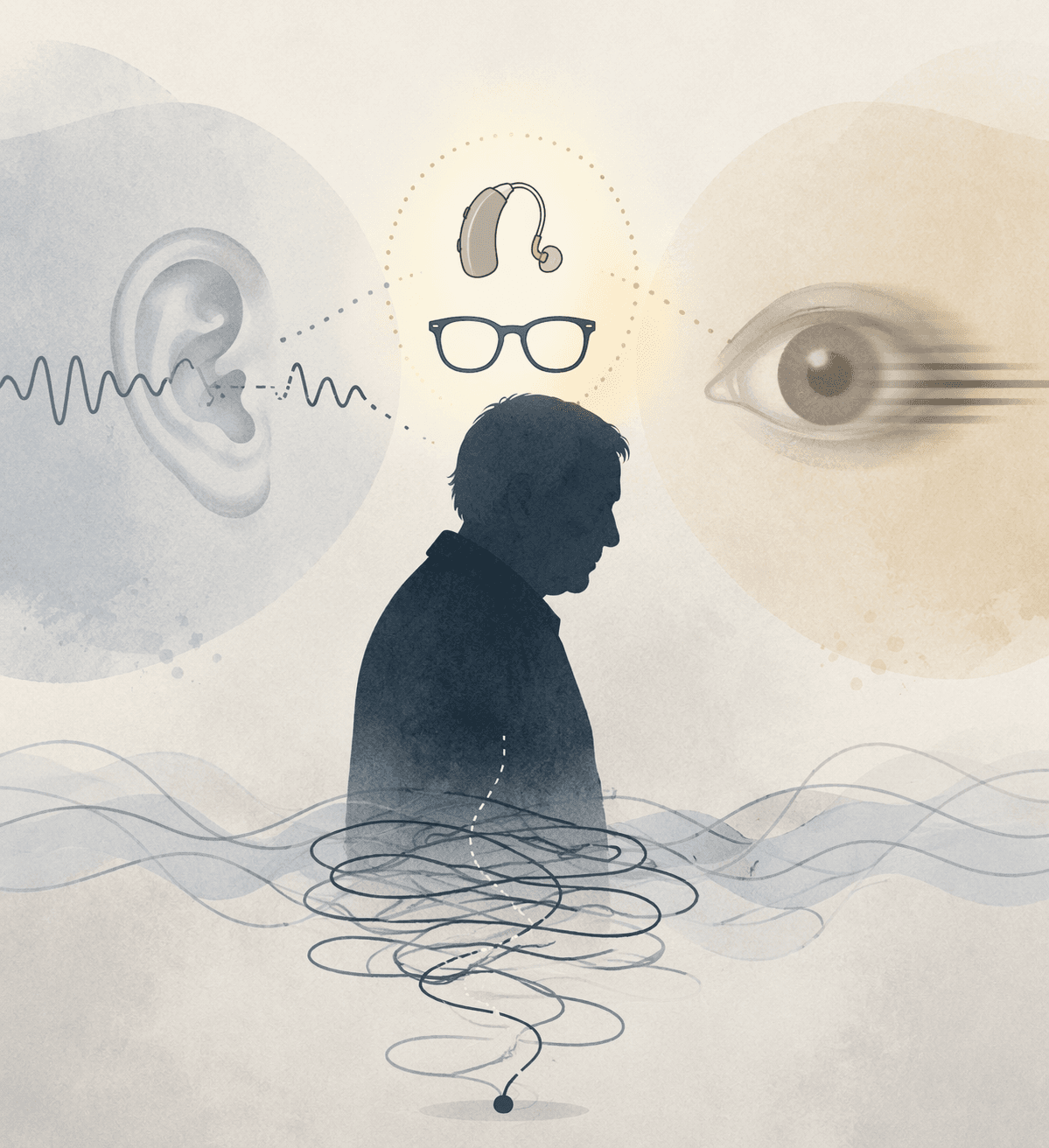
3. Vision and Hearing Problems That Change How the Body Navigates Space
Vision usually makes the fall-prevention list. Hearing often does not. Both deserve a place in the conversation.
The CDC reports that people with vision loss have almost twice the risk of falling compared with people without vision loss.[1] That risk is not hard to picture: missed edges, poor depth perception, difficulty seeing contrast on stairs, glare, dim bathrooms at night, or glasses that are not right for the task. Bifocals, cataracts, macular degeneration, glaucoma, and outdated prescriptions can all change how confidently someone moves through familiar rooms.
Hearing is easier to overlook because families tend to treat it as a communication problem. But the CDC notes that people with hearing loss are nearly 3 times as likely to fall, and that wearing a hearing aid is associated with a 50% lower fall risk.[1] That hearing-aid finding comes from observational evidence, so it should not be oversold as proof that a device alone prevents half of falls for every person. It should, however, change the appointment agenda. If hearing has declined, it belongs in the fall-risk discussion.
A practical caregiver question is simple: “When were vision and hearing last checked, and could either be contributing to falls?” If glasses are old, if the parent avoids wearing them, if hearing aids sit in a drawer, or if they startle when someone approaches from the side, mention it. These details may seem separate from falling until someone maps them onto balance, attention, and environmental awareness.
4. Chronic Conditions That Affect Feet, Joints, Sensation, or Steadiness
Chronic conditions can turn a familiar home into a harder place to move through. Diabetes may be linked with changes in foot sensation. Arthritis can make a person rush, limp, avoid bending a knee, or hesitate on stairs. Neuropathy can make it harder to feel the floor. Pain can alter gait. Dizziness, blood pressure problems, and some heart or neurologic conditions can affect steadiness. None of that can be sorted out by looking at the hallway rug.
This is where families often need to be more specific than the standard medical history form. “She has arthritis” is useful, but “she has stopped using the upstairs bathroom because her knees hurt on the stairs” is better. “He has diabetes” is useful, but “he says his feet feel numb at night and he has started shuffling” gives the clinician a clearer fall-risk clue.
The appointment should connect the condition to the movement problem. Ask whether foot sensation should be checked, whether pain control is affecting gait or alertness, whether dizziness needs evaluation, whether footwear is appropriate, and whether a podiatry, physical therapy, vision, hearing, or medication review referral makes sense. A diagnosis on a chart is not the same as understanding how that diagnosis changes the way someone crosses a room.
5. Home Hazards That Still Deserve a Second Look
Home hazards are still part of fall prevention in older adults. They are just not the whole story. After a second fall, it is worth checking the house again with the actual fall pattern in mind. Where did the fall happen? What time of day? Was the person rushing to the bathroom? Carrying laundry? Turning from the sink? Getting out of bed? Reaching for a pet bowl? Moving from carpet to tile?
A generic checklist may say “improve lighting.” The fall history may say the real issue is the path from bed to bathroom at 2 a.m., a glare spot near the kitchen door, or a missing handhold where the parent actually turns. A checklist may say “remove throw rugs.” The fall history may show that the more dangerous moment is stepping backward while opening the refrigerator.
Bring that information to the doctor too. It helps separate a trip hazard from a dizziness episode, a balance problem, a medication-timing issue, or a vision problem. The room matters, but so does what the body was doing in that room.
What to Bring to the Next Appointment
The goal of the visit is not to prove that one thing caused the fall. It is to look for modifiable risks that can be reduced together. Use the appointment to move from “my parent keeps falling” to a more usable clinical picture.
Bring every prescription medication, over-the-counter medicine, vitamin, supplement, sleep aid, pain reliever, allergy medicine, and as-needed product, preferably in the original containers.
Write down each fall: date or approximate timing, location, activity, footwear, lighting, whether there was dizziness, whether the parent tripped, whether they lost consciousness, and whether they could get up.
Describe specific movement changes: trouble rising from a chair, furniture-walking, shuffling, shorter steps, new cane or walker use, stair avoidance, slower turns, or fear of leaving the house.
Ask for a medication review focused on fall risk, including sedation, dizziness, confusion, blood pressure effects, duplicate ingredients, and interactions.
Ask whether blood pressure should be checked sitting and standing, especially if falls happen after getting up, bathing, meals, or medication changes.
Ask whether your parent needs gait, balance, lower-body strength, or assistive-device assessment, and whether physical therapy or an evidence-based exercise referral is appropriate.
Ask when vision and hearing were last checked, and mention outdated glasses, cataracts, poor night vision, hearing loss, unused hearing aids, or trouble locating sounds.
Mention chronic conditions that affect walking or steadiness, including diabetes, neuropathy, arthritis, foot pain, dizziness, joint pain, numbness, or recent illness.
Tell the clinician what home changes you have already made, including grab bars, lighting, rug removal, stair railings, bathroom changes, footwear changes, and cleared walking paths.
If your parent is still falling after you made the house safer, the answer is not that you failed the checklist. It is that the checklist covered only one domain. A better fall-prevention conversation looks at the house, the body, the senses, the diagnoses, and the medication list at the same time.




Comments
Join the discussion with an anonymous comment.