
STEADI: assess
What to Do After a Parent Falls on a Sidewalk
After an older parent falls on a sidewalk, hidden head or hip injuries can be made worse by moving too fast. Learn the first-15-minute sequence: when to call 911, the checks to run before helping anyone up, the safe get-up method, and why a lift assist beats lifting on your own.
Last verified: August 5, 2026. Medical review status: this article should be reviewed before publication by a named geriatric RN, occupational therapist, or CAPS-qualified reviewer. This information is educational and not a substitute for medical care. If you think your parent may be seriously injured, call 911.
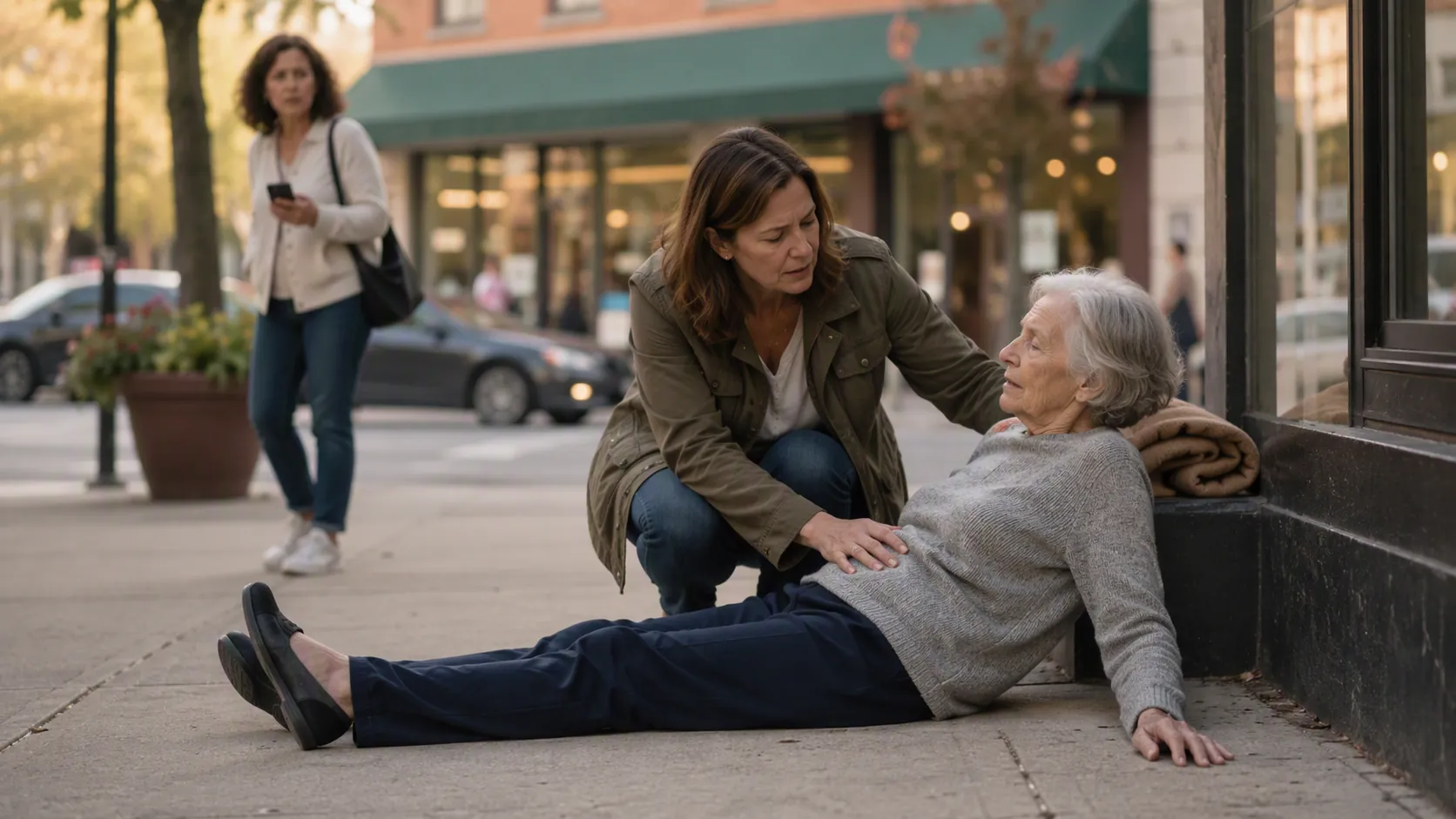
If your elderly parent falls on a sidewalk, the first rule is simple: do not rush to pull them up.
That rule can feel awkward in public. Someone may already be reaching under their arms. Your parent may be saying, “I’m fine,” partly because they are embarrassed and partly because lying on concrete with people staring is frightening. Cars may be edging past. A stranger may be trying to help. Still, the safest thing you can do in the first minute is slow the scene down long enough to check for the injuries that get worse when a person is moved too fast.
Sidewalk falls deserve that caution. In one study of outdoor falls among older adults, more than 70% of outdoor falls landed on hard surfaces such as concrete or asphalt, and most occurred on sidewalks, curbs, and streets.[1] A separate study from Florida Atlantic University’s Schmidt College of Medicine reported that about 90% of head injuries in older adults were caused by ground-level falls.[2] Those facts do not mean every sidewalk fall is a disaster. They do mean that “they only fell from standing height” is not enough reassurance.
The first 15 minutes: what to do before anyone gets up
Give yourself one job: keep the situation safe while you narrow the question from “A fall happened” to “Is this an emergency?” Use this order.
| What to check | What to do |
|---|---|
| Scene safety | Stop people from crowding, redirect foot traffic, keep cars or bikes away, and do not move your parent unless they are in immediate danger. |
| Responsiveness | Speak to them. If they are unconscious, hard to wake, confused, or not acting normally, call 911. |
| Head impact and blood thinners | Ask whether they hit their head and whether they take blood thinners. If yes or unsure, get prompt medical help. |
| Hip, neck, or back pain | Ask directly. If there is severe pain, deformity, numbness, neck/back pain, or they cannot bear weight, do not lift them. |
| Ability to move | Only if no red flags appear, ask them to move slowly and try a controlled get-up method. |
| Lift decision | If they cannot get up under their own power, request a lift assist rather than lifting deadweight yourself. |
If you are with them, get down near their face without blocking their breathing or twisting their neck. If you are directing someone by phone, give short instructions: “Do not pull her up. Ask if she hit her head. Ask if her hip, neck, or back hurts. Tell one person to call 911 if she is confused, in severe pain, or cannot stand.”
1. Make the sidewalk safer without moving the person
Your parent does not need a committee standing over them. Pick one helper and give that person a job. Ask someone to call 911 if you already see an emergency sign. Ask someone else to stand a few steps away and redirect pedestrians, carts, dogs, bikes, or cars. If it is cold, cover your parent with a coat. If their head is on bare concrete and you can slide a folded jacket under it without lifting or twisting them, do that gently. If they are in the path of traffic or another immediate danger, tell the 911 dispatcher what is happening and follow emergency instructions.
What you are trying to prevent here is the helpful but risky grab: hands under the armpits, a quick tug, and an older person suddenly vertical before anyone knows whether they hit their head or fractured a hip.
2. Check responsiveness
Say their name. Ask a plain question: “Do you know where you are?” or “Can you tell me what happened?” Watch for delayed answers, unusual sleepiness, slurred speech, repeated questions, or a blank look that does not fit the moment.
Call 911 if your parent is unconscious, was unconscious even briefly, is difficult to wake, seems confused, has trouble speaking, has new weakness, has trouble breathing, has chest pain, or simply is not acting like themselves. Do not sit them up to “see if that helps.” Do not give food or drink while you are still sorting out a possible head, neck, hip, or medical emergency.
3. Ask about head impact and blood thinners
Ask directly: “Did your head hit the sidewalk, curb, wall, car, or anything else?” Then ask, “Are you on a blood thinner?” If they are too shaken to answer, check a medical ID, wallet card, phone medical profile, or medication list if it is quickly available.
The CDC advises that an older adult who hits their head in a fall should get prompt medical evaluation, especially if they take blood thinners.[3] The reason is not that every head bump causes a dangerous bleed. The reason is that an older adult may look fairly normal at first, and blood thinners can raise the stakes when bleeding occurs. Harvard Health also advises prompt medical help for serious bleeding or injuries in people taking blood thinners.[8]
If your parent hit their head, might have hit their head, cannot remember, has a headache, vomits, becomes drowsy, is confused, has new weakness, or takes a blood thinner, treat the fall as a medical call—not as a quick dust-off-and-go errand.
4. Check hip, neck, and back before helping them sit or stand
Ask, “Where does it hurt most?” Then be more specific: “Does your hip hurt? Your groin? Your back? Your neck?” Pain after a fall can be scattered and confusing, so do not assume they would automatically mention the important spot first.
Do not lift, drag, or walk your parent if there is severe hip pain, groin pain, visible deformity, a leg that looks shortened or turned outward, neck pain, back pain, numbness, new weakness, or an inability to bear weight. Cleveland Clinic’s guidance on suspected hip fracture is clear that only trained personnel should move or lift the person, keeping the hip stable and supported.[4]
This is the moment when embarrassment can push everyone in the wrong direction. An older parent may say, “Just help me up,” because they want the scene to end. A bystander may say, “Come on, we’ve got you.” If the hip, neck, or back is in question, the answer is no. You can be kind and still be firm: “We’re going to wait. I don’t want to make an injury worse.”
When to call 911 after a sidewalk fall
Call 911 if any of the following are present:
- Your parent is unconscious, was unconscious, is difficult to wake, or seems confused.
- They hit their head, may have hit their head, cannot remember the fall, or take blood thinners.
- They have severe pain, especially in the hip, groin, neck, back, head, chest, or abdomen.
- They cannot bear weight, cannot move a limb normally, or have new weakness, numbness, or tingling.
- A leg or arm looks deformed, shortened, unusually rotated, swollen, or unstable.
- There is heavy bleeding, a deep wound, or bleeding that is hard to control.
- They are short of breath, have chest pain, fainted before falling, or have symptoms that suggest a medical event caused the fall.
- They cannot get up safely without being lifted.
- You are unsure. Dispatchers are used to helping people sort this out.
If you call, say this early: “Older adult fall on a concrete sidewalk.” Then give the location, whether they are awake, whether they hit their head, whether they take blood thinners, where the pain is, whether they can move arms and legs, whether they can bear weight, and whether there is bleeding. If the fall happened at a curb or near traffic, say that too.
Do not apologize for calling. A sidewalk is not a soft landing, and the dispatcher is not judging whether you are overreacting. They are deciding what help to send and what instructions you need until help arrives.
If there are no red flags and they can move: the safe get-up method
Only consider helping your parent get up if they are alert, breathing normally, not confused, have no known or suspected head impact, have no concerning head symptoms, have no severe pain, have no hip, neck, or back warning signs, can move arms and legs, and can participate in getting up. They should be doing the work. You are there to steady, guide, and protect—not to hoist.
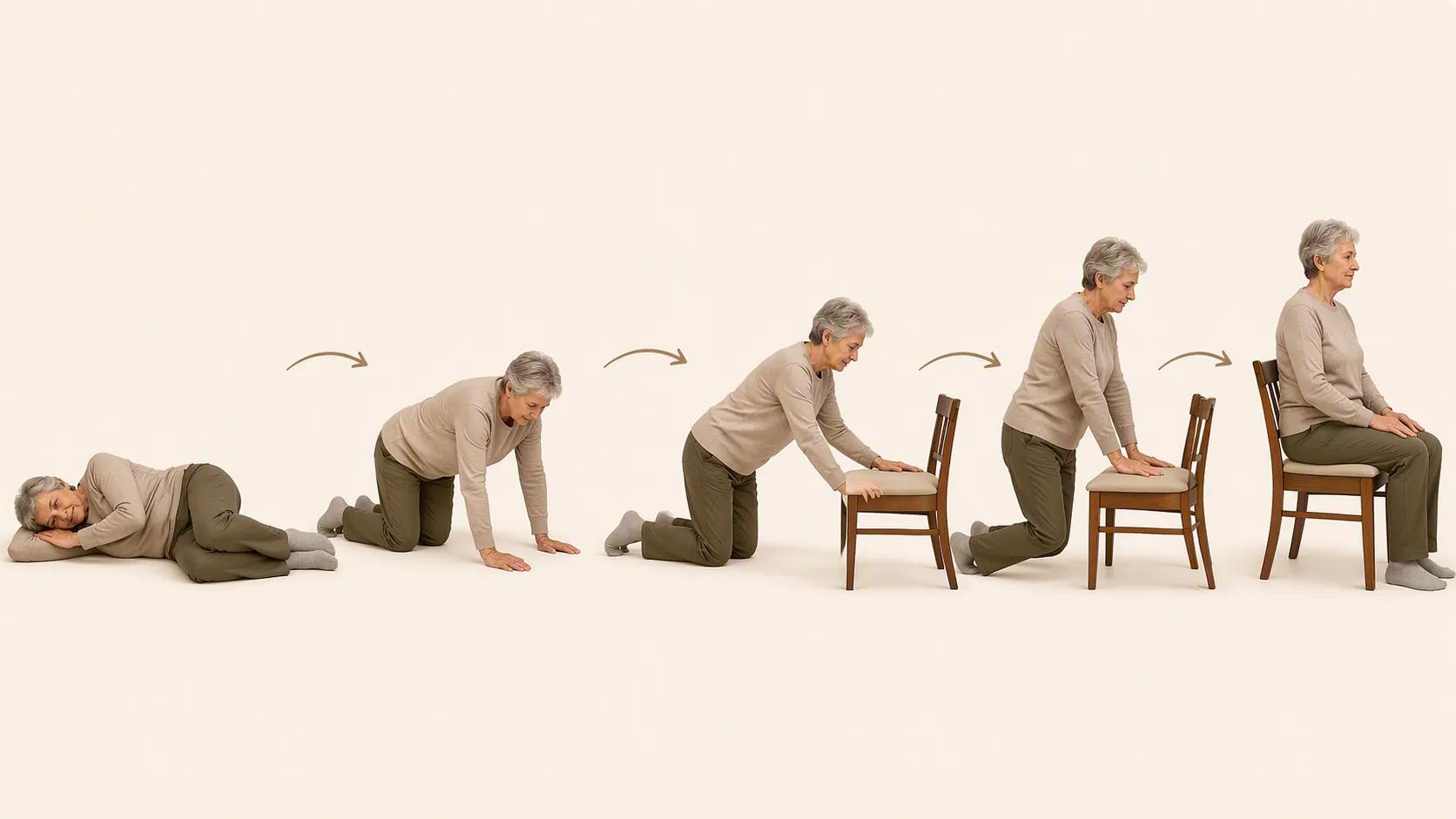
AARP and NHS fall guidance describe a controlled sequence: roll to the side, move onto hands and knees, crawl or shift toward a sturdy chair or support, bring one foot forward into a half-kneeling position, push up using the support, and sit before standing fully.[6][7] On a sidewalk, a bench, heavy chair, low wall, or other stable surface may help. A flimsy café chair, rolling walker that is not locked, shopping cart, or a stranger’s outstretched arm is not the same thing.
- Pause first. Let them breathe. Ask again about head, hip, neck, and back pain before they move.
- Have them roll slowly onto their side if they can do so without pain.
- Have them push up onto hands and knees.
- Bring a sturdy chair, bench, or fixed support close if one is available.
- Have them place both hands on the support and bring one knee forward so one foot is flat on the ground.
- Have them push through their arms and stronger leg to rise enough to sit on the chair or bench.
- Let them sit. Do not walk away immediately. Check dizziness, pain, bleeding, and mental clarity again.
If they become dizzy, pale, nauseated, confused, short of breath, or suddenly more painful at any point, stop and call 911. If they cannot move through the sequence without you taking most of their weight, stop. That is no longer a safe get-up; it is an unsafe lift.
Why a lift assist is safer than lifting them yourself
A fallen older adult can feel surprisingly heavy when they are scared, in pain, weak, or unable to coordinate their legs. Lifting from under the armpits can injure their shoulders, pull them off balance, or mask the fact that they cannot bear weight. It can also injure you. AgingCare warns that caregivers can hurt themselves trying to pick up a fallen senior and points to the lift-assist option when a person cannot get up safely.[5]
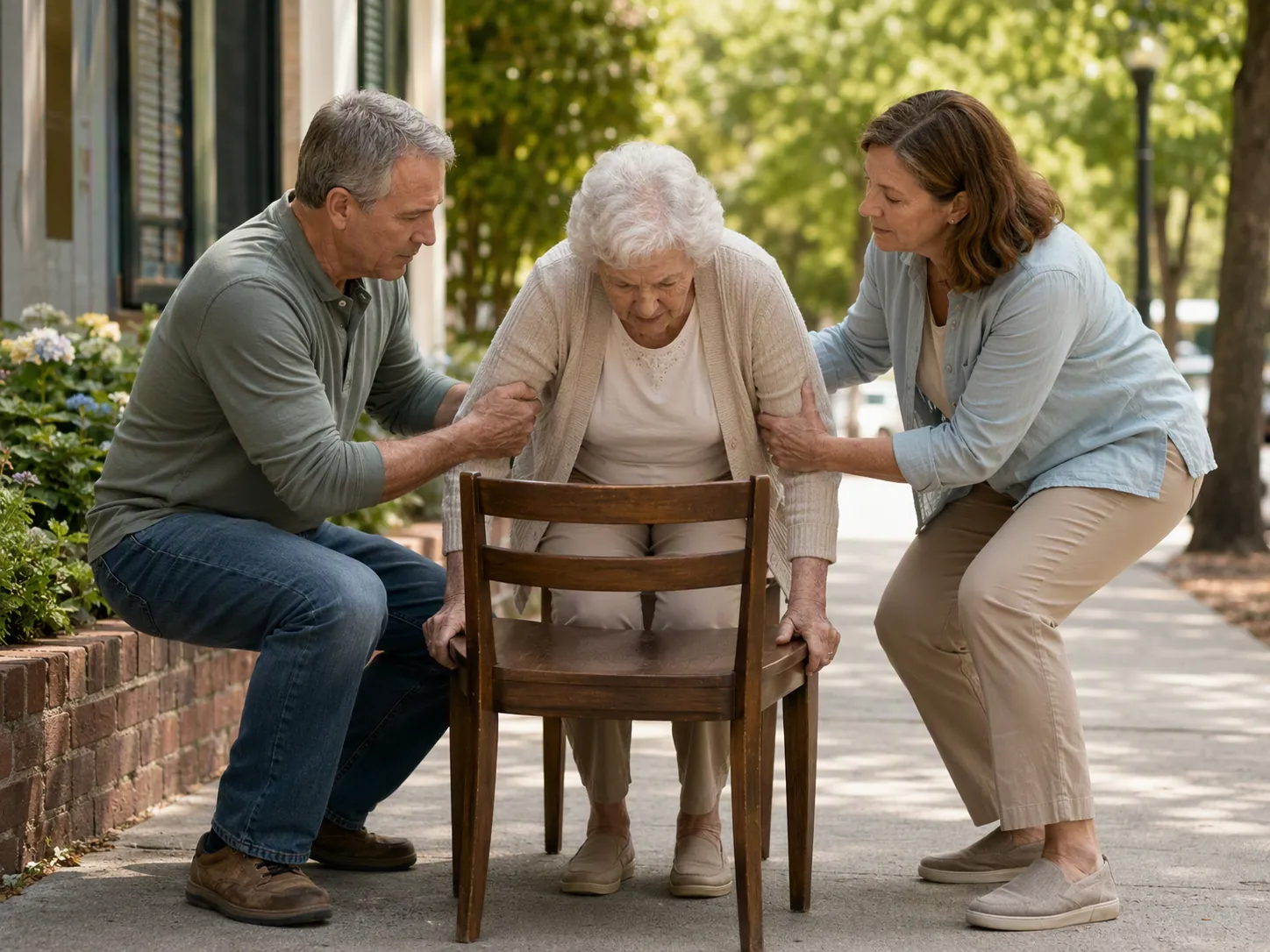
A lift assist means trained responders come to help someone up safely, and to check whether the fall needs medical evaluation. In many places, calling 911 is the practical way to request that help. If you call, be specific: “My parent fell on the sidewalk. They are awake, but they cannot get up without being lifted. I need a lift assist and assessment.”
If emergency responders arrive and your parent insists they are fine, let the responders hear the facts from you: “She hit the back of her head,” “He is on a blood thinner,” “She could not put weight on the right leg,” or “He was confused for a few minutes.” Older adults often minimize symptoms in public. The person who saw the fall may have the most useful information.
If they seem okay after getting up
Do not restart the errand as if nothing happened. Have them sit for several minutes. Check for bleeding through clothing, torn skin, swelling, new limping, dizziness, nausea, headache, or a change in how they answer questions. Ask them to tell you again what happened. Repeating the same question, not remembering the fall, or seeming unusually quiet matters.
If there was any head impact, possible head impact, blood thinner use, new headache, vomiting, confusion, unusual drowsiness, or worsening symptoms, seek medical advice promptly. If symptoms become severe or alarming, call 911.
If there was no emergency sign and they truly seem stable, still tell their doctor about the fall. A sidewalk fall can reveal a medication problem, vision change, blood pressure issue, balance decline, footwear problem, or fear of falling that needs attention. For the follow-up visit, it helps to use a clinician who asks directly about falls and medications; this guide to choosing a doctor who asks about falls and medications can help you prepare.
What to write down or tell the doctor later
After the immediate danger has passed, write down the details while they are fresh. You do not need perfect medical language. You need clear facts.
- Exact location: sidewalk, curb, street edge, parking lot, ramp, or store entrance.
- Surface: concrete, asphalt, wet pavement, uneven curb, gravel, ice, or another condition.
- Fall direction: forward, backward, sideways, down from curb, or unknown.
- Head impact: yes, no, possible, or unknown.
- Consciousness and memory: whether they blacked out, fainted, felt dizzy, or cannot remember the fall.
- Pain location: head, hip, groin, neck, back, wrist, shoulder, knee, ribs, or other area.
- Mobility after the fall: whether they could move limbs, bear weight, walk, or needed a lift assist.
- Medications: especially blood thinners, sedatives, sleep medicines, blood pressure drugs, or any recent medication changes.
- Symptoms afterward: headache, vomiting, confusion, unusual sleepiness, dizziness, worsening pain, swelling, bruising, or new fear of walking outside.
The emotional part may show up later. A parent who jokes on the sidewalk may be shaken that night. They may cancel the next outing, move more stiffly, or insist they are “just tired.” If fear starts shrinking their world, treat that as part of the fall too. For safer outings after they have been checked medically, this article on staying safe and connected at community events may be a useful next step.
In the moment, though, stay with the sequence: make the scene safe, check responsiveness, ask about head impact and blood thinners, check hip/neck/back pain, check whether they can move, and decide whether this is a 911 call, a lift assist, or a slow controlled get-up. The safest helper is often the one who stops the first bad decision before it happens.
References
- Outdoor Falls Among Middle-Aged and Older Adults: A Neglected Public Health Problem, American Journal of Public Health, https://pmc.ncbi.nlm.nih.gov/articles/PMC1483851/
- Geriatric Head Injuries, Anticoagulants and Delayed Hemorrhage, Florida Atlantic University Schmidt College of Medicine, https://www.fau.edu/newsdesk/articles/geriatric-head-injuries-anticoagulants
- Facts About Falls, Centers for Disease Control and Prevention, https://www.cdc.gov/falls/data-research/facts-stats/index.html
- Hip Fracture, Cleveland Clinic, https://my.clevelandclinic.org/health/diseases/17101-hip-fracture
- How to Pick Up a Senior After a Fall, AgingCare, https://www.agingcare.com/articles/pick-up-a-senior-after-a-fall-170447.htm
- How to Safely Get Up From Falls, AARP, https://www.aarp.org/health/healthy-living/how-to-safely-get-up-from-falls/
- Falls, NHS, https://www.nhs.uk/conditions/falls/
- Injuries and Blood Thinners: How to Stop Bleeding, Harvard Health, https://www.health.harvard.edu/staying-healthy/injuries-and-blood-thinners-how-to-stop-bleeding
Related reading
Noticed something outdated or inaccurate on this page? Flag a correction. We review every report against CDC, NIA, and AARP HomeFit guidance before updating a page.
Part of the Fall Prevention section.